


Every Sunday I pick the China tech stories that mattered that week, say what I make of each, and link back to where I first wrote about it. Subscribe free
Several of this week’s China tech numbers carried a choice about what to count. Two cloud companies claimed first place from the same report. A state news agency reported 16 million downloads without saying downloads of what.
Two Chinese clouds claimed first place from one IDC report.
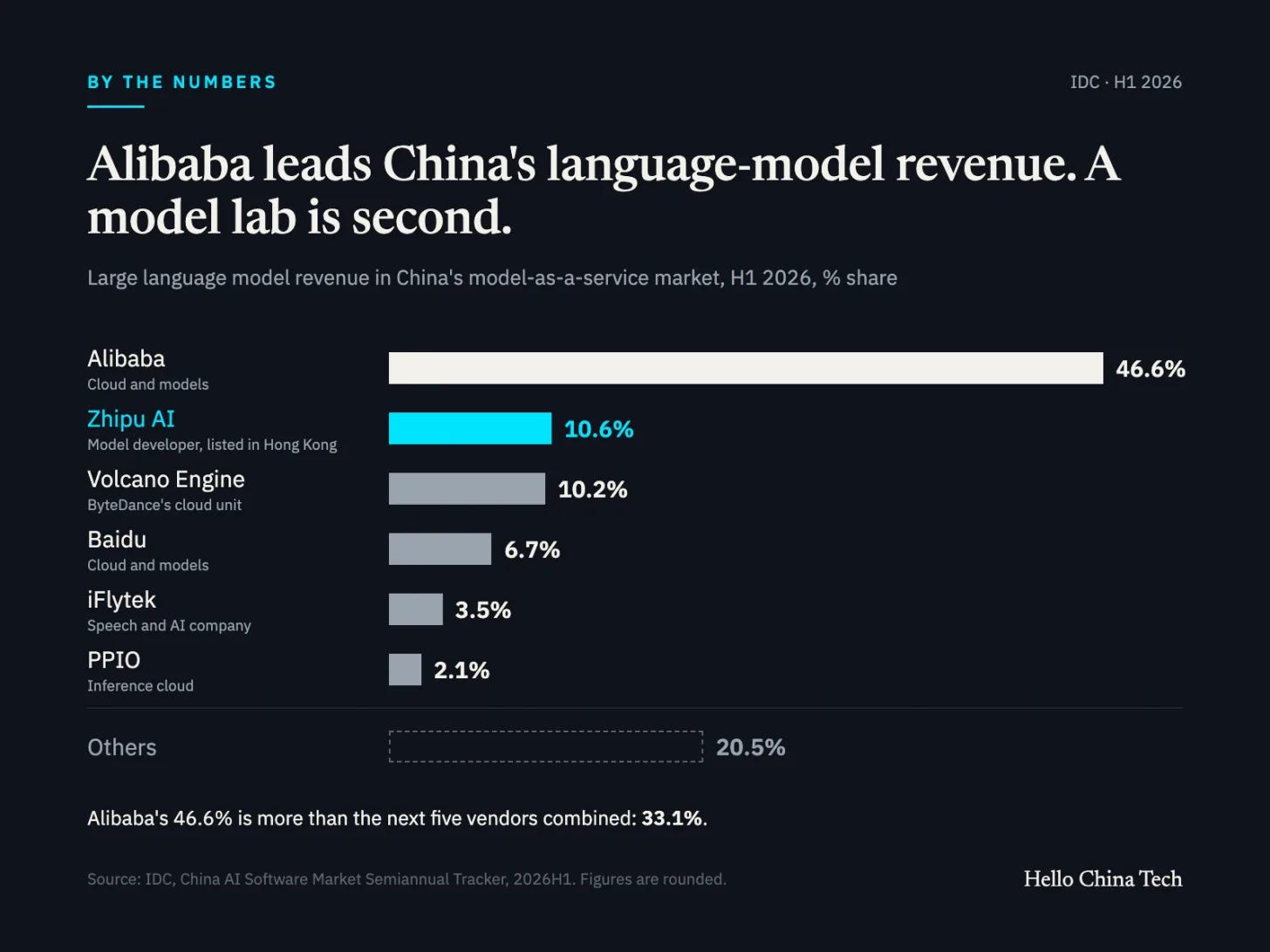
On October 29, Volcano Engine, ByteDance’s cloud unit, and Alibaba Cloud each announced a first-place ranking. Both cited the same IDC report, AIX Finance, a Chinese business outlet, reported. IDC estimates Volcano Engine had 45.1% of total revenue in China’s model-as-a-service market in the first half of 2026, according to a report on IDC’s figures. Alibaba’s first place is in large language models alone, where IDC estimates its share at 46.6%. IDC estimates video generation models made up 32.7% of the total. Zhipu AI, a standalone model developer, came second in language models with 10.6%, 0.4 points ahead of Volcano Engine on rounded figures.
This week I set Zhipu’s and MiniMax’s accounts against Anthropic’s S-1, filed October 26, for the same six months. That piece is free: Anthropic Puts China’s AI Labs on the Cheap Curve.
A cluster of 1,024 Huawei Ascend 950DT cards came online in Wuhan.
STAR Market Daily, a Chinese financial outlet, calls it China’s first Ascend 950DT computing cluster of 1,024 cards. It came online in Wuhan on October 29. Hubei Science and Technology Investment Group, a state-controlled investor based in Wuhan, built it. The report does not name a user or a training run.
In September, Eric Xu, one of Huawei’s rotating chairmen, said 950DT supernodes were still under testing. He put large-scale supply at the end of 2026 or early 2027. The report does not tie the cluster to it. My piece this week follows a Chinese customer comparing Huawei’s AI chips with Nvidia’s, task by task: iFlytek Shows Where Huawei’s Chips Fall Behind.
JPMorgan priced Unitree on a shorter clock. Then the quarter came in.
On October 25, JPMorgan raised Unitree Robotics, a Hangzhou humanoid maker listed in Shanghai since August, two notches to overweight. It lifted its December 2027 price target from Rmb 300 to Rmb 995. Sina Finance’s summary of the note gives the main reason as a shorter timeline. Unitree’s third-quarter report then showed third-quarter revenue up 69.93% from a year earlier, against 68.49% in the first quarter.
China’s Top Humanoid Stock Is Priced on a Borrowed Clock, my piece this week, asks whose timeline the bank is pricing. In August I wrote that Unitree’s hardware business “is also decelerating.” Third-quarter growth, at 69.93%, ran the other way.
State money is on 88% of the investor lists IT Juzi counted.
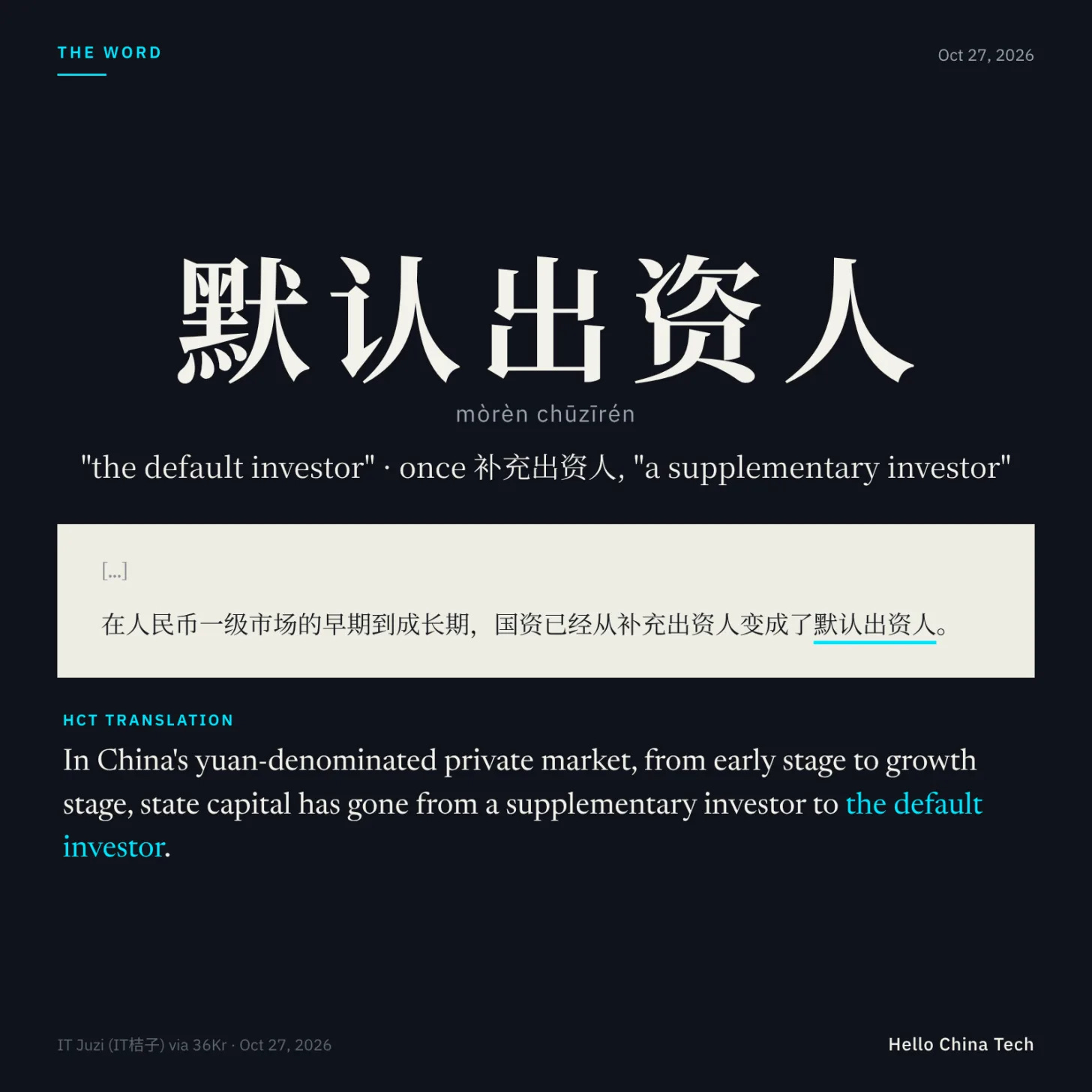
IT Juzi, a Chinese venture database, counted 558 Chinese companies founded since 2023 that have raised at least three rounds, mostly with the latest at Series A or later. Its study, republished by 36Kr on October 27, found 491 of them have had a state-backed investor or government guidance fund on their investor list: 88.0%. IT Juzi’s own words: in China’s yuan-denominated private market, from early stage to growth stage, state capital has gone from a supplementary investor to the default investor.
China’s state news agency reported 16 million downloads for a Wuhan robot-data base.
China News Service, a Chinese state news agency, reported on October 28 that the embodied AI datasets of a Wuhan data base have passed 16m downloads since it opened in August. The base is run by Ant Digital Technologies, the technology services arm of Ant Group, the Alibaba-affiliated fintech group. It did not say which datasets, on which platform, or whether repeat downloads count.
My robotics report counts “raw hours, downloads” as not enough on its own: Who Pays While China’s Robots Learn.
ALSO THIS WEEK
Beijing’s 2026-2030 energy plan, published October 28, says new computing centers will use 100% green power.
Waymo’s October 30 post on its Toyota deal says who will build and run the cars, not who will own them. China’s Pony.ai faces the same question: Pony.ai, Waymo and Paying for the Fleet.
On October 24, Chinese humanoid maker AgiBot set a Guinness World Record with 110 robots dancing at the same time, IT Home reported. The report does not say whether the robots danced on their own. At Beijing’s robot Games in August, dance events allowed fully autonomous mode only: China Built the Exam Before the Robots.
Next week I publish the second piece in Origins, my free history series: how a swapped chip fooled China’s experts in 2003. The chip the experts examined had 208 pins. The one shown at the launch had 144.
Paid readers get about 250 analyses so far, and my reports at $49 instead of $99.
$150/year, or $20/month.
Poe