

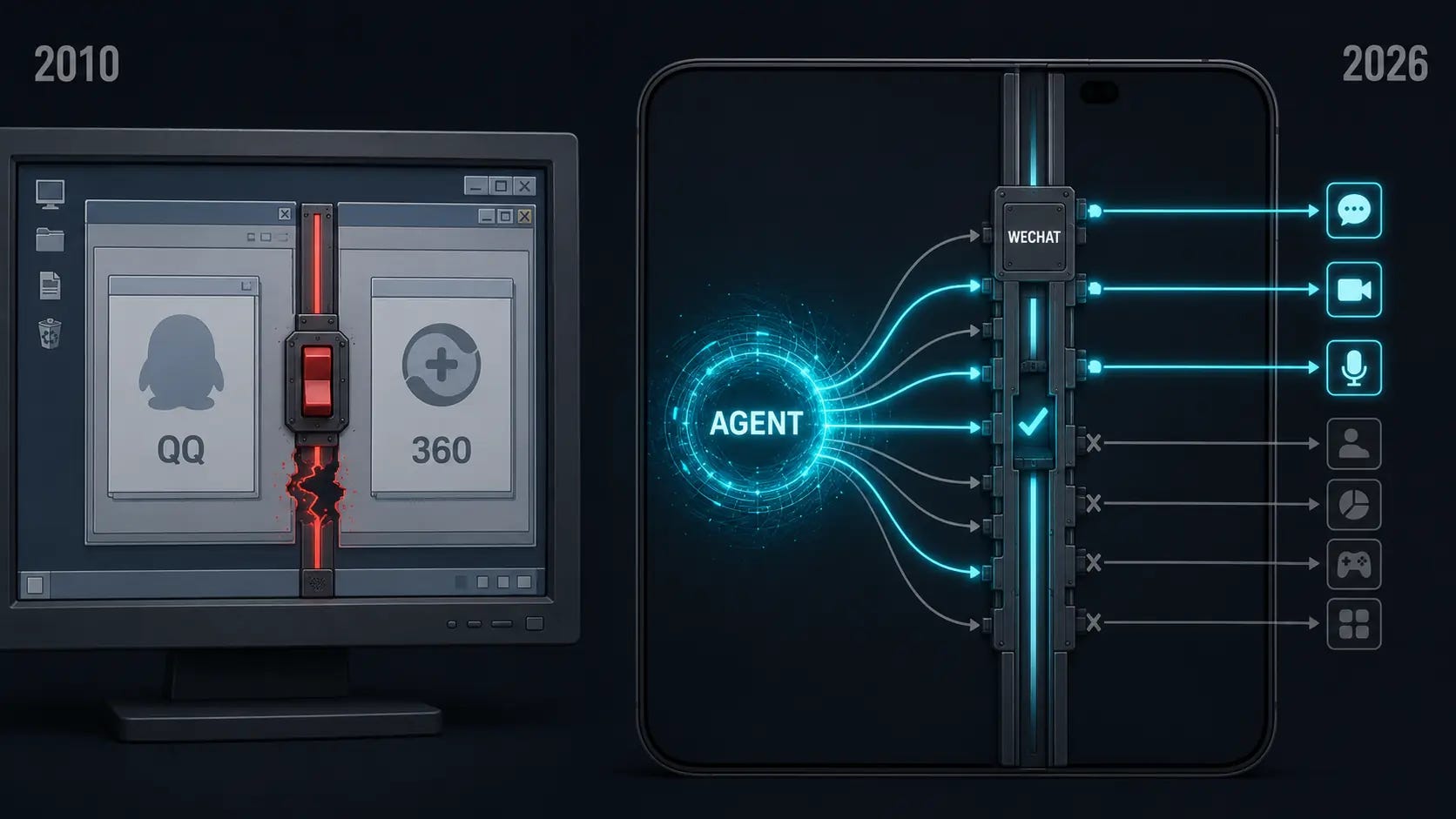
This is the first installment of Origins, a Hello China Tech series. Every China tech headline rests on a historical premise that has never been fully told in English. Over the past year, I have written about why WeChat became the gatekeeper for China’s AI agents, about the structural power that makes platform blocking possible, about why ByteDance launched an agent no platform would approve. They rest on the same foundation. This is that story.
If the connection between a 2010 desktop software war and today’s AI agent gatekeeping is new to you, this is what Hello China Tech covers three times a week: China’s AI, chip, robotics, and EV sectors, read from primary sources most English coverage never touches. Subscribe free to get every new analysis as it publishes.
An Extremely Difficult Decision
Shortly after 6 pm on November 3, 2010, QQ users across China began seeing a pop-up window on their screens. The message, titled “A Letter to All QQ Users,” opened with a line that would become one of the most quoted sentences in Chinese internet history:
“When you read this letter, we will have just made a very difficult decision.”
The decision: until Qihoo 360, the security software company, stopped what Tencent called unauthorized interference with QQ and malicious attacks on its reputation, Tencent would cease running QQ on any computer with 360 installed. Users had two options: uninstall 360 and keep QQ, or keep 360 and lose the messaging service that connected them to nearly everyone they knew.
By the end of 2010, Tencent reported 647.6 million active QQ accounts, with a peak of 127.5 million simultaneous users online. The word “accounts” matters; many people held multiple. But roughly 20 million users initially lost normal access, and about 5 million were still affected a week later.
According to Wu Xiaobo’s company history, CEO Ma Huateng made the final call that morning at Tencent’s Shenzhen headquarters. Dowson Tong recalled to Wu that the original pop-up showed two uninstall buttons of different sizes. Ma ordered them made equal, insisting on a “fair choice.” Fair or not, the choice was unprecedented. In effect, a corporate dispute had become a loyalty test imposed on hundreds of millions of users.
That night set a rule that still governs China’s internet. The full genealogy remains largely absent from English-language coverage.
China’s Two Walls
Why can’t you open a Taobao link inside WeChat? Why does WeChat decide which AI agents may reach its users?
The instinctive Western answer involves the Great Firewall, China’s state-run system for blocking foreign websites and services. But the Great Firewall does not directly explain this. The wall that shapes the daily experience of Chinese internet users is a different structure, built by China’s own technology companies against one another. Its blueprint can be traced to November 3, 2010. It was normalized in 2013, partially demolished in 2021, and evolved into a controlled access system for AI agents in 2025 and 2026.
Three Escalations
The conflict became known as the 3Q War, a shorthand combining 360 and QQ. It was not a story of villain and victim. It unfolded in three escalations, each crossing a new line.
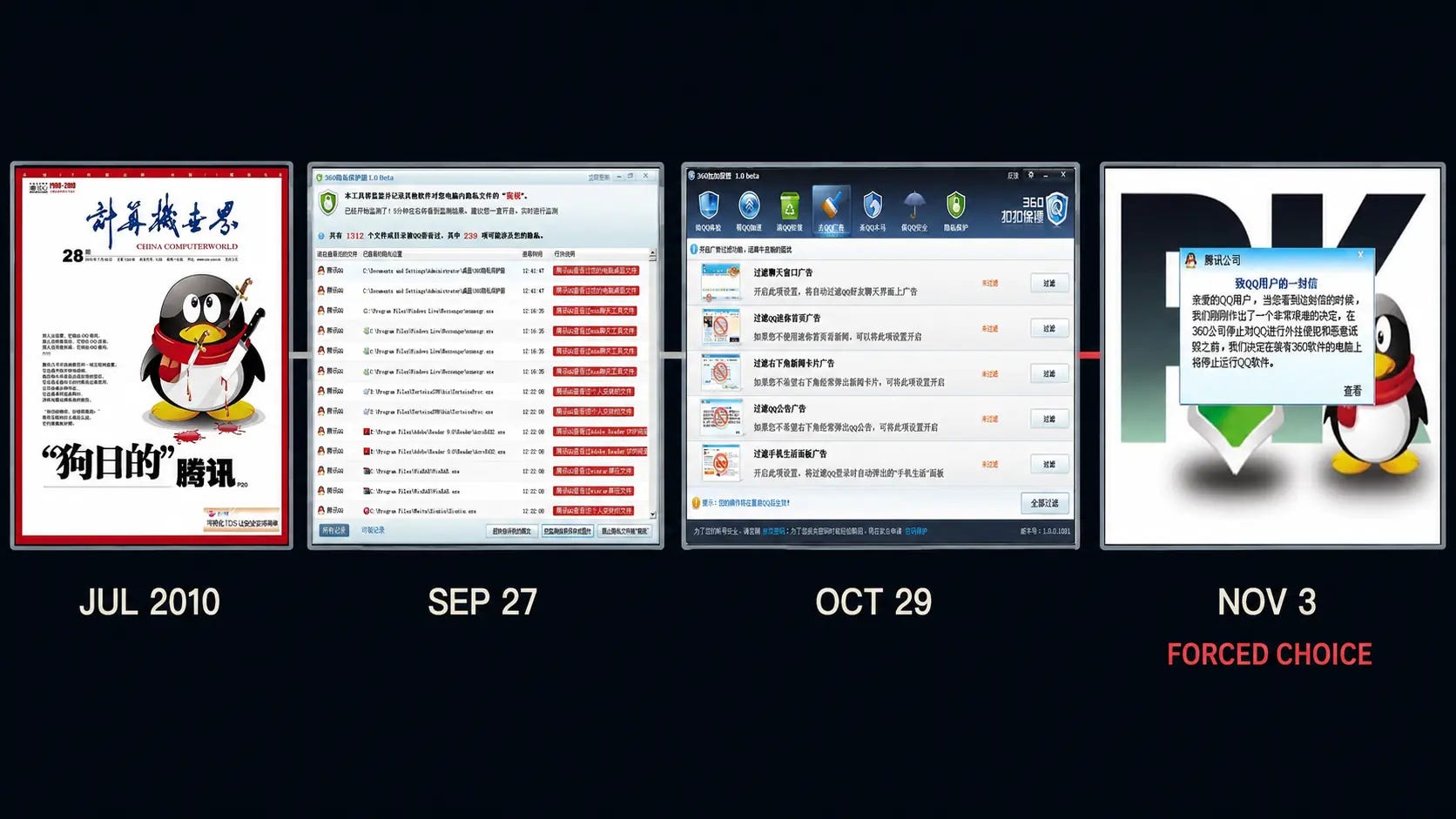
The backdrop was an industry already angry at Tencent. Two months before the conflict, Computer World, a major Chinese IT publication, had run a cover story headlined “Fucking Tencent,” a title whose profanity was deliberate. The article’s core accusation: Tencent “followed at every step, then carefully copied, then ruthlessly surpassed” competitors by using QQ’s massive user base to enter one market after another. Published online on July 24 and in print on July 26, the piece captured the industry’s mood. It preceded the conflict by two months.
The first escalation was Tencent’s. The company had been expanding into security software for months. On September 21, it announced that QQ Doctor and QQ Software Manager would automatically merge into QQ Computer Manager. Qihoo 360 was still an unlisted company with annual revenue of $57.7 million in 2010, against Tencent’s Rmb 19.6bn (about $2.9bn at 2010 rates) and a market capitalization of roughly $42bn by late November. But by January 2011, 360’s security products had reached a penetration rate of approximately 83.9% among Chinese internet users, according to iResearch data cited in the company’s pre-IPO SEC filing. What collided was not market capitalization but two kinds of reach: QQ’s social graph and 360’s desktop footprint.
The second escalation was Qihoo’s. On September 27, 360 released Privacy Protector, accusing QQ of scanning users’ personal files. On October 29, the company went further, launching Koukou Bodyguard, software that modified QQ’s interface, blocked its advertisements, and disabled revenue-generating features. 360 claimed over 10 million downloads within 72 hours. Qihoo had crossed from competition into direct interference with another company’s product.
The third escalation was Tencent’s response, and it was the most consequential. Rather than waiting for the legal process it had already initiated, Tencent extended the corporate dispute directly to ordinary users. The practice became known in Chinese as er xuan yi, “choose one of two.” The phrase does not appear in the original letter, but the action it described was unambiguous.
The concentrated enforcement of the forced choice lasted roughly one night. By November 4, after emergency intervention by the Ministry of Industry and Information Technology, 360 withdrew Koukou Bodyguard. But Reuters reported on November 10that 5 million users remained affected. The MIIT formally reprimanded both companies on November 21, ordering public apologies, a halt to mutual attacks, and full software compatibility.
The Price List: What Disconnection Cost Tencent
The MIIT’s reprimand criticized both companies for “unfair competitive practices.” But the language was asymmetrical. The phrase “even unilaterally cutting off service to users, causing adverse social impact” described conduct attributable to Tencent, though the reprimand addressed both companies together.
A regulation issued in December 2011 explicitly prohibited “malicious incompatibility” among internet service providers. The 3Q War was a significant backdrop for its rapid passage. No publicly documented penalty for disconnection under this rule has surfaced in the years since.
Two lawsuits reached the Supreme People’s Court. In the first, Tencent sued Qihoo over Koukou Bodyguard. The court found 360’s software constituted unfair competition by directly modifying QQ’s product and disrupting its business model. 360 was ordered to pay Rmb 5m in damages and issue a public apology.
In the second, Qihoo sued Tencent under the Anti-Monopoly Law. The judgment, dated October 8, 2014, and publicly pronounced on October 16, found for Tencent. The first-instance court described the forced choice as a restriction-of-trade practice that exceeded what was necessary. The Supreme People’s Court reproduced that reasoning in its judgment but resolved the appeal on narrower grounds. It concluded that Tencent had not been proven dominant and that the incompatibility had produced no clear exclusionary effect. The conduct therefore did not violate the Anti-Monopoly Law. The court added: “This does not mean the respondent’s ‘product incompatibility’ conduct is beyond reproach.”
The company that modified a competitor’s product paid Rmb 5m. The company that forced hundreds of millions of users to choose between their messaging service and their antivirus software received no financial penalty for the disconnection itself.
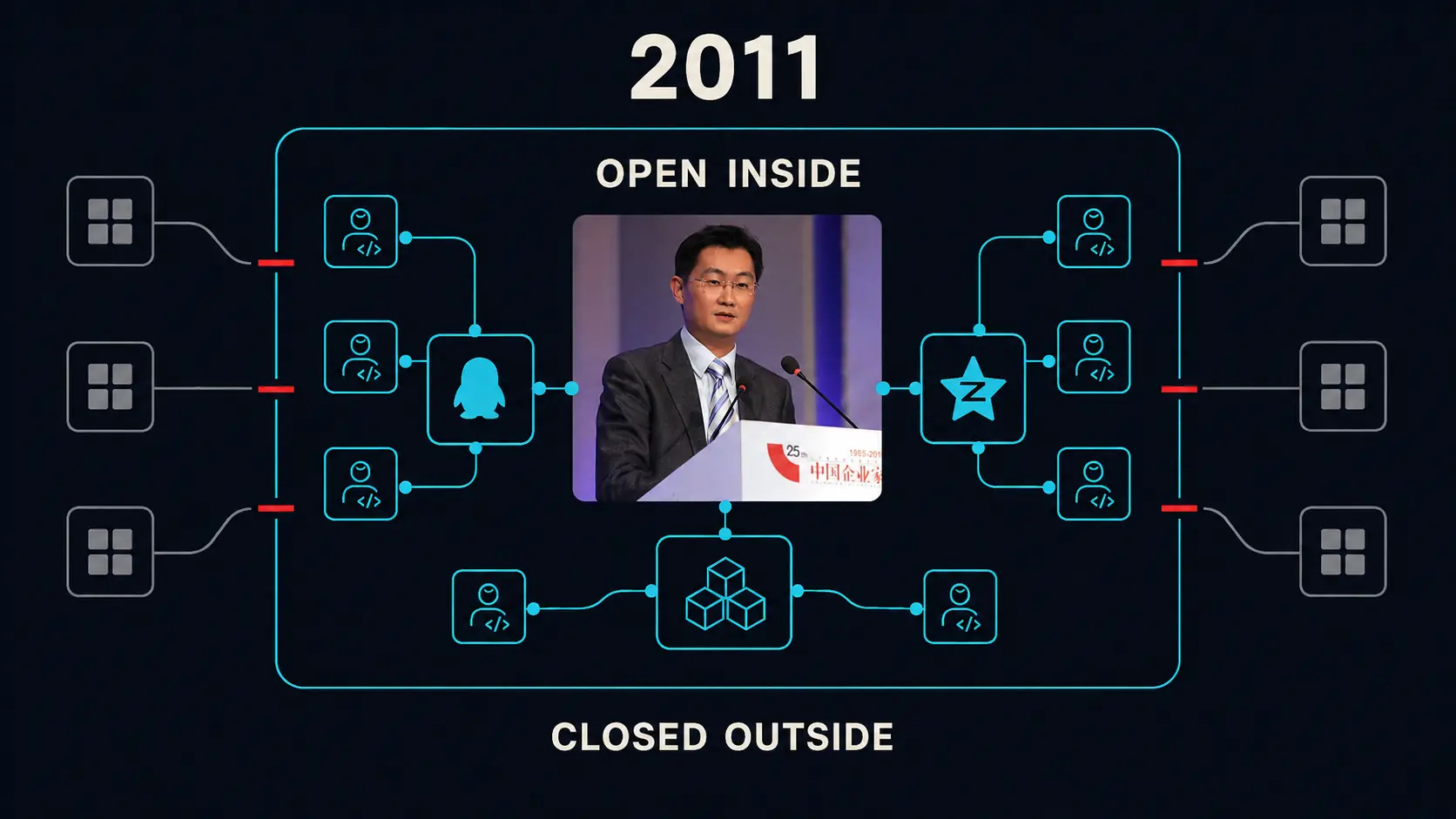
The conflict produced a seemingly contradictory outcome. Within weeks, Ma Huateng issued an internal letter linking the crisis to corporate reflection and later announced that Tencent would reorganize around “openness and sharing.” Litigation, regulatory pressure, and the shift to mobile all contributed. But Tencent itself treated the 3Q crisis as a catalyst. The company became more open to developers inside its ecosystem, not to rival ecosystems connecting to it. Every platform in China could read the price list.
Taobao, WeChat, and the Human Router
The tactic Tencent demonstrated in 2010 became the industry’s default. The mechanism changed: 3Q was desktop software detecting local installations; the mobile era brought server-side URL blocking. But the power dynamic held: the platform controlling an indispensable user entrance could impose the cost of disconnection on others. In the next major episode, Alibaba moved first.
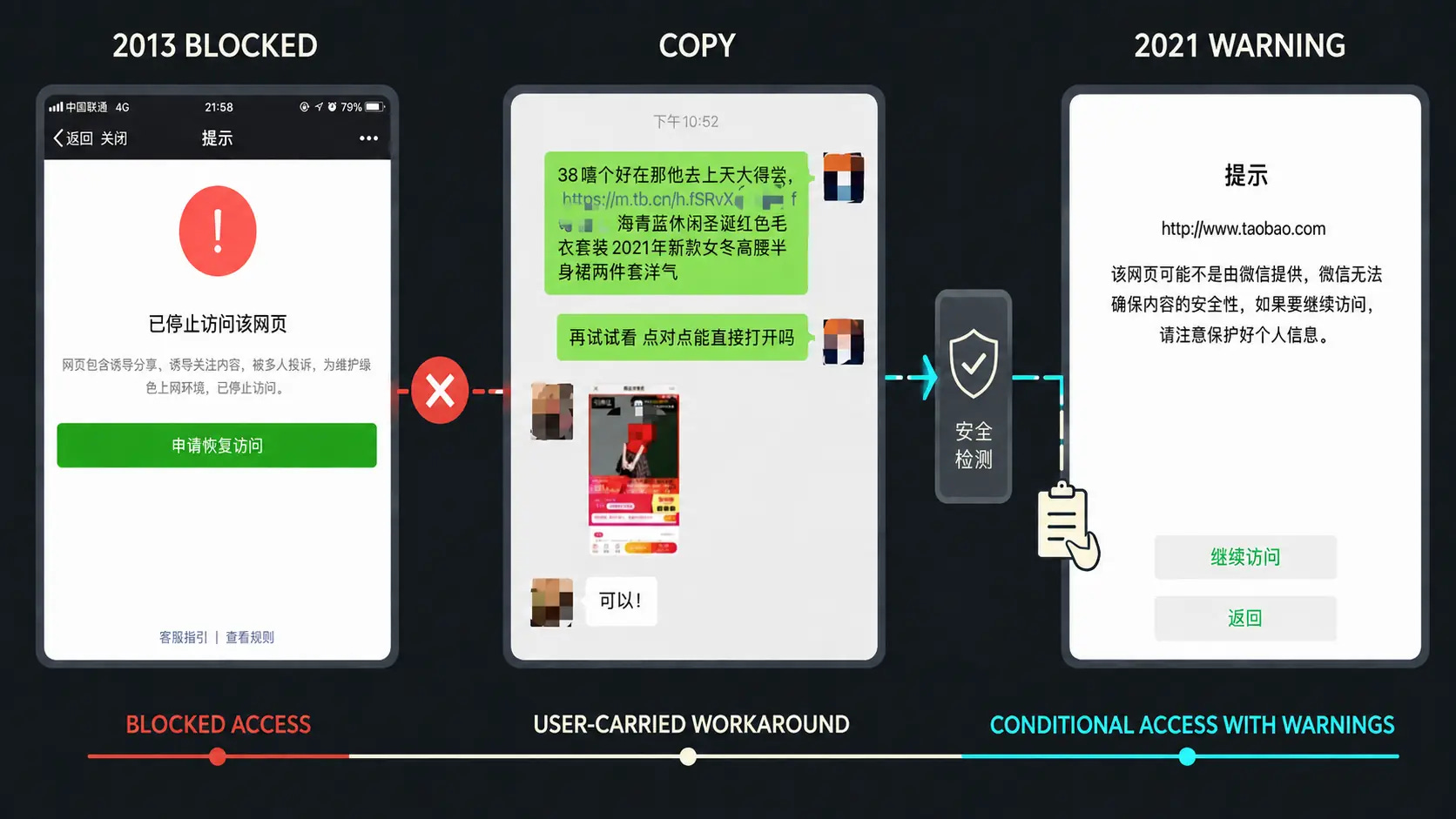
On July 31, 2013, Taobao, Alibaba’s e-commerce marketplace, suspended WeChat-linked applications from its seller service platform. Beginning August 9, Taobao banned newly posted external QR codes, primarily affecting WeChat-based commerce. On November 22, Taobao redirected WeChat users trying to access product and store pages to a download page for the Taobao app. Zhang Yu, then president of Taobao, told reporters: “As long as WeChat can guarantee security and integrity, we will reopen.”
WeChat responded by blocking Taobao links entirely, directing users to copy the URL into a browser. The precise date of WeChat’s countermeasure cannot be confirmed from public records; contemporary reporting says only “shortly after.”
The connection to 3Q was drawn immediately. As early as August 2013, state media analysis linked the Taobao-WeChat standoff to the 3Q precedent. In November, Alibaba’s competing messaging app Laiwang explicitly invoked Tencent’s blocking history.
The pattern replicated across years and companies. WeChat blocked Alipay’s red-envelope links in 2015. Douyin links vanished from WeChat Moments in 2018. ByteDance’s workplace tool Feishu was flagged in 2020. By January 2021, a single WeChat enforcement action caught QQ Music and QQ Browser alongside Zhihu and Xiaohongshu. Even Tencent’s own products were not exempt. Blocking had become a routine instrument of platform governance.
Direct links being blocked, platforms built workarounds that trained hundreds of millions of users to function as human routers. Want to share a Taobao product on WeChat? You could not paste a link. Instead, Taobao generated a string of characters that looked like gibberish, a platform-generated sharing code known in Chinese as a kouling. You copied it into a WeChat message. Your friend copied the noise, opened Taobao, and waited. The app read the clipboard, decoded the product identifier hidden inside, and displayed the item. When WeChat began filtering these passcodes, platforms added special characters and garbled text, what Chinese internet users called “Martian script,” to evade detection. By November 2021, after regulators had ordered platforms to open their links, a Pengpai News test found the workarounds had become more complex, not less.
Some of the security concerns were genuine. Phishing stores proliferated when Taobao traffic flowed through WeChat’s browser. But security enforcement and commercial protection were not fully separable. During Chinese New Year 2026, WeChat blocked AI-powered red-envelope links. The banned list included Tencent’s own Yuanbao AI product. The enforcement did not map neatly onto corporate rivalry.
The Half-Demolition
On September 9, 2021, the MIIT summoned nine major platforms to an administrative guidance session and ordered them to stop blocking one another’s links without justification by September 17. Reported standards required that legitimate URLs open within messaging apps as web pages.
WeChat moved in two phases: one-to-one chats opened to external links on September 17; group chats began a trial for e-commerce links on November 29. WeChat’s Moments, its social feed, was never included in either phase.
The intervention removed the most visible layer: the inability to open a URL. Everything beneath remained untouched. Platforms retained control over native sharing buttons, distribution through WeChat Moments, login and identity APIs, external payment acceptance, and app-level interoperability. “Accessible” did not mean “interoperable.”
Paid connections often opened faster than free ones. Advertisers paying for Moments placement could link directly to Taobao long before ordinary users could share a product link. Taobao’s full integration of WeChat Pay in September 2024represented genuine progress. A regulation that took effect the same month explicitly prohibited the targeted blocking of lawful information, but retained exceptions for security risks and legitimate justification.
As Caixin Global, an investigative business publication, reported, different regulators pursued different objectives. The MIIT focused on market order; other agencies prioritized content security. Full openness risked complicating their work. The contrast with the EU’s Digital Markets Act is instructive: the DMA imposes structured interoperability obligations on designated gatekeepers. China moved faster but left enforcement standards to evolve informally. The walls retreated. They did not fall.
WeChat Agents: From Blocking to Controlled Access
AI agents transplanted the 3Q War’s question to a new interaction layer.
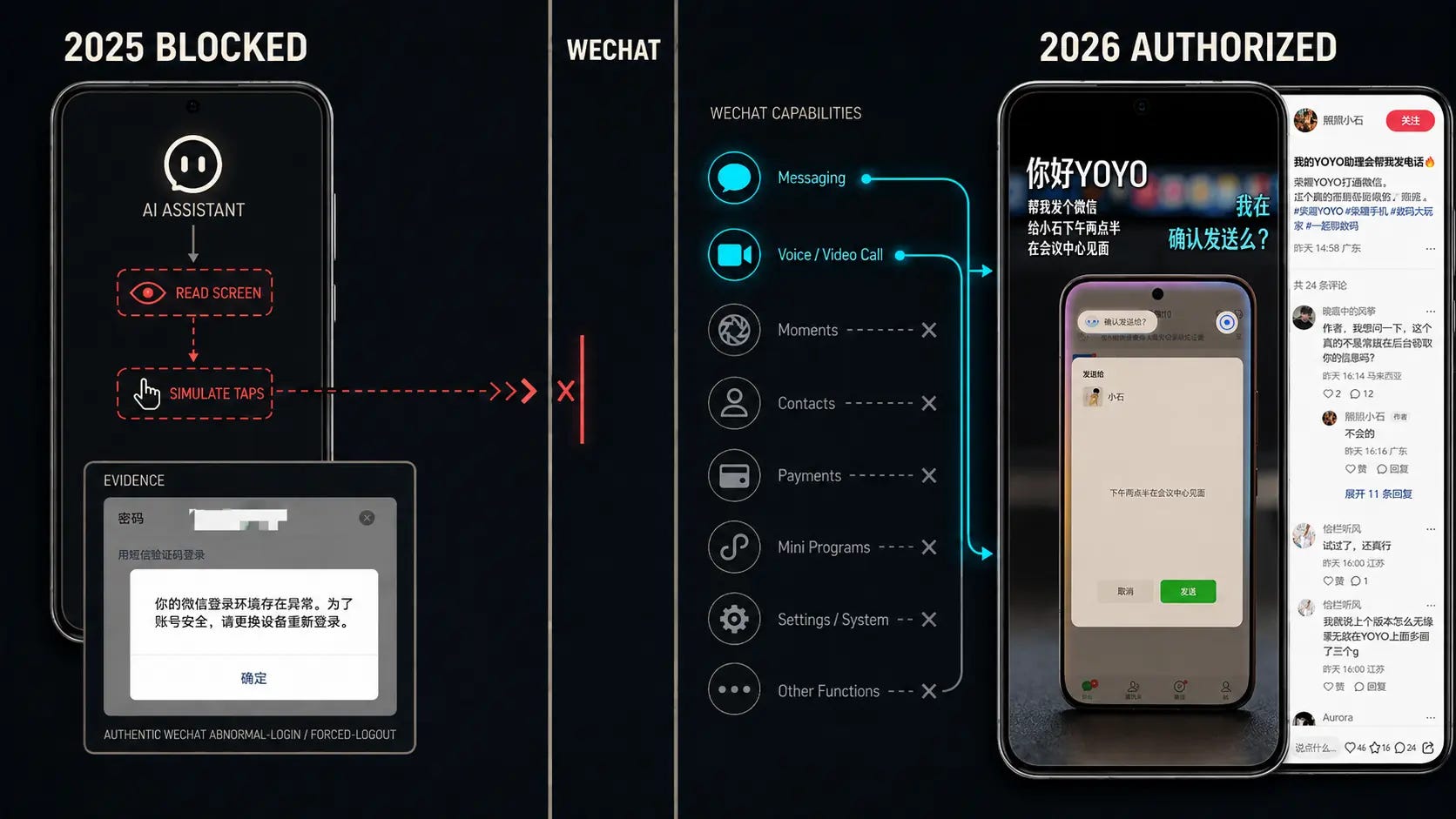
In December 2025, when ByteDance launched its Doubao Phone Assistant, a system-level AI agent that read screens and simulated taps across apps, WeChat blocked Doubao from operating inside the app within days of the launch. The parallel with 2010 is structural rather than legal. Koukou Bodyguard modified QQ’s interface; Doubao simulated user actions from the handset layer. What they shared was the absence of the application owner’s permission. In both cases, Tencent responded by asserting control over its product boundary.
Six months later, Tencent confirmed a reversal. WeChat would provide authorized A2A (Agent-to-Agent) access to phone AI assistants from Huawei, Honor, Xiaomi, OPPO, and Vivo. But access runs through Tencent’s protocol: WeChat executes the commands and defines the scope. The power to disconnect appears to have evolved into the power to authorize connection.
Data Compliance China, a legal analysis site, independently drew the 3Q comparison but argued that the legal frameworks differ. Samm Sacks of Lawfare has explained how walled gardens obstruct agents without connecting the history. I found no previous English-language account that assembled this full sequence.
The underlying question remains: who decides whether software connects or disconnects.
The Garden Was Never Legalized
No Chinese regulator ever authorized platforms to block one another’s links. No court ruled that disconnection was a right. The first-instance court described the forced choice as exceeding what was necessary. The Supreme People’s Court ultimately rejected the antitrust claim while stressing that Tencent’s conduct was not beyond reproach.
What happened was simpler. The price for forcing hundreds of millions of users to choose turned out to be a public apology and zero financial penalty for the disconnection itself. When the cost of building a wall is that low, platforms build them.
The wall that blocks foreign websites from China has a name. The wall that determines what you can and cannot open inside China’s own apps does not. It has only a birthday: the evening of November 3, 2010.
The next time a platform blocks an AI agent, a payment link, or a competitor’s content, the template will be the same one. The public record still shows no financial penalty for disconnection.
Hello China Tech covers how AI, semiconductors, and platform power are reshaping China’s technology sector. Origins is a free series tracing the historical foundations behind today’s headlines. For deep analysis as these stories unfold, subscribe to Hello China Tech.
Thank you for the fine analysis. I've never really delved into the history of cross-app blocking and its long-term impact. How would you compare this Chinese model of platform control with how US giants manage their walled gardens and AI agent access?