FlashPoint is our paid quick-strike column on market-moving China tech events. Today: a bank upgrade for China’s best-known humanoid robot stock that rests on a timeline the company does not control. In August, I recorded Wang Xingxing widening his own timeline to as long as ten years. My report on the sector, published this month, listed his next timeline update as a checkpoint. The update came before the 2027 conference I had named as a possible date, and it pointed the other way.
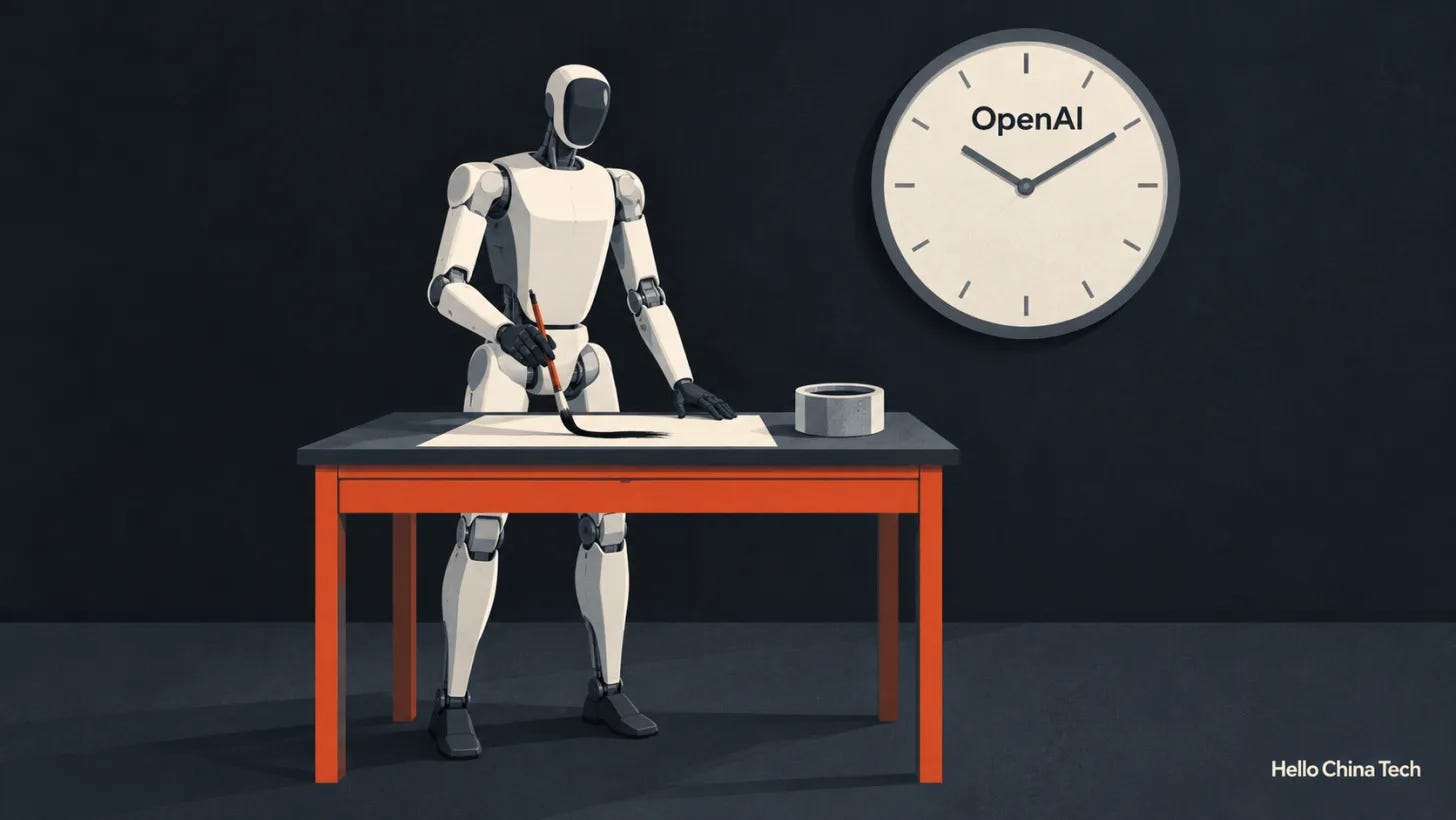
On October 25, JPMorgan raised Unitree Robotics two notches to overweight. Unitree is a Hangzhou humanoid maker, listed on Shanghai’s STAR Market, the technology board, since August. The bank lifted its December 2027 price target from Rmb 300 to Rmb 995. Sina Finance’s summary of the note gives the main reason as a shorter timeline. Three days earlier, Unitree co-hosted a conference with its partners in Hangzhou. There founder Wang Xingxing said a breakthrough in physical AI could come in one to two years, or two to three. His main example used another company’s model. His team, he said, had put OpenAI’s GPT-6 on Unitree robots with no training, and the robots painted and then cleaned their brushes. He has also predicted that GPT-7 could solve the problem next year.
I read this as a borrowed clock. The bank’s timeline is the founder’s timeline, and the founder’s evidence for it came from a model Unitree does not own.
Tracing a bank's target price back to the evidence behind its timeline is one example of how Hello China Tech reads China's tech sector: primary sources first, new analyses every week, across AI, chips, robotics, and EVs. Subscribe free to get the next one in your inbox.
Some venture investors read the same model the other way. On October 29, 36Kr, a Chinese tech news site, reported that three leading funds are pulling back from embodied AI. One reason investors gave: general models may match what startups building robot-control models spent heavily to develop. NE Times, an industry data service, counted Rmb 11.6bn of embodied AI funding in September, down 40% from August. The number of deals barely moved, 46 against 48, so the average round shrank.
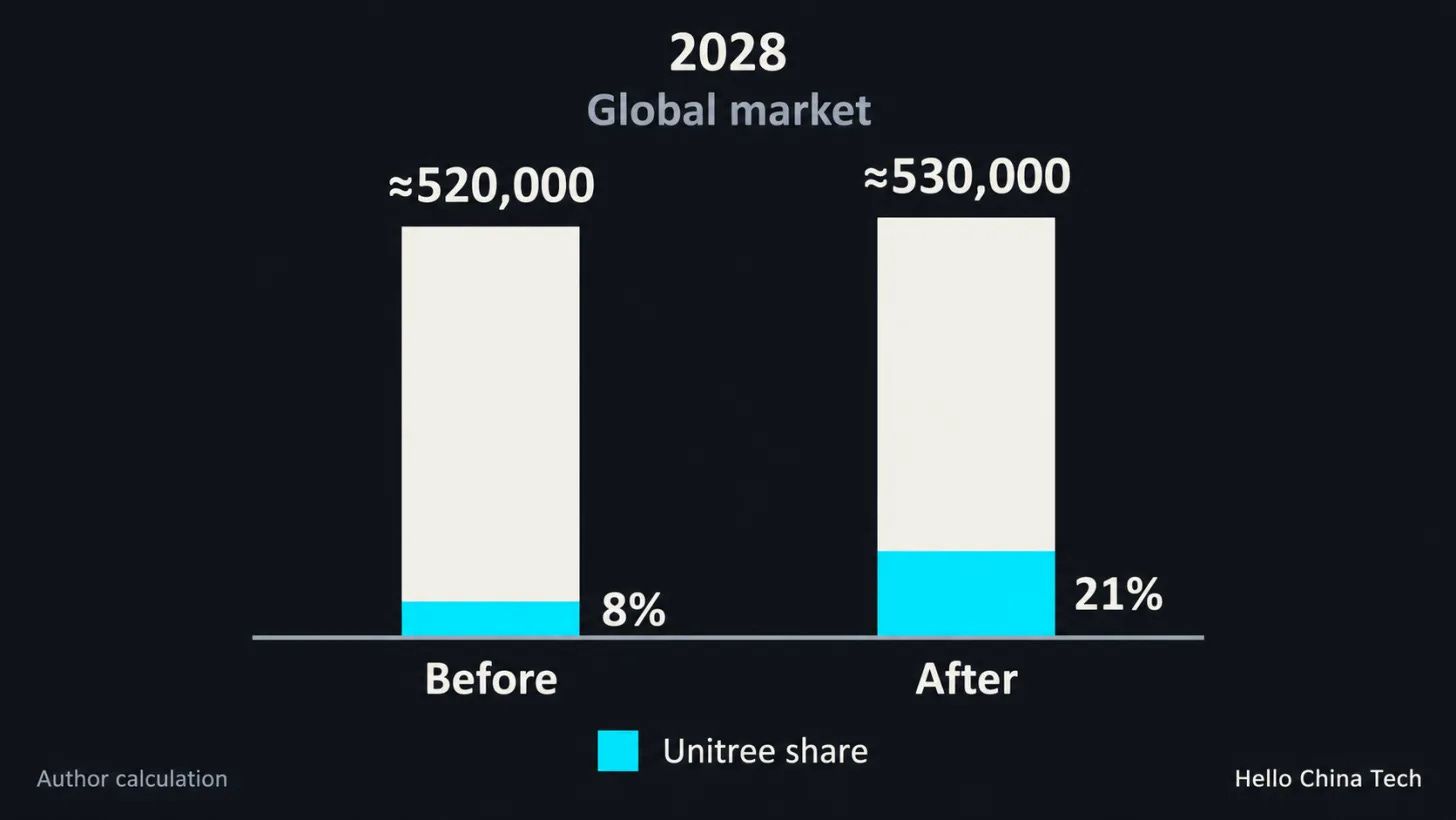
The target price rests on that timeline through one assumption. JPMorgan values Unitree at 30 times expected 2028 sales and raised its 2028 shipment forecast from 41,552 robots to 111,554. Dividing each forecast by the reported market share gives a 2028 global market of about 520,000 robots before and 530,000 after. That is my arithmetic, on rounded shares. What moved is Unitree’s share, from 8% to 21%. In late September the bank warned that Unitree risked becoming a mere hardware supplier. In the note’s logic, a shorter timeline makes deployed robots more valuable and that risk smaller. The bank’s forecast for 2027 adjusted earnings per share rose 25%. Its target, based on 2028 sales, rose 232%. Below: how Nvidia’s simulation results compare with Wang’s own standard, four lines from Unitree’s first quarterly report as a listed company, and a test of JPMorgan’s scarcity argument.