

On the evening of August 22, a humanoid robot ran 100 meters in 9.39 seconds at Beijing’s National Speed Skating Oval, the arena known as the Ice Ribbon. Usain Bolt’s human record is 9.58. It did not slow before the line. It hit a padded wall at full speed, went down, and was carried off by human handlers, the New York Times reported. Three days later the Tiangong robot, built by the Beijing Humanoid Robot Innovation Center, which goes by X-Humanoid in English, ran 8.86 seconds in the large-group second round.
One reading travelled fast in Western coverage, and on the stopwatch it holds up. The 2022 Guinness mark for a bipedal 100 meters stood at 24.73 seconds. Alan Fern, a robotics professor at Oregon State University, worked on it. Getting to 9.39 in four years is a huge achievement, he told the Times, and the gains came mostly from better hardware and control rather than a technical breakthrough. Michael Milford of Queensland University of Technology said most robot sports do not convert into the daily tasks people actually want done. The same report quoted Xinhua, the state news agency, conceding the point in its own commentary: factory robots do not need to win sprints.
I spent two evenings this week with the event schedule rather than the results table. The schedule reads as a grading sheet. The final column holds the rule on how much human help an event allows, and that column is where this year’s change sits.
If an autonomy weight coefficient printed beside each event on a robot competition schedule is new to you, this is a preview of what Hello China Tech does three times a week: reading China’s AI, chip, robotics, and EV sectors from primary sources most English coverage never touches. Subscribe free to get every new analysis as it publishes.
The Last Column
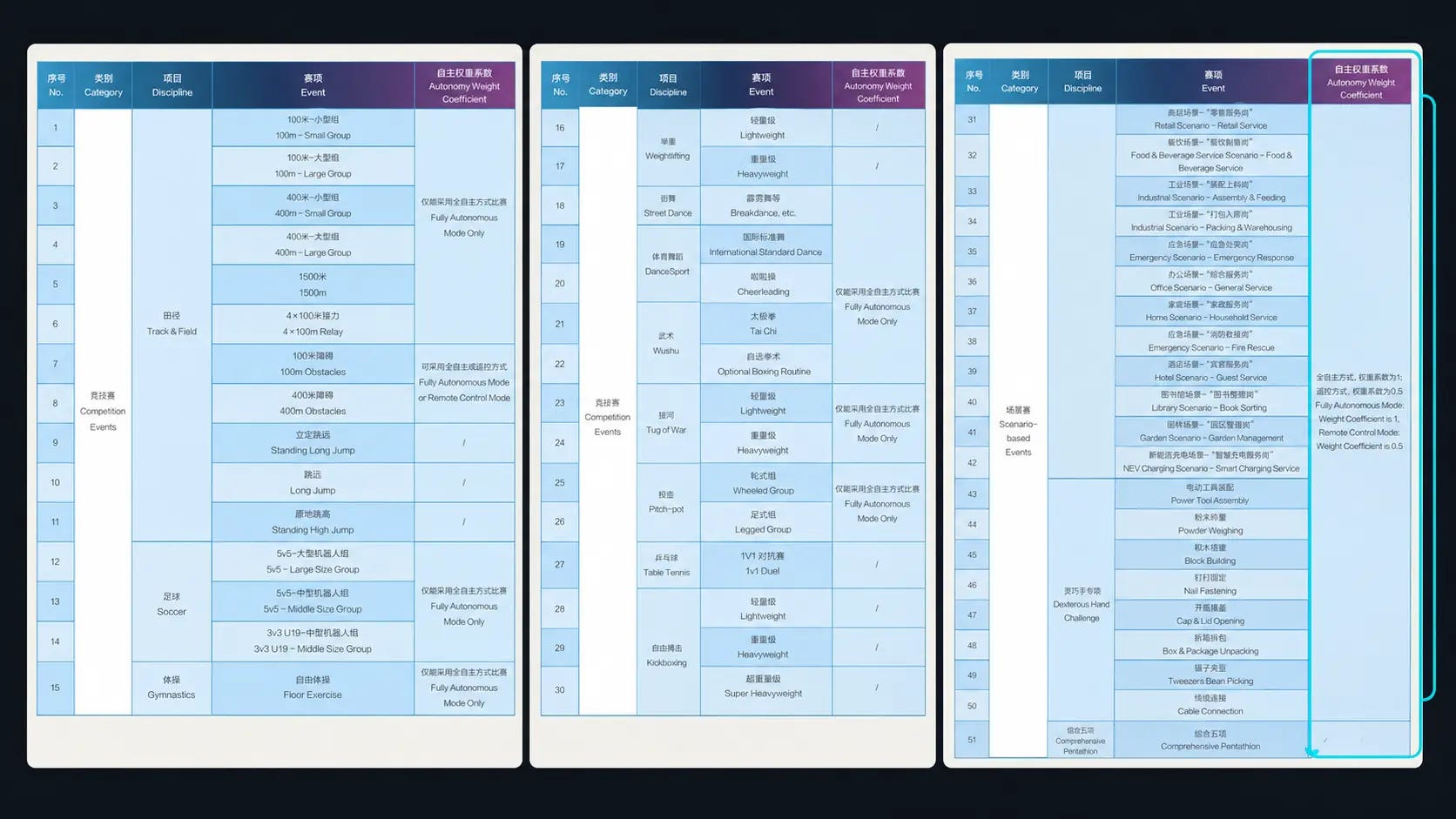
The table lists 51 events in two categories, competition and scenario. Each row carries a final column headed 自主权重系数, printed in the table’s own English as Autonomy Weight Coefficient.
Twenty of the 30 competition events carry a single line: fully autonomous mode only. These include every flat race, all three soccer formats, floor gymnastics, the dance events, tai chi and the optional boxing routine, tug of war, pitch-pot and table tennis. Two events, the 100m and 400m obstacle races, accept either mode. For 20 of the 21 scenario events the table sets a price rather than a ban: a fully autonomous run scores at weight 1, a remote-controlled run at 0.5.
Eight of the 30 competition events leave the column blank: the three jumps, both weightlifting classes and all three kickboxing weight classes. The comprehensive pentathlon, the final row of the table, is the ninth blank. One reading is that the table asks for autonomy where autonomy can be graded today and stays quiet where it cannot.
The two complaints I heard most about last year’s first Games were remote control and constant battery swaps. The rules moved on the first one. The municipal government’s own release says several competition events dropped manual remote control and now run autonomously end to end. The table uses two instruments. Twenty competition events shut remote control out. Twenty scenario events let it in at half credit. The weighting itself is not new, since Beijing’s robot half marathon in April already discounted remote-controlled entries in its scoring. What is new is that the autonomy question now runs across a 51-row program, nine rows of which still carry no coefficient at all.
The same release gives the scale: 16 countries, 666 teams, up 138%, 2,056 robots, four times last year’s count, 51 events over five days. Last year’s best 100m was 21.50 seconds and the standing high jump 95.641 centimeters. This year Tiangong Ultra cleared 2.8843 meters.
The largest upgrade at these Games is easier to find in the rules than in any single machine. In 2025 I argued that Chinese robot makers treat public imperfection as a commercial asset, shipping flawed machines and improving them in the open. The imperfection now comes with a weight coefficient attached.
One limit on all of this should be stated plainly. The column records what the organizers want, not what the machines delivered. It shows how autonomy is rewarded. It does not show how many autonomous entries finished, how often a human stepped in, or how the two modes compared on the clock. Those numbers are not in the published table.
Four Exams, Hardest Last
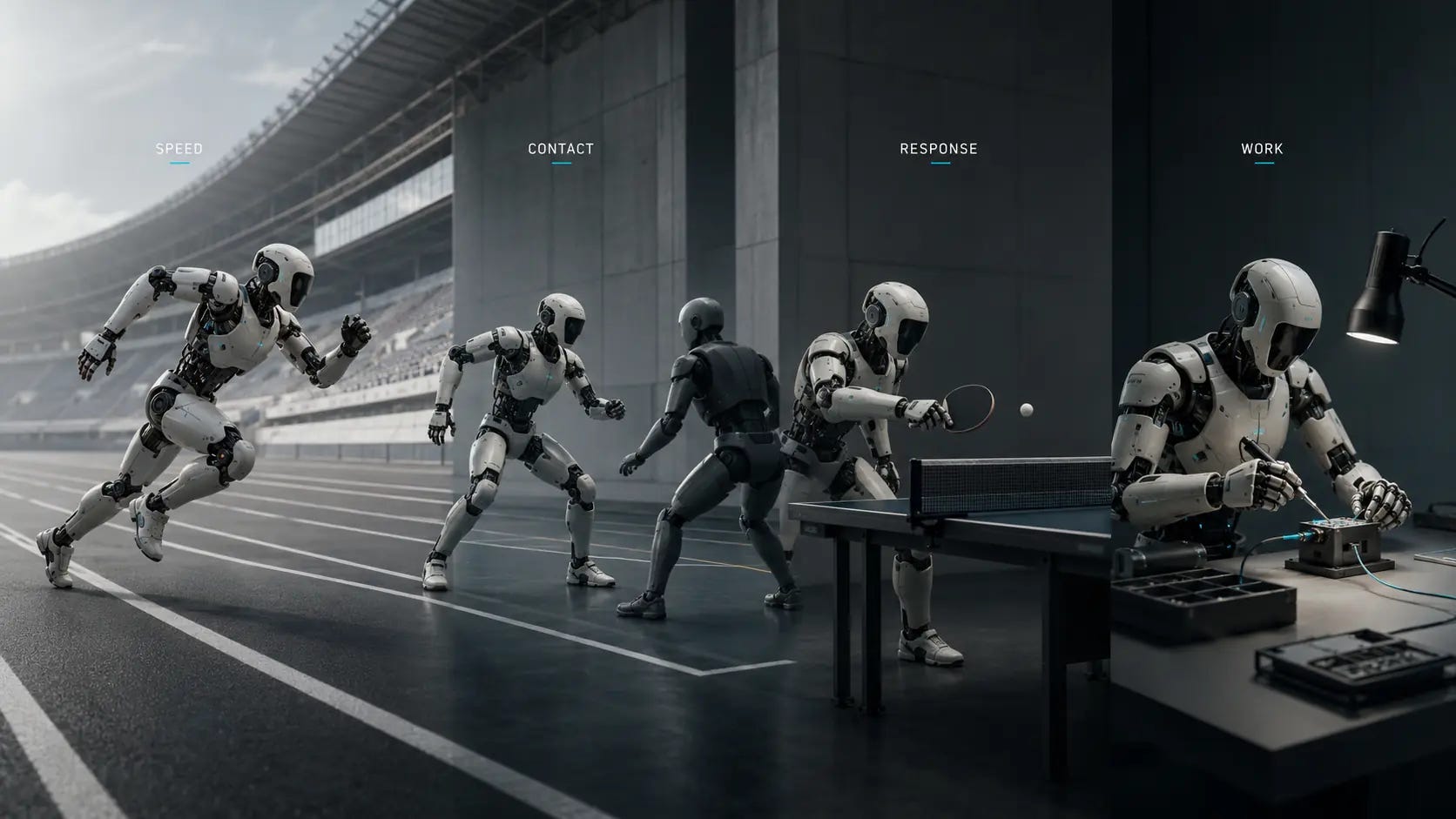
My own sorting, after a week of watching, is that the 51 events fall into four kinds of test. The medal count does not show the order.
A sprint is mostly a hardware and control result. The limits are how hard the joints can be driven, how fast the pack gives up its charge, and how long the machine sheds heat before the motors fade. Those limits move with the budget more than with the model. A bipedal machine beating a human record does show the control stack works. It says less about what the machine understands. The more telling detail is that machines sharing the Tiangong name hold both the sprint mark and the standing high jump. Winning two unrelated physical events points to how much performance now rides on a reusable hardware and control stack. It shows less about intelligence.
In April, Honor, the smartphone brand spun out of Huawei, won Beijing’s robot half marathon ahead of the specialist entrants. I wrote then that building good legs had become an engineering management problem. Four months later, the athlete’s oath at the opening ceremony was taken by an Honor robot named Lightning. The outsider from April was on the platform.
Fighting raises the difficulty in one specific way. A lane holds still. An opponent does not, and the disturbance arrives while the machine is already committed to a move. A Chinese business paper reporting from the floor described boxing robots wandering off in opposite directions. Most punches hit air. One machine raised a leg to kick and fell over first. A friend who was in the venue told me the boxing drew the loudest laughs of the day. My own read, after watching the rounds, is that most still did not dare to really hit. The table agrees in its way, since kickboxing is one of the events where the autonomy column is blank.
Table tennis is where the whole chain has to run at once. From the opponent’s contact to the machine’s swing there are a few tens of milliseconds. Inside that window the robot has to find the ball, project where it will be, and move the arm. A staged demo can cover a slow link in that chain. A rally in front of a camera is harder to stage. AgiBot is a humanoid startup in the listing queue. One of its vice presidents told the same paper that a table tennis system reached that level after a bit over two months of training.
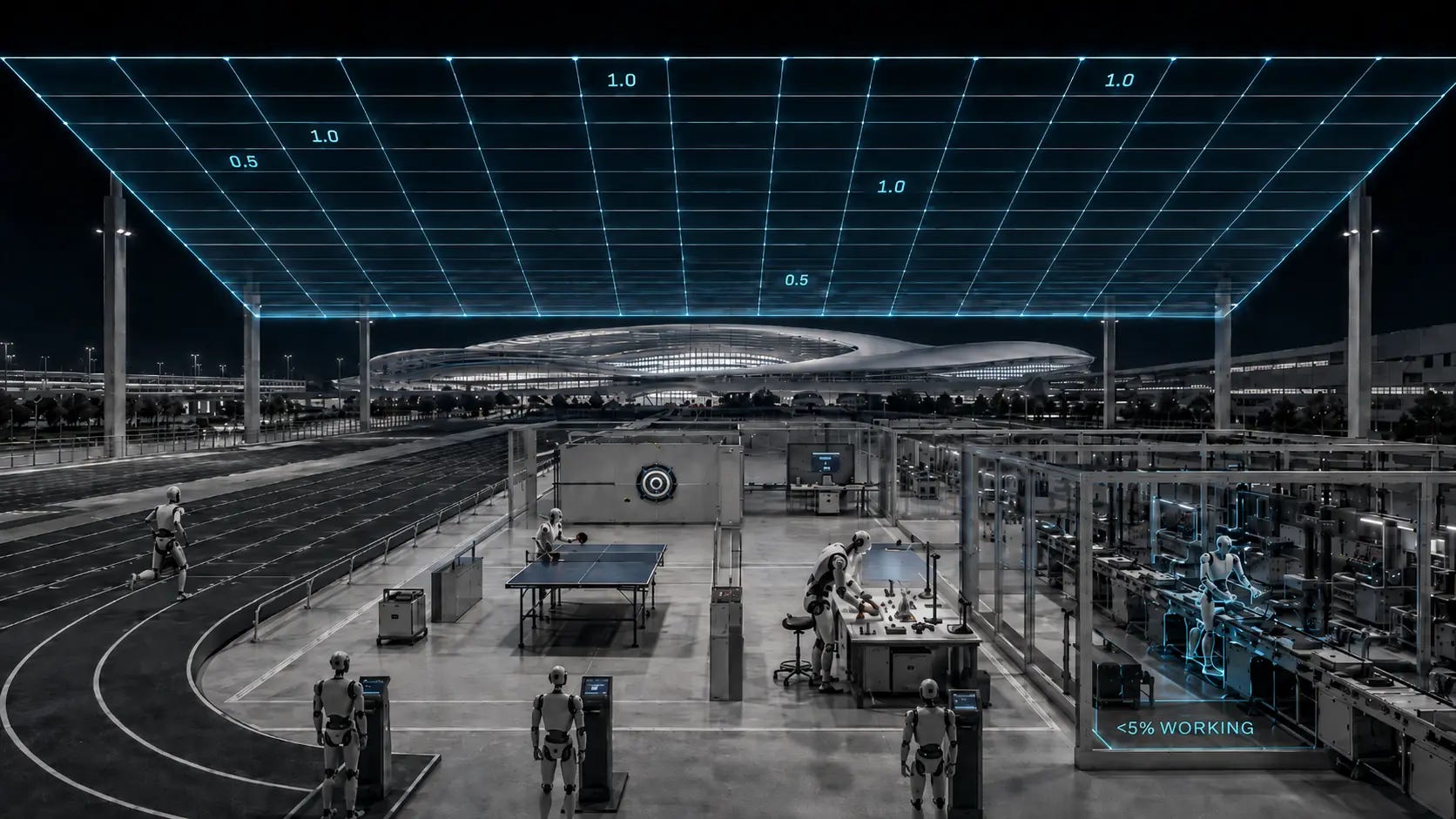
The scenario events empty the seats. They also sit at the top of the difficulty ladder, and the two facts go together: work worth grading is rarely work worth watching. Twenty-one of them cover nine broad fields including home, hotel and logistics. The schedule breaks them into 12 operational tasks, eight dexterous hand challenges and one pentathlon, and that second group maps where the industry actually is. Picking beans with tweezers. Weighing powder. Opening a cap. Fastening a nail. Connecting a cable. Watch two of these events back to back and the slowness stops reading as confusion. It is sequencing: see, compute, move, check, repeat. Each step gets solved before it is taken. That may be the state closest to paid work, because a warehouse buys repeatable before it buys quick.
A year ago I wrote about a robot that spent 17 minutes cleaning a hotel room at the first Games, picking up nine pieces of trash. A human housekeeper finishes that in under five minutes. I used it as a punchline. I would not write it that way now. On the evidence so far, the binding constraint looks less like top speed and more like the hand: grip, force control, fine manipulation. Those 17 minutes were the real exam paper, and I graded the wrong question.
Who Writes the Exam
On August 25, with the Games still running, the Ministry of Industry and Information Technology opened public comment on a draft guide for the national humanoid robot industry standards system, 2026 edition. The document states that no formally released humanoid robot standard exists at home or abroad, with more than 100 standards under research or pre-research. It sets a 2028 target of at least 100 key standards, covering capability testing and evaluation methods, key technologies, platforms and systems, scenario applications and safety governance. It also aims to have them promoted and implemented at more than 200 companies.
The structure runs to six parts, from basic and common standards through to safety and ethics. Two categories in the first part map onto the Oval directly. One grades robot capability by level of intelligence and by task complexity. The other sets benchmarks and test methods for physical function, intelligence features, resource use and system collaboration. A third category sits closer still to what the Oval actually does: standards for reliability and repairability. They cover whether a machine completes a defined task under defined conditions for a defined period, and how it is brought back after a fault.
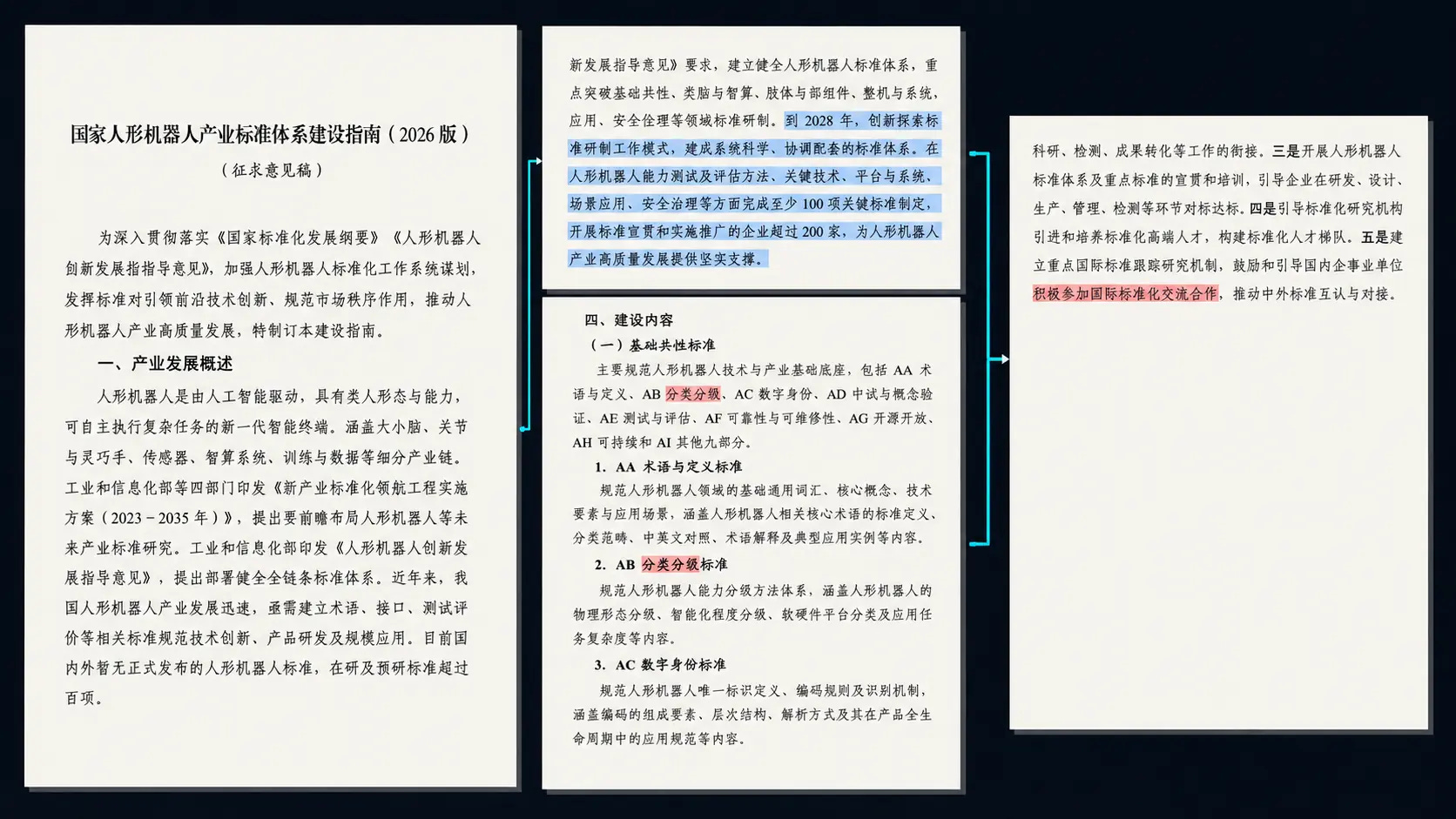
Put the two documents side by side and the division of labor becomes visible. The Games are an informal benchmark that runs once a year, with rules the organizers can rewrite between editions. The standards guide is the formal counterpart, still in draft, with a 2028 target and a company count attached. August 25 was also the day the sprint record fell again. The overlap in timing may be coincidence. The overlap in content is not.
The Games are hosted by the Beijing Municipal People’s Government and China Media Group, the state broadcaster. Two international bodies co-host: the World Robot Cooperation Organization and the Asia-Pacific RoboCup International Council. Operations are run by BAOC Group and Shougang Fund. A separate company, Shoucheng Holdings, describes itself as a deep participant in the Games through robot leasing, training and testing, and venue support. It is also an active investor in the sector, with holdings in Unitree, Galbot and several other Chinese humanoid startups. Kang Yu, general manager of its capital markets department, told reporters during the Games that the event works as a reliability test under the spotlight.
What follows is a question of degree. The institutions here are separate bodies. What converges around this one event is the functions: standard-setting, venue operations and investment attention, sitting closer together than a Western reader would expect at home. The effect worth watching is on price discovery rather than on any single result. Nothing in the record shows a medal moving a valuation. What the record does show is testing capacity, technical visibility and capital attention gathering at one venue. I have argued before that China’s state apparatus rarely builds the robots itself. It builds the machinery that lets robots be measured, ranked and priced. The last safeguard clause of the standards guide points at the next step. It asks domestic bodies to track key international standards, join international standardization work, and push mutual recognition between Chinese and foreign standards. That clause is where this reaches readers outside China. One industry report puts China at 97% of global humanoid shipments in the first half of 2026. That share of output gives China a reason to want influence over how humanoids are tested. Whether it gets that influence depends on adoption outside China and on participation in international standard-setting, and the draft settles neither.
What the Exam Cannot Measure
Kang Yu also warned against the obvious misuse of the event her firm helps support: medals rank single metrics, and single metrics do not add up to a company. Her sharper point concerned quantity. The audience sees one robot set a record. Some companies brought more than ten machines to the venue. Going from one to ten raises the consistency question, and consistency is the problem mass production has to solve. She makes the same case about joints, which carry a large share of a robot’s value and a large share of its reliability faults.
At the World Robot Conference, a trade show running in the same city that week, the mood ran the other way. Reporting from the show caught two founders trading valuation tactics over lunch. Go and find out what peers are quoting, one told the other: if a rival asks Rmb 1bn, we ask Rmb 800m. The sector’s valuation math I set out last week has not changed. One number in it has. Unitree founder Wang Xingxing pushed his timeline for an embodied-AI ChatGPT moment out to two or three years at best, five or ten at worst.
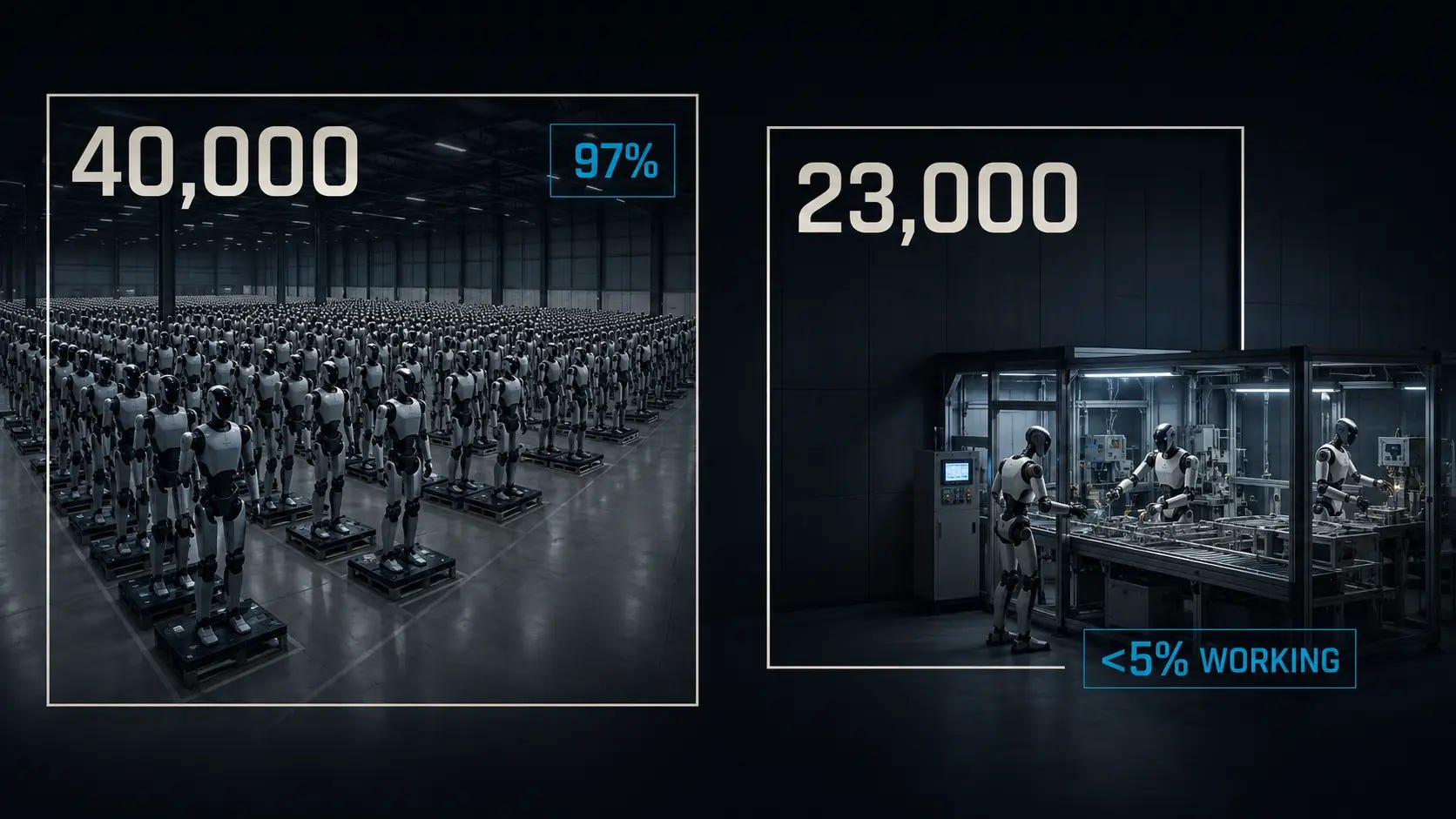
Two shipment counts circulate for the first half of 2026. The 40,000 units behind that 97% share come from an industry report. The head of Beijing’s Shijingshan humanoid robot data training center gives 23,000 for the domestic market, counted on a different basis. His estimate carries the harder qualification: of those 23,000 units, under 5% were stably doing real work on a production line. The reporting that carries his estimate proposes a stricter commercial test than shipment counts. An order for 100 machines followed by a larger repeat order the next year would say more than any first deployment. Nothing in these materials records one.
AgiBot’s argument that more real-scenario data will feed back into the models is reasonable on its own terms. It runs into the problem I set out earlier: robot training data has no common denominator across different bodies and tasks.
Midnight in the Prep Hall
Kang Yu’s best material, in the same interview, was not on the track. Near midnight, she said, she passed the soccer preparation hall and found the lights still on. Middle school students were still tuning their robots. One was doing summer homework while code ran. One had fallen asleep on the grass, then sat straight up when a teammate said the machine seemed off. Those people, she said, are the industry’s future.
A fast time travels well online. Taking a hit, holding an object and finishing a shift draw far less attention online. The table now tests versions of all three, though it still does not grade them equally.
So here is the reading order for next August. Open the new event table first, and the new records second. If the blank cells in the autonomy column start filling in, and if the weight for remote control drops below 0.5, the exam got harder. That would mean the organizers believed the field could pass it. If that column comes back unchanged, then this year’s rules were the ceiling rather than a step.