

This continues the series on China’s two listed AI model companies. It began with “Running Out of Runway“ in December 2025 and ran through their first annual reports and their first-half results in August and September 2026.
Three AI model companies have now published accounts for the same six months. Zhipu, the Tsinghua University-backed lab that listed in Hong Kong in January, reported on August 31. MiniMax, the Shanghai-based lab that listed a day after it, reported on August 26. Anthropic, the maker of Claude, filed its S-1 with the US Securities and Exchange Commission on October 26, with interim accounts for the six months to June 30, 2026. Until this week a reading of the two Chinese companies had no such comparable.
Revenue first. Anthropic booked $16.3bn in the first half. Zhipu booked Rmb 953.9m, about $142m at the company’s own conversion. MiniMax booked $116.6m. The gap is more than a hundred times. All three grew fast: Anthropic from $1.2bn a year earlier, Zhipu by 399.7%, MiniMax by 283.1%.
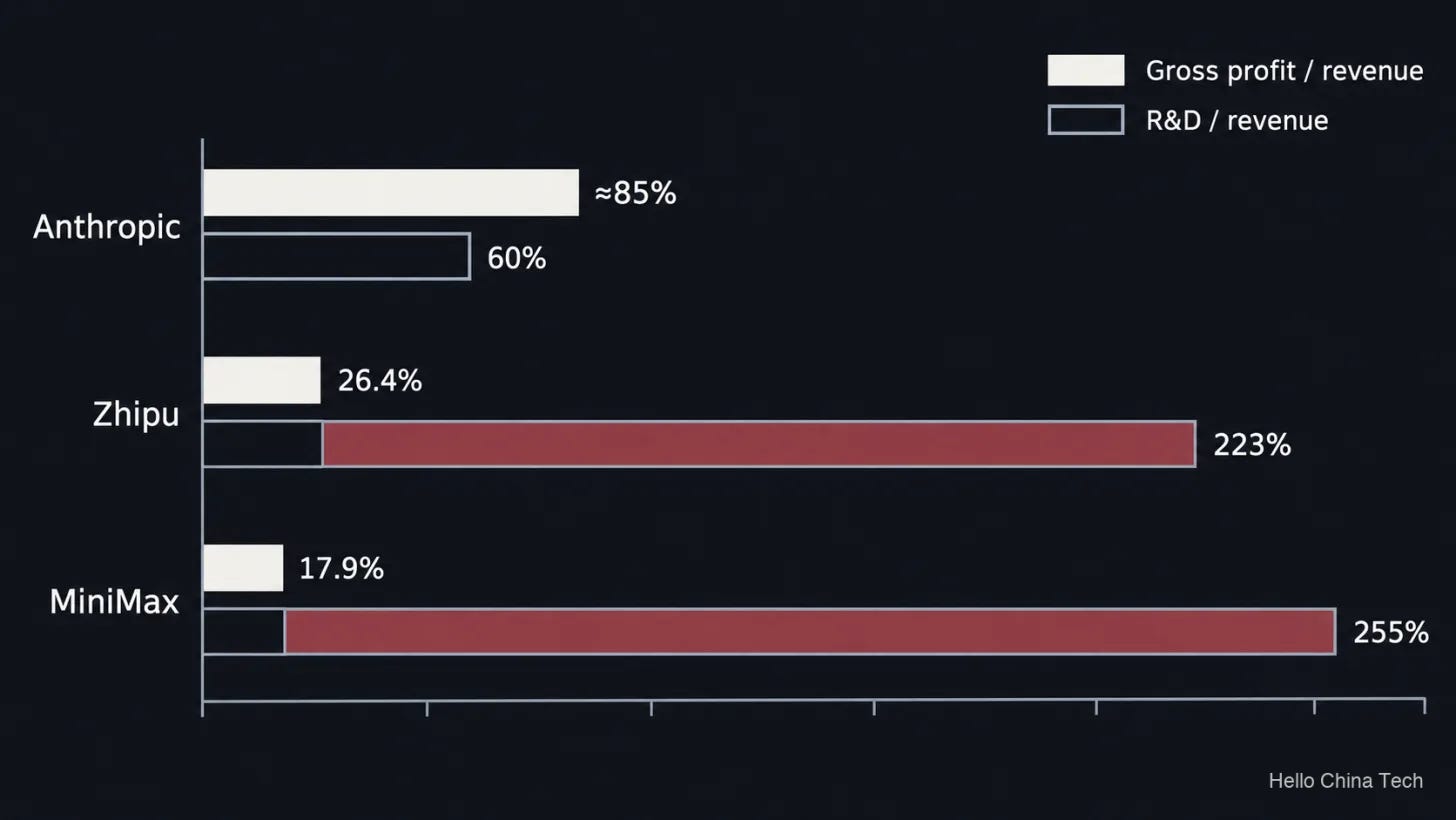
Then the cost of serving that revenue. Anthropic’s filing presents its expenses by function in the notes. Cost of revenue, which it says consists almost entirely of compute for customer workloads, came to $2.4bn, or about 15% of revenue. Zhipu’s cost of sales took 74% of revenue, for a blended gross margin of 26.4%; the company attributes most of the increase in that cost to computing service fees. MiniMax’s gross margin was 17.9%.
Then research. Anthropic’s R&D expense, which carries training compute as well as salaries, was $9.7bn, or 60% of revenue. Zhipu’s R&D ran at 223% of revenue, MiniMax’s at 255%.
Then the bottom line. Anthropic’s operating loss for the half was $693m, about 4% of revenue, and its second quarter showed an operating profit of $974m. Most of the headline net loss of $80.7bn, about $72bn, is an accounting charge on convertible notes that rose in value with the company’s valuation. Both Chinese companies also carried financing-related charges, which fell after their pre-IPO instruments converted at listing. On the adjusted measures both prefer, Zhipu lost Rmb 1.96bn, about $292m at the same conversion as its revenue, and MiniMax lost $293m, two and two and a half times their revenue. The loss measures are not on one basis: Anthropic’s operating loss includes stock-based compensation, and the Chinese adjusted figures exclude it and include items below the operating line. The revenue and R&D ratios carry the comparison.
In December I argued that Zhipu and MiniMax were caught in a structural trap: profitable per API call, loss-making as businesses, with the required level of spending set by competitors rather than by their own plans. Anthropic’s gross profit, taken from its functional expense table, exceeds its R&D expense, a relationship neither Chinese company can show. The FT and Bloomberg frame the filing as a test of investor demand for AI stock. Bloomberg also examines its compute intensity. Neither goes on to set those costs against Zhipu and MiniMax, which is what this article does. I read the filing as proof that the trap closes at scale, and as a statement of the condition: a gross margin near 85%, which the second section gives my reasons for reading as mostly price. Zhipu and MiniMax run the same ratios at a hundredth of the revenue and between a fifth and a third of the margin. In September I wrote that Zhipu’s pricing power rests on release speed and workflow depth. The S-1 adds the test behind that, whether pricing power produces enough gross profit to fund research.
Hello China Tech publishes new analyses every week on China's AI, chips, robotics, and EVs, built from primary sources rather than second-hand coverage. If setting a US frontier lab's S-1 against the Hong Kong filings of China's two listed model companies is the kind of reading you want more of, subscribe free and get each one as it publishes.
The Same Ratio, Different Stages
The series has tracked one ratio since March: R&D spending against revenue. When it falls, revenue is growing faster than the cost of staying competitive. This series has called that the scissors closing.
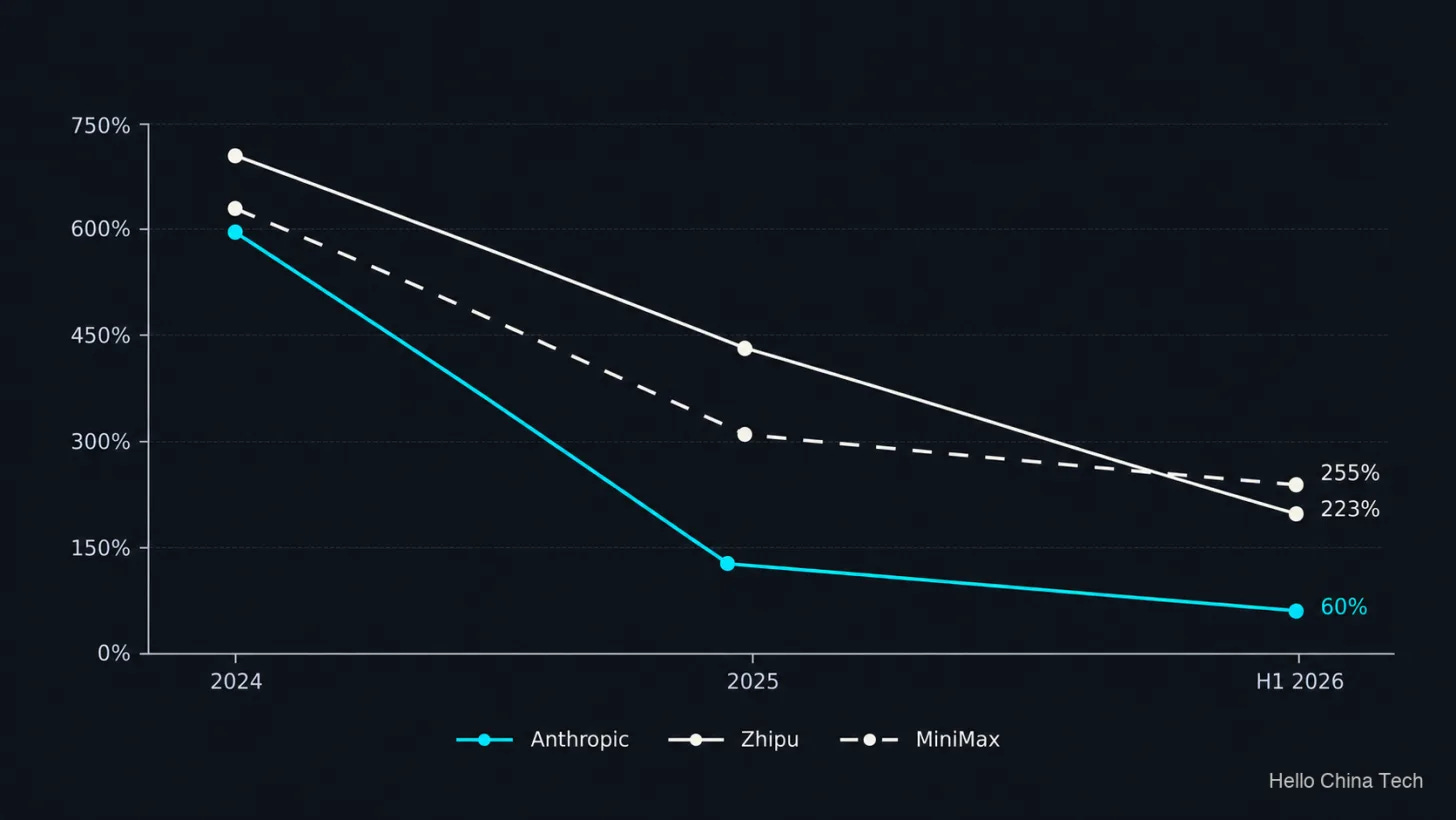
Anthropic’s filing gives that ratio for three and a half years. In 2023 the company spent $422m on R&D against $41m of revenue, a ratio above 1,000%. In 2024 it was 589%. In 2025 it was 138%. In the first half of 2026 it was 60%. The same filing gives the quarterly path for compute and infrastructure expense as a share of revenue: 251% in the first quarter of 2025, 48% in the second quarter of 2026.
Zhipu and MiniMax report higher ratios. Zhipu’s R&D ratio fell from about 700% in 2024 to 440% in 2025 to 223% in the latest half. MiniMax’s fell from 619% to 320% to 255%. Anthropic’s earlier ratios give a comparison, not a timetable: it passed through the levels they report now at some point between 2024 and 2025, and both Chinese companies made the falling ratio a point in their own reports.
The filing also explains the mechanism, and the explanation matters more than the ratio. Anthropic says it procures compute 12 to 18 months before it becomes available, so its compute expense “is generally fixed in the near term” and rises as committed capacity arrives, not in response to demand in the period. Revenue then grew faster than the cost of compute capacity committed in advance. In the second quarter of 2026 revenue rose 1,368% from a year earlier while compute expense rose 300%.
Zhipu built a metric for a related relationship from the other side. Its interim report defines a “compute multiplier”: open-platform and API revenue per Rmb 1 spent on training and inference compute. The company says the multiplier rose about 14 times from a year earlier. Anthropic’s nearest number, total revenue divided by compute and infrastructure expense, went from 0.4 in the first quarter of 2025 to 2.1 in the second quarter of 2026. Both ratios relate revenue to compute spending, but the revenue covered and the cost definitions differ.
The absolute levels cannot be compared. Anthropic’s ratio crossed one. Zhipu does not disclose the absolute value of its multiplier, and its cost of sales alone takes 74% of revenue.
Where the Margin Comes From
The 85% figure needs an accounting caveat first. Anthropic no longer reports gross profit as a line item. The 15% comes from a supplemental table in the notes that regroups the same expenses by function. That breakdown puts the compute for free users and the fees paid to cloud partners in sales and marketing, and the compute for training and internal use in R&D. Cost of revenue carries customer-serving compute plus a small share of personnel and overhead. Zhipu attributes most of the increase in its cost of sales to computing service fees. The materials do not establish how closely that line matches Anthropic’s cost of revenue. After subtracting cost of revenue and all sales and marketing expenses, Anthropic has 62% of revenue remaining. Zhipu has 26% before selling costs, MiniMax 18%. Price is the most visible part of that gap. Zhipu’s own numbers show the limit of the price argument. It reported an 80% cut in unit inference cost in its first-half review; its API margin for the half was 24.6%; the 101% rise in average API price runs to the report date in September. What remains is utilization and scale, and neither Chinese report gives a unit cost that would settle how much.
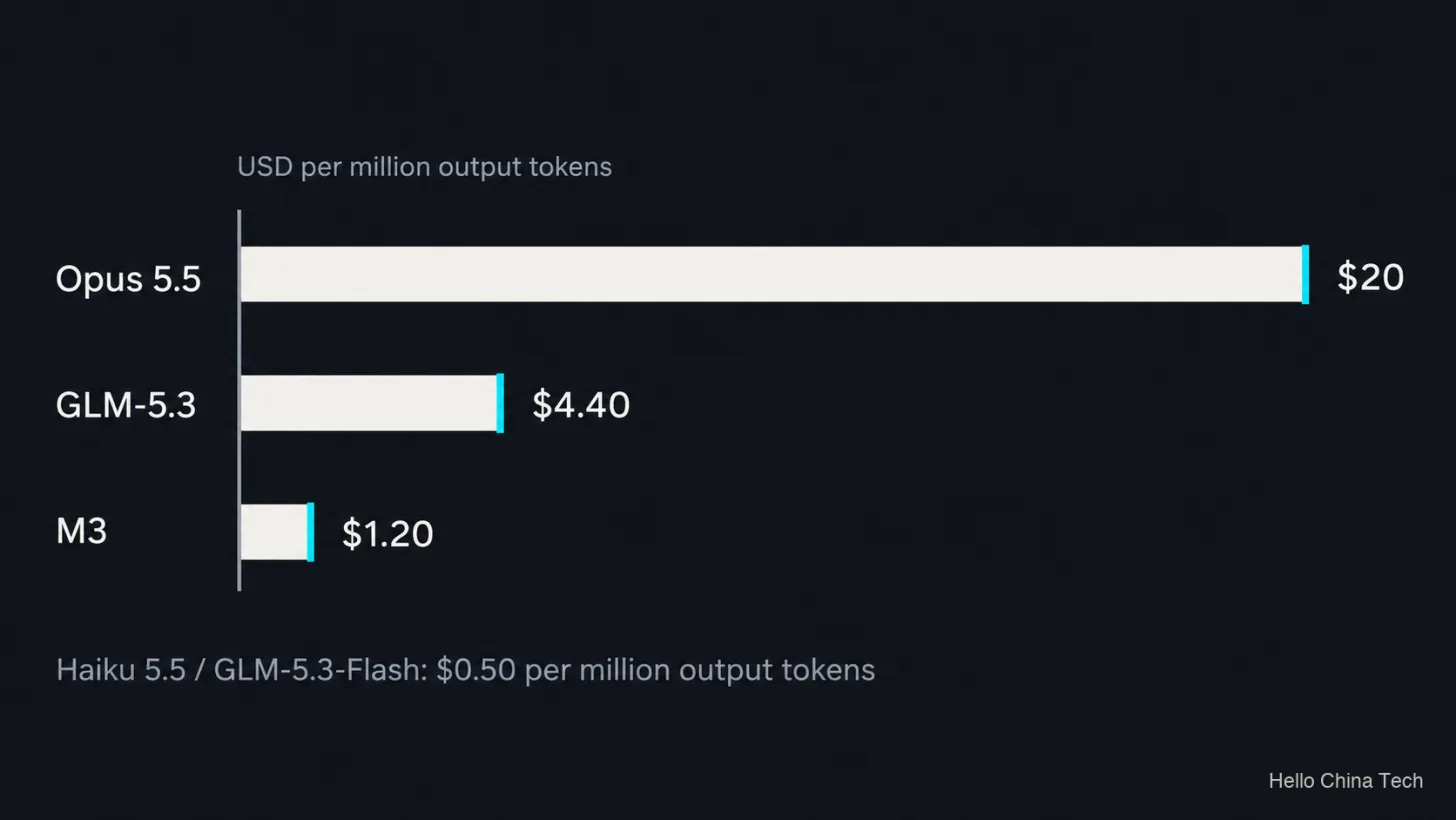
The three companies’ list prices on October 27 sit against those margins. Claude Opus 5.5 charges $4 per million input tokens and $20 per million output tokens. Fable 5.1, the most expensive model listed, charges $10 and $50. Sonnet 5.5 charges $2 and $10. Zhipu’s flagship GLM-5.3 charges $1.40 and $4.40. MiniMax’s M3, on its standard tier for inputs up to 512,000 tokens, charges $0.30 and $1.20, after a 50% launch discount that the company made permanent.
On output tokens, GLM-5.3 sells at about a fifth of Opus 5.5. M3 sells at about a sixteenth. At the cheap end of each range the gap disappears: for prompts up to 100,000 tokens, Claude Haiku 5.5 charges $0.10 and $0.50, within a few cents of GLM-5.3-Flash at $0.15 and $0.50.
The September installment described the two price curves Zhipu’s management had drawn on its earnings call: falling prices for any given level of intelligence, and a sustained premium for frontier models that open new tasks. The list prices show who stands where. The filing does not split Anthropic’s revenue by model. It does say 80% of first-half revenue was consumption-based, and that as of September 30 about 250 customers had each paid at least $10m over the preceding twelve months. The aggregate cost ratio cannot say which models earn that revenue. The two Chinese companies’ blended margins carry more than text APIs: MiniMax earned 36.6% of first-half revenue from consumer products and 60.8% of its revenue outside mainland China, and Zhipu earned 13.5% from on-premise deployment. List prices cannot explain those margins on their own. They do show the top of each company’s range. Zhipu doubled its average API price this year and still lists its flagship at a fifth of Opus 5.5’s output price. MiniMax listed its flagship at double the old price, discounted it by half from day one, and made the discount permanent.
The S-1 names the segment where the two Chinese companies sit. Among its competitors it lists “open-weight or open-source” models “released by international and domestic organizations” that compete “for a growing range of enterprise workloads that prioritize cost efficiency over intelligence.” That is the lower curve.
Anthropic also describes how it cuts prices. It says Opus 5.5 reduced customer cost per task by about 40% compared with Opus 5, and that compute efficiency lets it deliver those reductions “while preserving our margins.” In China’s model market, price moved first: in the price war of late 2024 and early 2025 Zhipu cut its flagship by as much as 90%, as this series recorded in April. Zhipu’s price increases this year run the other way. Its interim report attributes the API margin of 24.6% to scale, higher pricing and engineering work that lowered inference cost.
The checkpoint for that attempt sits on the price pages as well as in the next results. The comparison to track is list prices and discounts against GLM-5.3’s $4.40 and M3’s $1.20. A higher launch price would test demand for a premium Chinese model, and the results after it would show whether customers paid it and whether the margin followed. A price cut alone would not settle either company’s long-term position, since cuts also come from cost declines and product tiers.
Both Formulas, One Company
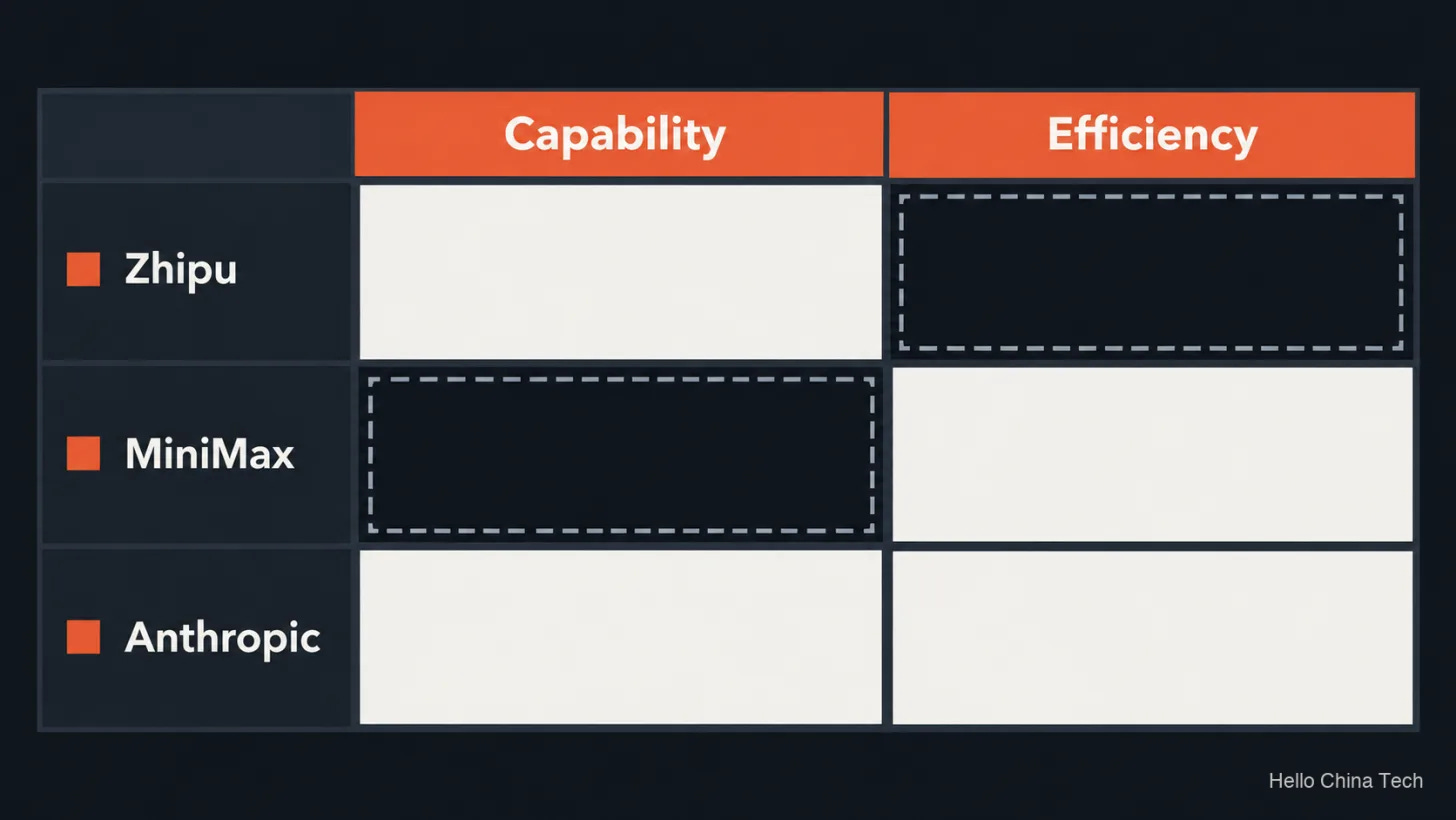
Each Chinese company has stated a survival equation. Zhipu’s annual report opened with one: the commercial value of artificial general intelligence, or AGI, equals the intelligence ceiling multiplied by token consumption. MiniMax’s interim announcement gave the counter-formula: inference efficiency decides how much post-training and how many experiments a lab can run, which decides how fast its models improve, so cheap inference is a production function for intelligence.
The S-1 contains both. Zhipu’s equation appears as net revenue retention of about 900% as of September 30. The filing calculates it by dividing current-period revenue by base-period revenue for the same qualified customers, and excludes Claude Pro and Max subscribers. It also appears as more than 11,900 customers that each paid at least $100,000 over the preceding twelve months. More capable models make more tasks possible, and the tasks are metered. MiniMax’s equation appears as what the filing calls “compute multipliers”: algorithmic gains in training and inference that Claude now helps discover. The company calls that recursion “closing the loop” and claims it serves more customers per unit of compute than other approaches.
An April installment of this series argued that China’s independent model companies could pursue only one commercial lane at a time, while platform companies could run several. The same budget logic applies inside a lane, to capability and efficiency. A frontier lab with $16bn of half-year revenue funds both from a research budget that takes 60% of revenue. Zhipu and MiniMax chose one half each because at 223% and 255% revenue cannot fund both. The likelier explanation for the choice between the two formulas is a budget constraint rather than a disagreement about how AI makes money. Anthropic’s gross profit now covers its R&D expense. Neither Chinese company’s does.
The constraint is also why the two Chinese companies have started to converge. Zhipu says GLM-5.3-Flash beats GLM-5.2 at a tenth of its price, a move onto the cost frontier. MiniMax is training M3 Pro, a model it says approaches 3 trillion parameters, to reach the capability frontier. Both companies are now working on the half they did not start with.
China in the S-1: Attacker, Risk, Student
The S-1 mentions China in three roles that matter for this comparison, and the third is the one that bears on the two companies.
The first is as an attacker. Anthropic says that in September 2025 it detected a campaign in which a Chinese state-sponsored group manipulated Claude Code into attempting intrusions at about 30 organizations, which it calls “the first documented case of a large-scale cyberattack executed without substantial human intervention.” The second is as a regulatory risk. The filing says Washington has increasingly scrutinized AI companies’ exposure to Chinese state actors, and that future rules could restrict its ability to serve users connected to China.
The third is as a student. The filing warns that third parties “have attempted in the past and will likely continue to attempt to replicate, distill, extract, or otherwise derive the functionality or capabilities of our models.” It does not name them there. Anthropic’s September threat report did: it said Zhipu rotated through 273 fraudulent accounts over ten days, attributed more than 3.4m exchanges to Zhipu across 17 days in June and July, and said MiniMax built a proxy network through a shell company. The filing describes the segment both companies sit in without naming them. The threat report names them, as users of the premium curve’s output.
The next sentences matter more for the two Chinese labs. If the ability to build highly capable models spreads, the filing says, “competition could increasingly depend on access to large-scale compute rather than on model development capability.” Anthropic lists that as a risk to its differentiation. For Zhipu and MiniMax, cheaper inference and open weights are the stated strategy, so the same sentence names their constraint: the contest then moves to compute access, and the filing also lists US export controls on advanced chips to China among the factors shaping compute supply.
Anthropic had raised $141.1bn of capital by June 30 and held $112.4bn in cash and $19.3bn in short-term investments. Bloomberg reported that compute agreements signed since the end of 2025 carry minimum obligations of about $417bn, some running 20 years; the filing leaves the total blank in this draft. Zhipu raised about Rmb 27bn in a July placement, then HK$15.66bn in a September placement and about $3.01bn net from a convertible bond the same month. Its interim report says it runs inference on about 100,000 domestic chips; on its earnings call, management said training supply remains heterogeneous. MiniMax reported a cash-balance measure of $1.32bn at June 30; its July placement and convertible bond raised HK$16bn gross, and management put reserves above $3bn. Both companies are in what the July installment called the perpetual raise, returning to the market before revenue can fund the next stage. Anthropic is raising too. The size of its raise is the contrast. Its revenue already covers its research budget, though not yet the whole cost base for the half, and its shrinking operating loss points to expansion being funded from revenue.
Capital First, or Model First
The December article emphasized balance-sheet depth. The March update emphasized distribution. The S-1 corrects both. At Anthropic the balance sheet and the model moved as one variable. Anthropic committed compute 12 to 18 months before the capacity became available, customer demand used the capacity, revenue then grew faster than compute expense, and the revenue funded the next model.
Zhipu and MiniMax have run the same loop in a different order. The model came first, because it is what the market would fund. Compute is bought as a service and prepaid, on terms the reports do not disclose, at a margin that leaves little to reinvest. Revenue arrives at prices set by a market with several comparable labs and platform companies able to sell below cost. Both companies have improved unit economics, and their gross profit still falls short of R&D spending. After the July and September raises, Zhipu holds capital on a scale closer to Anthropic’s order. My next test is whether Zhipu can use its larger capital base to secure compute that revenue can support. Prepayments and purchase commitments are two measures to watch in its next annual report.