

On October 22, iFlytek released Spark X2.6. iFlytek is a Chinese speech-recognition company that has become one of the country’s main developers of large language models. Its chairman, Liu Qingfeng, told the audience that the new model was trained entirely on Chinese chips. He did not say which chips.
In its 2025 annual report, published in April, iFlytek said it planned to release a flagship model on the Ascend 950 at this same event. The Ascend line comes from Huawei, the Chinese telecoms equipment maker that also designs AI chips. Six months later the model arrived and the chip name did not.
Huawei’s roadmap gives chip specifications. It does not give training comparisons with Nvidia. iFlytek’s earnings briefings do. iFlytek has trained its main models on Huawei hardware since 2023. Since April 2025 it has given investors at least six readings against Nvidia. It has also said where the gap sits and how many months it adds to each model.
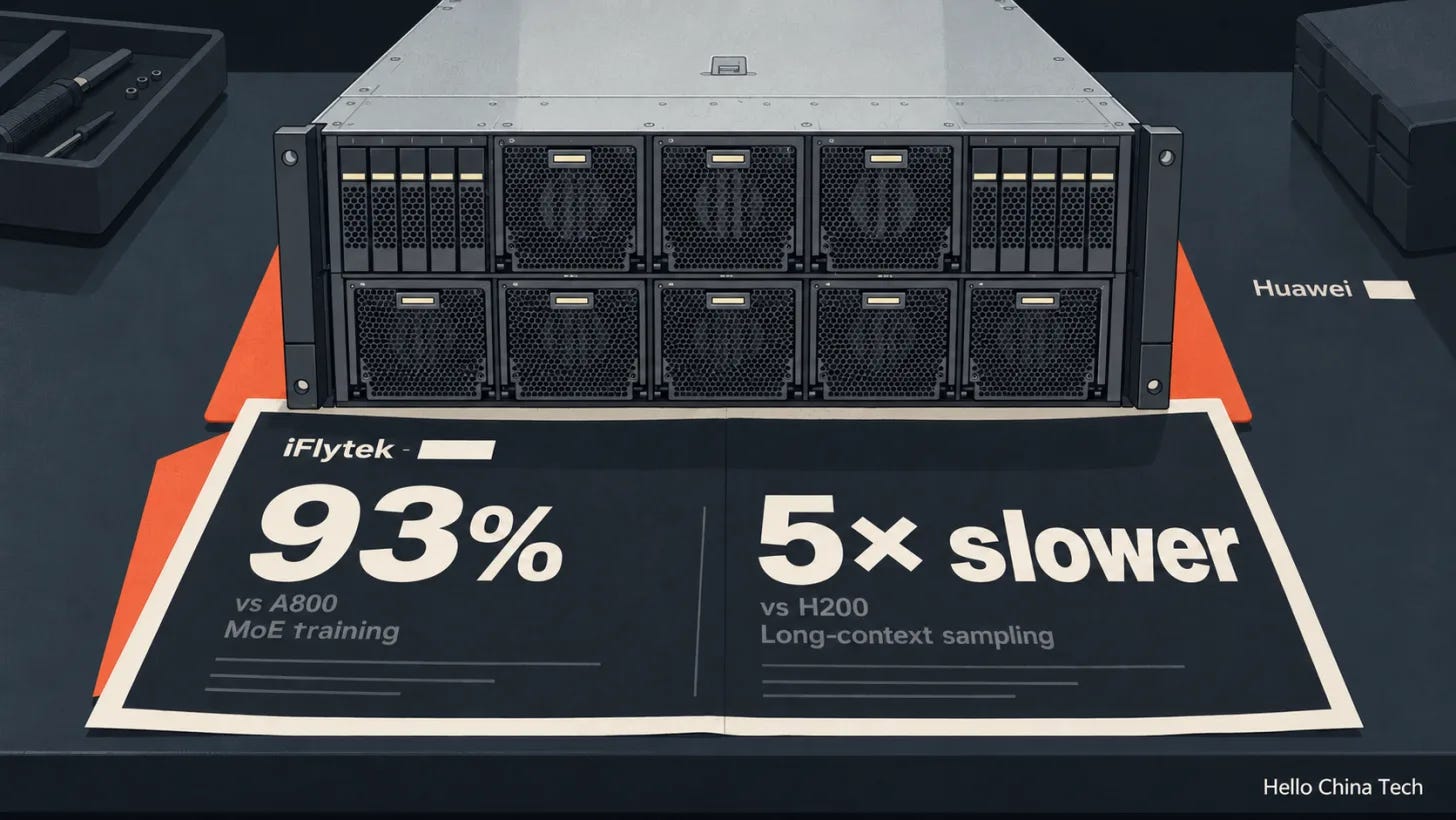
Read together, the readings show how much the answer depends on the task and the baseline. On the tasks iFlytek reported, tuning brought the 910B close to Nvidia’s older A100 and A800. Sampling on very long contexts stayed about five times slower than on the newer H200. iFlytek’s own explanations point most often to memory and training software. I read the record as the most detailed customer-side evidence that Huawei’s chips can carry a serious training program. Their weakest reported point is long-context sampling.
If reading a chip's training gap through its customer's own disclosures is new to you, this is a preview of what Hello China Tech does every week: reading China's AI, chip, robotics, and EV sectors from primary sources most English coverage never touches. Subscribe free to get every new analysis as it publishes.
The figures also need context. iFlytek has its own reasons to describe the gap the way it does, and those reasons shape how readers should assess each comparison.
A Flagship Without a Chip Name
Liu’s launch speech gave a training gain and a scheduling method, but no chip. iFlytek said it raised training efficiency on very long contexts about four times. It split long and short tasks and scheduled them across “existing domestic computing power.” That phrase does not identify the chips used for X2.6. “Domestic” is also wider than “Huawei”: iFlytek works with Hygon and Cambricon, two other Chinese AI chip designers. After the launch Liu told reporters that more progress would come in the first quarter of next year.
Huawei’s own calendar is the context for that plan. In September 2025, Huawei set out its roadmap. The Ascend 950DT is the version built for training. It carries 144GB of memory and 4TB/s of memory bandwidth, from high-bandwidth memory (HBM) of Huawei’s own design, and was due in the fourth quarter of 2026. Its sibling, the 950PR, targets the first stage of inference and recommendation systems and was due in the first quarter. In April 2026, iFlytek told investors that Huawei would mass-produce the 950 after the third quarter. At a media briefing during Huawei Connect in September 2026, Eric Xu, one of Huawei’s rotating chairmen, said 950DT supernodes were still under testing. Supernodes link many chips so they work as one system. He put large-scale supply at the end of 2026 or early 2027.
iFlytek’s August earnings briefing fits that timeline. The company said the 950DT “is mainly used for model training.” It said it “will complete” the replacement of its existing equipment, and that a joint team with Huawei had started work in advance. Those read as the words of a customer preparing for a chip.
iFlytek put the training time at two to three months, and Liu told reporters the work had run for two months. Neither account names the chips. X2.6 has the same parameter count as X2.5, released about 45 days earlier. iFlytek has not said whether X2.6 continued training from X2.5.
In April 2026, iFlytek said plainly that X2-flash, a smaller model, was trained on an Ascend 910B cluster. In October it named no chip at all. The launch did not show whether iFlytek had used the 950, so the hardware part of the April plan remains unconfirmed.
The paid section reads, line by line, the four comparisons that carry the argument, with the Nvidia baseline and the task behind each. It then asks why iFlytek publishes them, and what they leave out.