

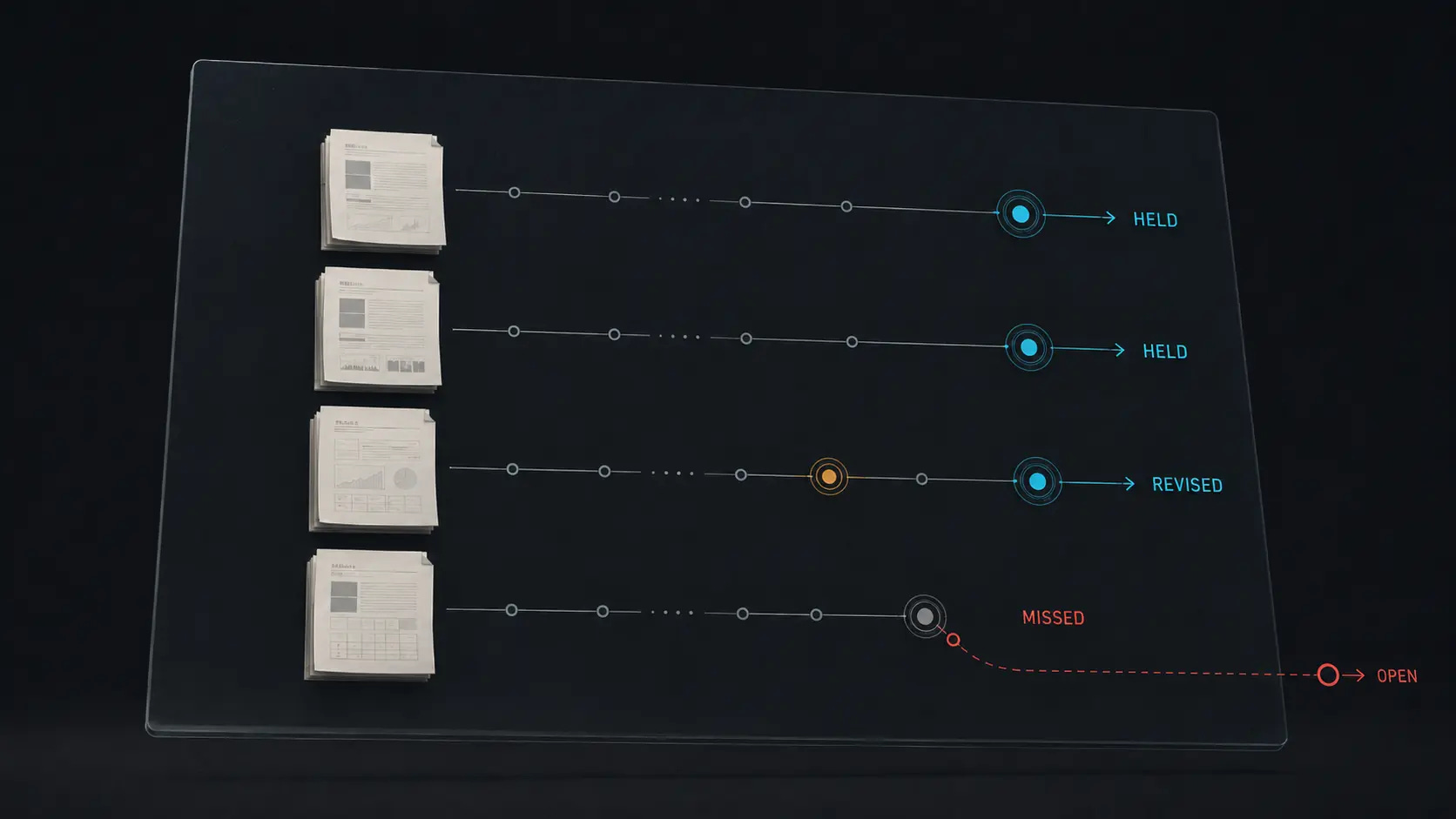
Hello China Tech turned on paid subscriptions one year ago this week. This essay applies the newsletter’s own standard to itself: specific claims, matched against what happened. A year of paid coverage produces a record that can be checked. Every essay in the archive carries a date, and enough time has now passed for the early ones to be scored. The China Tech Field Guide did this at the framework level in July: six principles, scored against twelve months of evidence. This essay goes one level down, to individual calls. What did a specific essay say, on a specific day, and what happened next.
Public scorekeeping is rare in China coverage. This essay grades a year of Hello China Tech calls against filings and outcomes, the same standard the newsletter applies to companies three times a week. Subscribe free to get every new analysis as it publishes.
Four entries follow. The selection rule is simple: enough time passed, and enough public evidence landed, for a clean score. The archive holds other claims still too young to grade.
The Ledger
1. The option that got exercised
On January 5, after Moonshot AI closed a $500m round that pushed its reserves past Rmb 10bn, I wrote that the money had bought the right to say no: the option to skip the consumer traffic war and fund the compute race on its own terms, while Zhipu and MiniMax were pushed into IPO filings by their burn rates. Founder Yang Zhilin’s internal memo said the company was not in a rush to go public.
Seven months later, Moonshot sold that option. In July it circulated a shareholder resolution for a Hong Kong listing that could come within six months, and Bloomberg reported a pre-IPO round at up to $50bn pre-money. Kimi K3 sits between the two decisions: the launch came so close to Moonshot’s compute ceiling that the company paused new consumer subscriptions three days in.
Scoring this honestly requires splitting it. The structural claim held. A startup cannot fight a traffic war and a compute war at once, and the companies without that option were forced to list first. The arithmetic did not hold. The January essay sized the cushion at 18 to 24 months of compute inflation, measured against December’s spending profile. K3 made that measure obsolete in weeks: at the frontier a win arrives as a bill, and a runway figure computed in December stopped being a fixed quantity. The option was real. The unit I measured it in was not built for a frontier launch.
2. The token boom got audited
In November I argued that China’s AI market reads more clearly through tokens, tenders and pricing than through model benchmarks. In April I examined Beijing’s March decision to elevate the token into an official economic indicator, at 140 trillion a day, and asked what that accounting framework captures and what it leaves out.
An answer arrived on June 30, in audited form. SiliconFlow, China’s largest independent token supplier, filed for a Hong Kong listing. The prospectus confirmed the volume story: 578.5bn tokens a day, throughput up twelvefold in sixteen months, revenue up 653%. It also confirmed the caution. Public cloud gross margin sat at negative 119%, compute rental consumed 86.9% of direct costs, and 716,000 paying accounts averaged roughly Rmb 20 each. The boom is real, and selling it for a living remains brutal. The volume call held. The April question got its answer, and a framework that had been running on estimates now runs on filings.
3. The consensus machine, priced
In February I described China’s robot investment frenzy as a consensus machine: a system in which narratives become investable faster than independent underwriting can catch up. The sector had raised Rmb 39.8bn across 325 deals in 2025, and projects that struggled at Rmb 200m valuations were oversubscribed at Rmb 3 to 5bn months later.
Disclosure documents have since done the underwriting. Unitree’s IPO filing showed that 73.6% of its humanoid revenue in the first nine months of 2025 came from research institutions and universities. Earlier this month I priced the sector’s favorite moat: data collectors earn Rmb 20 to 40 an hour while delivered robot data is quoted at up to Rmb 1,000, a gap that accumulated hours alone cannot explain across five model-first valuations at or above Rmb 20bn. The frenzy was real. So was the distance between the narrative and the filings. The call held. The coming IPO wave will keep testing it.
4. The one I missed
The working hypotheses behind this newsletter, written down in October 2025, treated each industry’s exit from overcapacity as relatively contained. EVs would export their surplus. Models would deflate into domestic enterprise deals. Chips would consolidate under policy. Nothing in that framework anticipated that a dominant company would use one cycle’s overcapacity as the launch point into an adjacent value chain.
CATL did exactly that. By the time I named the pattern in June, the company had committed Rmb 4.1bn for a stake in the controlling shareholder of a data center power supplier, agreed to pay up to $942m for a stake in a data center operator, and reportedly put around $740m into DeepSeek’s fundraise, with total exposure potentially past Rmb 15bn. The Field Guide records the miss. What the miss taught is now part of the framework: exits from state-driven overcapacity can migrate across value chains, and the analyst’s job is to watch for the migration, not just the glut.
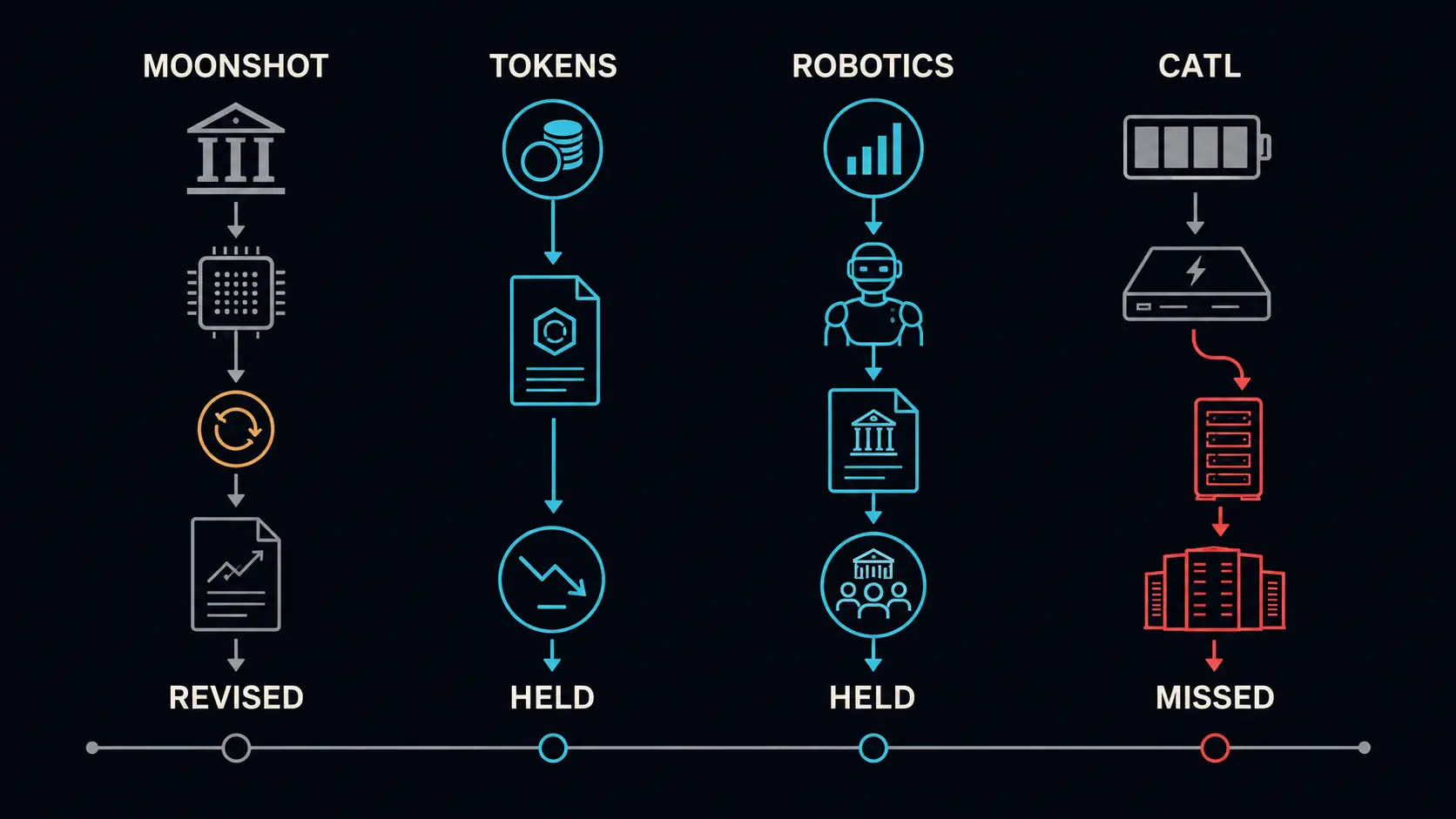
The correction produced its own testable claim, posed at the end of the June essay: whether the battery playbook survives contact with a power architecture defined by Nvidia, incumbents like Delta and Vertiv, and hyperscale customers building their own facilities.
Four Questions for Year Two
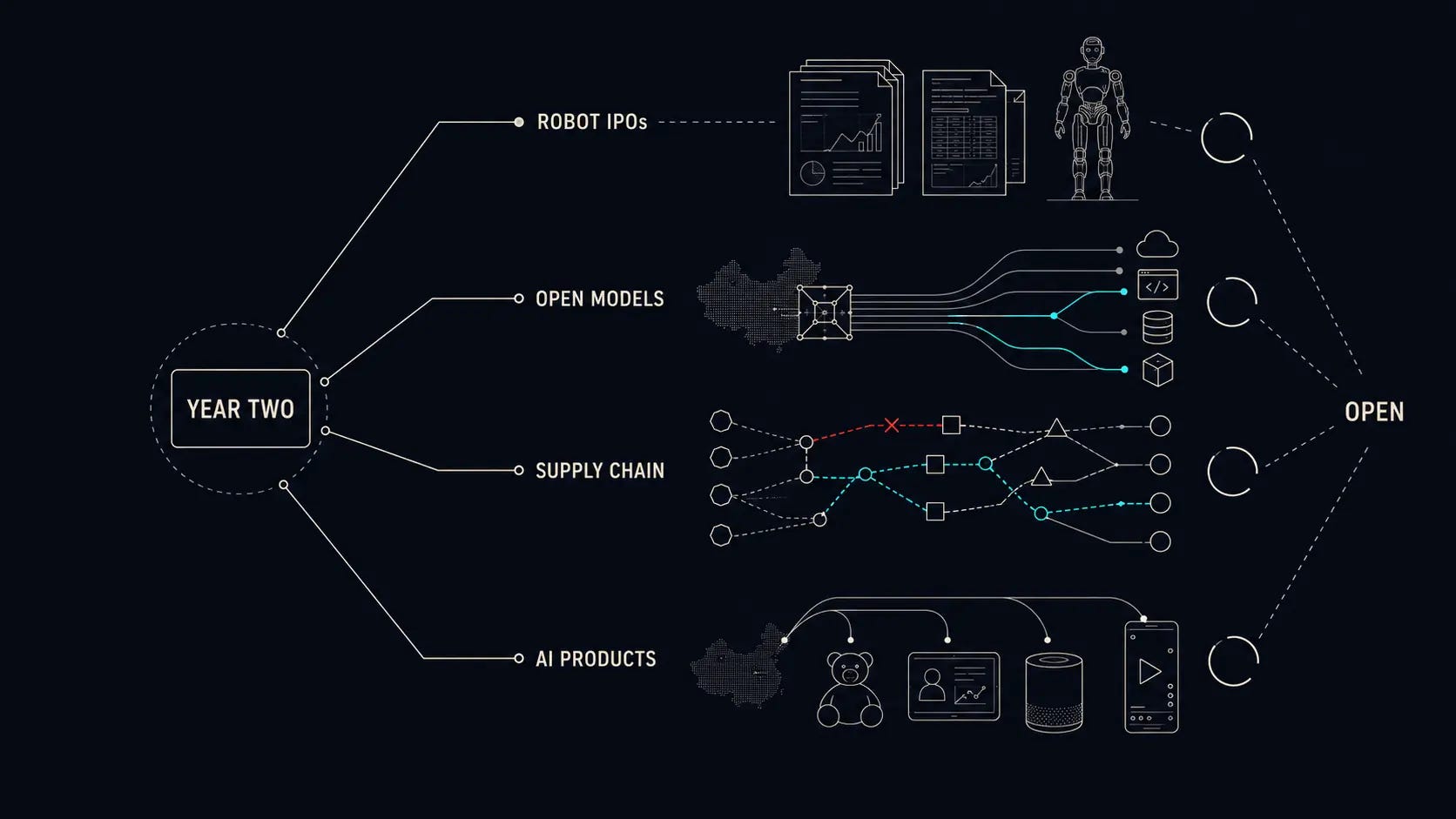
A ledger only matters if it keeps running. These are the four questions I expect the next twelve months of coverage to keep answering, stated now so they can be scored later.
Can China’s robot makers survive the disclosure test? The IPO wave is moving the sector from press releases to prospectuses. Unitree’s filing already showed how much humanoid revenue still comes from universities and research institutes. As more companies list, quarterly reports will put audited numbers under every order announcement.
How much of the global market do China’s open-weight models actually take? DeepSeek and Qwen already anchor a parallel stack, and Kimi K3 shipped as the largest open-weight model yet. The test for year two is whether open weights convert downloads into paying workloads outside China, and where American incumbents concede ground rather than defend it.
Where does the AI supply chain actually split, and where does it quietly re-fuse? Export controls push in one direction while commercial gravity pushes back. The map worth drawing shows both: the separations that get announced, and the transactions that continue despite them.
What does China’s application layer teach the rest of the world? Toys, tutoring, companions, short drama: China ships AI products at industrial scale while much of the West is still debating formats. Year two will show which of these playbooks travel.
The Method Stays
The method behind this ledger: filings read in full, prices checked against the people doing the work, every claim dated so it can be scored. The framework absorbed a miss this year and will absorb more. These questions will run through the next year of coverage. The scoring method stays the same.
If you read Hello China Tech free, the ledger above is what the paid side looks like from the inside. The two open essays close Sunday.