

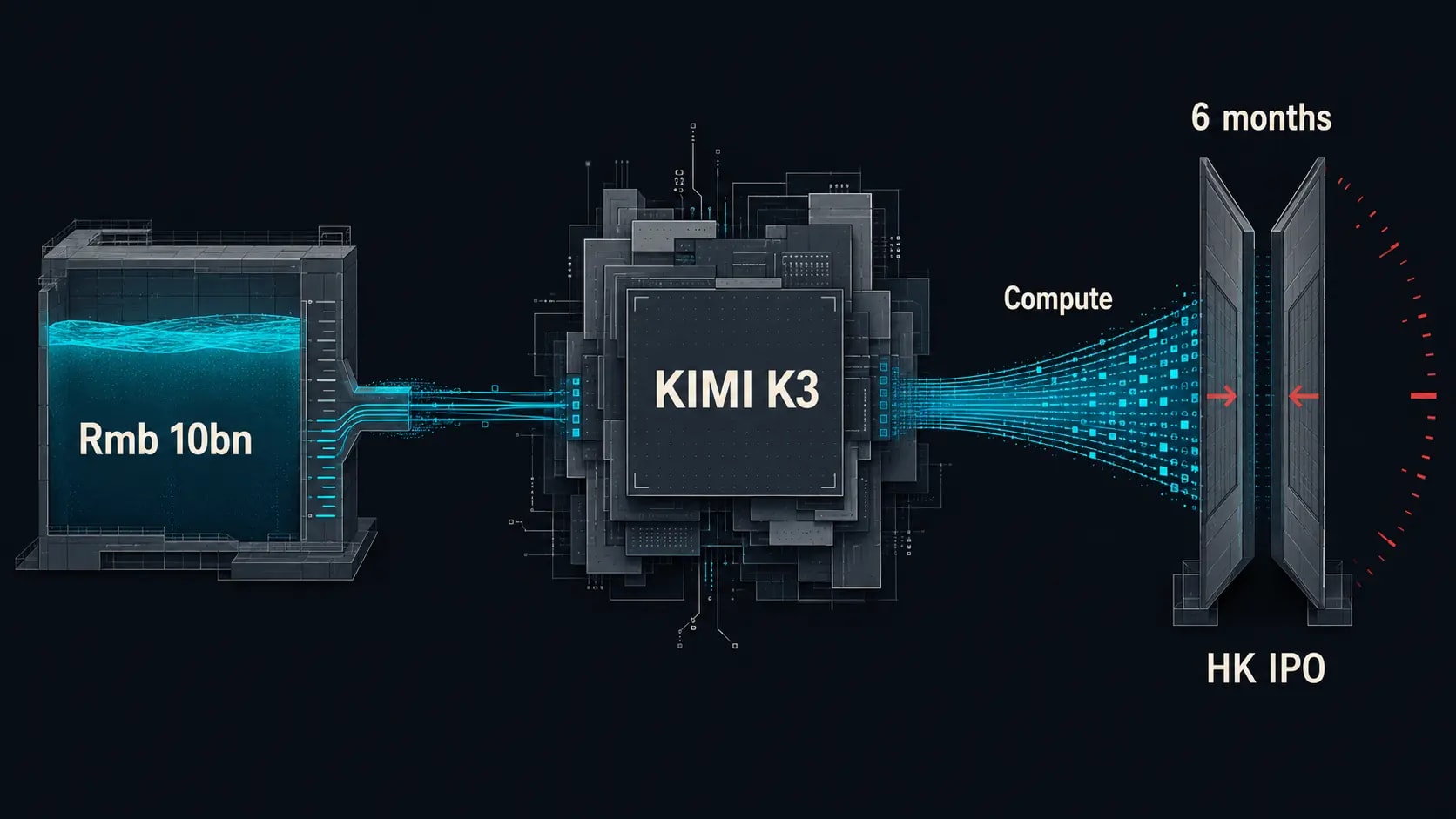
In December 2025, Moonshot AI (月之暗面), the Beijing startup behind the Kimi chatbot, held an unusual cushion. As I reported in January, a $500m round had lifted reserves past Rmb 10bn, about $1.4bn at the time, more than Zhipu and MiniMax held combined before their Hong Kong listings. Founder Yang Zhilin said so in an internal memo, adding the line that traveled: the company was not in a rush to go public. The money had bought the right to say no.
Seven months later, Moonshot has circulated a shareholder resolution seeking approval for a Hong Kong listing that could come within six months, and plans to open a final pre-IPO round in August at a pre-money valuation of up to $50bn, Bloomberg reported.
Bloomberg also reported that Moonshot had been preparing to list before Kimi K3 launched, and that it judged the moment right once annual recurring revenue reached $300m in June. The launch did not create the decision. What it appears to have done is reprice the option December’s cash had bought, from both directions at once: demand exposed what a frontier model costs to serve, while the reception supported a higher valuation ask. At the frontier, a win arrives as a bill.
Forty-Eight Hours to the Ceiling
Moonshot released K3 in mid-July, on the eve of Shanghai’s World Artificial Intelligence Conference, China’s flagship state-backed AI summit. At 2.8tn parameters with a 1m-token context window, it is the largest model any lab has committed to releasing as open weights. The full weights are scheduled for release by July 27. Until then public users cannot self-host it, so access runs through Moonshot’s China-based servers. It took first place on a public front-end coding arena and third on a composite intelligence index, behind two Western closed models. Elon Musk called it “impressive.” Moonshot’s own blog was more restrained, putting overall performance behind Anthropic’s Claude Fable 5 and OpenAI’s GPT-5.6 Sol.
Three days after launch, Moonshot paused new consumer subscriptions. Demand over the preceding 48 hours had pushed close to the limits of available capacity, it said on X, and compute would go to existing members. Moonshot said it would split membership into two plans, one for the Kimi app and agent product, one for coding workflows, to match compute more precisely.
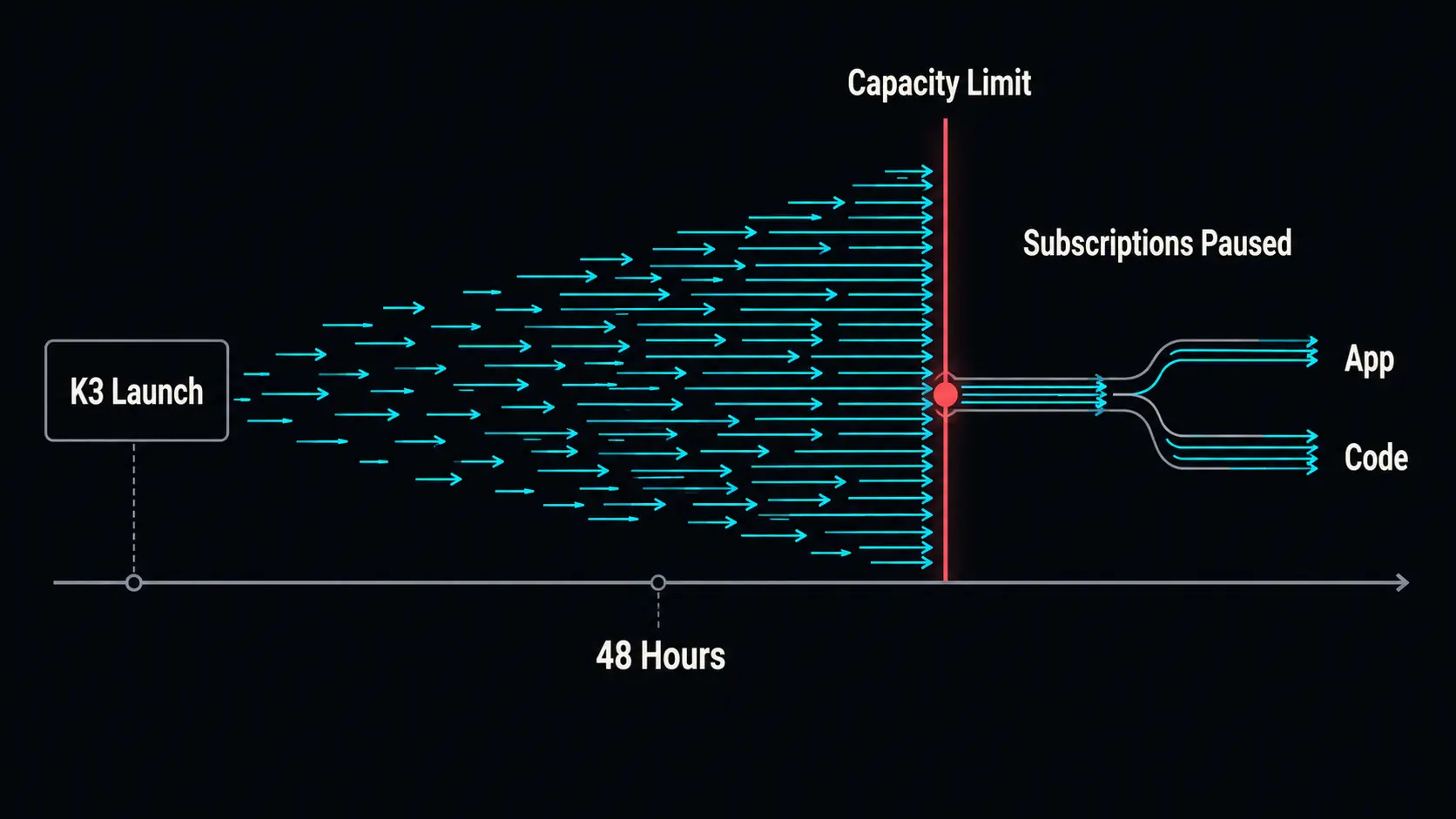
A demand surge is usually a problem worth having. Queue the users, bank the revenue, add servers. Moonshot did the opposite, and an executive later put the trade plainly: the company would rather forgo new revenue than degrade the experience of customers already paying. That trade is rational under two conditions. Either the marginal consumer user loses money, or capacity cannot be added on any timescale that matters. The ceiling is documented. The loss-making consumer user is not; that rests on practitioner estimates rather than disclosed unit economics.
The constraint is also the one claim ten days of English-language coverage did not fight over. Participants disputed whether K3 closed the gap with American labs and whether its weights were distilled from a Western model. On compute they converged. The company conceded the ceiling, and OpenAI’s Greg Brockman, pushing back on the idea that open weights make models free, noted that they still run on expensive hardware.
The ceiling is not a Chinese artifact. OpenAI has shelved product work over capacity and Anthropic has rationed tokens at peak. What differs is how quickly the constraint became binding. Moonshot came close to its capacity limit within days of the launch, with access to high-end imported hardware restricted and domestic accelerators still short on software support.
Companies normally get pushed toward public markets when the cash runs low. Moonshot’s had not. The question is why a company with that much cash now sees value in moving fast, and it starts with what a frontier launch costs to serve.