

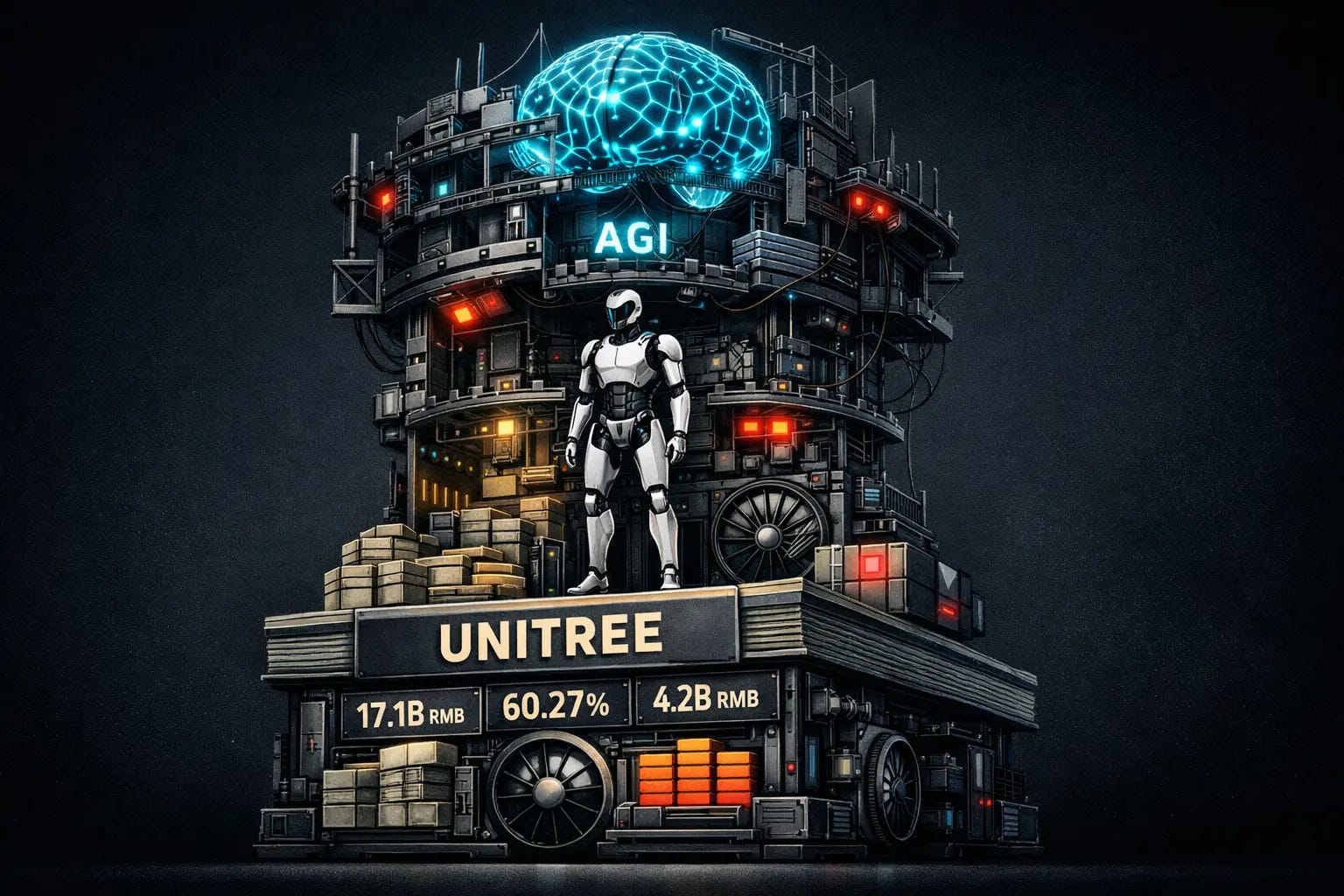
On March 20, Unitree Robotics submitted a 363-page prospectus to the Shanghai Stock Exchange ,formally applying to list on China’s STAR board and raise RMB 4.2 billion ($610 million). For an industry built on demo reels, funding announcements, and Spring Festival Gala performances, this document represents something rare: audited financial disclosure with legal consequences for inaccuracy.
The headline numbers will dominate coverage. Revenue of RMB 1.71 billion in 2025, up 335% year over year. Adjusted net profit of RMB 600 million, implying margins around 35%. Positive operating cash flow of RMB 672 million. Gross margins reaching 59.45% in the first nine months of 2025 and 60.27% for the full year on a reviewed basis, figures closer to Kweichow Moutai than to any hardware manufacturer. Global number one position in humanoid robot shipments, with over 5,500 units delivered in 2025.
These figures describe the strongest publicly disclosed commercial record in humanoid robotics to date. They also describe a company whose founder closes his investor letter with the words: “Let us together achieve humanity’s ultimate dream: AGI!”
Between those two realities sits the central tension of this IPO. Unitree has built a genuinely profitable business. The question buried in the fine print is what that business actually consists of, and whether a post-listing valuation in the neighborhood of $5.8 billion (implied by the targeted raise and minimum issuance ratio) prices in a company that exists today or one that may never arrive.
The Numbers That Matter
Unitree’s financial trajectory is extraordinary by any measure.
Revenue grew from RMB 121 million in 2022 to RMB 1.71 billion in 2025. The company turned profitable in 2024, with net income of RMB 94.5 million, then expanded that to RMB 288 million in 2025 on a GAAP basis. The difference between GAAP net income and the RMB 600 million adjusted figure stems from a one-time share-based compensation charge of RMB 349 million tied to an employee equity incentive program. The charge involves no cash outflow.
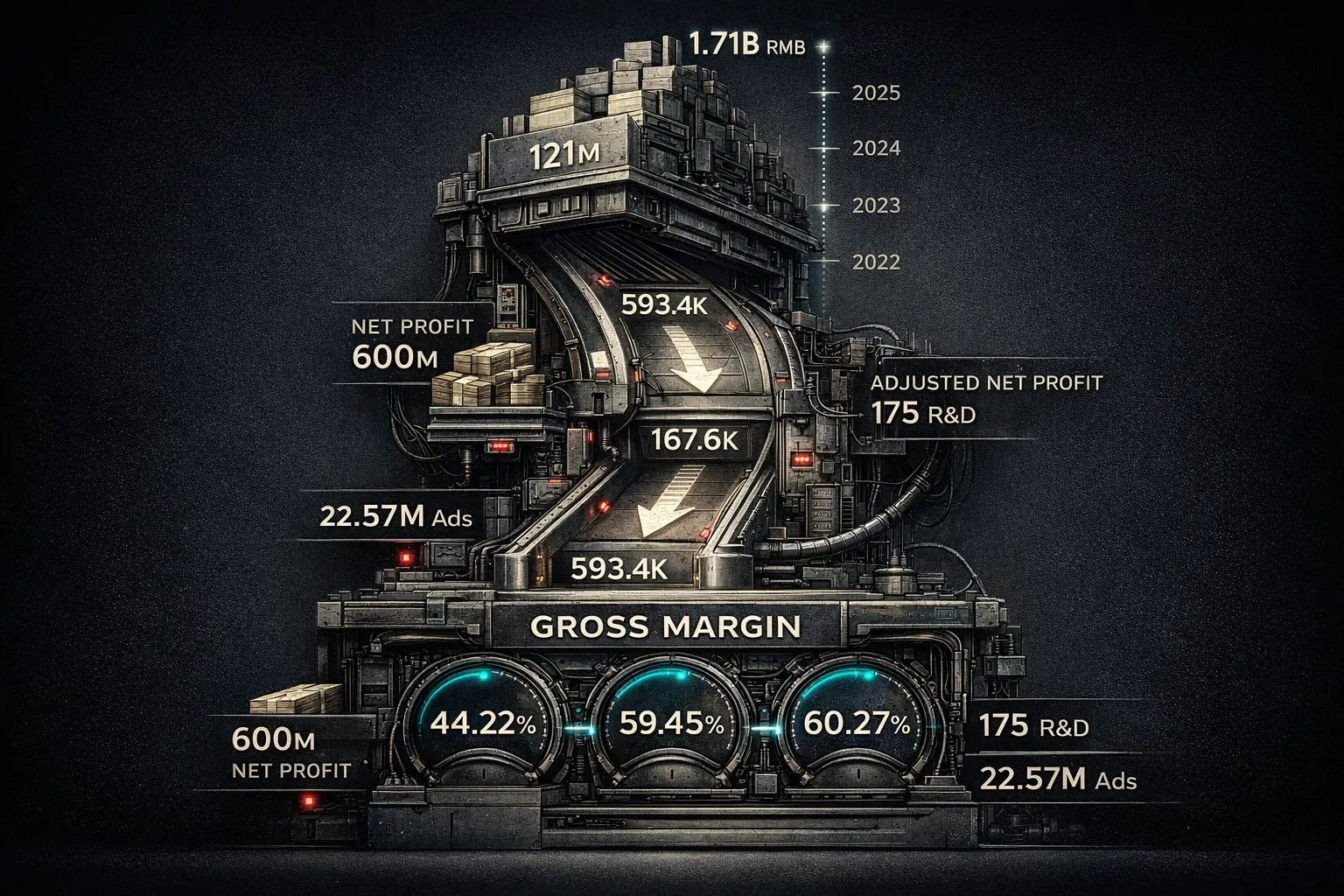
The margin profile is striking. Main business gross margins climbed from 44.22% in 2023 to 59.45% in the first nine months of 2025, reaching 60.27% for the full year on a reviewed basis. This improvement occurred while average selling prices were falling sharply. Humanoid robot ASP declined from RMB 593,400 in 2023 to RMB 167,600 in the first three quarters of 2025, a 71.7% drop. Quadruped robot ASP fell 29% over the same window.
Margins rising while prices fall is the signature of a company whose costs decline faster than its revenue per unit. Unitree attributes this to full-stack vertical integration: self-designed motors, reducers, mechanical structures, and control systems. As production scales, procurement leverage compounds the advantage.
The company accomplished this with a remarkably small team. As of September 2025, the filing shows 175 R&D staff, or 36.46% of total headcount. R&D expenditure for the first nine months of 2025 totaled RMB 90.2 million, representing 7.73% of revenue. Marketing spend was even leaner: RMB 75.6 million in sales expenses, of which only RMB 22.57 million went to advertising.
For readers who have followed my coverage of the Chinese humanoid robot sector over the past year, these figures create an immediate puzzle. I have documented an industry where companies spend millions on television placement while their products operate at a fraction of human efficiency, where municipal governments deploy billions in fund capital seeking IPO exits rather than industrial breakthroughs, and where the gap between marketing spectacle and commercial reality grows wider each quarter. Unitree’s prospectus forces a confrontation with that thesis. Here is a company that appears to have solved the profitability problem in an industry I have argued cannot yet support profitable businesses.
The resolution lies in the details.