

Editor’s Note: This article extends Hello China Tech’s coverage of CATL’s strategic expansion. In April, I examined how CATL’s profit growth far outpaced its cash generation as global commitments accelerated. In June, I analyzed the unusual structure of DeepSeek’s $7.4 billion first round, which reportedly included a $740m CATL commitment. Today: what connects CATL’s recent data center investments to the playbook that made it dominant in batteries, and where that logic meets a different class of competition.
In April, CATL, the Chinese battery group that holds roughly 39% of the global EV battery market, agreed to invest Rmb 4.1bn for a 49% stake in the controlling shareholder of Zhongheng Electric, a Shenzhen-listed supplier and one of China’s leading providers of high-voltage direct current power systems for data centers. Zhongheng’s equipment is deployed in data center projects for Alibaba, Tencent, Baidu, and ByteDance.
In May, a CATL-affiliated fund agreed to pay up to $942m for as much as 38.1% of VNET Group, China’s first US-listed internet data center operator. The deal, expected to close in Q4 2026, would make the fund VNET’s largest shareholder, though the buyer has agreed, for a specified period, to vote according to founder Chen Sheng’s instructions. VNET runs more than 50 facilities across 30 cities with 889 megawatts of wholesale capacity.
In June, reports put CATL’s commitment to DeepSeek’s first external fundraise at around $740m, or roughly Rmb 5bn. Reuters said the round raised more than Rmb 50bn(roughly $7bn) at a valuation exceeding $50bn. CATL has not publicly confirmed the investment.
The Zhongheng and VNET deals represent Rmb 10.5bn in announced commitments, with the DeepSeek stake potentially pushing total exposure past Rmb 15bn. Each investment targets a different layer of the AI data center energy chain. The structure matters as much as the sum: CATL is buying positions along the chain without taking full operating control of any single link.
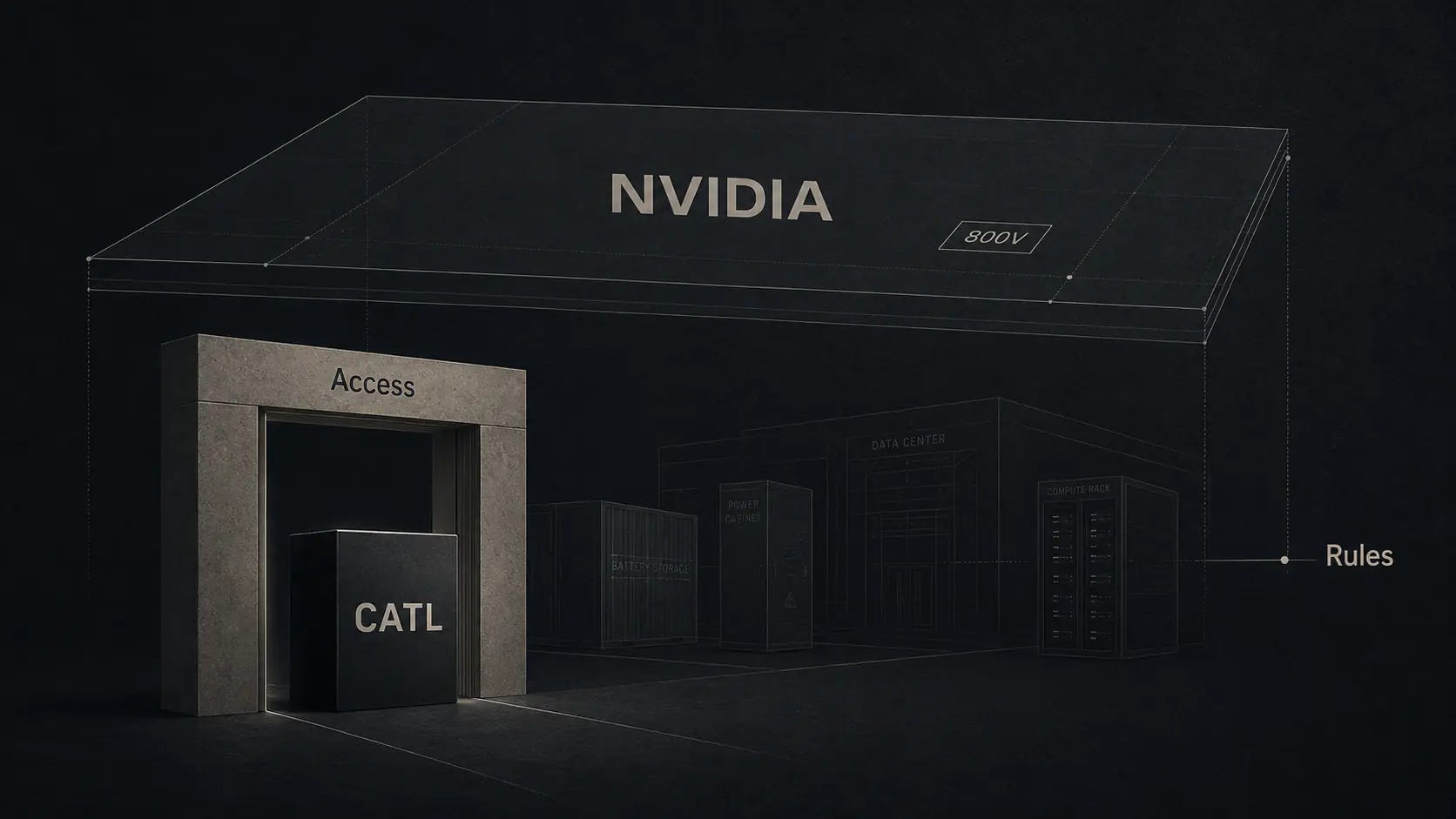
The sequence suggests deliberate strategy rather than opportunistic diversification. CATL is assembling a vertical chain along the energy infrastructure feeding AI compute. Its own battery storage sits upstream. Zhongheng’s power conversion and distribution hardware occupies the midstream. VNET’s data centers provide the downstream channel. DeepSeek, which has begun recruiting for data center operations in Inner Mongolia, anchors demand at the end. English-language coverage has largely treated these as separate transactions. The vertical pattern becomes visible only when the deals are read together.
The pattern resembles the playbook CATL used to dominate lithium batteries: secure critical links in the value chain, route products through captive channels, and keep a larger share of the chain’s margin. Robin Zeng, CATL’s founder and chairman, telegraphed the intent in a November 2024 interview with Reuters. He said CATL planned to develop standalone energy systems for data centers and cities, and estimated the opportunity at “ten times” the size of EV battery supply. In June 2026, CATL told Reuters it expects energy storage to account for half of global sales by 2030, up from roughly a quarter today.
The strategic intent is clear: CATL wants to become the energy infrastructure layer beneath AI compute. Whether the playbook translates is the harder question. In batteries, CATL faced fragmented customers on one side and weaker cell suppliers on the other. In data centers, the power architecture is being redefined by Nvidia. The equipment incumbents include Delta Electronics and Vertiv, companies with global scale and deep certification moats. And CATL’s largest potential customers are spending tens of billions building their own facilities. CATL proved it can capture a value chain. The question is whether this value chain can be captured the same way.
For subscribers: how CATL captured the battery value chain, why data centers look structurally similar, and why Nvidia, Delta, Vertiv, and the hyperscalers make this version harder to control.
