


Editor’s Note: “Galaxy General and the Chip Bag Test” examined the brain-first bet at street level; “Unitree Files for $610M IPO” read the sector’s first audited disclosure. This asks what the asset underneath is worth.
Three prices for the same hour
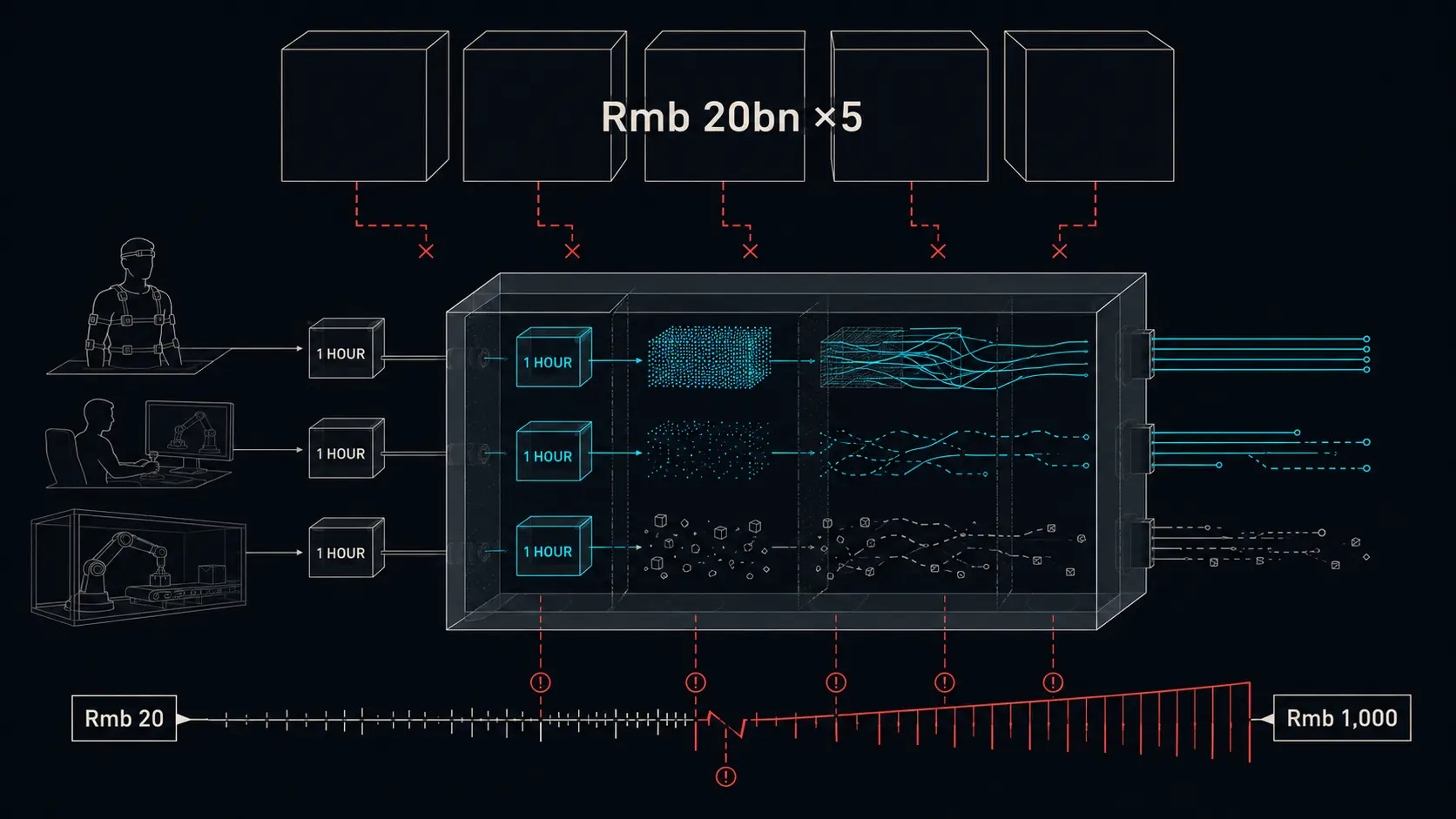
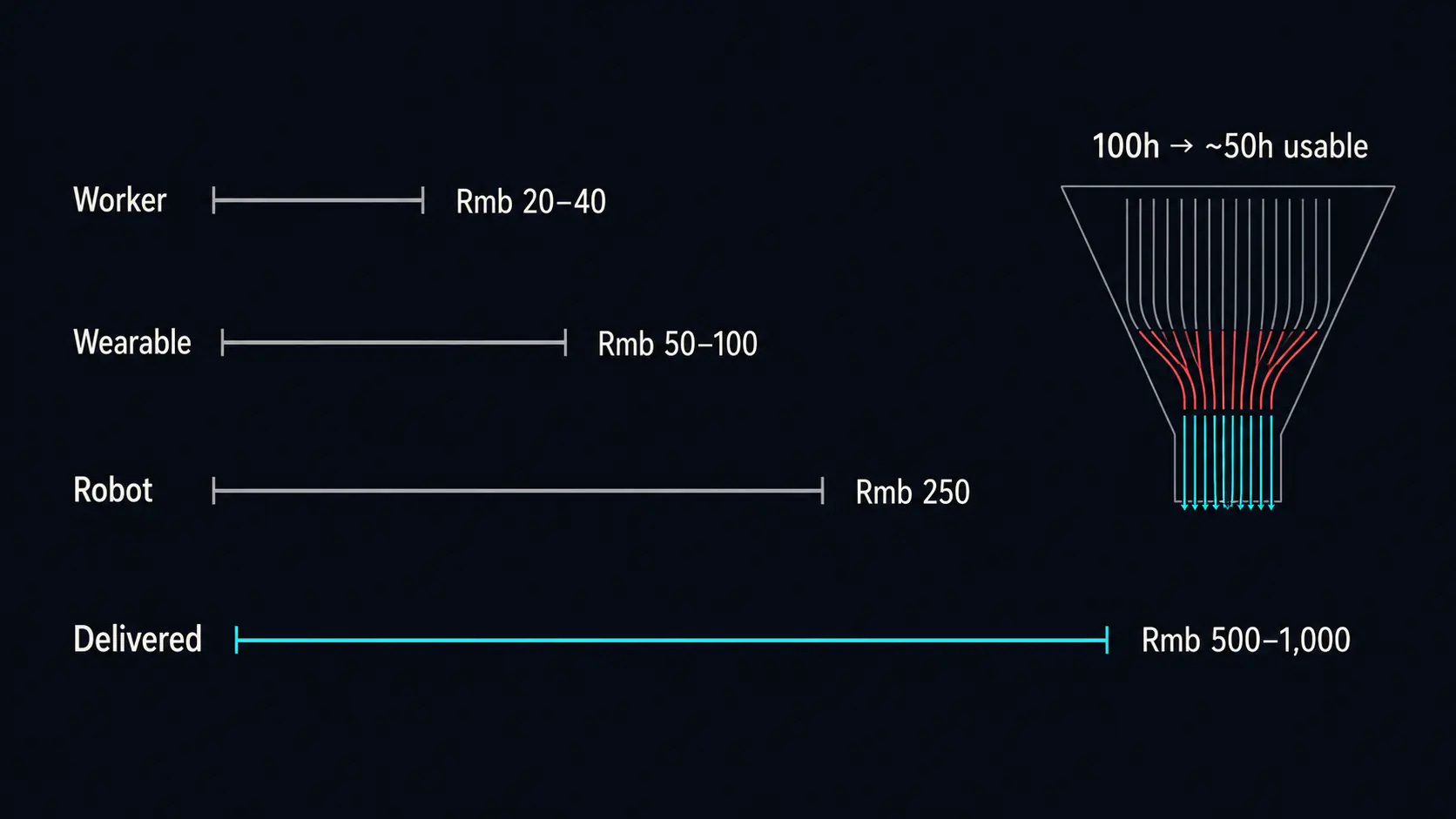
In a Chinese robot data-collection facility, an operator in teleoperation gloves earns Rmb 20 to 40 an hour. Outsourced through a labor agency, the same hour bills the client Rmb 25: Rmb 20 to the worker, Rmb 5 to the agency.
Move one layer up and the same hour costs more. Gao Jiyang, chief executive of Galaxea (星海图, a separate company from Galaxy General), put his firm’s internal production cost at Rmb 50 to 100 an hour for wearable capture and around Rmb 250 with a robot in the loop. He gave a blended figure of Rmb 100 to 150, and in the same interview put 1m hours at Rmb 100m to 200m, wider than the hourly numbers imply.
At the service layer, the hour becomes a product. Government-backed training grounds, which host robot fleets and sell the data collected, quote Rmb 500 to 1,000 an hour. Mifeng (觅蜂科技), the AgiBot-backed data platform, quotes Rmb 200 to 400 without a robot and Rmb 500 to 1,000 with one. These are list prices, not evidence of a liquid market; many such facilities report weak utilization and uncertain profitability. Much of the raw material may not survive intake: 100 hours of collection can yield around 50 usable.
Three prices, one label. They are not three stages of a supply chain that reconcile at the end. The gap between wage and invoice is where the risk sits: the seller absorbs the robot’s depreciation, the rent, the trajectories that fail acceptance, the labor of cleaning what survives, then adds a margin. That makes the multiple defensible as a business and useless as a measurement. An hour of teleoperation in a training ground and an hour of wearable capture in a warehouse book identically and train differently.
That matters because of what is priced on top of it. A July Chinese media tally counted eight Chinese embodied-AI companies at or above Rmb 20bn (roughly $2.9bn) as of June 2026, though AgiBot’s place rests on an inferred figure, not a disclosed round. Several of the five priced primarily on models rather than shipments remain at the hundred-unit level. Humanoid robotics absorbed $6.95bn in the second quarter, more than double the previous one. Only two of the five have published a data figure in a unit comparable across companies, and none of the claims has been independently audited.
What replaces shipments as the valuation metric
Unitree (宇树) and AgiBot (智元) can point to shipments. Even there the units differ. A third-party estimate put AgiBot’s 2025 shipments at 5,168 general-purpose humanoids, including wheeled dual-arm machines, while Unitree’s prospectus disclosed 5,500 bipedal ones. Each was called the global leader under a different definition. The model-first five, priced on models rather than shipments, are Galaxy General (银河通用), Galaxea, Spirit AI (千寻智能), X Square Robot (自变量机器人) and AI² Robotics (智平方). They have pilots and deployments, nothing on a comparable scale. Galaxy General, the most aggressive proponent of synthetic data among them and the best funded, was shipping fewer than 150 robots a year as of June 2026 against a valuation above Rmb 20bn. An accumulated data stock is one of the few assets such a company can show before revenue becomes large enough to anchor the valuation.
So it gets shown. The problem is that the five count in ways that do not convert into one another.
Every number above is public, scattered across interviews, recruitment ads, dataset pages and one company paper. Assembled, they point somewhere other than where the valuations point. What follows works through what the five claims actually count, the evidence behind the two most-quoted cost ratios, what the open-sourcing signals, and the three tests that could settle the argument.
If the idea that an asset class can be priced without a common unit of account is new to you, this is a preview of what Hello China Tech does three times a week: reading China’s AI, chip, robotics, and EV sectors from primary sources most English coverage never touches. Subscribe free to get every new analysis as it publishes.