


Every Sunday I pick the China tech stories that mattered that week, say what I make of each, and link back to where I first wrote about it. Subscribe free
This week’s China tech stories fell on three layers of the AI stack. DeepSeek reportedly plans to train its next model on Huawei chips. Monthly cards for a Chinese AI app went for Rmb 0.01 on a livestream, and a Beijing startup tested OpenAI’s model on robot tasks. I see the bottom of the stack moving toward homegrown chips, if the DeepSeek report holds, with the brain at the top still open to borrowing.
DeepSeek reportedly plans to pre-train V5 on Huawei chips.
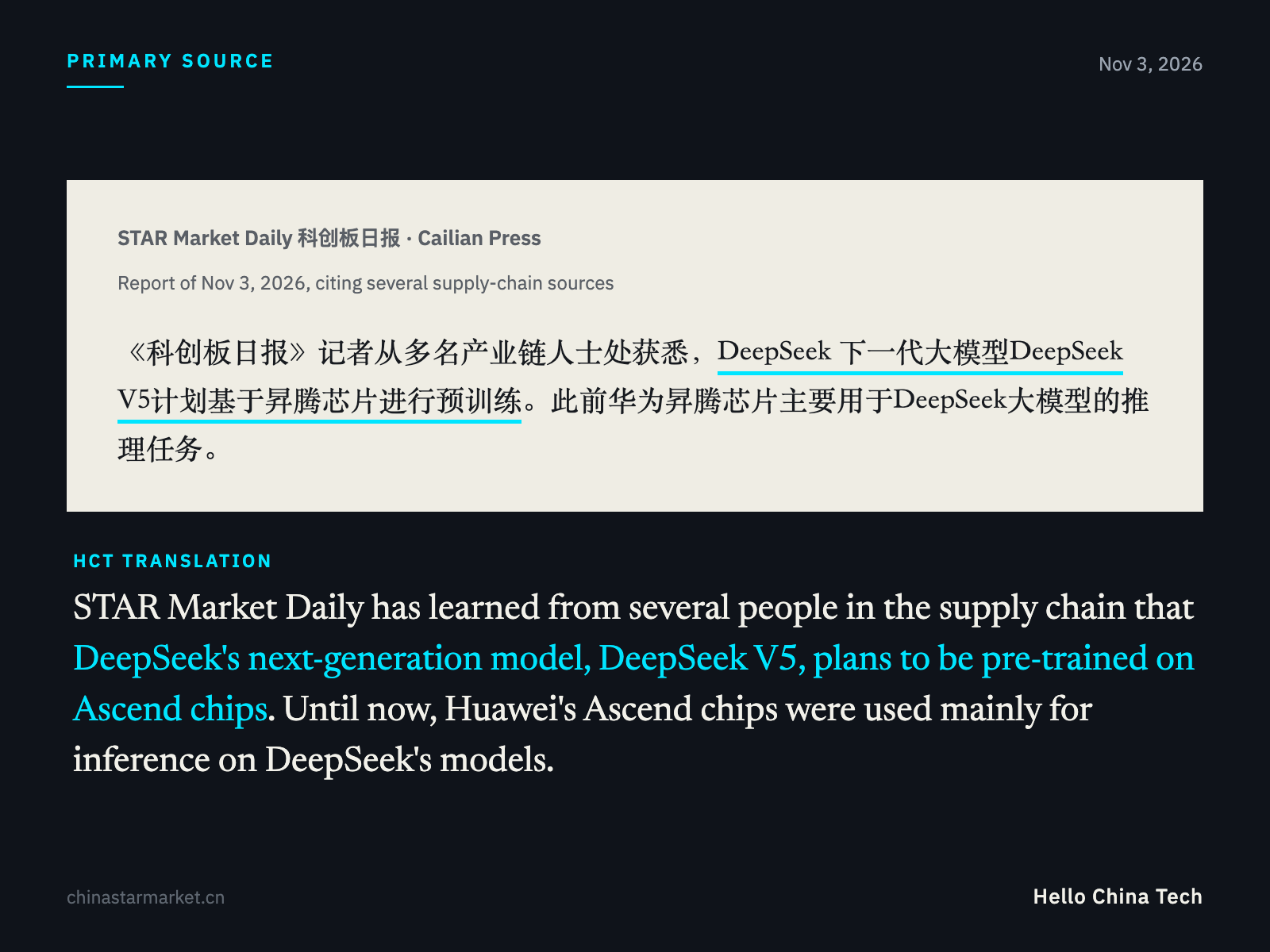
DeepSeek plans to pre-train its next model, V5, on Huawei’s Ascend chips, according to several people in the supply chain cited by STAR Market Daily, a Chinese financial outlet, on November 3. Its original article is no longer online, but Sina Finance carried the report. Until now, DeepSeek used Ascend chips mainly for inference, the report says. Bloomberg reported in early September that DeepSeek had so far relied on Nvidia accelerators for training.
The proof I would wait for is V5’s technical report. DeepSeek’s V4 technical report gives 32 to 33 trillion tokens of pre-training data. It does not specify the chips. In July I wrote that “crossing the training threshold and closing the training efficiency gap are different questions”: China’s AI Chips Enter the Training Stack.
China’s AI chipmakers, one quarter on.
Five mainland-listed AI chip designers filed third-quarter reports between October 20 and 29. In September I named the lines to check:
Cambricon’s bank acceptance bills rose to Rmb 5.0bn from Rmb 3.1bn in June, and inventory reached Rmb 11.7bn. By the test I set, suppliers are still carrying the build. No filing shows whether the bills can be paid when they fall due.
Hygon’s customer deposits did not come back. They fell to Rmb 12m. Hygon borrowed Rmb 2.3bn more from banks in the quarter.
The other three mainland filers no longer share one answer. Moore Threads added Rmb 0.8bn of long-term bank loans in the quarter. MetaX’s operating cash flow was close to zero in the quarter, at minus Rmb 41m. Enflame’s contract liabilities, cash customers paid before delivery, rose to Rmb 6.4bn from Rmb 0.3bn in January.
MetaX booked a Rmb 383m fair-value loss in the quarter. In the first half, fair-value gains on SJ Semiconductor shares had made it profitable.
By my count, two checks held and one split. The filings do not say whether MetaX’s loss came from SJ. The first-half picture is in Who Is Financing China’s AI Chip Inventory.
A Chinese livestream sold AI office cards at Rmb 0.01.
On November 2, a Taobao livestream hosted by Li Jiaqi, one of China’s best-known online sellers, listed monthly membership cards for QwenWork, Alibaba’s AI office app. Close to 100,000 cards sold in about half an hour. 21st Century Business Herald and China Newsweek put the token quota attached to them at about 2 trillion. The Rmb 28 card cost Rmb 0.01 in the livestream. China Newsweek, a Chinese magazine, put the actual sales at about Rmb 1,000.
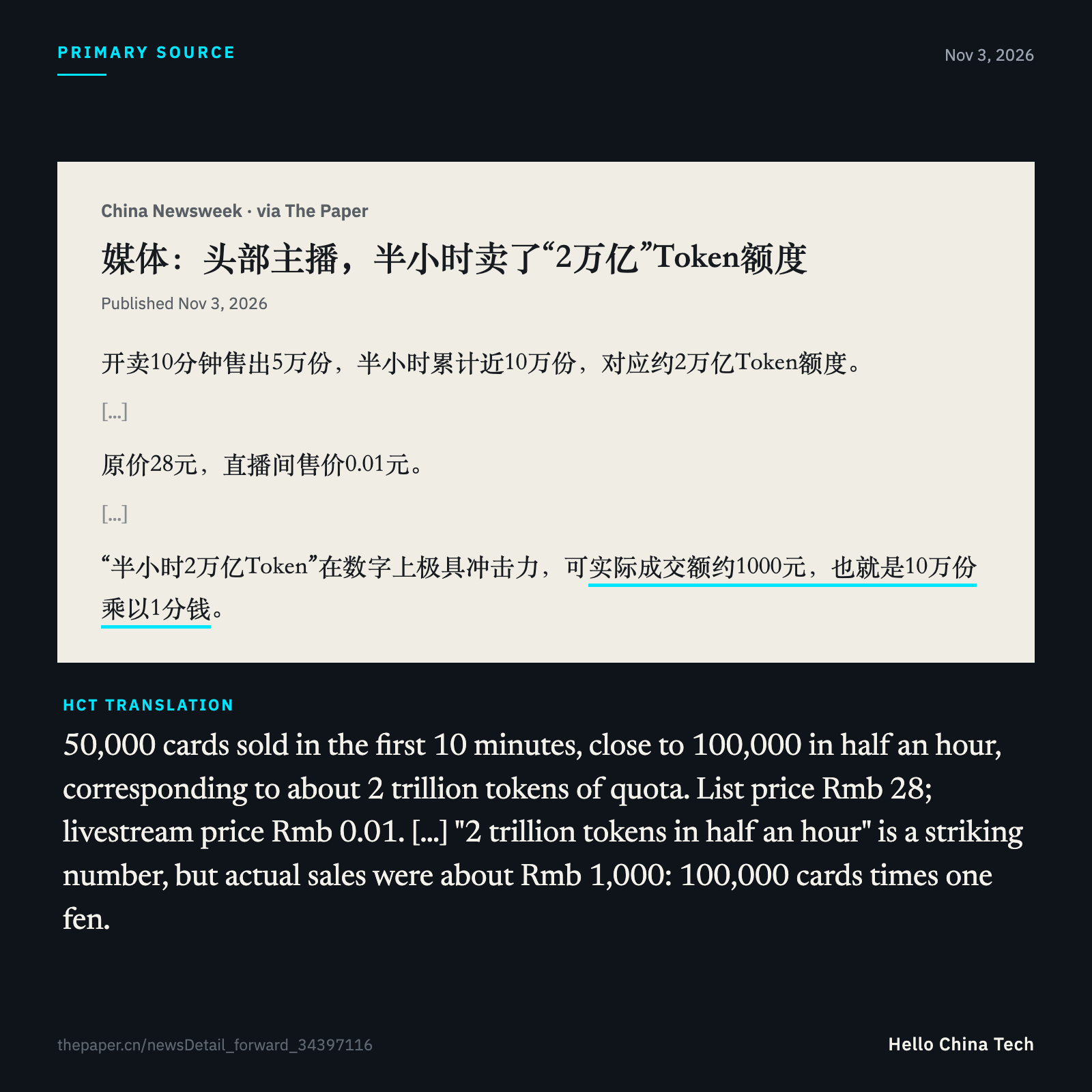
At Rmb 0.01 a card, I count it as close to free. The 2 trillion is quota, not use. My report published November 4 asks four questions of any Chinese token number. Its Executive Summary is free: China’s Token Economy.
OpenAI’s model, tested by a Chinese robot startup.
Galaxy General, a Beijing humanoid startup, tested OpenAI’s GPT-6 Astra, Dingjiao One reports in a piece carried by 36Kr, a Chinese tech site, on November 5. On selected RoboDojo tasks, Astra controlling the robot directly succeeded 26% of the time, against 15.67% for π0.5, a robot model from Physical Intelligence. With Astra making decisions and π0.5 executing, the rate rose to 48%. The piece names downstream robot makers as the clearest gainers. I read it the other way. If every robot maker can plug in the same brain, the brain gives none of them an edge. My October piece looked at JPMorgan’s Unitree upgrade, on a timeline built on OpenAI’s model.
Six AgiBot robots worked in a Shanghai store for 24 hours.
Six G2 robots from AgiBot, a Shanghai humanoid robot maker, worked in a Shanghai convenience store for 24 hours, on a livestream from November 2 to November 3. AgiBot’s final count was 1,730 completed tasks, including 683 customer receptions and 147 coffees, Jiemian reported. AgiBot said it would track metrics including task success rate, first-attempt success rate and how often humans took over, among eight it listed.
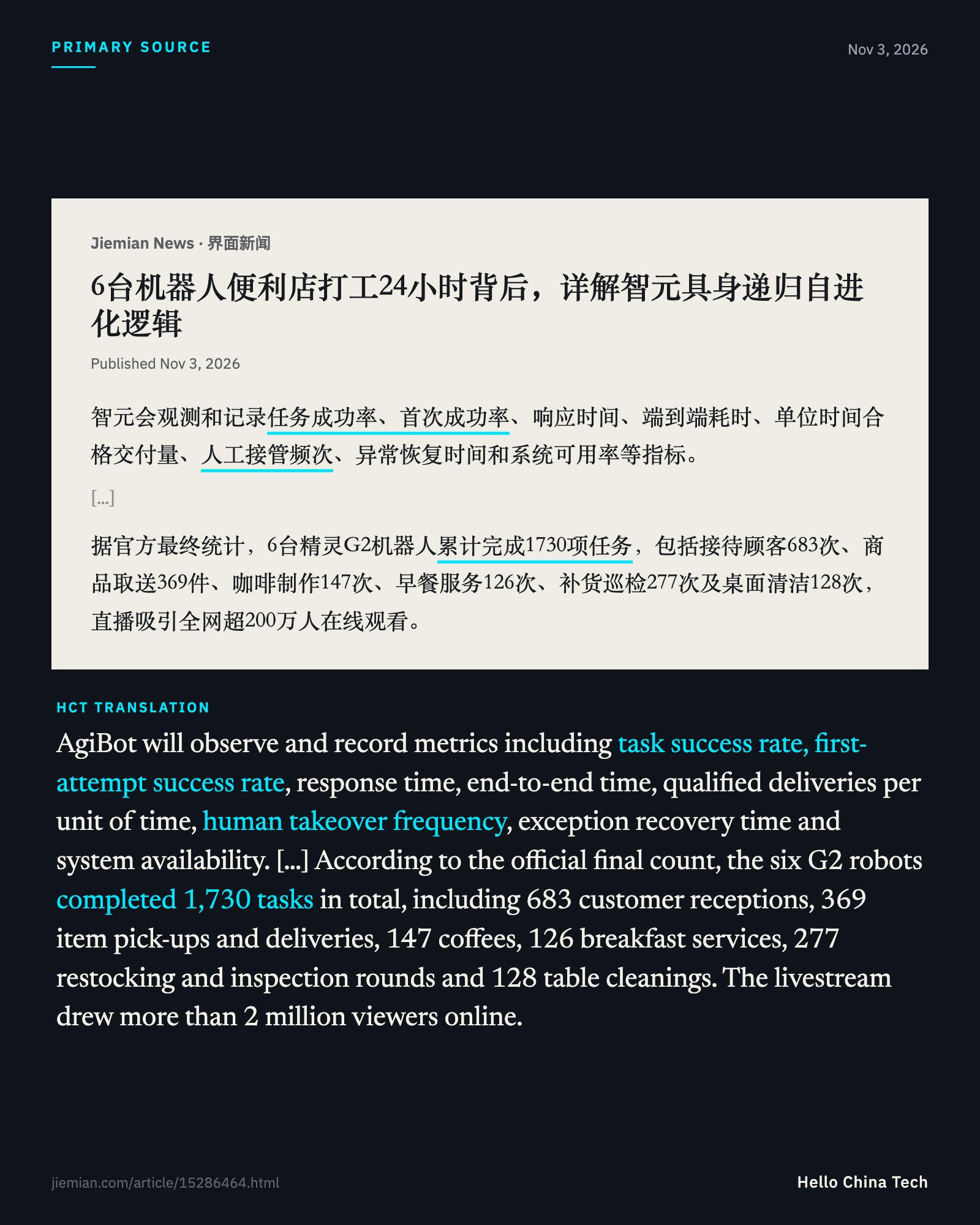
The final figures in the reports I read, from Jiemian, Securities Times and Time Weekly, are counts. None gives a success rate or a takeover count. For a buyer, I would want those more than the total. In August I wrote about counting robot data: The Robot Data Moat Has No Common Denominator.
ALSO THIS WEEK
Tencent’s WorkBuddy and the Second Contract: a Rmb 23,760 procurement notice and Tencent’s route to Chinese enterprise buyers.
China’s AI Job Rules Guard the Exit: China has put a price on AI dismissals, and hiring studies in China and the US show weaker demand for junior workers.
The Hanxin Fraud, free to read: how a swapped chip fooled China’s experts in 2003.
The South China Morning Post quoted me on November 3 on first-half 2026 margins at Zhipu (Z.ai) and MiniMax, two Hong Kong-listed AI labs: “Low prices can win usage, but at today’s margins they cannot fund research. For now, the capital market pays for the gap.”
Next week I publish my analysis of world models in China. On November 3, Baidu’s self-driving chief architect said a world model has to become “an examiner” that checks whether a driverless car is safe. I look at who sets the pass mark for robotaxis and humanoid robots.
Paid readers get about 250 analyses so far, and my reports at $49 instead of $99.
$150/year, or $20/month.
Poe