


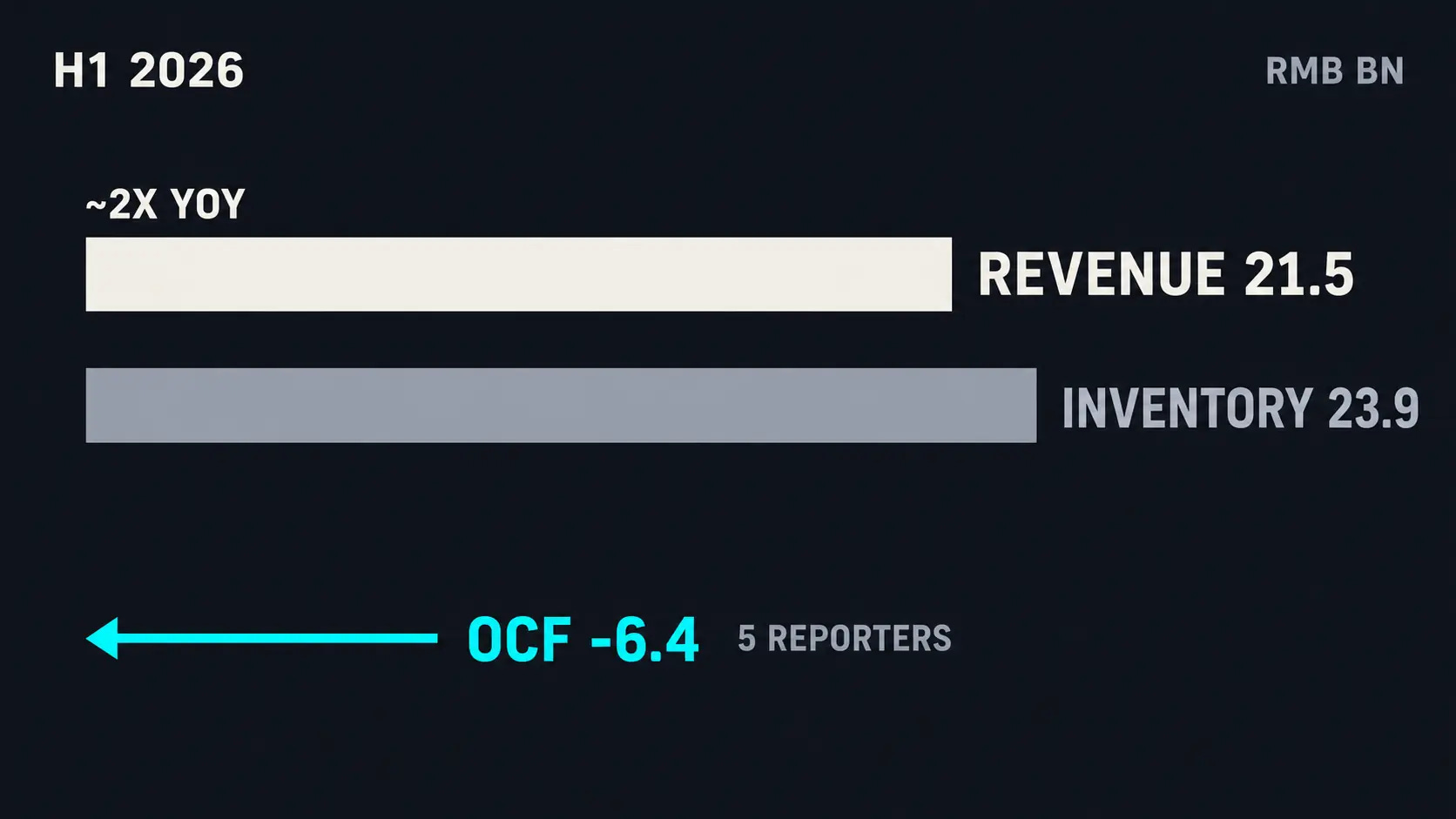
By early September, the seven listed or listing AI compute chip designers tracked here had reported, or in Enflame’s case forecast, their first-half 2026 numbers. Combined revenue reached about Rmb 21.5bn, close to double a year earlier. Only two earned a profit from their core business. One is Hygon, a Shanghai-listed CPU and accelerator maker. The other is Cambricon, the AI chip designer whose market value passed Rmb 1tn last year. Two more, MetaX and Iluvatar CoreX, GPU designers that listed within the past year, reported profits that came almost entirely from paper gains on shares in another company. Core profit here means profit excluding non-recurring items for the mainland-listed companies, and reported profit less fair-value gains for the Hong Kong pair. The two measures agree in direction, not in detail.
The balance sheet points the other way. The six companies that disclose inventory held Rmb 23.9bn of it at the end of June, about $3.5bn at today’s rate. That is more than the seven companies’ combined revenue for the half. Inventory has to be financed before it becomes revenue. The income statement does not say by whom.
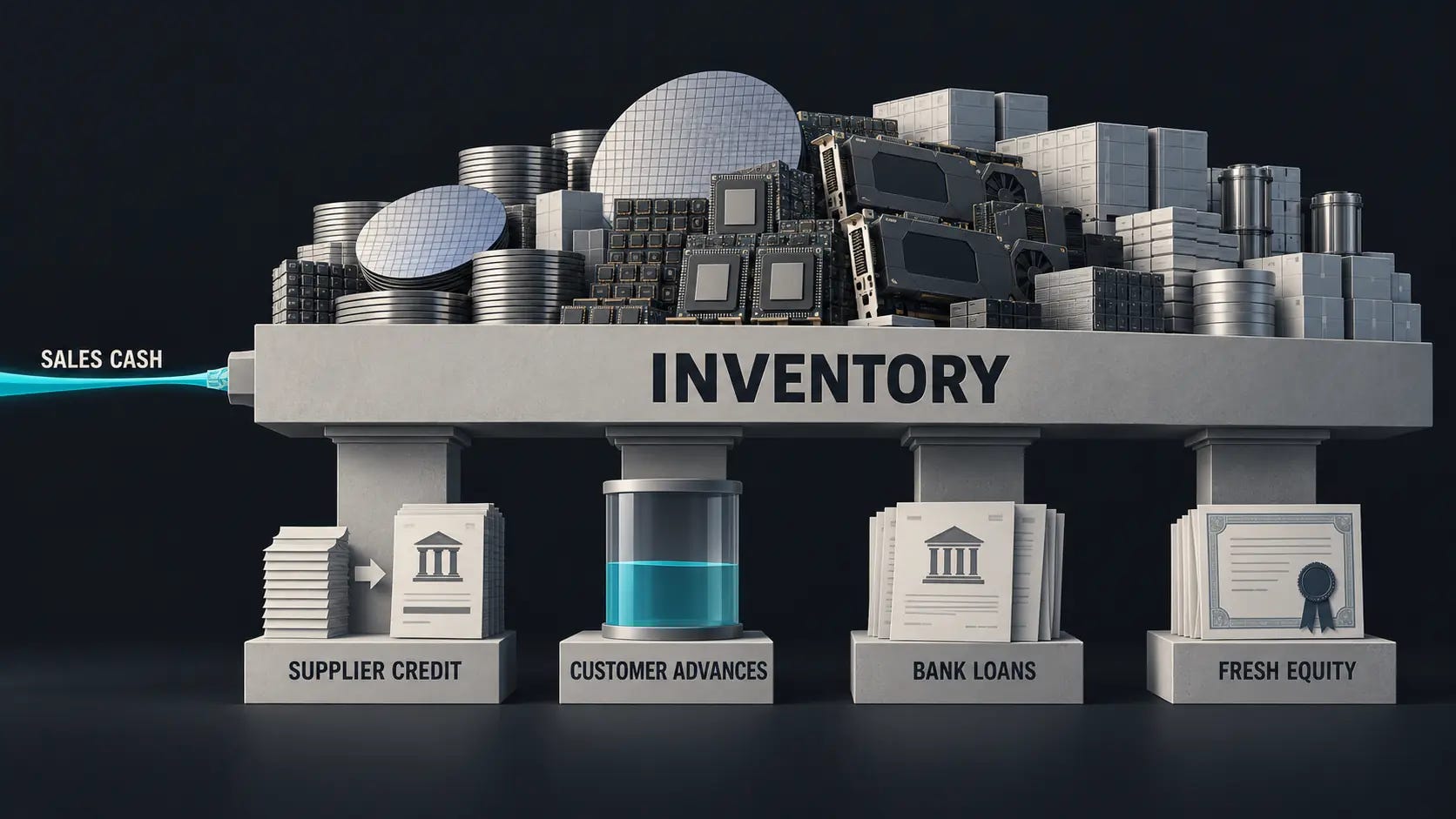
The five companies that publish operating cash flow burned a combined Rmb 6.4bn in the half. Only Cambricon reported a positive figure. The obvious reading is that Cambricon has reached self-funding and the rest have not. The filings support a narrower reading. None of the filings shows sales cash covering the inventory build. The filings point instead to four sources: supplier credit backed by banks, customer advances paid last year, bank loans, and fresh equity. Which source carries the load is the line to check first when the next disclosures arrive.
This piece extends “The Perpetual Raise,” which asked whether China’s AI chip companies could turn fresh capital into operating cash. If that is a useful lens, subscribe free and get every new analysis as it publishes.
Why the money sits upstream
Cambricon’s inventory note is the clearest map of where a fabless company’s cash goes. Foundry wafers, memory, substrates and packaging are paid for months before a finished card ships, and in a tight market the payment moves earlier still. Of Rmb 9.0bn in gross inventory, Rmb 5.7bn was raw materials and Rmb 2.5bn was materials held by contract manufacturers. Finished goods and goods shipped but not yet accepted came to Rmb 0.7bn, about 8% of the total. The money is locked in wafers and work in progress, not in products waiting for a customer to sign off. Cambricon’s advances to suppliers rose from Rmb 0.7bn to Rmb 2.9bn in six months, and two suppliers received 89% of them. The filing does not name them.
Paying ahead is common across the industry. Nvidia’s latest filing lists $279bn of supply commitments. The difference is scale relative to sales. Using average inventory and annualised cost of sales, Cambricon carries roughly 445 days of inventory and Moore Threads about 590, against roughly 108 at Nvidia. The Chinese figures mix chips with cluster projects, but the order of magnitude holds. The other difference is direction. Nvidia’s operating cash flow fell to 40% of net income in the quarter to late July after it extended payment terms of up to a year to large customers. Nvidia is financing its customers. China’s chip designers are relying on suppliers, banks and equity investors while they finance their own inventory.
Someone has to fund that gap, and the group found more than one answer. Among the five companies that disclose operating cash flow, the one positive figure is also the one most visibly built on somebody else’s money.
What follows traces where each company’s inventory money came from and which balance-sheet line moved to cover it. Each line has its own next disclosure date.