

Origins, No. 2: the history behind today’s China tech headlines.
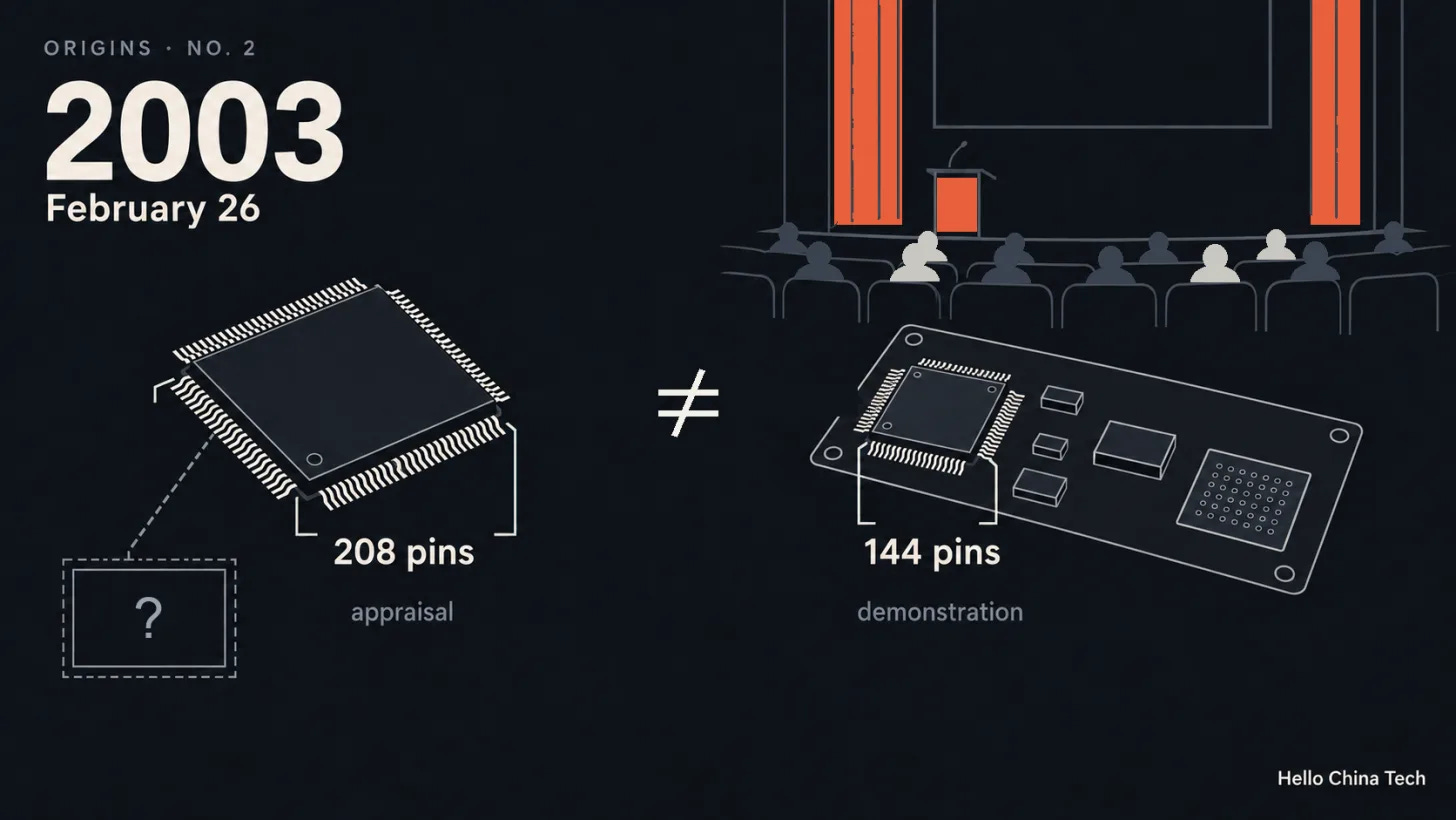
On the afternoon of February 26, 2003, officials gathered in the small auditorium of the Jinjiang Hotel in Shanghai. In 1972, China and the United States had issued the Shanghai Communiqué in the same hall. The officials came from Shanghai’s government and from several national ministries. They had come to see a chip.
The chip sat in a demonstration system built to play MP3 audio. Chen Jin, head of Shanghai Jiao Tong University’s chip and system research centre, introduced it as Hanxin No. 1. Hanxin means, roughly, “Chinese chip.” He described the chip at length. According to a Chinese business newspaper, he held a master’s and a doctorate in computer engineering from the University of Texas at Austin. The paper added that he and two colleagues had spent more than ten years on digital signal processors, or DSPs, at Motorola in the United States. A DSP handles sound, images and wireless signals inside consumer electronics. China was spending close to Rmb 10bn a year on imported DSPs, Chen said. Hanxin would replace them. Within the year, he promised, Chinese-made electronics would carry Hanxin chips.
Zhang Rujing, known in English as Richard Chang, also spoke to reporters. He was president of SMIC, the Shanghai foundry that had made the chip and later became China’s largest contract chipmaker. “Now SMIC is helping Jiao Tong make its chips,” he said. “In future, Jiao Tong will help SMIC by giving us orders.” A press release for the launch said Hanxin chips had already won orders for more than a million units.
That morning, a panel of experts had appraised the chip. Xinhua, the state news agency, reported that the Shanghai Science and Technology Commission conducted the appraisal. The university’s microelectronics school website, as quoted by the same business newspaper in 2006, said the panel was led by Wang Yangyuan, a member of the Chinese Academy of Sciences. According to the same website, the panel members agreed. Xinhua reported the conclusion: Hanxin No. 1 and its design and application platform were “the first of their kind in China” and had “reached an advanced international level” (国内首创,达到了国际先进水平).
According to the launch materials, the Jiao Tong team designed the chip and SMIC made it on a 0.18-micron process. A Shanghai firm, Weiyu, packaged it. The Shanghai Integrated Circuit Design Research Centre tested it. A deputy director of the city’s science commission called it “completely made in China.” Now, he said, there was a precedent for joining up the industry chain.
If checking a Chinese chip claim against the chip that actually ships is new to you, this is a preview of what Hello China Tech does every week: reading China's AI, chip, robotics, and EV sectors from primary sources most English coverage never touches. Subscribe free to get every new analysis as it publishes.
Chen’s titles by 2005
By late 2005, Chen held several posts and titles. He was dean of the university’s School of Microelectronics. The Ministry of Education had named him a Changjiang Scholar, a title it gives to leading professors. He was general manager of a company, Hanxin Technology. He also led projects funded by central ministries.
More chips had followed. The company said Hanxin No. 2 and No. 3 had reached the level of high-end international DSP design. In project papers sent to government ministries, Hanxin No. 4 was described as a dual-core chip.
The January 2006 accusation
In December 2005, Shanghai Jiao Tong University received a complaint about Chen and others. The university made a first inquiry. Then, as it later said, it asked national authorities to investigate.
On January 17, 2006, according to a local newspaper, an anonymous whistleblower posted a long accusation online. The version that survives is titled “The shocking inside story of Hanxin” (触目惊心的汉芯黑幕). The paper reached a person through the phone number left with the accusation. He said he had worked under Chen.
In 2002, the post said, Chen had ordered ten Motorola DSP chips from the United States. The longer surviving version names the model as the 56858. The shorter version and the local newspaper’s report cite “56800.” Chen had started to sand off the Motorola marks himself. Hired workers had then finished the job with fine sandpaper. A packaging plant run by Amkor in Shanghai had printed “Hanxin No. 1” and the Hanxin and Jiao Tong logos on the smooth surface. Motorola’s chip unit was renamed Freescale in 2004, so the post named both companies.
The post also described visits by officials and experts to the Hanxin office before new projects were approved. A Hanxin MP3 player was on show, it said, playing the same three songs year after year.
One line in the post asked for a simple test: “Just test the so-called Hanxin No. 1 at Motorola or Freescale, and the lie will fall apart” (只要将当时所谓的”汉芯一号”芯片,在MOTOROLA/FREESCALE公司测试一下,谎言不攻自破).
Asking the same experts
In its report published on January 20, the same local newspaper quoted the head of the university’s publicity department. The school, the official said, had made an initial inquiry with the experts who appraised the chip. The official said the post lacked sufficient factual basis.
On January 21, Hanxin Technology sent a statement to a Chinese news website. It denied any fraud. The website reached both sides. Chen called the claims a complete fabrication. More than 100 technical staff had developed Hanxin, he said. His brother did live in the United States, but had not ordered any Motorola 56858 chips. The whistleblower would say only that he had been a Hanxin engineer. He said he still held one of the sanded chips.
Neither side showed direct proof. The whistleblower repeated his test to the website and added a second version: put a Motorola 56800 chip into the Hanxin demonstration system and test that. Chen said he would send technical documents soon. It was the weekend, he said, and his staff were resting.
The white car
Over these weeks, people who said they had worked for Chen talked to several newspapers. The reports do not say whether they were the same person. A week after the post, at 11 p.m. on January 24, a reporter from the business newspaper met one of them in a white car parked on People’s Square in central Shanghai. The man in the car had never met a reporter face to face before. The paper did not say whether he had written the online post. They talked for close to two hours. Every 20 minutes he moved the car a short way. “We are very worried about our safety,” he said.
The man in the car described two chips. The first, he said, was the chip that Chen’s design had produced at SMIC. It was a large chip. In his account it could not work on its own, because it lacked a debugging interface, the part engineers use to test and program a chip. He called it the “big chip.” The second was the sanded Motorola part, relabelled as Hanxin. It was smaller. He called it the “small chip.” “I watched the workers sanding,” he said.
Then he described the day of the appraisal. For several hours before the test, he said, he was there. He saw Chen take out the big chip. Then he left, and did not see the test itself. “I do not know how this test was done,” he said. The demonstration at the press conference that afternoon, he said, used the small chip. He had first had doubts earlier, when Chen showed both chips inside the team. “The big and small chips had different markings and different specifications.”
The newspaper then tried to reach the experts. An assistant to Wang Yangyuan said he was on holiday in Sanya with his family. Another panel member, who headed the chip design expert group of the national 863 high-tech programme, twice said he could not talk and hung up. Two more panel members did not answer emails before the paper went to press.
According to the paper, Chen had said publicly that Hanxin had won international orders for 1.5 million chips. The man in the car had a question about that. If the orders were real, could Chen show who placed them, and the shipping papers and invoices?
208 pins, 144 pins
On January 28, the Ministry of Science and Technology, the Ministry of Education and the Shanghai government set up an expert investigation team. At 6 p.m. on February 16, a whistleblower met the business newspaper’s reporter at a Hong Kong-style café on Wanping Road in Shanghai. He said he spoke for a group that included former core staff from Hanxin’s technology, research and marketing departments. In his account, the team’s method was simple. The insiders handed over Hanxin’s original design and layout data. The team asked Chen for the chip he held. If the two did not match, it could check photos of the 2003 launch. Then it could set the results beside Freescale’s public data for the 56858.
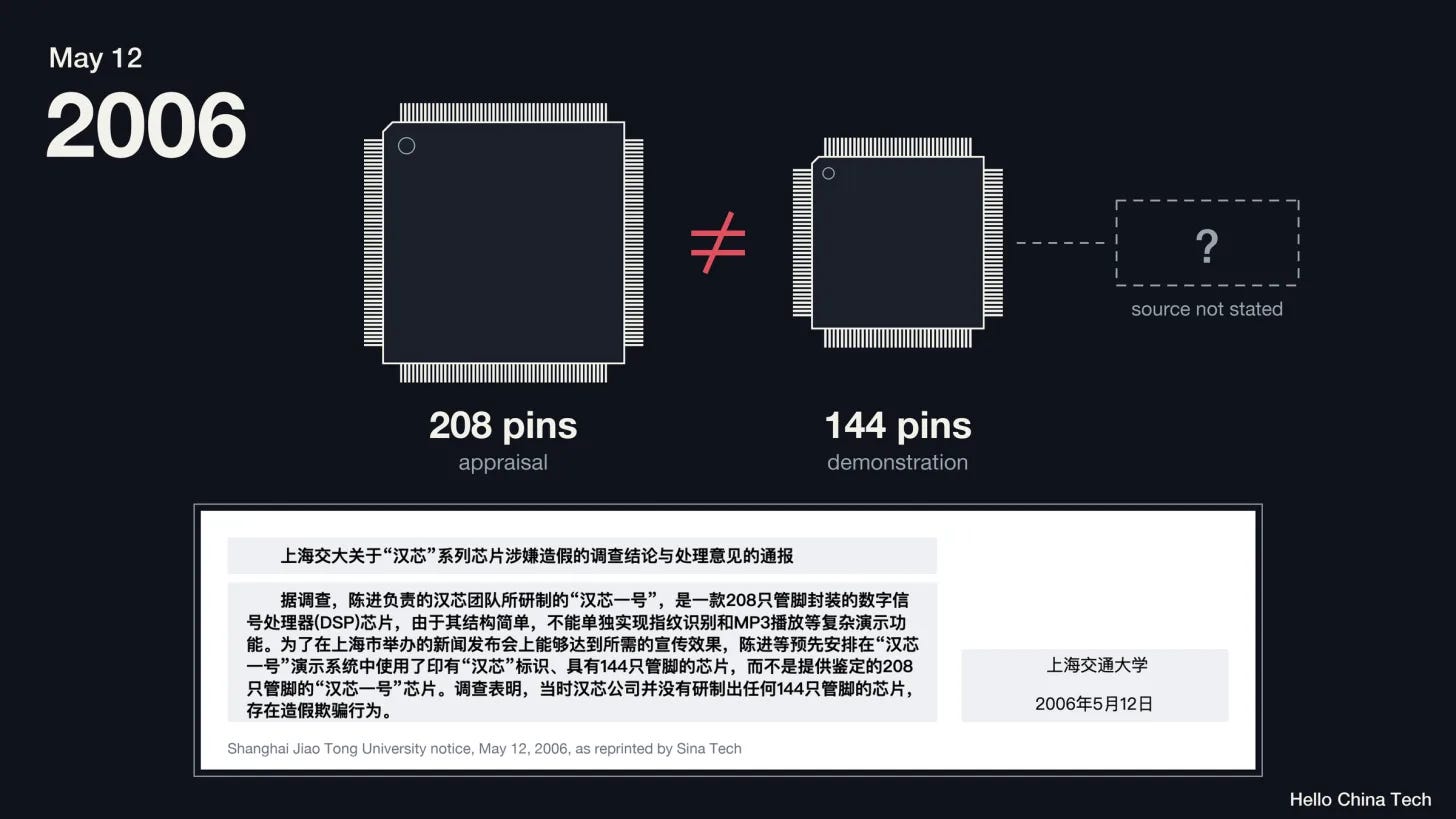
The university’s notice, when it came, said the team had spent more than two months on interviews, documents, the demonstration system itself and audio and video records. The university published the findings on May 12, 2006. Hanxin No. 1, the team found, was a DSP chip in a 208-pin package. Pins are the metal contacts that connect a chip to a circuit board. Its structure was simple. On its own, it could not run complex demonstrations such as fingerprint recognition and MP3 playback. The chip in the launch demonstration had 144 pins and carried the Hanxin mark. It was not the 208-pin Hanxin No. 1 that had been given to the experts for appraisal. At that time, the Hanxin company had not made any 144-pin chip. Chen and others, the team found, had arranged the swap in advance to get the publicity they wanted.
The notice did not say where the 144-pin chip came from. It did not mention Motorola, Freescale or sandpaper.
The team also reported problems with Hanxin No. 2, No. 3 and No. 4. Hanxin No. 2 was a DSP soft core, a processor design commissioned by another company. Hanxin had done the design work but did not own the core technology. No. 3 was a simple extension of No. 2. No. 4 used another company’s central processor and had no Hanxin DSP core in it. It was a single-core chip, not the dual-core chip described in the project papers.
The university’s verdict was that Chen had committed “serious fraud and deception in the course of leading the development of the Hanxin series of chips” (在负责研制”汉芯”系列芯片过程中存在严重的造假和欺骗行为). With false research results, it said, he had deceived the appraisal experts, the university, his research team, the local government, central ministries, the media and the public. It removed him as dean and ended his professorship. According to the notice, the Ministry of Science and Technology ended his projects, demanded the money back and barred him from future national research programmes. The Ministry of Education withdrew his Changjiang Scholar title. The National Development and Reform Commission ended his industrialisation project and demanded its funds back.
The 1994 appraisal rules
The appraisal rules of the time did not lack tools. They were issued in 1994 by the State Science and Technology Commission, the body that later became the science ministry. A result could be appraised by a testing body, by a meeting of experts, or by written review. Experts were to assess, among other things, a result’s maturity and its value in use. They had the right to ask for test or experiment results to be checked again (要求复核试验或者测试结果). People from the unit that produced a result could not sit on its panel. Applicants could not pick their own experts. Under one article, experts who neglected their duties, knowingly gave false conclusions and caused harm could face administrative sanctions. They could also lose their eligibility to conduct appraisals. The rules even named market competition as a way to judge a result. I found no article in them on where the sample had to come from. The sources cited here do not identify the Hanxin appraisal format, or say whether anyone asked for a recheck.
The record leaves one point open. The notice says the 208-pin chip was the one given for appraisal. It also says Chen deceived the appraisers, and Xu Guanhua later spoke as if they had been fooled by a relabelled part. The documents cited here do not say what the experts saw running. They do show that Chen’s team supplied the samples for both the appraisal and the demonstration. The challenge came from people who said they had worked for Chen.
Xu Guanhua, June 2006
In an interview on state television broadcast on June 16, 2006, Xu Guanhua, China’s minister of science and technology, was asked about Hanxin. Many experts had taken part in reviewing and checking the chip, the presenter said, and it had passed with no trouble. Did that make it harder to accept?
Xu said he had asked some of the appraisal experts how it had happened. He passed on their answer. “Within the range of what they could imagine, they never thought that someone could grind off a chip’s markings and then put his own mark on it. Something this simple, they really had not imagined” (在他们想象的范围之内,他们再也想不到有人竟然能够把芯片给磨掉,然后打上自己的标记,这样一种最简单的,确实没有想象到).
Part of the problem, Xu said, was how research was judged. Work meant for the market was measured by technical indicators, and those indicators often did not show whether it could compete. Judged by such indicators, he said, Hanxin could avoid the test of the market.
The presenter then put a second question. Chen had worked in a university, a fairly closed place that did not have to think much about the market. If he had been making chips in a company, about to go into mass production, could this have happened?
“No,” Xu said. “That is exactly the problem.” When he thought about Hanxin, he said, he thought of the ministry’s own proposal to stop holding appraisal meetings and “let the market test it” (让市场去检验). “Then this problem would not have happened.”
In November 2006, the science ministry issued rules on handling research misconduct in national programmes. Its spokesman, a vice minister, said cases such as “Hanxin” made stronger research integrity urgent. At the end of 2006, a national newspaper asked the ministries whether anyone had faced legal action. No one had, the paper reported. In 2016, the ministry repealed the 1994 appraisal rules. Its decision recorded that the State Council had already taken appraisal out of administrative approval in 2004.
The Shipping Chip Test
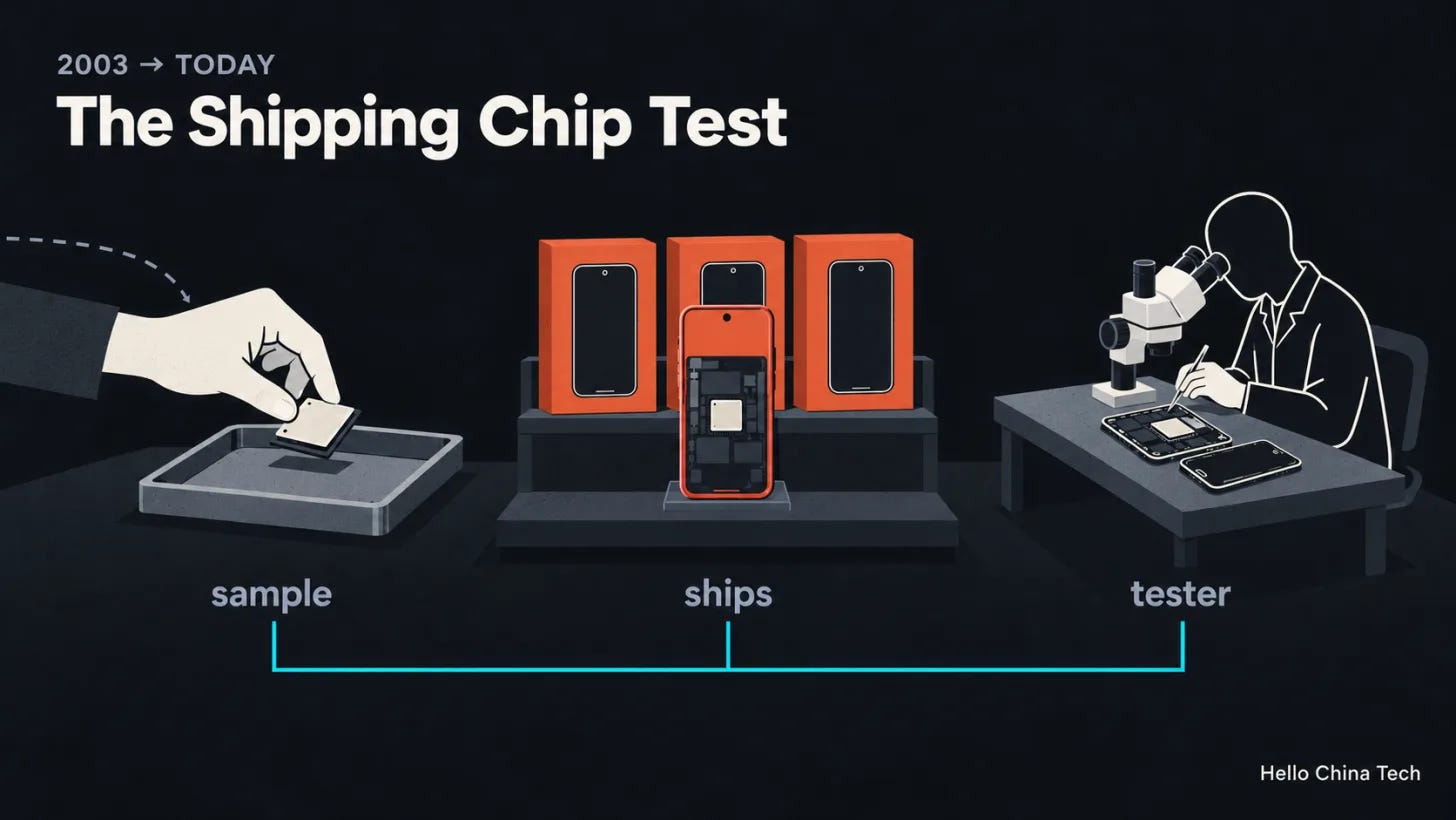
The whistleblowers wanted the chip tested by someone outside Chen’s control. The minister wanted the market to judge it. I read them as asking for two checks at once. A Chinese chip breakthrough is a claim until someone outside the launch event examines the chip that actually ships. That is the lesson I take from Hanxin, and the cases since 2022 suggest it still holds. I call it the Shipping Chip Test.
It has three questions. First, who supplied the sample? Chen’s team supplied both the appraisal sample and the demonstration chip, so the appraisal could check only what the claimant chose to show. Second, is it the chip that ships? A demonstration board, an engineering sample or a chip shown at a launch is not yet a product. In January 2006, almost three years after the press conference, the business newspaper reported that Hanxin was still not in mass production. Third, does the tester stand apart from the claim? The commission that, according to Xinhua, conducted the Hanxin appraisal also praised the result. On the same day, a deputy director of the Shanghai science commission called the chip “completely made in China.” The test does not assume that Chinese chips are fake, and it can confirm a claim as well as disprove one.
YMTC’s retail drives, 2022
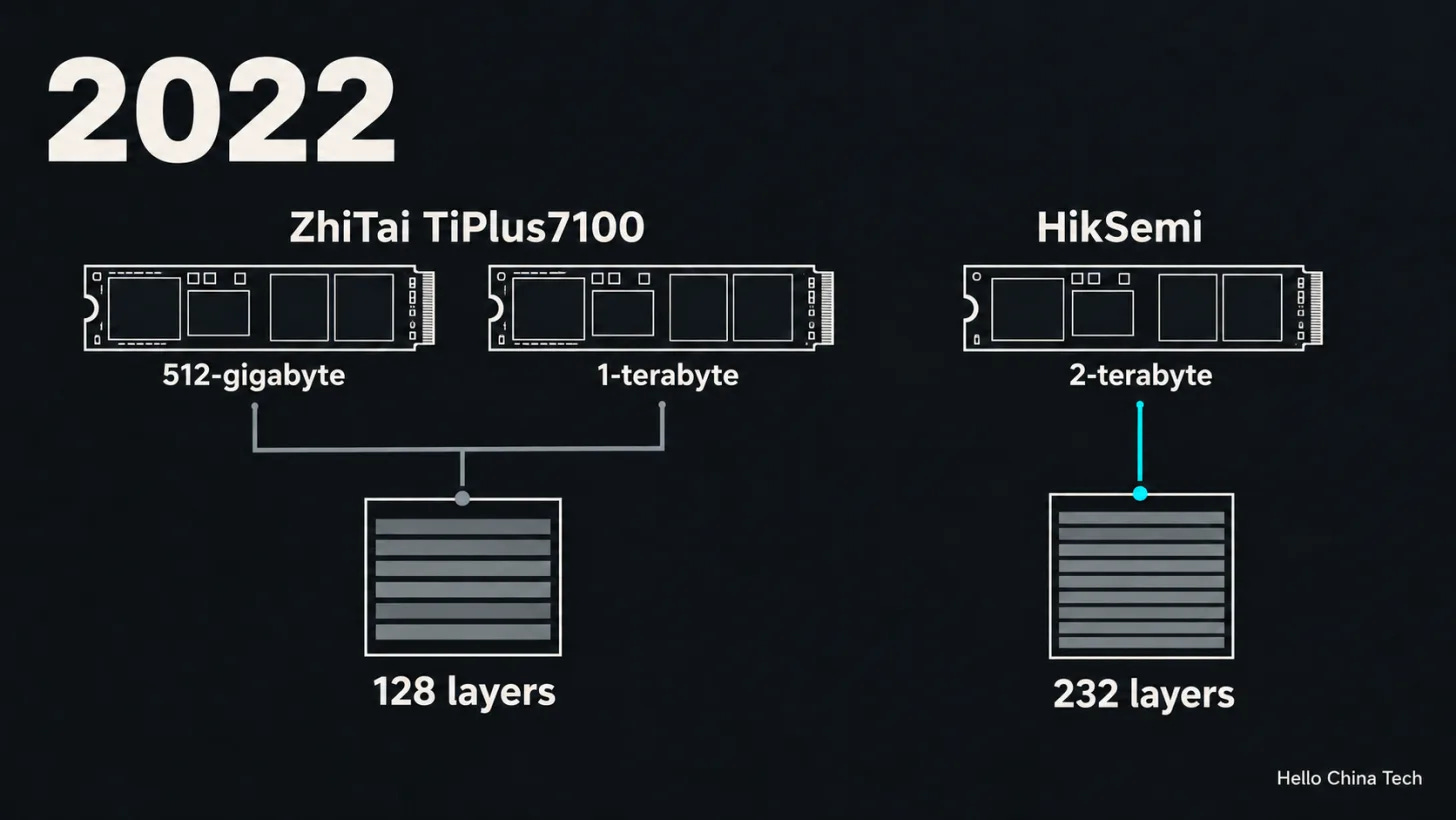
In 2022, Yangtze Memory Technologies (YMTC), China’s leading maker of NAND flash memory, announced Xtacking 3.0, a new generation of its chip architecture. TechInsights is a chip analysis firm with a laboratory in Ottawa, Canada. In its November 11 report, it said YMTC had advertised Xtacking 3.0 in every version of a fast consumer drive, the ZhiTai TiPlus7100. TechInsights bought the 512-gigabyte and 1-terabyte versions and took them apart. The team wrote: “We were surprised by our findings.” It had “not yet found” Xtacking 3.0 inside. The dies examined so far, the silicon cores of the memory chips, had 128 layers. In this kind of memory, more layers store more data in the same space. The team was still examining the drives. The 2-terabyte version was not yet on sale, and the firm allowed that it might not have been lucky.
TechInsights kept buying drives. The 232-layer YMTC die turned up in a different product, a 2-terabyte drive sold by HikSemi, a storage brand linked to Hikvision. TechInsights called it the first 3D NAND flash with more than 200 layers on the market. YMTC, it wrote, had got there “ahead of its rivals.” The same report noted that Micron had announced mass production of its own 232-layer chip in July 2022.
YMTC had made the chip it described. It had not yet turned up in the versions of the product that TechInsights first bought.
Huawei’s phone and laptop, 2023-2024
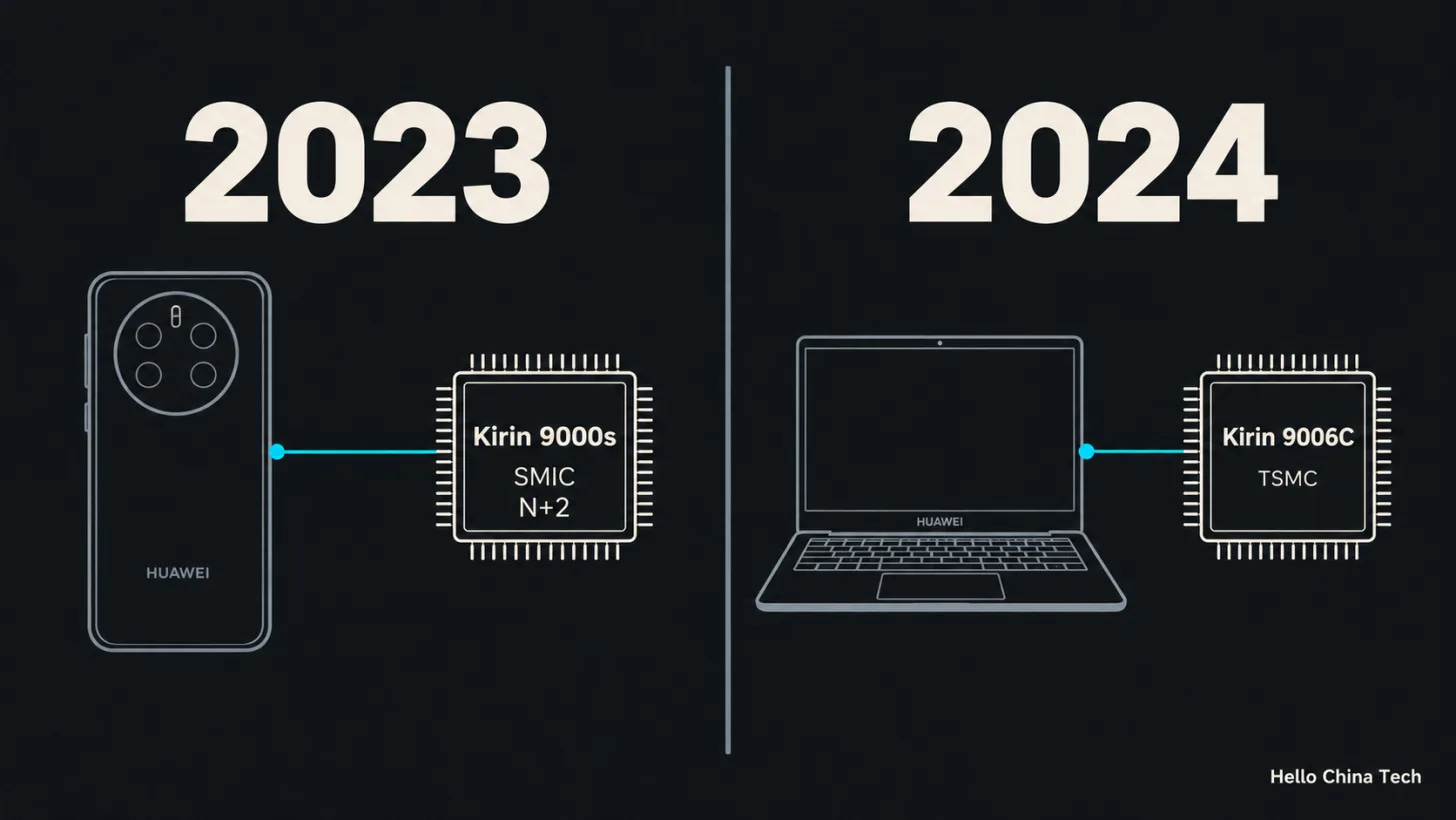
In early September 2023, TechInsights opened Huawei’s new Mate 60 Pro phone. Inside was the Kirin 9000s, a processor from HiSilicon, Huawei’s chip design unit. Within a day, the team had measured the die at 107 square millimetres. Its features were finer than SMIC’s 14-nanometre process and coarser than the 5-nanometre chips TechInsights had seen. The firm concluded that SMIC had made the chip on its 7-nanometre-class process, which it called N+2. Dan Hutcheson, the firm’s vice chair, said the find showed “the technical progress China’s semiconductor industry has been able to make without EUV lithography tools.” EUV tools are used to print the finest chip patterns.
On January 5, 2024, TechInsights published its analysis of a Huawei laptop, the Qingyun L540. The open question was whether its Kirin 9006C was a newly made Chinese chip or stock Huawei had bought before sanctions. TechInsights found, “with high confidence,” that TSMC, the Taiwanese contract chipmaker, had made it. The chip had been packaged in the 35th week of 2020. TSMC has said it stopped supplying Huawei in mid-September 2020. I read the packaging date as support for the stockpile explanation.
Both chips came out of products on sale.
Other ways to check
A teardown is one kind of outside check. A public benchmark is another. In June 2016, Jack Dongarra of the University of Tennessee published a report on Sunway TaihuLight, a Chinese supercomputer installed in Wuxi. The machine was built on the SW26010, which the report called a Chinese “homegrown” many-core processor. It ran the standard Linpack benchmark at about 93 petaflops, a measure of computing speed. The same report also showed the machine’s weak points, such as slow memory. It showed what the installed system could do on standard tests. It did not describe how anyone obtained a processor sample. A benchmark and a teardown answer different questions.
A benchmark can also raise questions about a chip’s origin. On May 7, 2023, Powerleader, a Shenzhen computer maker, launched what it presented as its own Powerstar CPU, with desktop computers built around it. The South China Morning Post reported that results published on Geekbench, a public benchmark site, on May 26 showed parameters identical to those of Intel’s Core i3-10105. The paper could not verify whether the chip was a rebadged Intel part. The question had come from outside the launch, within three weeks.
Why Hanxin still comes up
Hanxin’s name has come back in recent coverage. On July 30, 2022, China’s top anti-graft body announced an investigation into Ding Wenwu, general manager of the China Integrated Circuit Industry Investment Fund. The body said he was suspected of serious violations of discipline and law. The fund, known as the Big Fund, had been set up in 2014 by the Ministry of Finance and China Development Bank Capital. Its first round managed more than Rmb 138bn. Days later, the South China Morning Post wrote about the probe. It said the case “could be another scandal as big as the Hanxin chip case.” In May 2023, the same paper set the Powerleader case beside “the infamous Hanxin case in 2006.”
I expect more claims of Chinese chip breakthroughs, some from companies and state media, and some that are guesses. Each new claim can go through the same three questions.
In my article on Huawei’s folded Kirin chip, I worked from teardown measurements of the previous Kirin generation. In my article on China’s supernode, I used teardowns of Ascend 910C processors already in use.
For Hanxin, the answer took three years and insiders willing to talk. For a chip inside a phone on sale today, a teardown lab can give a first answer within a day. What I am watching is breakthrough claims for chips that are not on sale.
This is the second installment of Origins, a free Hello China Tech series on the history behind today’s China tech headlines. The first, The 3Q War, traced how China’s walled gardens were built. For the chip stories where this test matters now, read The Silicon Bill Behind Huawei’s Folded Kirin, China’s Supernode Moment and China’s 14nm AI Chip Wager. The Credential Economy explains why, in China’s chip market, official approval can count as much as performance. For deep analysis as these stories unfold, subscribe to Hello China Tech.