

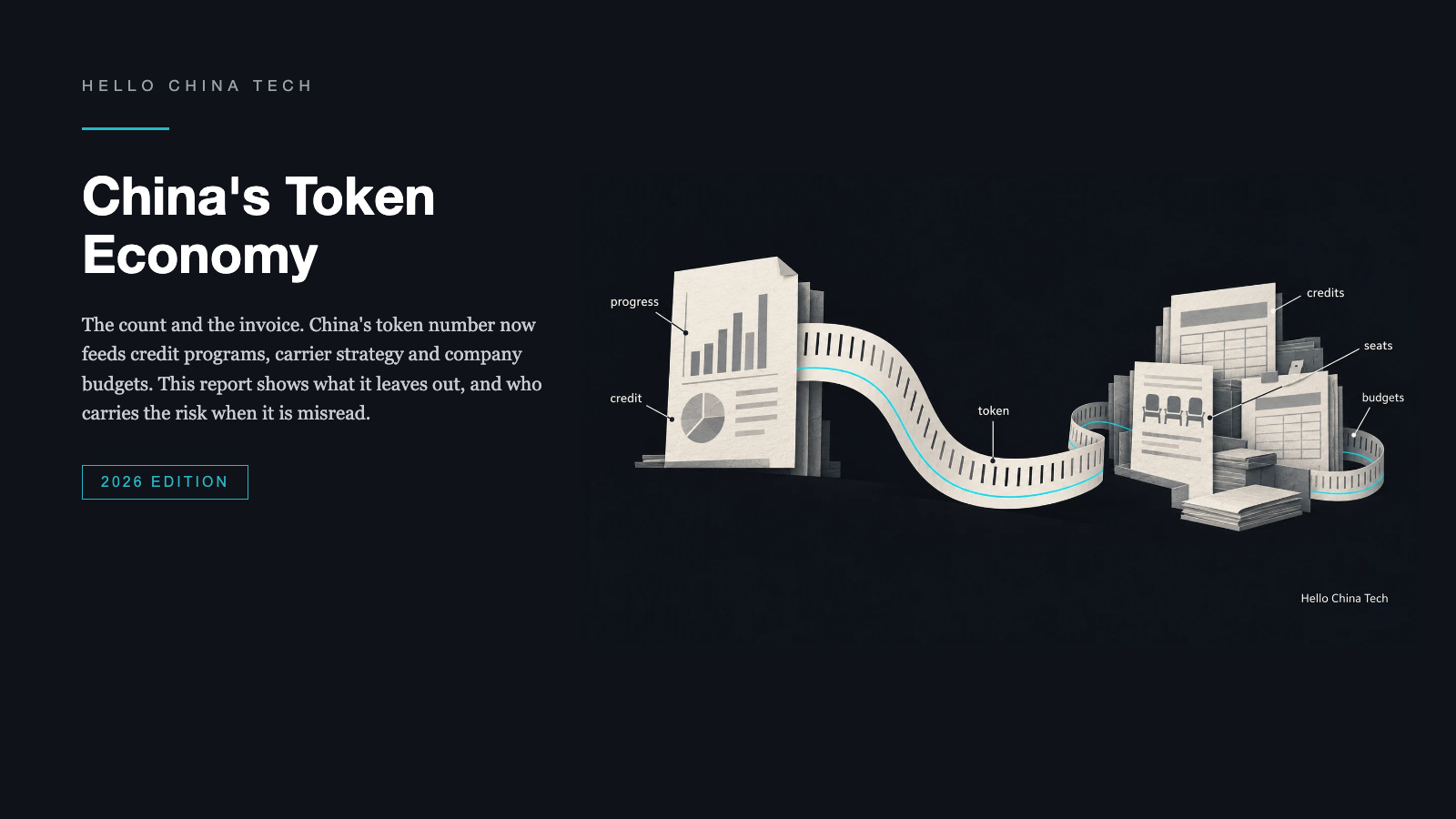
Since October 2025 I have written about China’s token numbers one earnings call, one filing and one local program at a time. Read together, those pieces point to a larger change. In China the token is no longer only a technical unit. It has an official name and a national daily figure, and it now appears in loan products, carrier strategy and company budgets. This report asks what the number can support once money depends on it.
My core argument: each actor defines the token to fit what it manages, and the further an actor sits from an invoice, the more weight the token tends to carry. That is my judgment from the evidence, and the report names the exceptions.
Five findings from the report:
The national figures come with no published scope. Official and think-tank sources give more than 140 trillion tokens a day by March 2026 and about 500 trillion in June. A separate report gives nearly 175 trillion for June. The material I reviewed does not explain the gap.
Usage has become an input for credit. Guangzhou’s Haizhu district says token consumption can enter lenders’ view, and it also subsidizes token spending. A subsidy and a credit signal can therefore touch the same number. For an application company, that number is usually a cost.
Carriers have put tokens in their strategy and not in their accounts. All three state carriers discuss tokens in their first-half 2026 reports. None reports token revenue separately.
Volume and revenue tell different stories. IDC counts 1,944 trillion tokens through China’s public cloud model services in 2025, against revenue of Rmb 3.07bn.
Run rates mean different things at different companies. Kuaishou, the Chinese short-video company, has written down a times-12 formula. Reports of the earnings call of Zhipu, a Hong Kong-listed AI model developer, give figures at times 12 and times 52. MiniMax, another listed model developer, gives no run rate in its interim filing.
Where my earlier calls were wrong, I say so in the chapter where it matters, and name the assumption that failed. I withdraw, for example, my February claim about where the compute behind China’s token exports ran. The report also follows one kind of API call across the border, where China’s draft export rules, Chinese local programs and a US federal notice each describe it differently. It closes with four questions to ask of any token number and five directions to watch. The free sample covers the Executive Summary and Chapter 2.
Paid subscribers pay $49 for this report instead of $99. The report draws on the analysis they read each week. If you want the next one as it develops, subscribe below.