

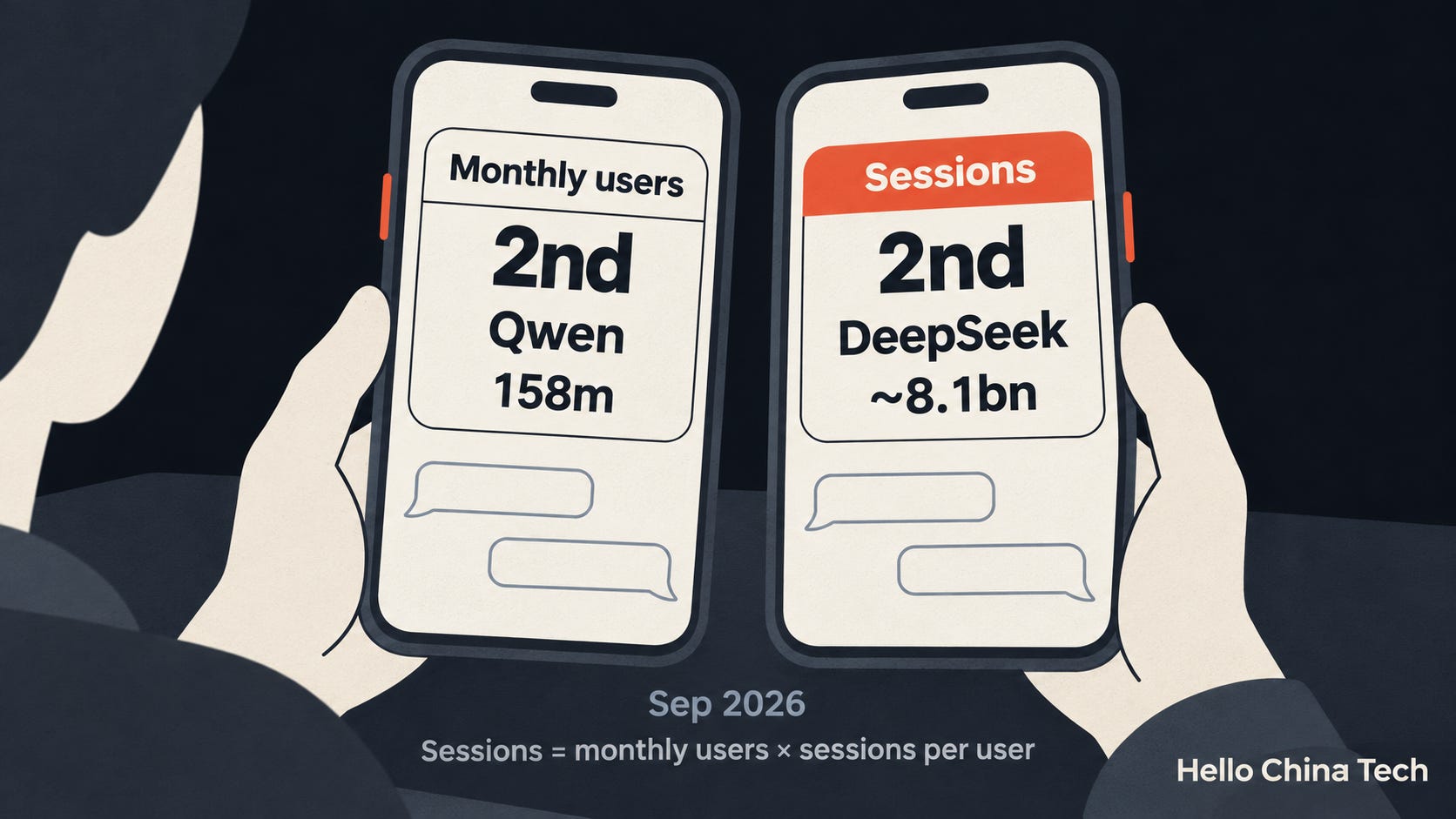
Qwen, the AI assistant from Chinese ecommerce group Alibaba, had 158m monthly users in September. DeepSeek, the Hangzhou AI lab whose chatbot spread across China early in 2025, had 123m. By that count Qwen is second among China’s standalone AI apps, behind Doubao, the assistant from TikTok’s owner ByteDance.
The same report gives a second count. DeepSeek’s users opened the app 66 times a month on average. Qwen’s opened it 18 times. Multiply each pair and DeepSeek users opened their app about 8.1bn times in September. Qwen users opened theirs about 2.8bn times. These totals are my calculation from QuestMobile’s figures. On total sessions, DeepSeek is well ahead of Qwen.
Both counts come from QuestMobile, a Beijing firm that tracks app usage on Chinese phones and computers. Its autumn report, released in early November, covers data to September.
I read the September data as two rankings that disagree about second place. A monthly-user list answers how many people an app reached. It does not answer how much they used it, or what they used it for. Chinese AI apps will be ranked many more times, so this piece sets out five checks to run before trusting a ranking. Each uses the September numbers. One of them settles a call I made a year ago.
If checking what a Chinese AI app ranking counts, people or use, is new to you, this is a preview of what Hello China Tech does every week: reading China’s AI, chip, robotics, and EV sectors from primary sources most English coverage never touches. Subscribe free to get every new analysis as it publishes.
Ask What the Plugins Are For
QuestMobile sorts Chinese AI use into five kinds. The first is AI-native apps, standalone apps built around a model: Doubao, Qwen, DeepSeek, and Yuanbao from Tencent, the owner of WeChat. The second is AI plugins, its word for AI features inside other apps. One example in its reports is an AI tool for writing listings inside Xianyu, Alibaba’s second-hand marketplace. The third is AI apps from handset makers such as Huawei, Xiaomi, OPPO and vivo. That group covers their assistants, their specialized AI apps and AI features built into the phone’s system. The last two are AI on the PC, through the browser or through desktop apps.
In September, native apps had 546m monthly users, up 82% from a year earlier. Plugins had 639m, down 16%. Handset makers’ AI apps had 783m, up 17%. The PC browser had 183m and PC desktop apps 26m. These groups overlap. One person can use Doubao, an AI search box inside another app and a phone assistant in the same month, so the five numbers cannot be added.
The first check is what each kind is used for. For plugins, it is mostly search. QuestMobile’s report includes a chart of the ten largest uses of AI, split by the five kinds. The two largest are search and assistants, and they look nothing alike.
The chart adds up each use’s users across the five kinds without removing overlaps. A person who uses AI search both in a plugin and in a standalone app counts twice. On that basis, AI search totals about 766m. I estimate the split by kind from the chart. About 560m came through plugins, AI answers inside apps people already use. About 120m came through standalone apps, close to the user count of DeepSeek, which QuestMobile files under search. Handset makers’ apps supplied none. Assistants were the reverse. They total about 1.16bn. Handset makers’ apps supplied about 570m and native apps about 490m. Plugins supplied almost none. The estimate is rough, but it is clear enough that most of the plugin count is search.
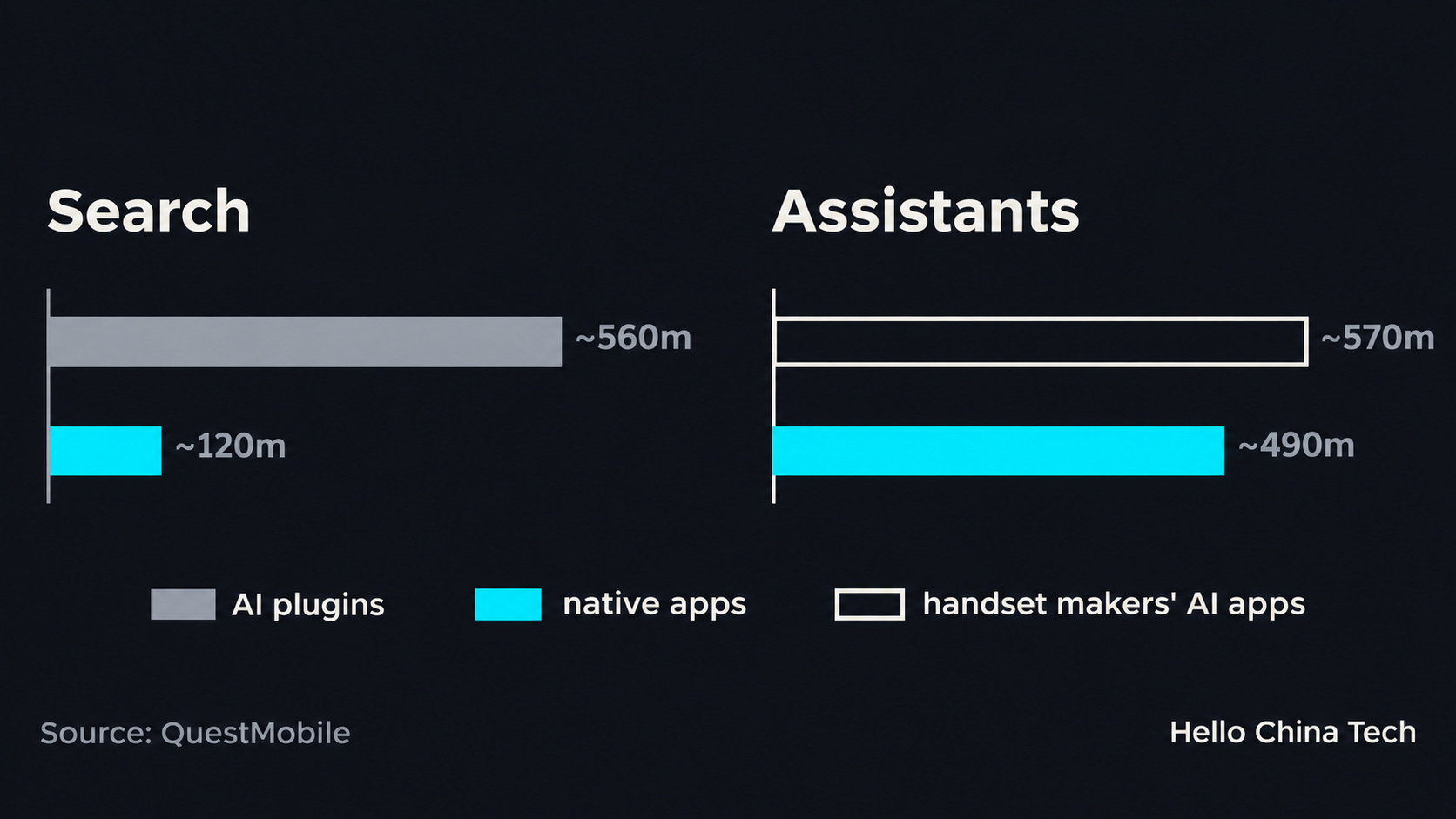
I read the split as a matter of where each job starts. In China, many searches start inside the app where the content already sits, which would explain why AI search mostly arrived as a feature of those apps. An assistant has no such obvious home, which fits the contest the chart shows between standalone apps and handset makers’ apps. Outside China, AI answers also spread through search boxes that already existed. The difference, I think, is that China’s searches are spread across Baidu, the country’s largest search engine, and several large content apps. The split also puts DeepSeek’s audience in context. Most of the AI search count comes from inside other apps. DeepSeek’s users are the part that opens a separate app for the same job.
This check settles that call. I argued in November 2025 that AI inside super apps led standalone apps by 706m users to 287m. I called it a lasting lead: “that 2.5x gap is not temporary.” Those figures came from an earlier QuestMobile report, which may not use the same definitions. The autumn report’s own monthly series gives a like-for-like comparison. In September 2025, plugins led native apps by about 758m to 300m, or about 2.5 times. Now the lead is 639m to 546m, about 1.2 times. My mistake was to treat AI as one job. It is at least two. In search, plugins still have more than four times the users of standalone apps on this chart. Assistants are a contest that plugins barely entered, between standalone apps and handset makers.
That rivalry has been close for a while. In QuestMobile’s mid-year report, handset makers’ AI apps reached 755m users against 499m for standalone apps, and standalone apps were opened 92.7 times a month against 51.4. In September the figures were 783m against 546m, and 88.2 against 51.9. Handset makers’ apps still reach more people. Standalone apps are still used more often. Recent deals between phone makers and large apps suggest the apps are setting the handover between them, deciding how much of a task a phone assistant may pass on.
One kind can also move in opposite directions in different uses. In office work, plugins grew 35% over the year, to 39m users, while plugins overall shrank.
Multiply Before You Rank
The second check is to multiply. QuestMobile publishes monthly users and, separately, how often and how long the average user opens each app. Monthly users measure reach. Users times sessions per user measure use. The two answer different questions.
On September’s numbers, Doubao leads both lists by far. It had 419m monthly users who opened it 72 times each, about 30.2bn sessions. DeepSeek follows with about 8.1bn. Qwen had about 2.8bn and Yuanbao about 1.4bn. Qwen’s users averaged 23 minutes a month in the app. DeepSeek’s averaged 137 minutes, close to Doubao’s 133.
I use sessions as the main measure and minutes as a check. Minutes can mislead. DeepSeek’s reasoning mode makes users wait while the model thinks, and the tracker likely counts that wait as time in the app. Among these four apps, the order is the same on either measure: Doubao, DeepSeek, Qwen, Yuanbao.
The PC gives a third view, from a separate list. QuestMobile’s ranking of the most-used PC software counts active devices, not people. It puts Doubao at 56m, DeepSeek at 48m and Qwen at 38m. It is counted differently from the 26m figure for PC desktop AI apps above, so the two should not be compared. On this list too, DeepSeek is ahead of Qwen.
This corrects my October piece, which said Qwen had replaced DeepSeek in second place in China’s AI apps. On reach, that holds. On use, Qwen trails DeepSeek by a wide margin among the general assistants QuestMobile details. The October piece explained Qwen’s rise through Alibaba’s promotions and advertising. Paid reach brings people to an app. Qwen’s total sessions still fell about 3% between June and September.
Use is closer to revenue than reach, with one condition. Ads and transaction fees depend on people coming back. Use is also a cost. Each question asked in a session takes computing work to answer, called inference. Use turns into revenue only where the company has a way to charge. Doubao belongs to ByteDance, which runs a large ad business, and since August has taken a combined fee of about 12% on hotel bookings made through it. Qwen belongs to the same group as Alibaba’s shopping apps. DeepSeek’s chatbot is free, so its use is real demand that the app does not yet charge for.
Kimi, the chatbot from Moonshot AI, shows the gap from the other side. It is not among the top ten apps by monthly users, yet its average user opened it 26 times in September, more than Qwen’s 18. That figure fell 22% from June.
When Averages Rise, Ask Who Left
The third check matters most when an app’s average use goes up.
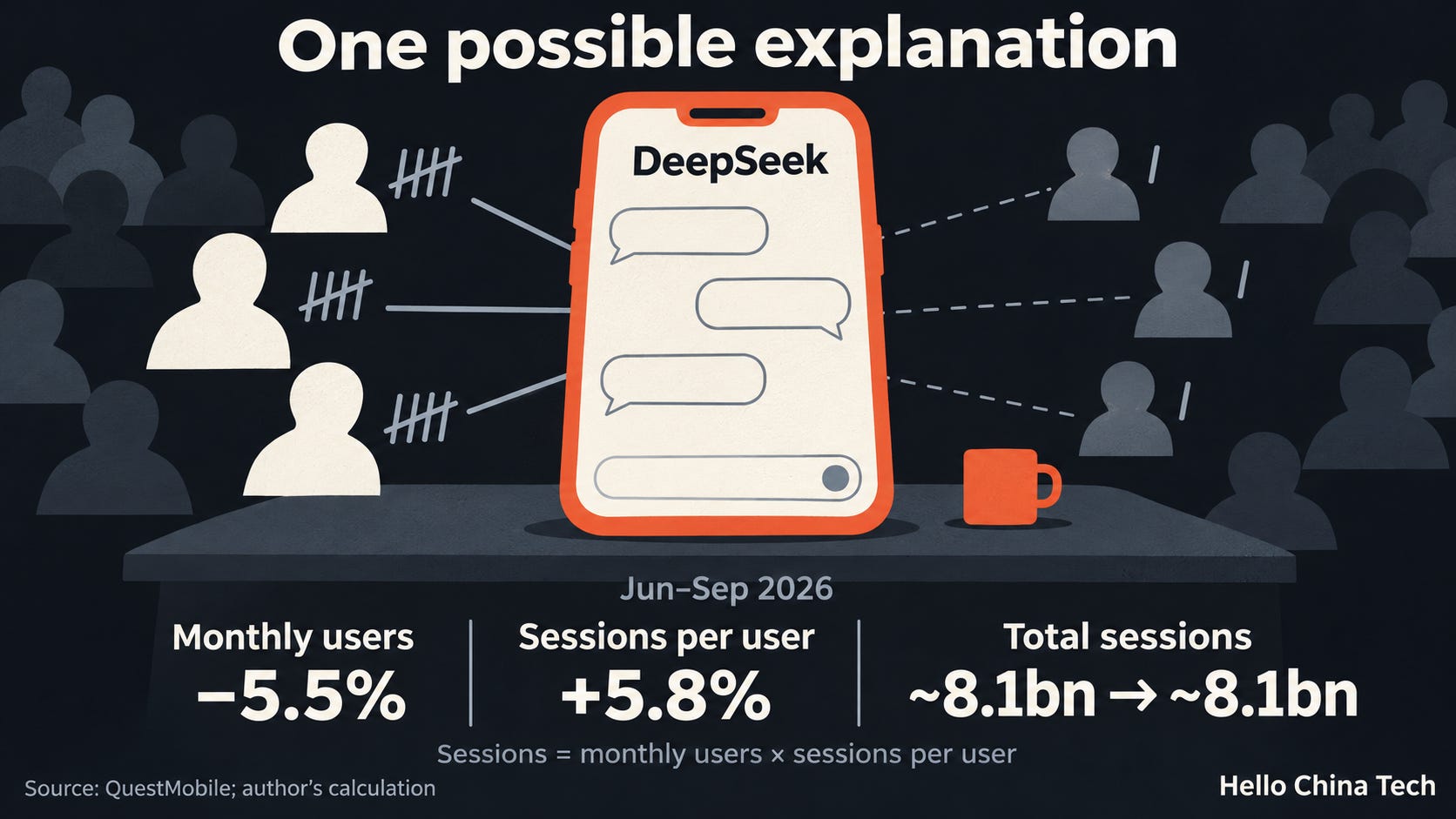
Between June and September, DeepSeek’s monthly users fell 5.5%. Its sessions per user rose 5.8%. That looks like a smaller but more loyal audience. Working back from QuestMobile’s quarterly changes, total sessions were flat: about 8.1bn in June and about 8.1bn in September. Yuanbao shows the same pattern more sharply. Its monthly users fell 25%, sessions per user rose 33%, and total sessions moved by less than 1%.
The arithmetic fits one story: light users left, and heavy users kept using the app as before. If the people who left had opened it rarely, their exit would lift the average without changing the total. The report does not follow the same users from June to September. That leaves another story open: some regular users also left, and those who stayed used the app more. Either way, the rise in the average says little about whether the product got better.
QuestMobile reads it differently. Its report calls frequent use “the most honest check on retention.” The arithmetic does not support that reading for these two apps. An average can rise because light users leave. Retention requires tracking who comes back, and the report does not show that.
Doubao shows the reverse pattern. Its monthly users rose 9.6% over the quarter while sessions per user fell 6.1%. Total sessions rose about 3%. I read this as new, lighter users pulling the average down while the app grew. Read alone, the falling average would look like a warning.
Yuanbao’s case also updates a target. A test set here in late 2025 was whether it could reach 100m monthly users by the end of 2026. On QuestMobile’s figures, it had about 50m monthly users in June and 37m in September. The direction is away from the target.
Read the Level After the Push
The fourth check is about timing. Chinese AI apps often grow in steps. The largest recent step came around the 2026 Lunar New Year, when Alibaba, Tencent and ByteDance were paying people to try their assistants with vouchers and cash gifts.
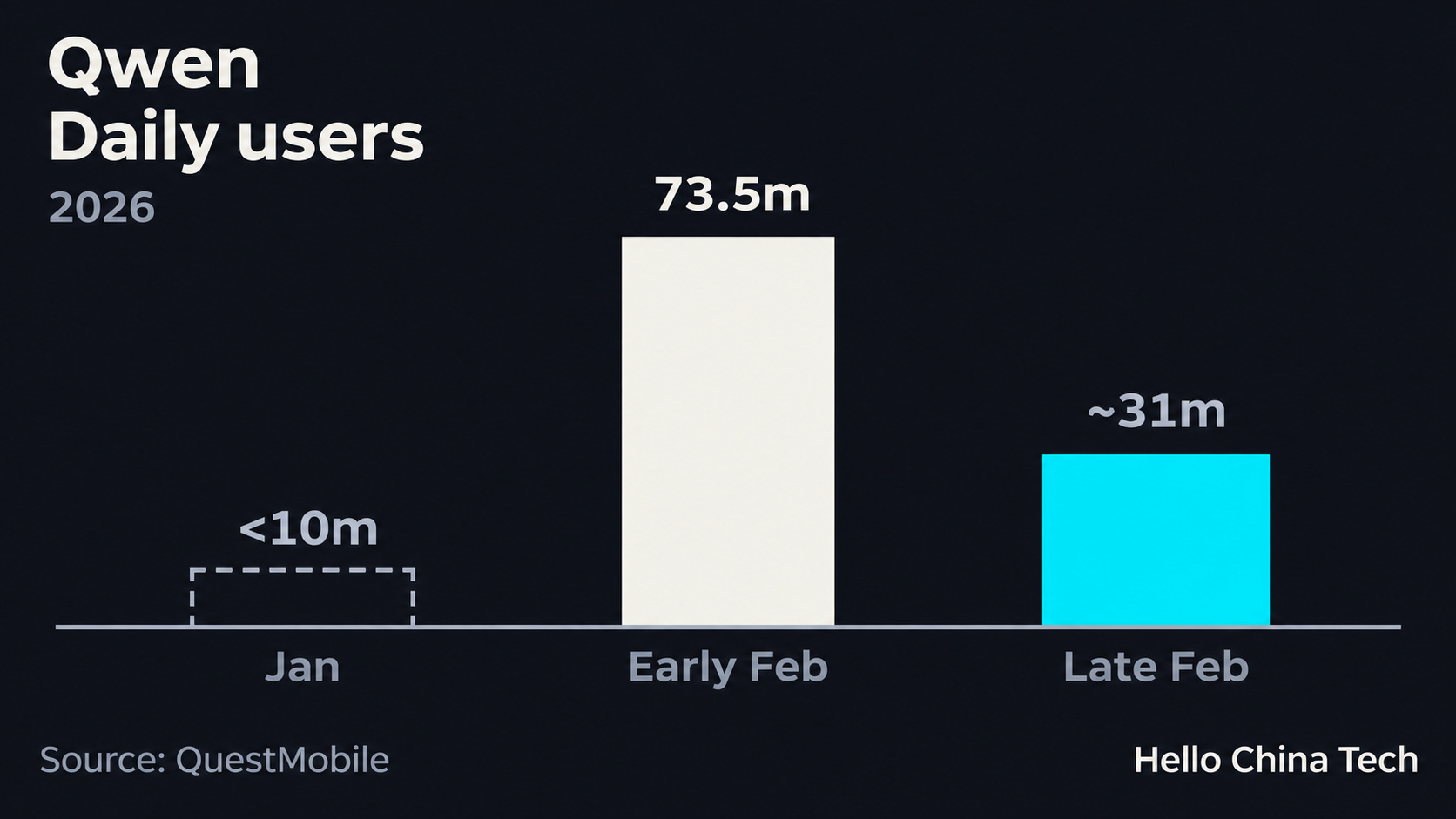
QuestMobile’s monthly chart shows native-app users jumping in February. Average sessions rose in the following months. Both stayed above their January levels through September. An earlier QuestMobile report on AI users gives daily counts. Qwen’s daily users went from under 10m in January to a peak of 73.5m in early February and about 31m by the end of the month. Yuanbao peaked at 40.5m and returned to about 7m.
I give more weight to the level after a campaign than to its peak. That level can still be shaped by advertising, as the spending below shows.
The spending has not stopped. QuestMobile’s advertising data for the third quarter puts the category it labels AIGC, for AI-generated content, at about Rmb 1.3bn of display advertising. That is up about 60% from a year earlier, the fastest growth on a chart of the top 20 internet categories by spending, which leaves out those that shrank. I read the figures from the chart. They cover display ads, including search ads inside shopping apps, and exclude search-engine ads and influencer deals. They describe the category, not any one app. They suggest the industry is still buying reach. That makes the second check more useful. Paid reach tends to show up first in monthly users, and in sessions only later, if at all.
Know Who Is Counting
The fifth check is the source. QuestMobile estimates activity on the phones and computers it tracks. This report does not show app revenue, token use or completed orders. It also does not give enough detail on sampling or on how it removes overlaps for anyone to reproduce its estimates. Companies count differently and choose their moment. Tencent’s quarterly results have not carried a user number for Yuanbao through the second quarter. Its own figure came in a February 18 announcement, the day after a report on its Rmb 1bn cash giveaway: more than 50m daily users and 114m monthly users. QuestMobile counted about 57m monthly users for the standalone app in March. The figures come from different sources and periods.
Seasons also move the numbers. QuestMobile’s university-student group had 23.6m AI app users in September, against 19.0m in August, as the academic year began. It defines the group as 18- to 24-year-olds who use study and exam apps. Before judging an education app’s September growth, I would compare it with the previous September. Summer holidays raise total phone time.
The checks apply beyond China. Many markets now have AI in search boxes, AI in phones and standalone AI apps. Each is likely to produce one count of people that mixes jobs, and averages that move because the base moved. China is a useful place to practice, because its trackers publish these splits by format and by use.
So who is second among China’s standalone AI apps? By reach, Qwen. By total sessions among the apps QuestMobile details, DeepSeek, a lab with no shopping, video or messaging app to send it users. For a reader judging these companies, my answer is the second ranking, because use is the closer guide to what a business can one day charge for. What I am watching is DeepSeek’s total sessions in QuestMobile’s next quarterly figures. If they hold while its user count changes, the demand behind that answer looks steady. If they fall, my answer weakens.
This analysis is free. The paid coverage behind it did the groundwork: The Three-Way Fight for China’s AI Phone, on how models, handset access and service fulfillment sit with different companies, and China’s AI Phone Is Becoming a Switchboard, on how the largest apps decide how much of a task a phone assistant may do. Upgrade to paid to read them.