


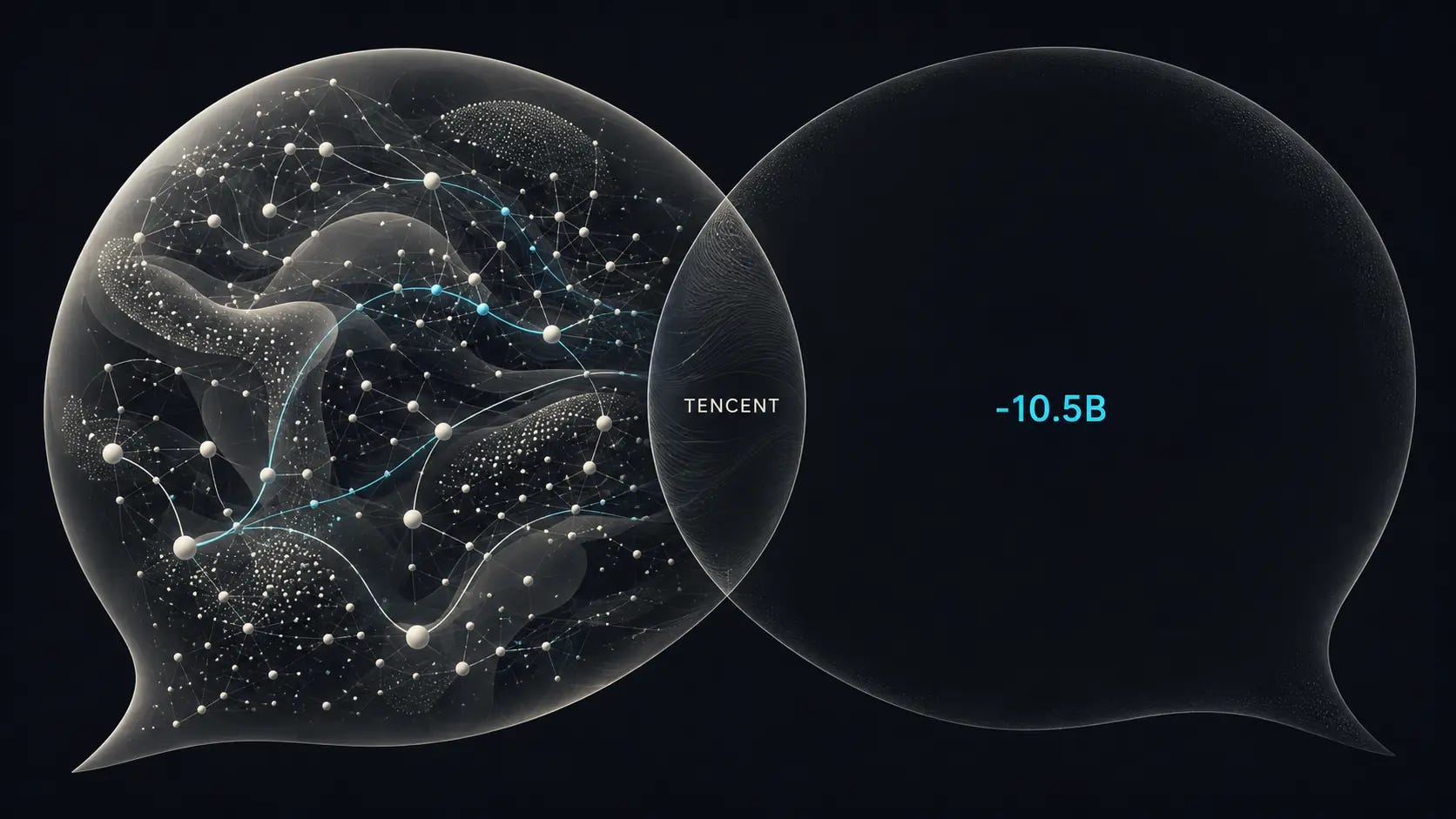
On August 13, the morning after Tencent reported second-quarter results, the stock closed at HK$441.00, down 4.46%. The Hang Seng Tech Index rose 0.33% that day, leaving Tencent 4.79 percentage points behind its own benchmark on a day the benchmark went up. The US-traded ADRs had priced the release a day earlier, falling 5.44% to $56.28 on August 12, then a further 1.79% to $55.27 on August 13.
This has now happened twice. On March 19, after Tencent posted its strongest annual results in years, the stock fell 6.81% and lagged the same index by 4.62 points. The absolute decline was larger in March. Measured against the index, the August reaction was at least as severe.
The two sell-offs share more than a shape. In March, President Martin Lau asked investors to treat Tencent’s AI spending as a strategic investment rather than margin compression, and to judge it separately from the core business. In August he made the request explicit. “You can look at Tencent businesses and break it into two businesses,” Lau told analysts on the earnings call. One is the existing franchise. The other is a new AI-native business with its own model, its own applications, and its own compute.
A simpler story is available for the sell-off. IFRS net profit attributable to shareholders came in at Rmb 56.0bn against a Reuters consensus of about Rmb 61.8bn, and free cash flow turned negative. A miss plus a cash shock accounts for one bad day without any theory about disclosure. It does not account for what the research did next. Analysts used Tencent’s excluded-profit figure to confirm the core business was healthy, then went on charging the AI spending against the value of the group. The price move is a day of evidence. The published notes are the durable part.
Two Profit Numbers, One Cash Flow
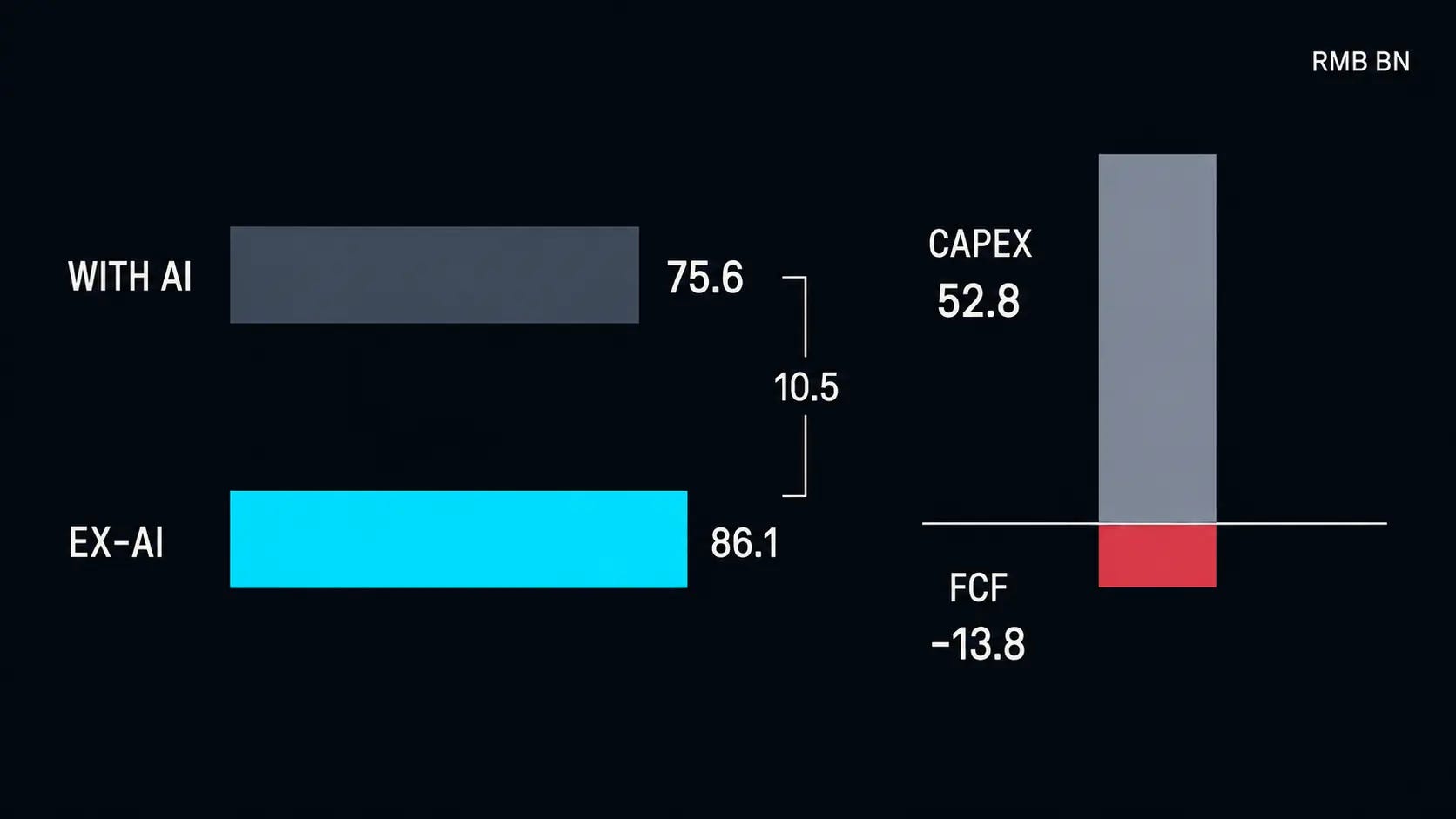
Tencent now publishes two operating profit figures. Non-IFRS operating profit for the quarter was Rmb 75.6bn, up 9%. Excluding new AI products, it was Rmb 86.1bn, up 19%. The difference is the effect of what Tencent calls new AI products, which its footnote says consist “primarily” of Hunyuan, the in-house foundation model family its results materials brand as Hy, plus the Yuanbao chatbot, the CodeBuddy coding tool, the WorkBuddy office agent, and Xiaowei, the WeChat-native assistant. The perimeter remains management’s to redraw. Operating margin diverged the same way: 36.9% blended, down 0.6 points year on year, against 42.0% excluded, up 2.8.
The cash statements moved in the opposite direction. Capital expenditure reached Rmb 52.8bn, up 176% year on year and 65% from the first quarter. Free cash flow was negative Rmb 13.8bn, which Tencent attributes to capex payments and large compute prepayments in a seasonally weak quarter for game receipts; excluding the prepayments it puts the figure at positive Rmb 37.6bn. Net cash fell 60% to Rmb 58.2bn from Rmb 146.9bn, absorbing Rmb 59.3bn of capex payments, Rmb 41.6bn of 2025 dividends and about Rmb 14.7bn of buybacks. The same quarter a year earlier produced Rmb 43bn of free cash flow on Rmb 19.1bn of capex, and left Rmb 74.6bn of net cash.
Lau framed the spending as finite. The AI-native capex is “more of a sort of a lump sum that we are going to be investing this year and next year,” he said, and paying for it “should not be just measured against our operating cash flow” but against the balance sheet, the investment portfolio and a prudent level of debt capacity. That is a request to move an expense out of the earnings frame and into the funding frame.
Bernstein’s Robin Zhu asked what these purchases do to depreciation over the coming quarters. Chief Strategy Officer James Mitchell answered with the rental option, a use Tencent has explicitly ranked last, and Lau answered with the funding source. Property, plant and equipment rose from Rmb 149.9bn at the end of December to Rmb 198.9bn at June 30, a net figure that already absorbs depreciation and disposals and is not broken out by use. The direction is not in doubt: a capex step this size lifts depreciation for years. Tencent has not quantified the timing, or how much lands inside the excluded perimeter
Two profit numbers, one cash flow statement, and a request to weight the higher one. What the sell-side did next was more interesting than agreement or refusal.
This piece extends The Two Tencents, the March analysis of a company asking to be valued as a cash machine and an AI venture at the same time. If that lens is useful, subscribe free and get every new analysis as it publishes.