

Three “World’s Firsts,” One Stage
At the World Artificial Intelligence Conference in Shanghai, which opened on July 17, three companies each unveiled what they called the world’s first AI agent smartphone.
Nubia, ZTE’s consumer phone brand, showed the NaviX Ultra. This second-generation device, built with ByteDance’s Doubao AI assistant, is reportedly preparing total inventory of roughly 200,000 units, with the initial batch under 100,000. The device was still completing final procedures for commercial release. The first-generation M153 shipped roughly 30,000 units in December 2025 and sold out quickly.
StepFun, a Tencent-backed Chinese foundation-model startup, displayed the STEPX Neo running its own agent operating system. The phone had no price and no disclosed retail date. StepFun was also absent from the regulator’s newly published list of on-device generative AI registrations, though the company has indicated a product event in late October.
Honor, a major Chinese smartphone maker formerly part of Huawei, brought a Robot Phone with a mechanical gimbal camera that tracks users and rotates on its own.
Two days before the conference, the Cyberspace Administration of China published registrations for 7 on-device generative AI services, covering Apple, Huawei, OPPO, vivo, Xiaomi, Samsung, and Nubia. It was the first time the regulator had published on-device mobile AI registrations as a separate group.
The market these products enter is shrinking. Smartphone shipments in China fell 4.3% year-on-year in Q2 2026, the fifth consecutive quarterly decline. IDC projects next-generation AI smartphones at 53% of China’s market this year, though that category includes devices with generative AI features but no agent-level execution. AI has become the most compelling growth story the industry has left.
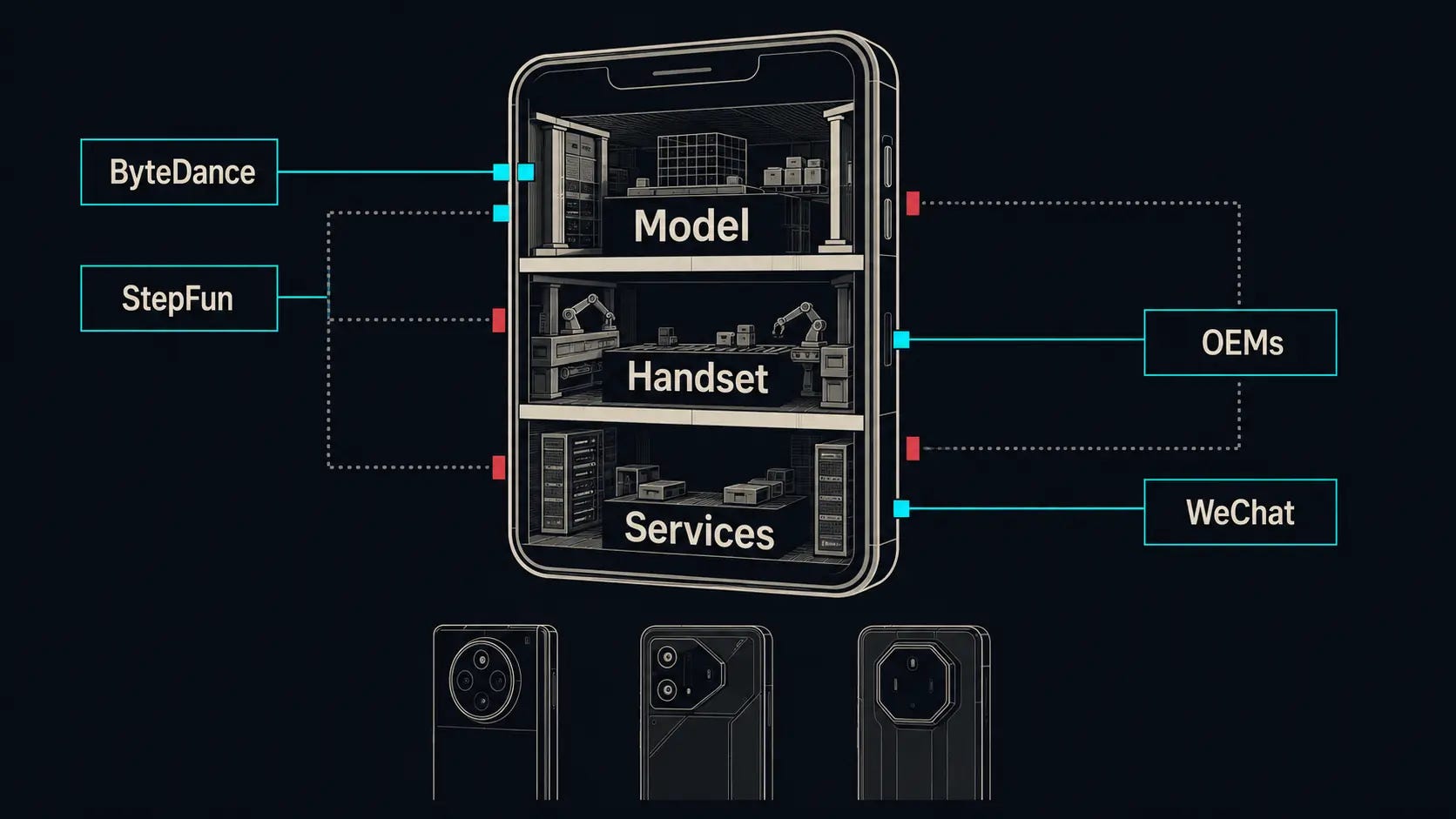
Three simultaneous “world’s firsts” reveal that no one has defined what an AI agent phone is. The deeper driver appears structural. Building this product requires capable models, a handset and operating-system entry point, and access to the services where transactions close. Those capabilities remain distributed, with no participant currently controlling all three.
No One Controls All Three Layers
China’s largest tech groups often span more than one layer. ByteDance spans the model and consumer-platform layers through Doubao and Douyin. Tencent does the same through its models and WeChat. Yet each still lacks critical pieces.
ByteDance’s Doubao has 345 million monthly active users and substantial model and agent capabilities. But when it launched the first Doubao phone last December, WeChat flagged accounts, forced logouts, and restricted access within days.
StepFun says its models have shipped on more than 42 million devices through partnerships covering roughly 60% of China’s top phone brands. Yet STEPX Neo itself arrived without an installed base or a disclosed retail plan.
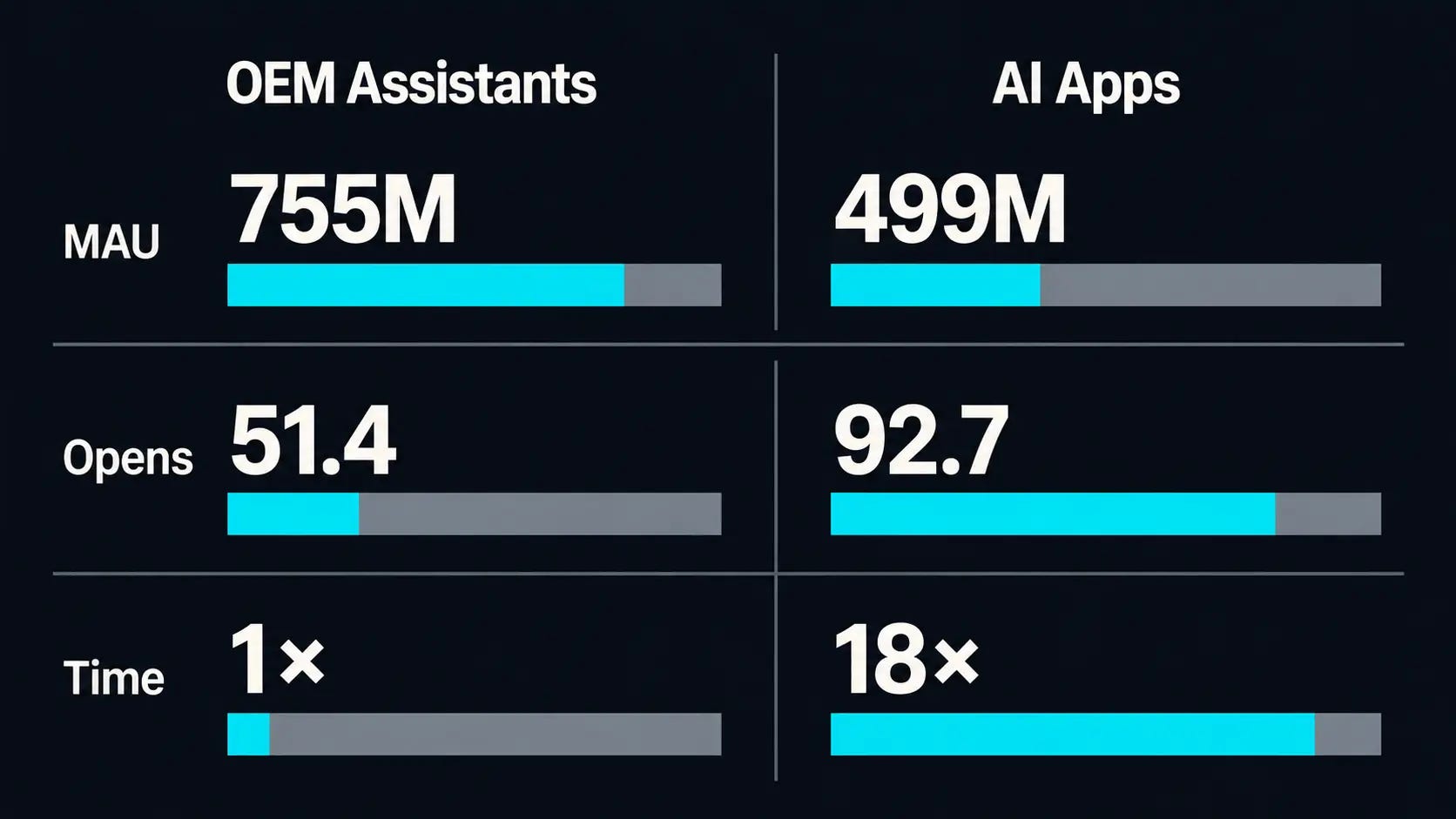
OEMs occupy a paradoxical position. Their built-in AI assistants reach 755 million monthly active users, more than the 499 million using standalone AI apps, according to QuestMobile, a Chinese mobile analytics firm. But users open standalone AI apps 92.7 times per month, compared with 51.4 for system assistants. Standalone AI apps also command roughly 18 times as much usage time. OEMs won the install race and are losing the engagement race.
Super apps face their own constraint. WeChat’s mini-program ecosystem handles payments, food delivery, and government services. Few phone assistants in China can claim to cover users’ daily needs without WeChat access. But Tencent does not control the hardware entry point. An AI layer that captures user intent before users open an app threatens to push WeChat toward back-end infrastructure.
The fight over which technical approach connects these three layers sounds like an engineering debate: GUI automation, A2A protocols, or API integration. The question underneath is about distribution power: when a user says “order me a coffee,” the AI understands the instruction, but does it route the order to Luckin, Starbucks, or a local independent café?
Whoever controls the agent’s recommendation stands to redirect traffic and reshape distribution fees, even when the underlying app completes the transaction. What follows examines how each side is positioning itself, and why the near-term result is more likely to be coexistence than conquest.
This piece builds on the “App-up vs. OS-down” framework from our WeChat AI gatekeeper analysis. If that lens for understanding platform power in China’s mobile ecosystem is new to you, subscribe free to get every new analysis as it publishes.