

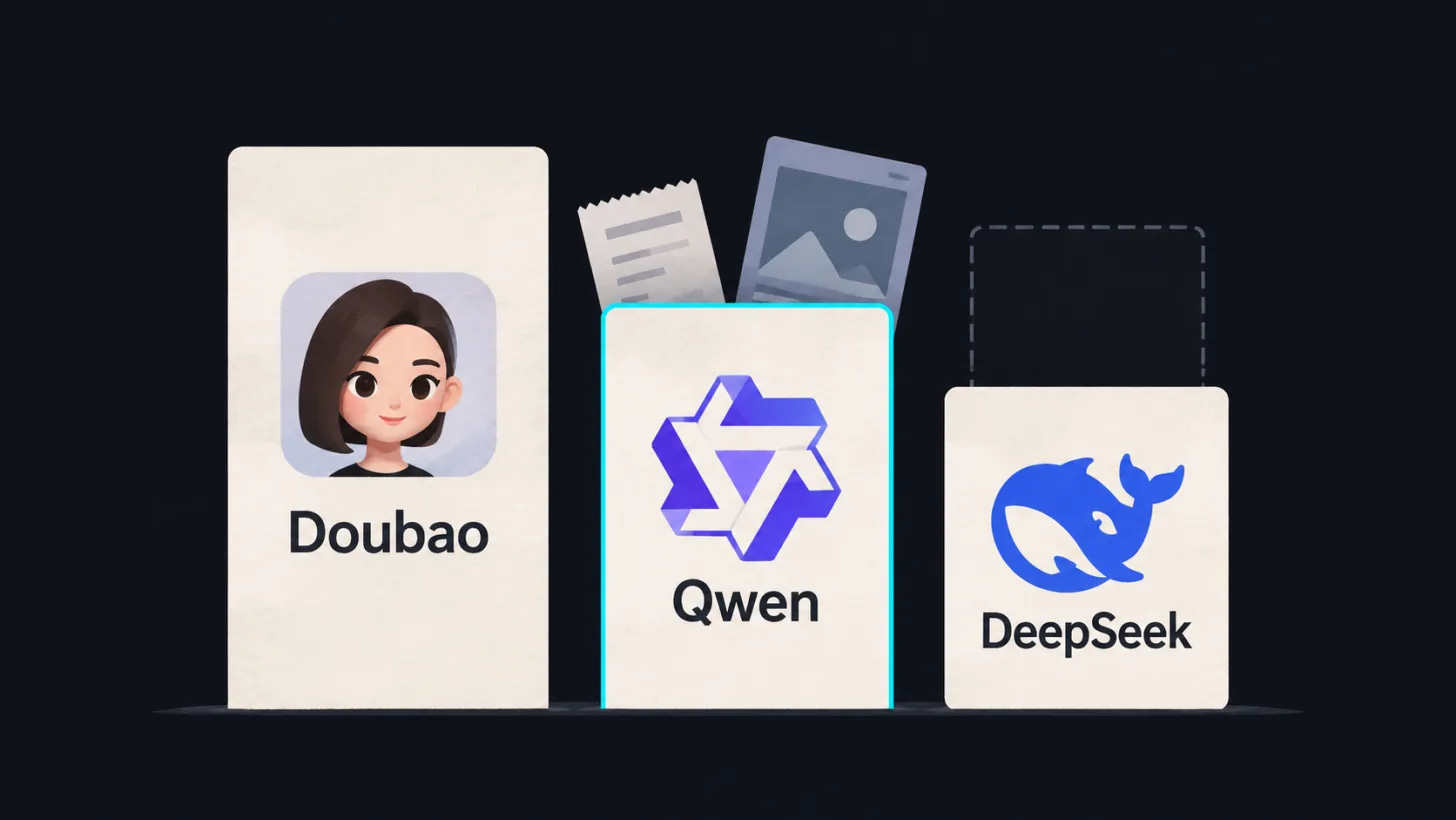
Doubao, ByteDance’s AI assistant, led China’s AI-native apps in August 2025 and leads them still. Qwen replaced DeepSeek in second place.
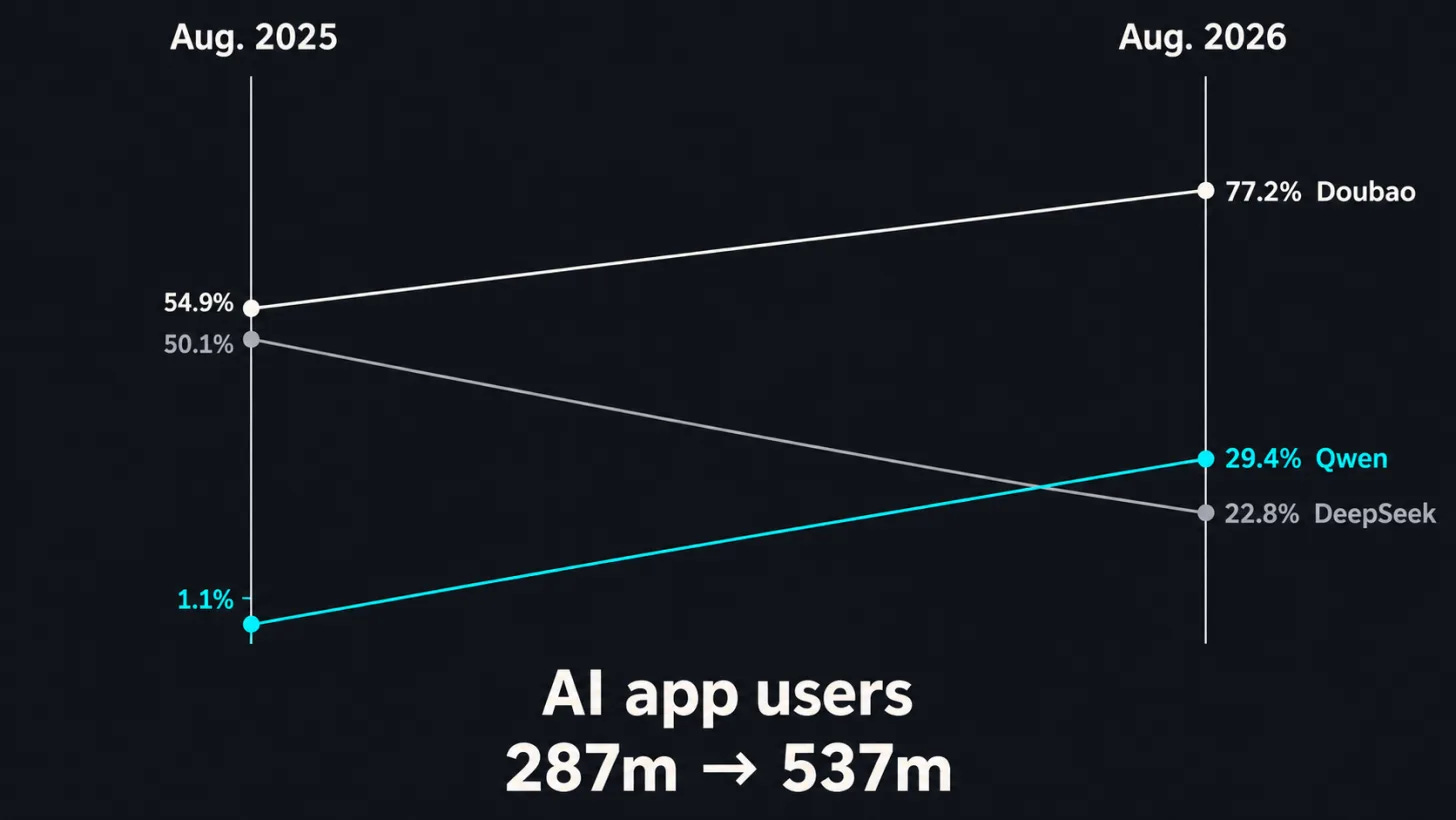
In August 2025, 50.1% of Chinese users of AI-native apps opened DeepSeek at least once that month. In August 2026, 22.8% did. Over the same twelve months, Qwen, Alibaba’s AI assistant app (formerly Tongyi), went from 1.1% to 29.4%. Doubao rose from 54.9% to 77.2%.
The figures come from QuestMobile’s 2026 report on AI users and marketing, carried by 36Kr. QuestMobile is a Chinese mobile-internet data firm. It calls the measure active penetration: the share of all AI-native app users who opened a given app in the month.
The base grew fast. QuestMobile counts 537m monthly users of AI-native apps in August 2026, up from 287m a year earlier. Multiplying each app’s share by that base gives a rough user count. The arithmetic is mine, not QuestMobile’s. By this calculation, DeepSeek fell from about 144m monthly users to about 122m while the market nearly doubled. Qwen rose from about 3m to about 158m.
I read this as a ranking set by distribution and paid reach, with model reputation less decisive. Assistant markets elsewhere face the same question: does the best model or the widest distribution win the daily habit? This report measures neither directly. The ranking is consistent with a distribution advantage.
Reading an AI app's rank by where its users settle after a promotion ends, and by its share of ad spending, is one example of how Hello China Tech reads China's tech sector: primary sources first, new analyses every week, across AI, chips, robotics, and EVs. Subscribe free to get the next one in your inbox.
The seats are not exclusive. Users who open only one AI app fell from 36.7% of the base to 25.4%. Those who use three or more rose from 32.5% to 44.0%. Second place means reaching more users than most rivals. It does not mean those users rely on Qwen alone.
Over the past year I made six calls about this market. The report lets me revisit all six. Four can be checked against the data. Two remain open or untested. The clearest miss is about Qwen.
How the Seat Changed Hands
DeepSeek, whose app made AI a mass habit in China in February 2025 by QuestMobile’s account, is a model lab. Unlike ByteDance, Alibaba and Tencent, its owner runs no shopping app, short-video feed or messaging network that could send users into its chatbot. When the market nearly doubled, its share was diluted. By my calculation, its user count fell as well. The report does not measure how much traffic any app received from a parent platform. The platform gap here is about ownership. The traffic itself is not measured.
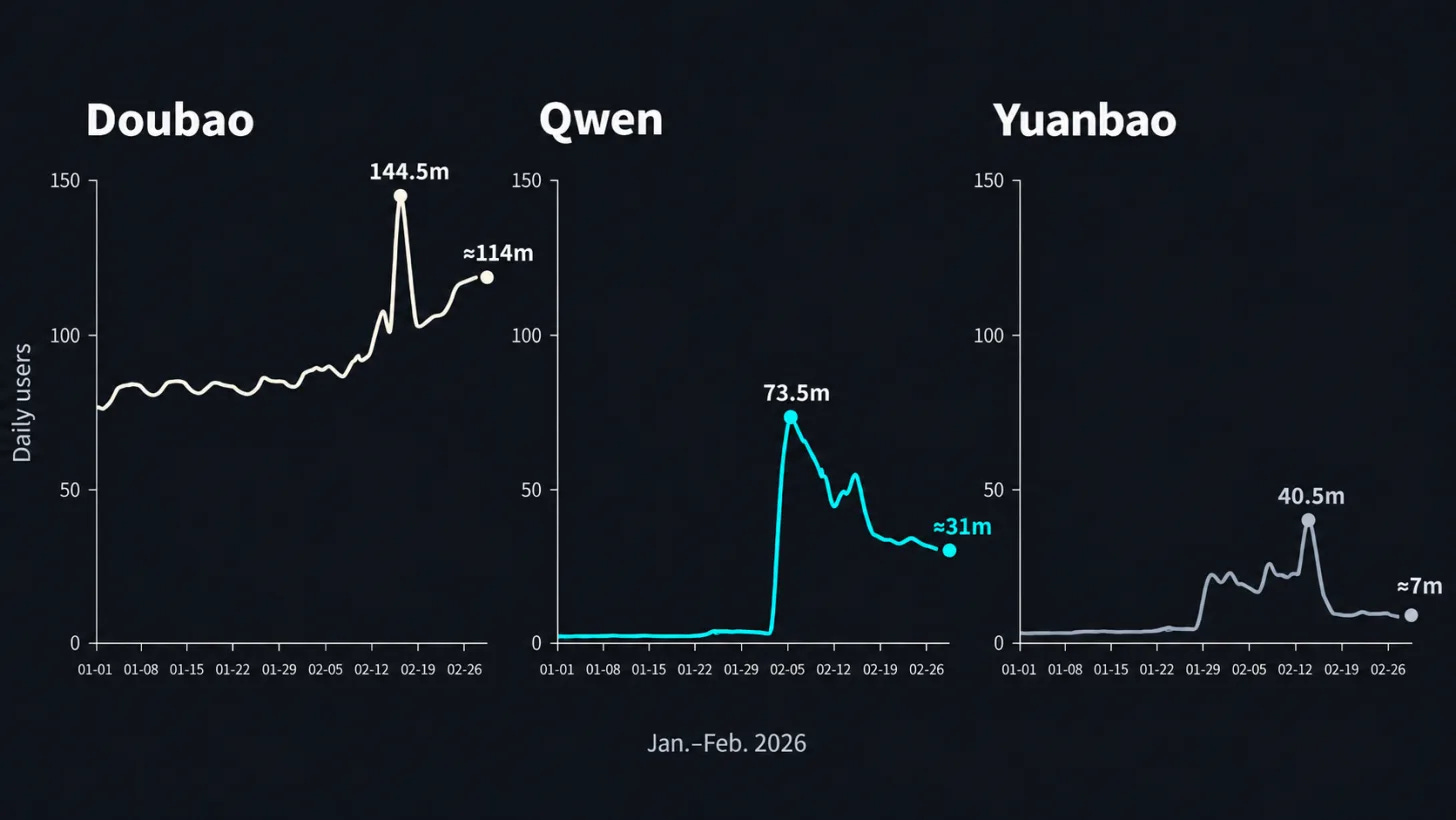
Qwen had two things working for it. The first was an owned transaction layer. In February 2026, Alibaba announced a Rmb 3bn Lunar New Year promotion through Qwen. The mechanism was a Rmb 25 voucher with no minimum spend. A user updated the app, then spent the voucher on milk tea, takeout or holiday shopping through Taobao’s instant-delivery service. Qwen’s daily active users went from under 10m in January to a peak of 73.5m in early February, and the timing ties the jump to the promotion. The February piece cited an earlier daily count of 58.48m. The full January-February chart shows the peak was higher. At the end of February, Qwen was still at about 31m.
Tencent’s Yuanbao ran a similar push with a different tool. Tencent announced Rmb 1bn in digital cash gifts, known as red packets, and users shared them through WeChat and QQ, Tencent’s messaging apps. Yuanbao’s daily users went from under 10m to a peak of 40.5m in mid-February. By the end of the month they were back near where they started, at about 7m.
The second was paid reach that kept running after the holiday. QuestMobile estimates ad spending for three assistants it tracks as typical AI advertisers: Qwen, Doubao and Yuanbao. These are third-party estimates and do not cover all actual spending. The influencer figures cover Douyin, Kuaishou and Xiaohongshu, and exclude commissions and placement fees for livestream deals. In June 2026, Qwen accounted for 77.7% of the three apps’ media ad spending and 79.4% of their influencer spending. June was also the month of university applications after China’s national college entrance exam, and all three apps offered tools for that process. In the last week of June, Qwen had 101m weekly users, against 318m for Doubao and 26m for Yuanbao.
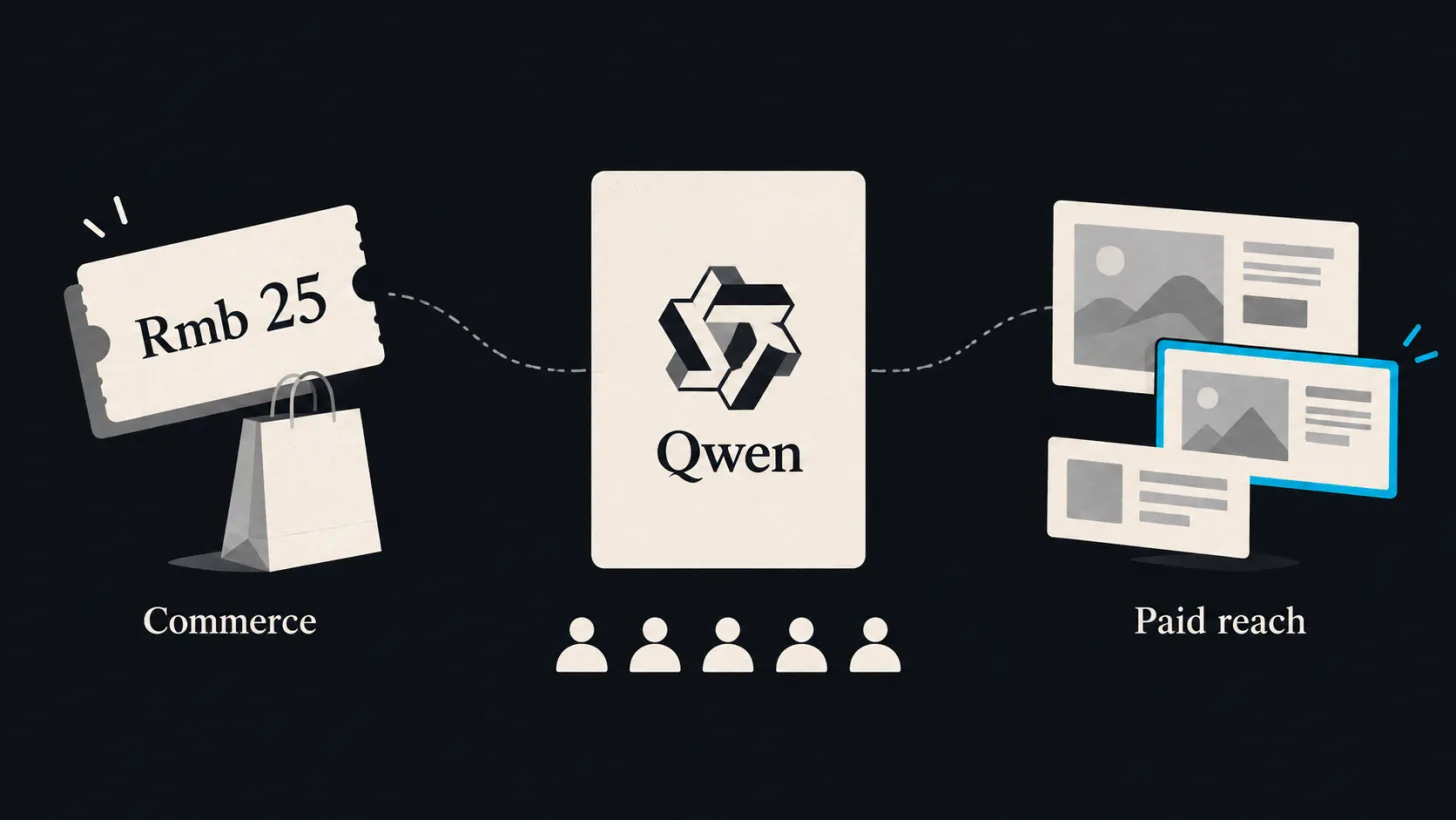
The spending figures do not explain Qwen’s growth on their own. In the week to February 1, Yuanbao outspent Qwen on media ads by more than two to one. Its daily user count later returned close to its January level. In the two weeks to January 25, Qwen outspent both rivals and stayed under 10m daily users. I read Qwen’s rise as a combination of paid reach and a subsidized shopping use case.
The data does not separate the two causes. Some users may have stayed because ordering through Qwen was useful, others because Alibaba kept paying to remind them; by June it was still paying. The peak says little about where a Chinese AI app stands. The level after the push says more. By the end of February, Doubao’s daily user count was about 39m above its January level and Qwen’s roughly 25m higher. Yuanbao was close to its January level. These are changes in daily counts, not retention rates for campaign users.
What the Payment Chart Cannot Say
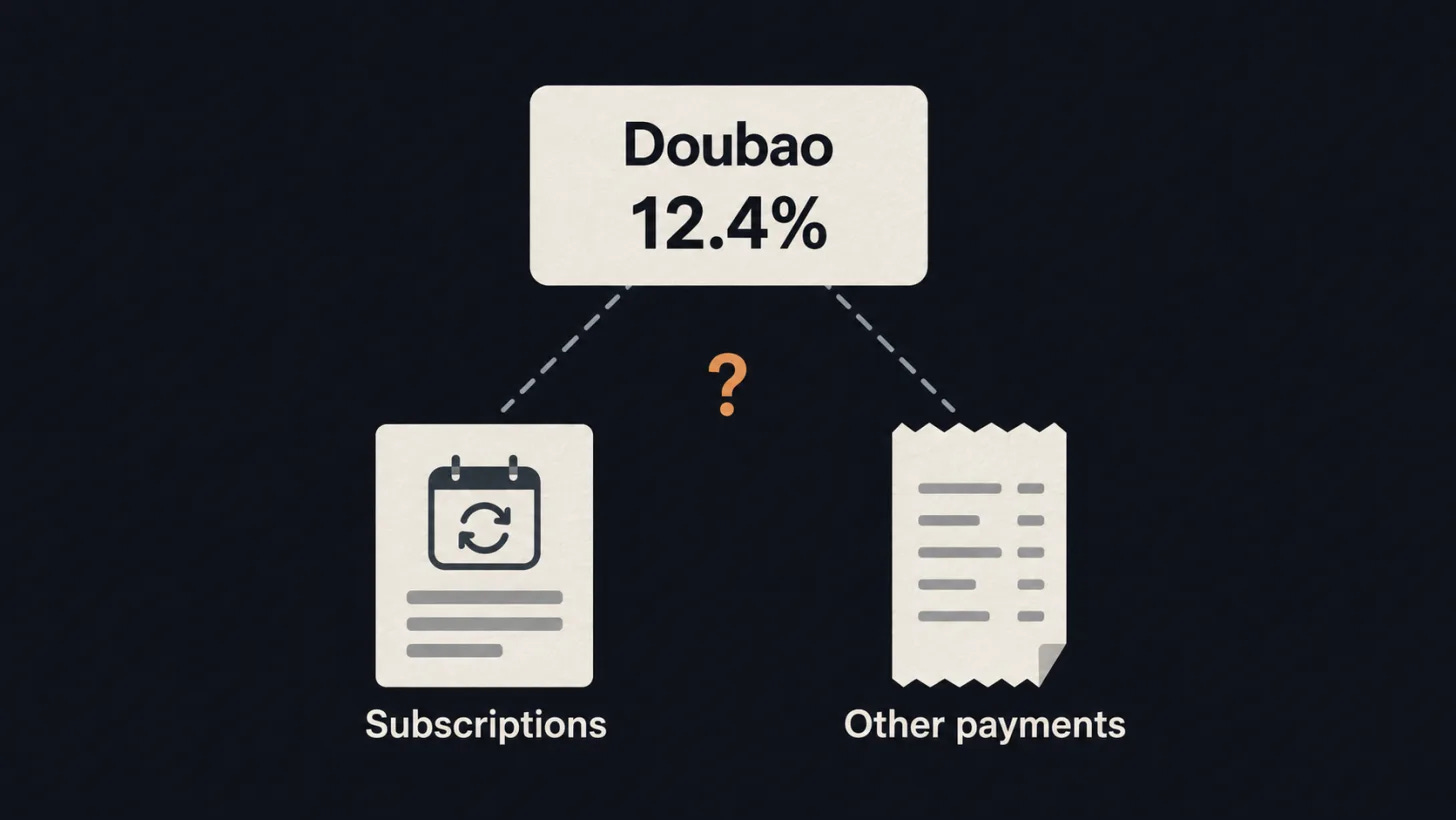
QuestMobile also reports a payment rate: monthly users who paid for anything inside an app, divided by that app’s monthly users. Among the ten apps it charts, Ant Afu, Ant Group’s health assistant, leads at 16.5%. Doubao is second at 12.4%. DeepSeek shows 7.1%, Qwen 5.9%, Yuanbao 5.7% and Kimi, Moonshot AI’s chatbot, 4.0%. Among users who spend more time than average in AI apps, Doubao’s rate is 19.1%.
The definition matters more than the ranking. QuestMobile counts users with any payment inside an app during the month. It does not say which payments it counts for DeepSeek, whose chatbot is free to use. Either way, the figure cannot be read as a subscription rate. It is also not comparable with the subscription conversion figures in my May piece.
If most of these users paid for transactions, the rate would say little about subscription adoption. ByteDance has opened both routes. In May 2026, Doubao’s App Store listing disclosed paid tiers under test at Rmb 68, Rmb 200 and Rmb 500 a month. From August 10, ByteDance charged hotels a 12% all-in fee on bookings routed through Doubao, according to a company disclosure cited by Yicai. The chart cannot show which of the two the 12.4% reflects.
Six Calls, Graded
Distribution owners win: holds. The November 2025 piece said “the winners will be distribution giants that bolt AI onto existing moats, not standalone innovators.” Both leaders belong to platform companies, and DeepSeek, the independent lab, lost ground. That result is consistent with the call. The report does not measure how much each parent platform contributed, so it supports the call without proving the mechanism. One part of that piece goes untested. It argued that the gap between AI features inside super apps and standalone AI apps would last. This report counts standalone apps only, so it cannot settle that half.
Tencent’s wall: holds. The February 2026 piece said “distribution power without product gravity produces downloads that do not convert to habits.” Yuanbao’s February curve fits that reading: a spike to 40.5m daily users, then a return to about 7m, near its starting level. Its penetration fell from 11.5% to 8.2% over the year.
Yuanbao at 100m: target open, reading withdrawn. The November 2025 piece asked whether Yuanbao could reach 100m monthly users by the end of 2026. By my calculation, it grew from about 33m in August 2025 to about 44m in August 2026. The December deadline is still ahead, but the reading I attached to a miss was wrong. I wrote that failure “would confirm that AI platforms require technical leadership, not just distribution muscle.” The data points the other way. DeepSeek, the lab best known for its model rather than its platform, lost share. The two apps that gained most had platform owners behind them.
User acquisition is over: wrong. In November 2025 I wrote that Qwen’s rebrand “marks the end of user acquisition and the start of execution hell.” I was wrong to call the acquisition phase over. Alibaba kept funding promotions and advertising as Qwen grew. The continued spending suggests paid acquisition is still part of the competition in China’s consumer AI.
Alibaba’s wall is reliability: untested. The February piece named reliability as Alibaba’s constraint, citing an agent that could take 10 million orders in nine hours and still deliver the wrong coffee. This report does not test that claim. Qwen’s user growth does not show whether its orders became more reliable.
ByteDance stays out: too strong. The February piece said ByteDance’s Spring Festival strategy “had nothing to do with” the consumer race between Yuanbao and Qwen. It treated the Gala mainly as a hardware and enterprise play. It also noted that Doubao handed out cash red packets without disclosing a total. Doubao joined late, on February 10. For the night of the Spring Festival Gala, China’s Lunar New Year television show on CCTV, the state broadcaster, it announced tech gifts and cash red packets. QuestMobile also estimates Doubao’s media ad spending at about Rmb 47m in the week to February 1, more than Qwen’s that week; most other weeks were close to zero. Doubao’s daily users were about 75m in January, peaked at 144.5m on Gala night and stood at about 114m at the end of February, the largest rise of the three. The ad spending and the rise in daily users point to a consumer acquisition effort as well. “Nothing to do with” was too strong.
Doubao had more weekly users despite a smaller share of the tracked ad spending. Before any holiday push began, it already had about 75m daily users. In June it accounted for 12.0% of media ad spending and 18.2% of influencer spending among the three tracked apps, and had more than three times Qwen’s weekly users.
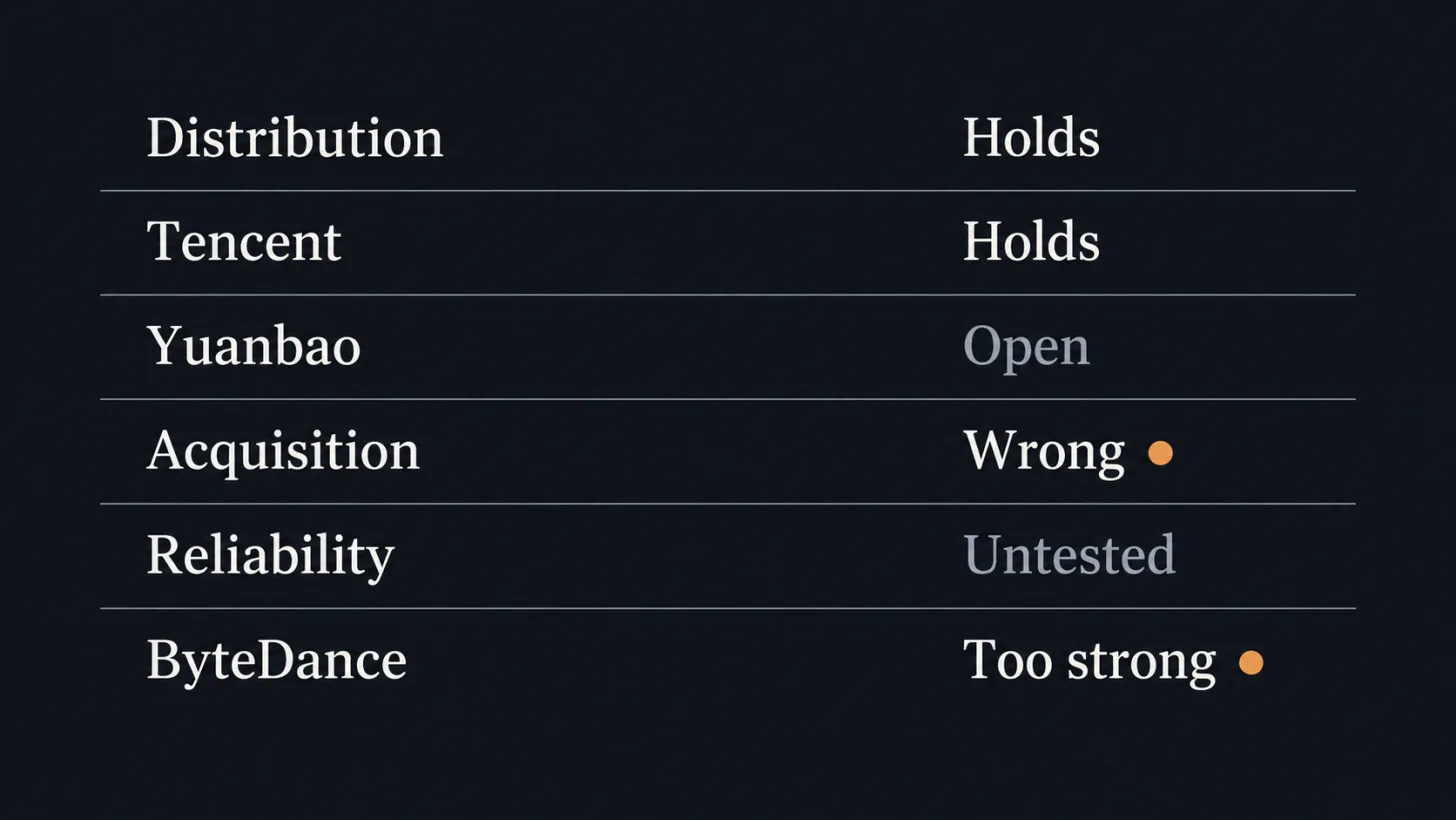
The largest revision in this scorecard is to Qwen. Two earlier pieces treated its position as a test of execution. This year it looked more like a test of spending. What I am watching is whether Qwen’s user base holds if Alibaba reduces its ad spending.
I really can't see how Doubao can keep racking up users by selling subscriptions. Ben Thompson said 1 thing that I strongly agree with: when it comes to utilities and software, no users in this world want to pay for them, ad model wins always