


Every Sunday I pick the China tech stories that mattered that week, say what I make of each, and link back to where I first wrote about it. Subscribe free
Two of this week's China tech stories started in the United States: Anthropic's record IPO, and Nvidia's first earnings call since Jensen Huang stepped down. Three came from China: results from Tencent and Alibaba, and a registry change at DeepSeek. Each headline came with a second line that changes how it reads. Those second lines are what this letter is about.
Anthropic raised $81.3bn. Zhipu and MiniMax keep raising.
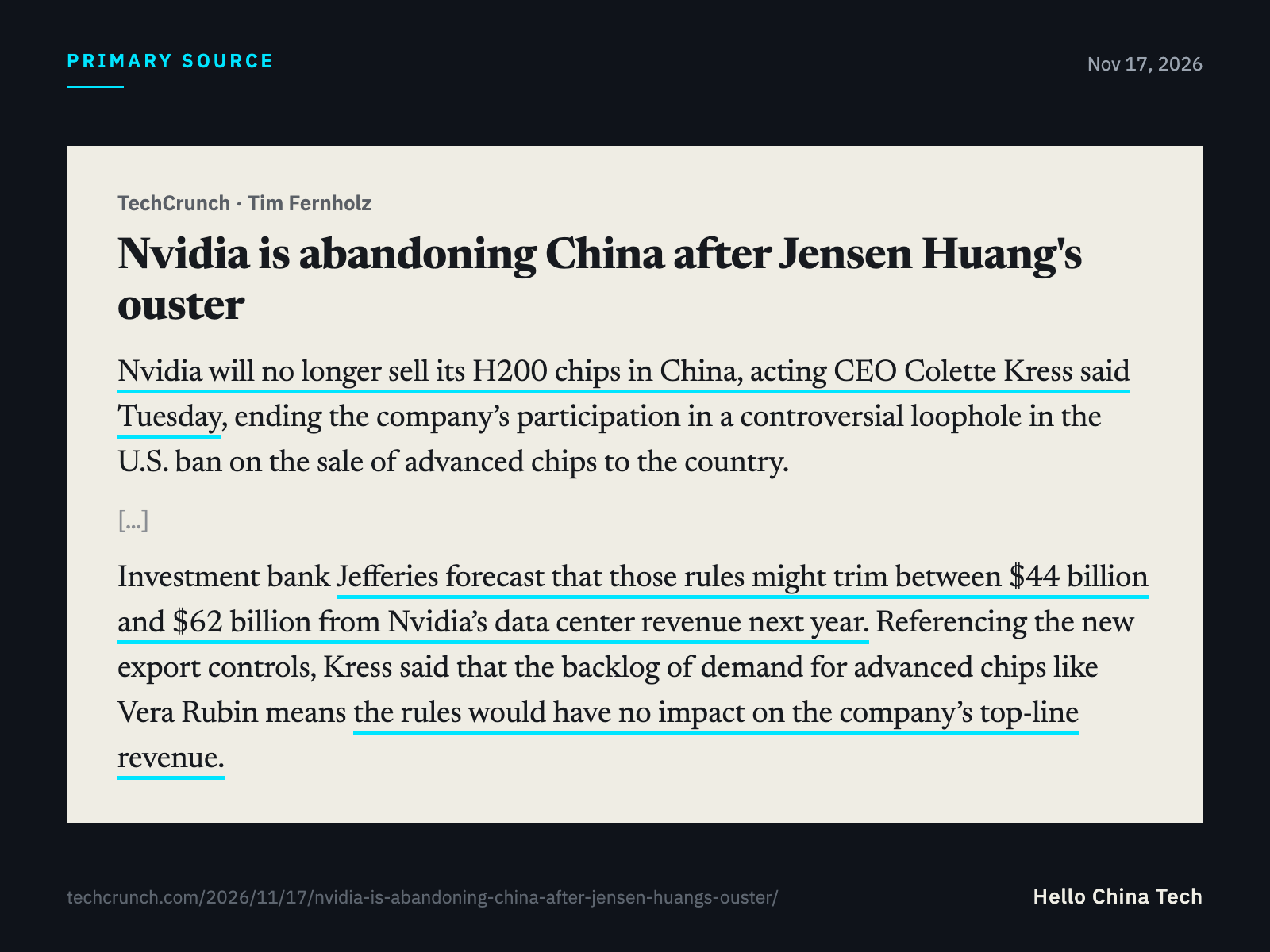
Anthropic raised $81.3 billion at $83 a share, CNBC reported, and began trading on Nasdaq on Thursday. The stock closed its first day at $97.17 and its second at $88.91, 8.5% lower, Reuters reported. Earlier that Friday in Hong Kong, MiniMax closed down 10.8% and Zhipu down 7.17%, Chinese business weekly Time Weekly reported. For those two listed Chinese AI labs, I think the size of Anthropic's raise is the contrast that matters. Both keep returning to the market before revenue can fund the next stage. In October I compared what the three companies' filings show about revenue and research spending.
The South China Morning Post quoted me on this on Thursday: for the many Chinese developers chasing users with free consumer apps and heavily discounted APIs, "heavy usage arrives as a compute bill before it arrives as revenue." SCMP
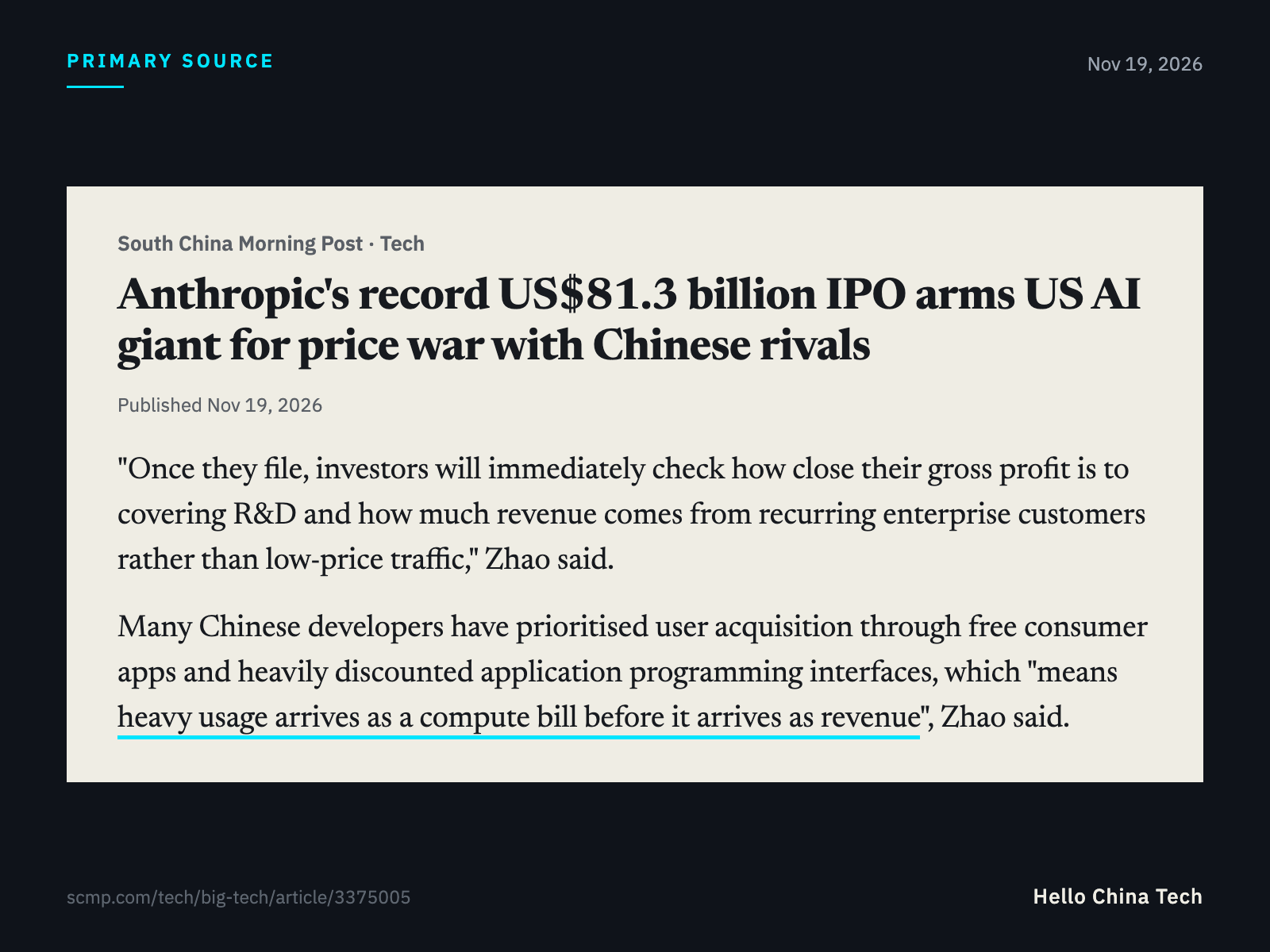
Nvidia says it will no longer sell the H200 in China.
Nvidia will no longer sell its H200 chips in China, acting CEO Colette Kress said on Tuesday, November 17, TechCrunch reported. A day earlier, the US issued rules barring advanced US chips from foreign data centers that serve Chinese customers remotely. I do not read the call as Nvidia leaving an open market. Its own August filing says licensed H200 sales "were restricted by the PRC government." On Monday, a day before the call, I mapped the three side channels Chinese buyers still use for Nvidia compute, and what Jensen Huang's exit puts at risk in each.
Tencent reported two profit figures that moved in opposite directions.
On November 18, WeChat owner Tencent reported third-quarter non-IFRS operating profit of Rmb 68.1bn, down 6% year on year. Excluding new AI products, the same measure rose 8% to Rmb 83.3bn, after growing 19% in the second quarter. The gap between the two figures is the net effect of the new AI products, counting both their revenue and their costs, so I would not quote it as Tencent's AI spending. This week I worked through which part of Tencent slowed between the two quarters.
Alibaba's CEO expects Chinese chips to train most of its models.
On Alibaba's November 19 earnings call, CEO Eddie Wu said he expects most models from Alibaba, its partners and its customers to rely on domestic chips for pre-training and post-training, Chinese business outlet Yicai reported. Through an interpreter, Wu said Alibaba expects to begin mass production of its V900 chip in the first quarter of 2027. Later in the call he said, again through the interpreter, that building on its own proprietary chips "is structurally advantageous for our gross margin." That is the chip owner's margin claim, a different measure from training cost. For my October report on China's AI chips I collected the 12 public readings that come closest. None compares the total cost of the same training job on Chinese and Nvidia hardware.
DeepSeek's registry shows who came in. It does not show how much.
DeepSeek's corporate registry now lists one new shareholder, a Hangzhou partnership, according to Qichacha registry data cited by Chinese business outlet Yicai on November 19. Over the same period, that partnership added 31 partners. Tencent and battery maker CATL, through three funds, tie for the largest stake in the partnership. The registry change does not show the size of the round.
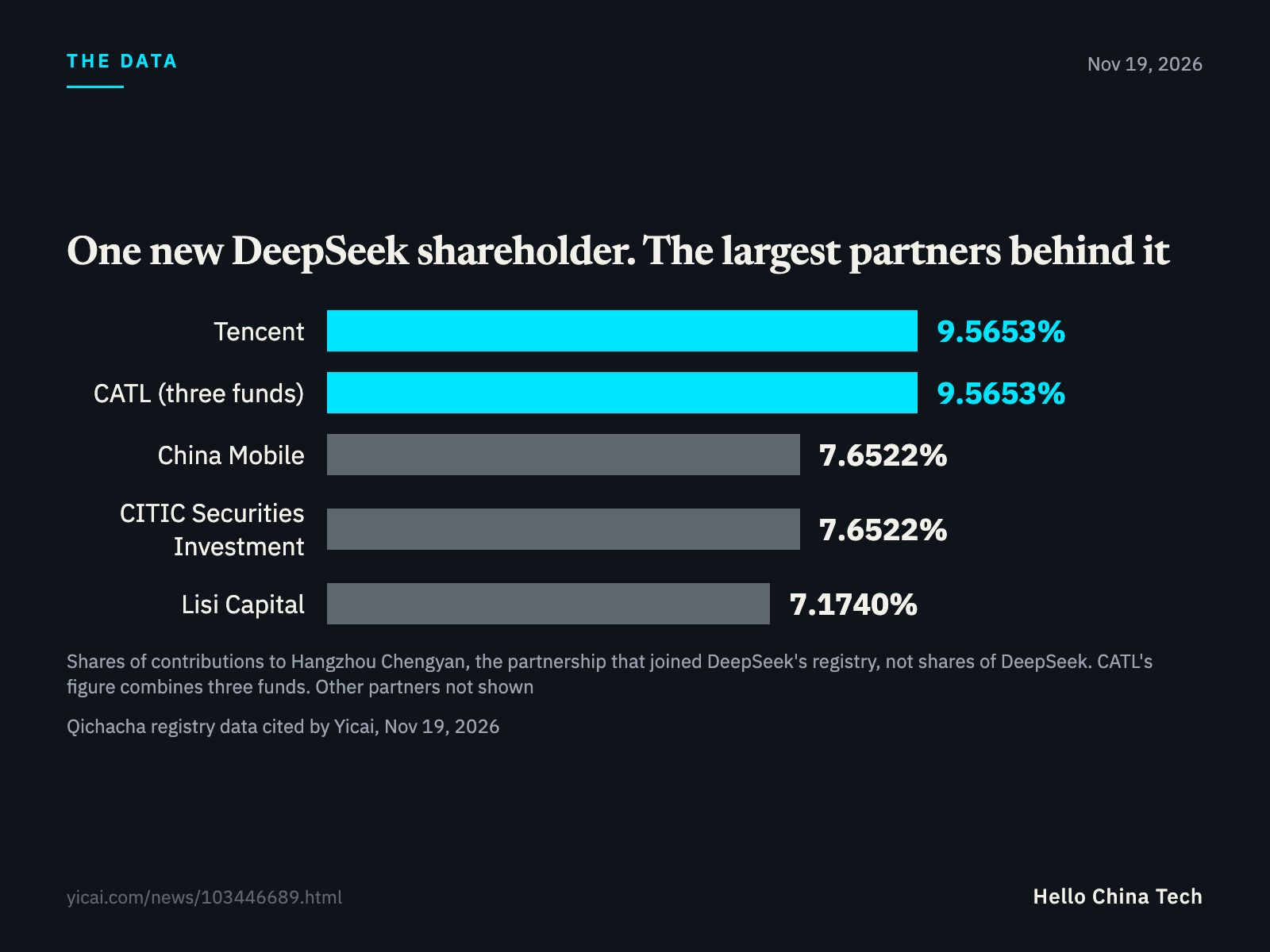
The stakes are shares of the partnership, so I would not read them as stakes in DeepSeek. In October I wrote that DeepSeek "is filling a shareholder list before an IPO filing."
Also this week:
Baidu and Google Made the Same Search Promise: One promise made by two search companies in the same quarter, with opposite results.
XPeng and the Tax Clock on China's EV Exports: XPeng's overseas margin advantage, just as Beijing trims the export rebate for new-energy vehicles.
Next week I publish my analysis of the US rules issued on November 16 on remote access to advanced chips from foreign data centers. The question I am working through is which Chinese company's accounts show the cost first.
$150/year, or $20/month. You can also buy any single piece at the end of its free preview ($5 for a deep dive, $3 for a FlashPoint).
Poe