

Since May 2025 I have written about China’s AI chips one listing, one teardown and one export rule at a time. Read one by one, those pieces answer an old question: can Chinese chips train large AI models? By mid-2026 the public record says yes, at least in company claims. This report takes up the harder question that replaced it. What does it cost to run AI on China’s own chips, who is paying, and what decides when the gap closes?
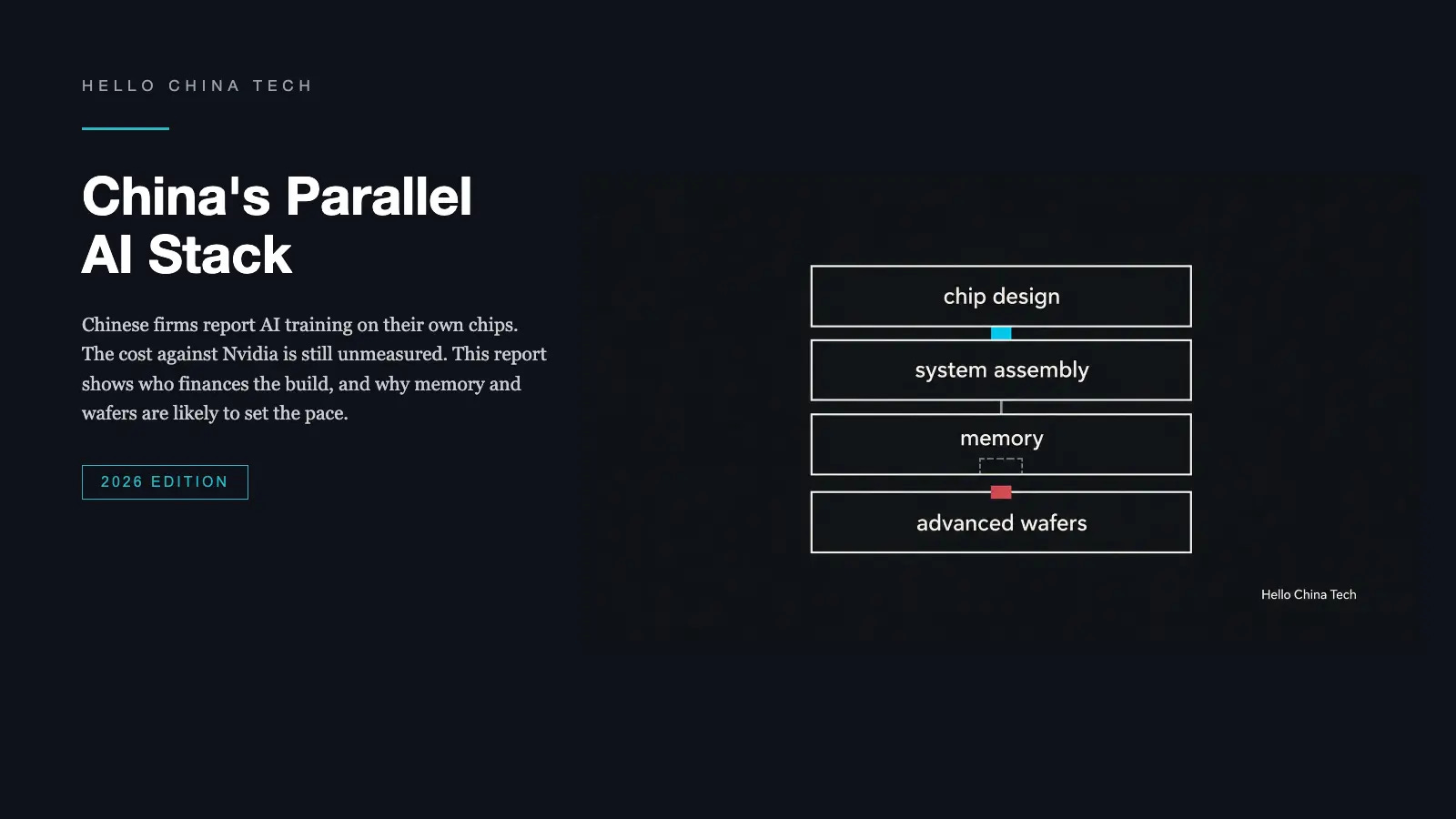
My core argument: China’s parallel AI stack is furthest along in chip design and system assembly, and weakest in memory and advanced wafers. The cost gap is real but unmeasured. What the accounts do show is how the build is financed.
Five findings from the report:
The cost comparison does not exist yet. I collected the 12 public readings that come closest. None compares the total cost of the same training job on Chinese and Nvidia hardware. The report sets out the four readings a fair comparison would need.
Sales do not yet pay for the build. In the first half of 2026, six listed Chinese AI chip designers used about Rmb 8.4bn of operating cash and held Rmb 23.93bn of inventory. Cambricon, a Shanghai-listed chip designer, paid suppliers with bank acceptance bills that rose from Rmb 351m to Rmb 3.1bn in six months.
Two gates shape demand. Nvidia’s latest quarterly filing says its licensed sales to China “were restricted by the PRC government” and that US controls have “effectively foreclosed” it from the market. In September a state security evaluation added Huawei’s Ascend 950 to its list of AI chips that have passed.
Memory is the scarcest input. Teardowns of two samples of Huawei’s Ascend 910C accelerator found Samsung and SK Hynix memory, according to Bloomberg. In September Reuters reported higher prices for Huawei’s newest training card as memory ran short.
Some layers need no Chinese version. In optical modules, Chinese firms already supply the global AI build. Dependence there runs both ways.
Where my earlier calls were wrong or are still open, I say so in the chapter where it matters, and name the assumption that failed. The report closes with six directions to watch and a short guide to reading the next chip headline.
Read the free sample (Executive Summary and Chapter 1)
Paid subscribers pay $49 for this report instead of $99. The report draws on the analysis they read each week. If you want the next one as it develops, subscribe below.