

On November 12, Jensen Huang resigned as president, chief executive, and board member of Nvidia, effective immediately, with CFO Colette Kress named interim CEO.
Wall Street analyst Dan Ives called it a "dream scenario for China" over time, telling The New York Times that Huang and Nvidia were "the biggest gating factor between the U.S. and China." The Times reported that losing Huang as an industry bridge to Washington could accelerate China's push for chip self-sufficiency as firms brace for tighter US controls. I was quoted in that report on the short-term risks for Chinese AI labs and the conditional upside for domestic chipmakers. Nvidia's Form 10-Q for the quarter ended July 26, 2026 identifies another constraint: Chinese restrictions on licensed chip sales. Even after Washington licensed its H20 and H200 chips for China, "such sales were restricted by the PRC government."
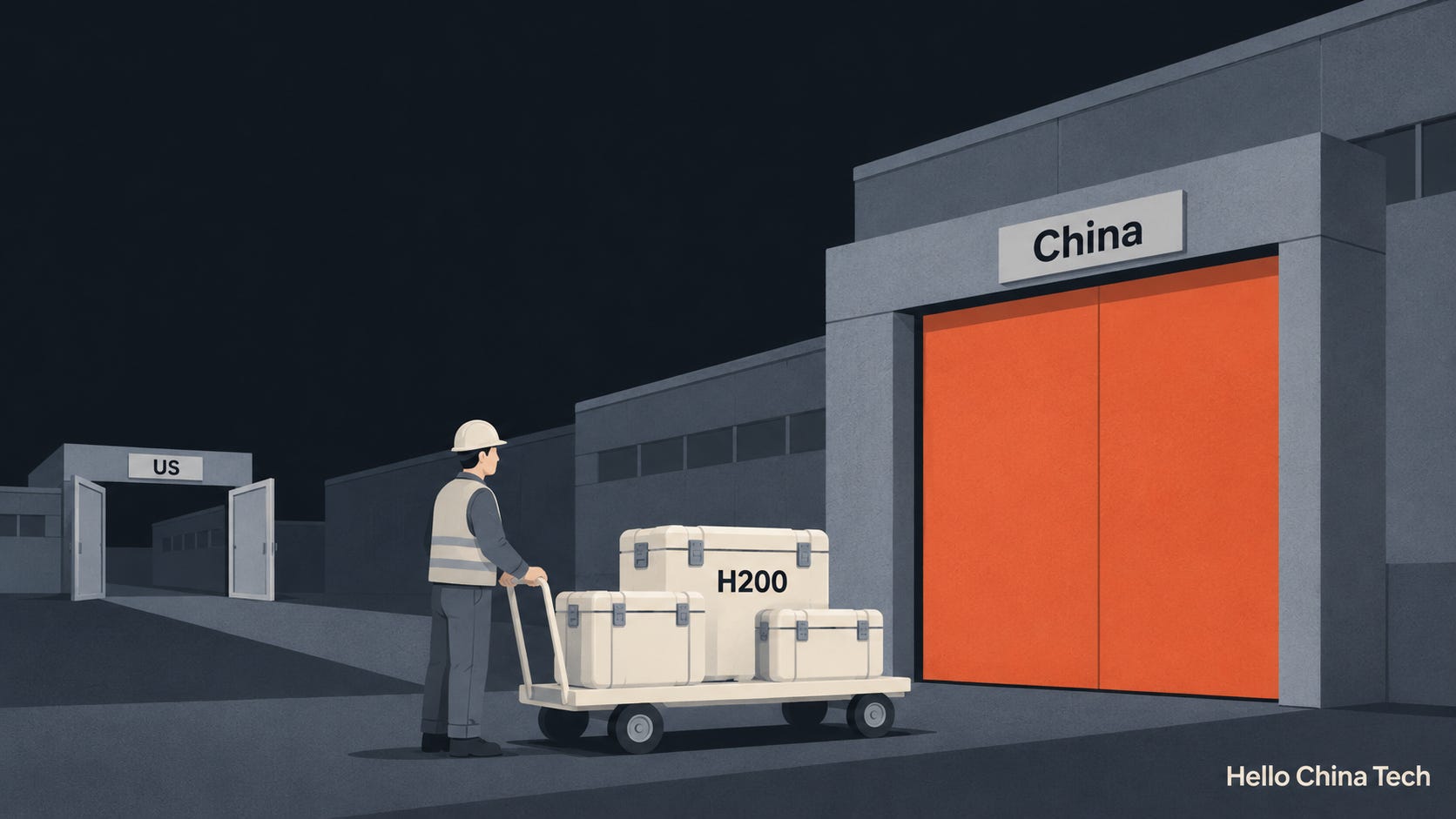
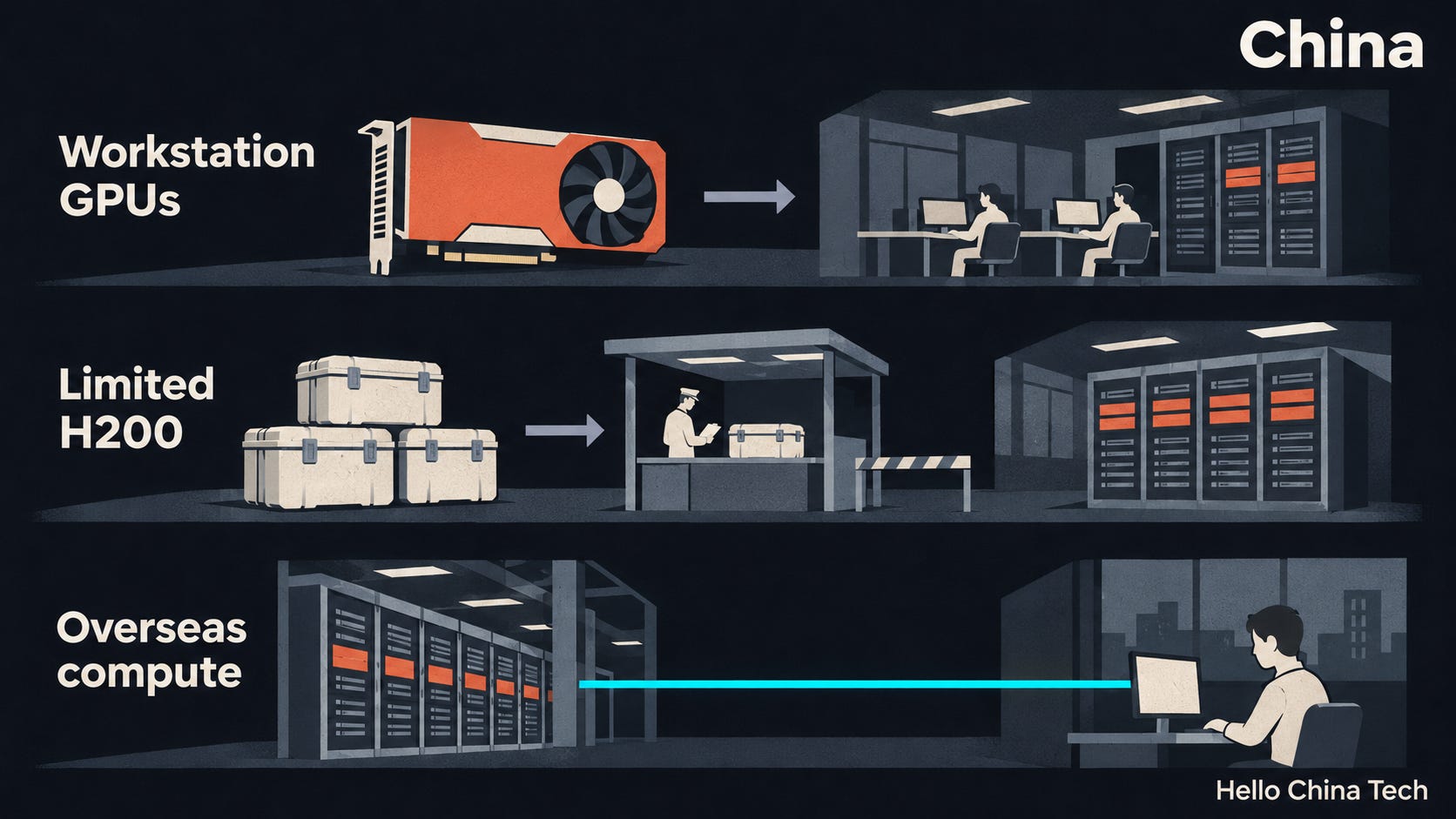
Beijing had already shut the front door to large-scale imports of the data-center chips China wanted most. What Huang's exit threatens are the three side channels Chinese buyers still use: export-compliant gaming and workstation cards, limited H200 supplies, and rented compute in overseas data centers.
Hello China Tech reads China's AI, chip, robotics and EV sectors from primary sources that English coverage rarely reaches. Subscribe free to get each new analysis as it publishes.
The Front Door Was Already Shut
Any US data-center chip sold into China passes two gates, a structure I called The Demand Gate in our October report on China's AI stack. Both governments use approvals to direct chip flows, on opposite sides. Washington controls supply by deciding what may ship. Beijing controls demand by deciding what buyers may purchase and where it runs.
On January 15, the US Commerce Department's Bureau of Industry and Security moved H200 and equivalent chip exports to China and Macau from a presumption of denial to case-by-case review. Exporters must certify four conditions: sufficient US supply, no foundry capacity diverted from US customers, recipient security procedures, and third-party US testing. The rule also caps cumulative exports to China and Macau at 50% of US shipments of the same products, measured by total processing performance. Because overseas-made H200s must enter the United States for inspection before shipping to China, they trigger a 25% US import tariff. Nvidia says it has been unable to pass that tariff on to customers.
Beijing held the second gate closed. Washington began licensing the lower-spec H20 in August 2025 and the H200 in February 2026. In both cases, Nvidia's August 10-Q states, "such sales were restricted by the PRC government." Nvidia could not sell its H20 inventory, and for the H200 it wrote that "we have been unable to sell all the products for which we have licenses." It recorded a $0.4bn charge for H200 excess inventory and purchase obligations in the first half of fiscal 2027 "as the demand for H200 products diminished." Second-quarter China Hopper shipments were "less than 1% of Data Center revenue."
Nvidia's 10-Q also cites a Chinese Action Plan setting standards for compute performance per watt and per unit of memory bandwidth in new and renovated data centers. Returning to scale requires a product that "meets the approval of both the USG and the Chinese government."
Reuters reported that Washington had approved H200 sales to 10 Chinese firms in May, while Beijing imposed its own constraints on imports. Beijing has since allowed limited entry while withholding approval for large-volume imports. Reuters reported on November 5 that about 600,000 H200s were stored in Hong Kong awaiting mainland clearance. Several major Chinese internet companies had each obtained about 10,000 chips in recent months, its sources said.
The Side Channels Chinese Buyers Still Use
If Beijing blocked large-scale data-center imports, how did Nvidia still hold 34% of China's AI accelerator market in the first half of 2026? According to data from market research firm IDC reported by Reuters, Nvidia shipped 678,000 accelerators in China, down 44% year on year, while remaining first by volume. IDC did not disclose which models made up that 34%.
Nvidia's 10-Q identifies a product category still reaching China: "while we were able to ship uncontrolled products to China, such as gaming and workstation GPUs, we were effectively foreclosed from competing in China's data center computing/compute market."
The first channel is export-compliant gaming and workstation cards. Sitting below US data-center thresholds, they can be imported legally for inference and smaller training clusters. According to Reuters, Chinese tech groups Alibaba, TikTok owner ByteDance, and Tencent ordered over 3 million RTX Pro 5500 workstation GPUs. Their combined list value reportedly topped $35bn.
The second channel is limited H200 supply. Obtaining roughly 10,000 H200s each gives major internet companies access to high-bandwidth memory for model training. Reuters cited a July report by The Information that Chinese officials had told major tech firms they could buy limited H200s for training, potentially under 200,000 chips in total. Officials directed them to prioritize domestic processors for inference.
The third channel bypasses Chinese customs by renting compute overseas. Carthage Capital founder Stephen Wu told AFP that "US export controls restrict where a chip is shipped, not who uses it," letting Nvidia GPUs sit in Malaysia's Johor region "in full compliance while a customer in Shenzhen logs in." White House adviser Michael Kratsios said this summer that Beijing-based Moonshot AI had used high-end Nvidia chips in Thailand. In recent days, Chinese companies in Malaysia have begun racing to lease data-center space with advanced US chips before new restrictions arrive, a data-center executive told the New York Times.
Unofficial imports provide another source of restricted hardware inside China, at a steep premium. Grey-market quotes in mainland China for an eight-card H200 server reportedly topped Rmb 6m in late October, about three times the price a year earlier, according to Reuters. A November 13 Reuters review of more than 150 tenders, investment plans, and disclosures identified over Rmb 23bn ($3.2bn) in Chinese data-center projects specifying restricted Nvidia chips. That figure includes buildings, power infrastructure, and unbuilt proposals, pointing to demand outside official import channels.
Washington Targets the User and the Threshold
Those three side channels rest on regulatory lines in Washington, where Huang argued for continued US chip sales to China. He warned that cutting China off would hand a $50bn market to Huawei, the Chinese telecoms and AI chip supplier, and weaken the US tech stack. In an October Fortune interview, he said Nvidia "could be of great service" to China while putting US customers first. Trivium China analyst Joe Mazur told the New York Times that Huang's exit could "embolden the voices in Washington that are less in favor of cooperation, more in favor of a hard-line approach." Fortune reported on November 10 that three House committee chairs had requested a private briefing with Huang. The proposed date was November 18, the day after Nvidia's third-quarter earnings.
Without Huang lobbying in Washington, US regulators could restrict those channels in two ways. First, enforcement can shift from the shipping address to the user. Sunny Cheung of the Jamestown Foundation told Reuters that Washington must look beyond "who buys the chips on the surface and start examining who ultimately uses the computing power." Nvidia's 10-Q notes that US licenses already limit foreign firms from offering large GPU clusters as a service. Nvidia's August 10-Q also cited proposed legislation, the Remote Access Security Act, which could bar cloud providers from serving firms with an ultimate parent headquartered in China. If Washington tightens rules on remote access and intermediaries, Southeast Asian compute rentals and grey-market resellers would face direct restrictions.
Second, Washington can restrict lower-performance products. Nvidia warns in its 10-Q risk factors that "if the USG expands such controls to restrict additional gaming products," it could disrupt supply chains and sales. The reported RTX Pro 5500 orders face that risk.
The paid section compares the disclosed domestic-training results and sets out three checks for Nvidia's next filing.
What follows is a task-by-task reading of where Meituan and iFlytek place the training gap on Chinese chips, and the three lines in Tuesday's 10-Q that will show which channel Washington hits next. Only need this article? Buy the full article as a PDF for $5. No subscription needed.