

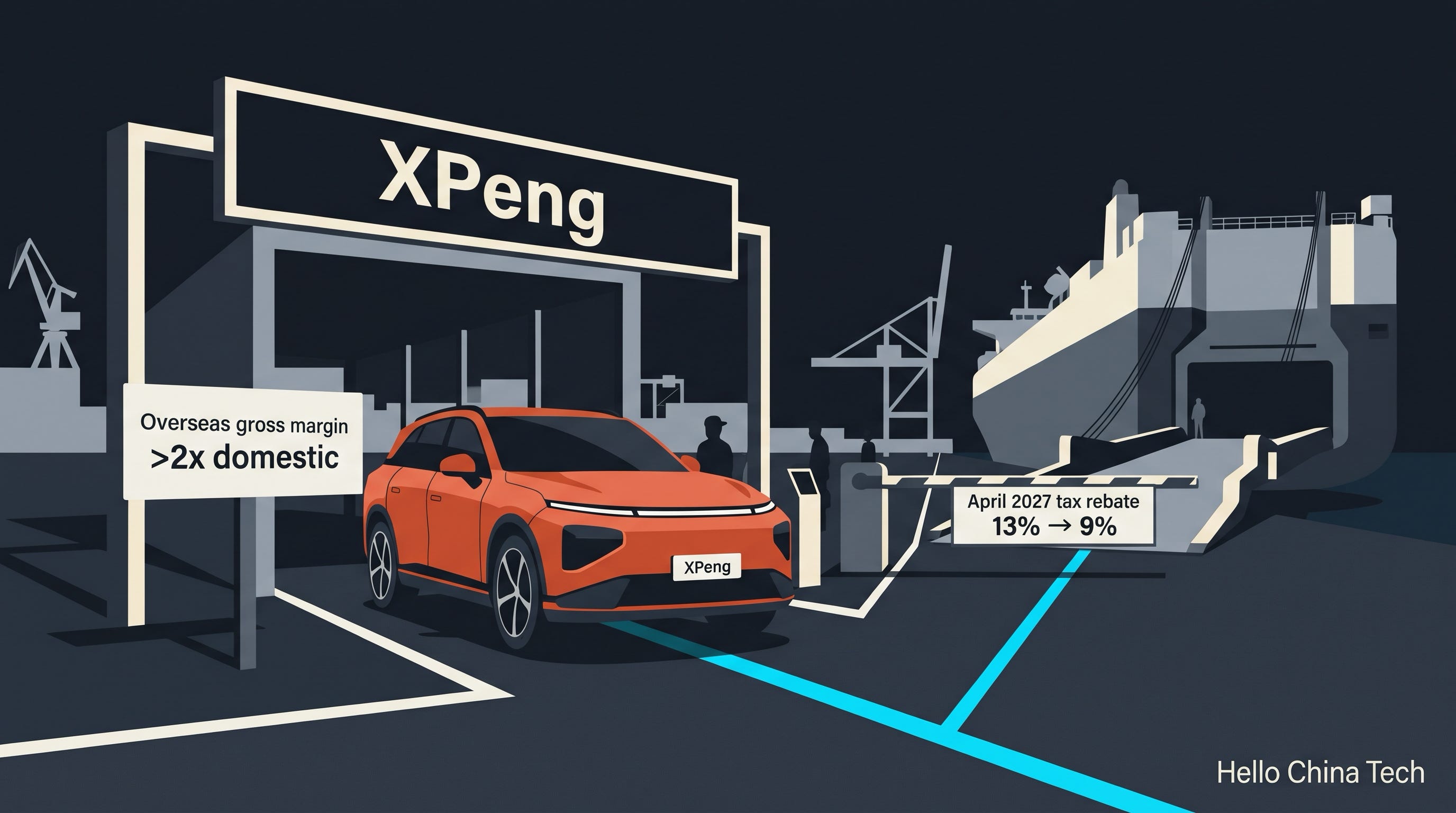
FlashPoint is our paid quick-strike column on market-moving China tech events. Today: XPeng's third-quarter call quantifies its overseas margin advantage, just as Beijing trims the export tax rebate for new-energy vehicles. In September, Hello China Tech examined how BYD uses overseas gross profit to offset domestic weakness and why China's auto export valve has an expiry date.
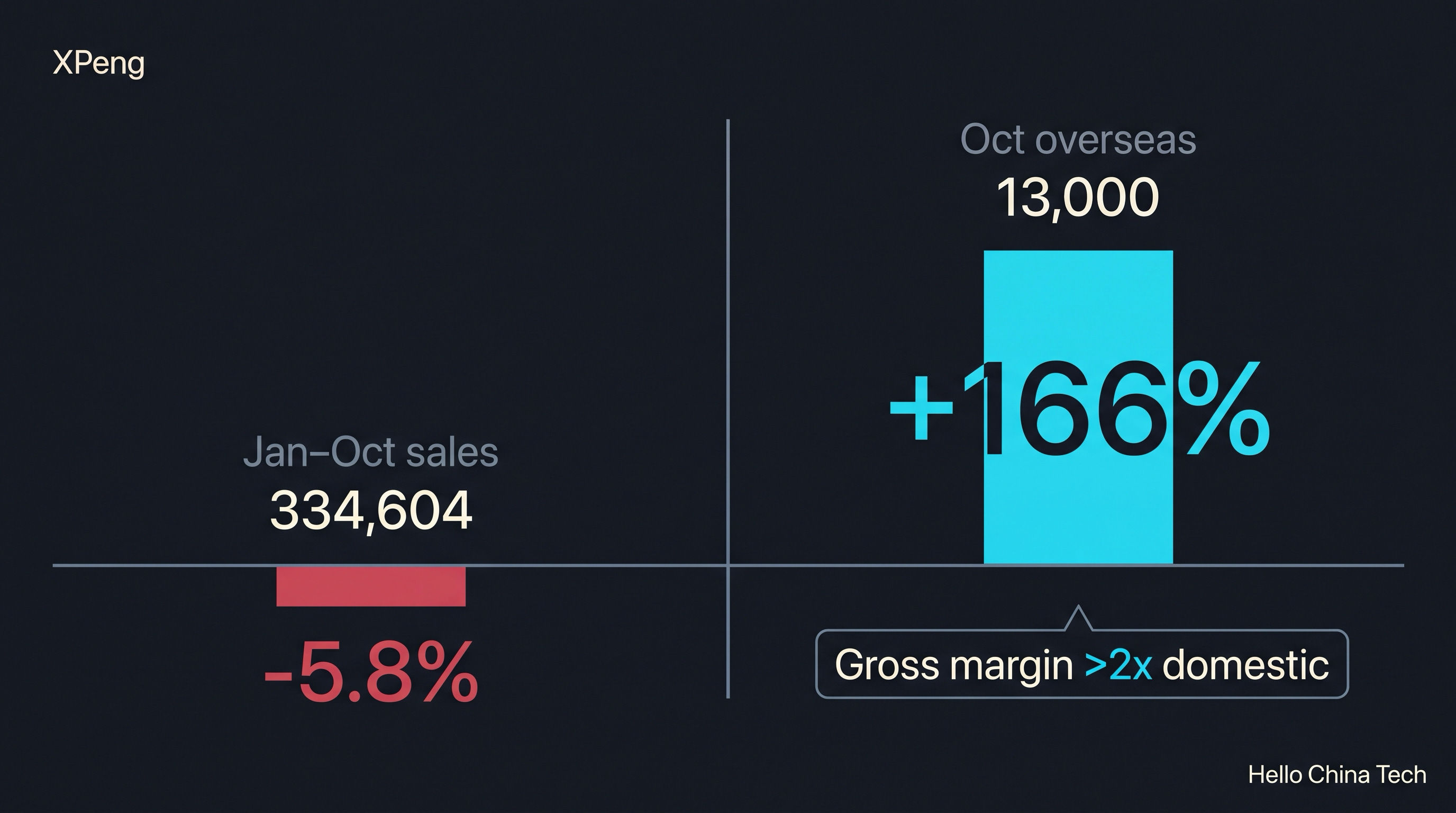
On November 16, XPeng, a Guangzhou electric-vehicle maker listed in New York and Hong Kong, reported third-quarter revenue of Rmb 24.28bn ($3.62bn), up 19.1% year-on-year. Vehicle gross margin rose one percentage point from the second quarter to 13.1%, while net loss widened 127.9% year-on-year to Rmb 868m ($130m). Finance vice-president James Wu said exports topped 20% of third-quarter volume, with overseas gross margin more than twice the domestic rate and net profit contribution at several times the domestic level. I read XPeng's overseas profits as funding for domestic competition and AI spending. The April rebate cut adds an incentive for Chinese carmakers to assemble abroad.
Hello China Tech reads China's AI, chip, robotics and EV sectors from primary sources that English coverage rarely reaches. Subscribe free to get each new analysis as it publishes.
XPeng's delivery split shows where sales are growing. Third-quarter deliveries rose 2.1% year-on-year to 118,390 cars, and ten-month sales fell 5.8% to 334,604. Overseas deliveries jumped 166% year-on-year in October to 13,000, a quarter of XPeng's 50,237 monthly total. A Xinhua Finance and Bread Finance tally put October vehicle sales at 23 listed Chinese carmakers at 2.50m, down 1.76% year-on-year, while new-energy vehicle sales at 19 reporting companies rose 15.13% to 1.72m. In total vehicle sales, exports topped half of October volume at Chery (67.8%) and Great Wall Motor (52.2%) and doubled year-on-year at Geely and BYD. On October 12, China's finance ministry and tax authority said the value-added tax export rebate for new-energy vehicles will drop from 13% to 9% on April 1, 2027. That category covers battery-electric, plug-in hybrid and fuel-cell models. Below: a breakdown of XPeng's overseas profit sources, management's three-part response to the rebate cut, and two measures to track exports through June 2027.
What follows is the margin and tax math behind XPeng's distributor model and European carbon credits, why the four-point VAT cut favors knock-down assembly over finished-car shipments, and the April export test that could prove the front-loading thesis wrong. Only need this article? Buy the full article as a PDF for $3. No subscription needed.