

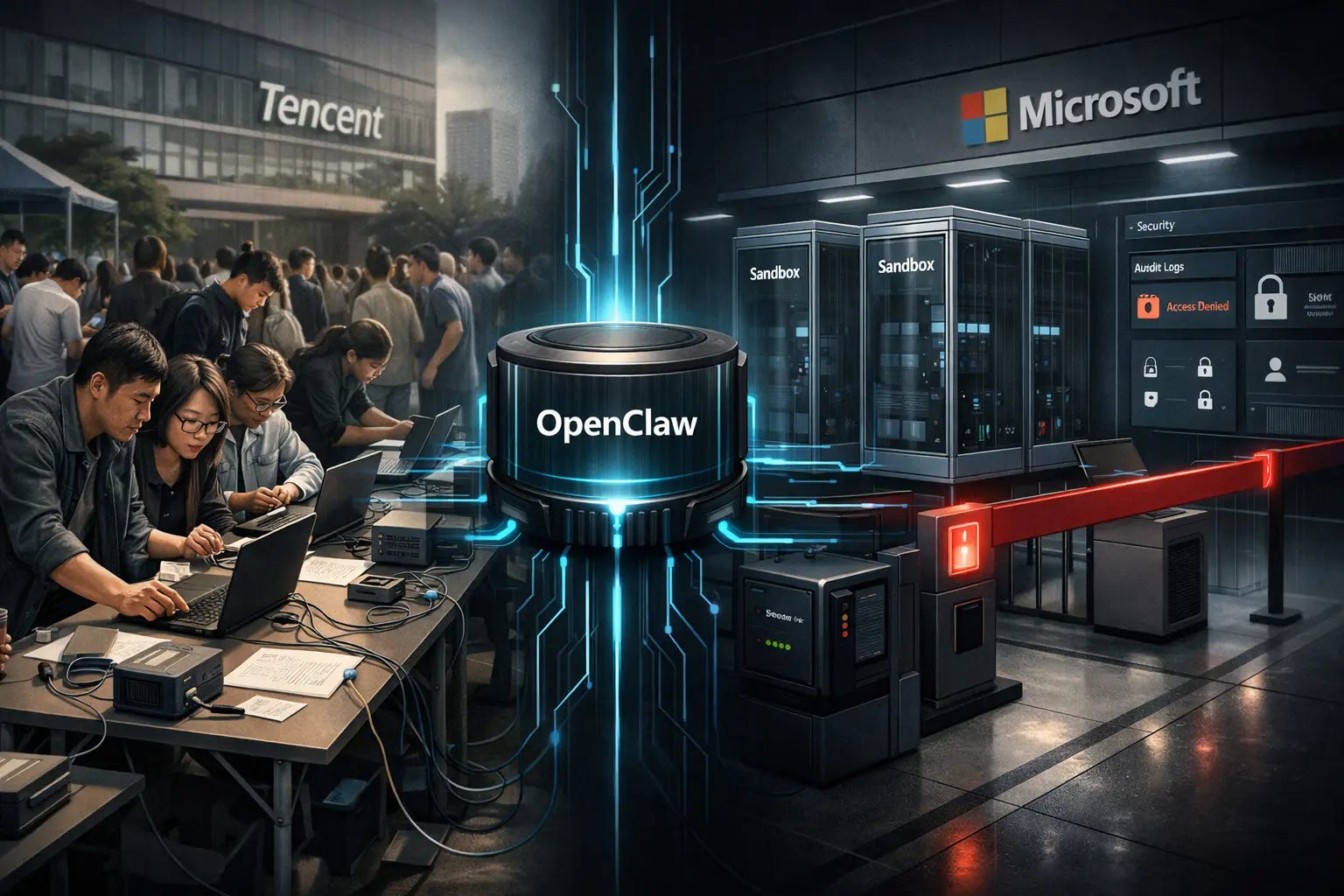
On March 6, Tencent engineers set up folding tables outside the company’s Shenzhen headquarters and spent the day helping strangers install free software on personal devices. Some visitors carried NAS drives. Others brought MacBooks. A few showed up with mini PCs under their arms. Appointment slots ran out within an hour. The software was OpenClaw, an open-source AI agent built by Austrian engineer Peter Steinberger that can browse the web, write and debug code, manage calendars, send emails, and execute multi-step tasks autonomously through messaging platforms like Slack, WhatsApp, and Telegram.
The project took roughly 100 days to become the most-starred repository in GitHub history. Of the more than 142,000 publicly visible OpenClaw instances tracked by monitoring platforms, nearly half originated from China. Less than three weeks earlier, Microsoft’s security research team had published a detailed warning advising enterprises to treat OpenClaw as untrusted code execution, to be run only inside fully isolated sandbox environments with minimal permissions. Never on a regular workstation.
Same technology. Opposite first instincts. And a broadly similar pattern emerged across many of the major tech companies in both countries. OpenClaw became a controlled experiment of sorts: an identical open-source AI agent arrived in the world’s two largest technology ecosystems at the same time. What each side chose to do with it tells us something about where the real divergence in AI strategy now sits.
Absorb First, Diverge Fast
China’s tech establishment responded with a speed that startled even domestic observers. Within weeks, Alibaba Cloud, Baidu Cloud, Tencent Cloud, and ByteDance’s Volcano Engine had all launched one-click deployment services. Moonshot AI and MiniMax built hosted versions around their own models. On Meituan, China’s largest local services platform, users could purchase remote OpenClaw installation the way they might order food delivery. In Shenzhen, a district government drafted subsidy policies offering up to two million yuan for OpenClaw skill development. Paid installation services appeared on Xianyu, Alibaba’s secondhand marketplace, typically charging $7 to $40 for remote setup and up to $100 for in-person visits.
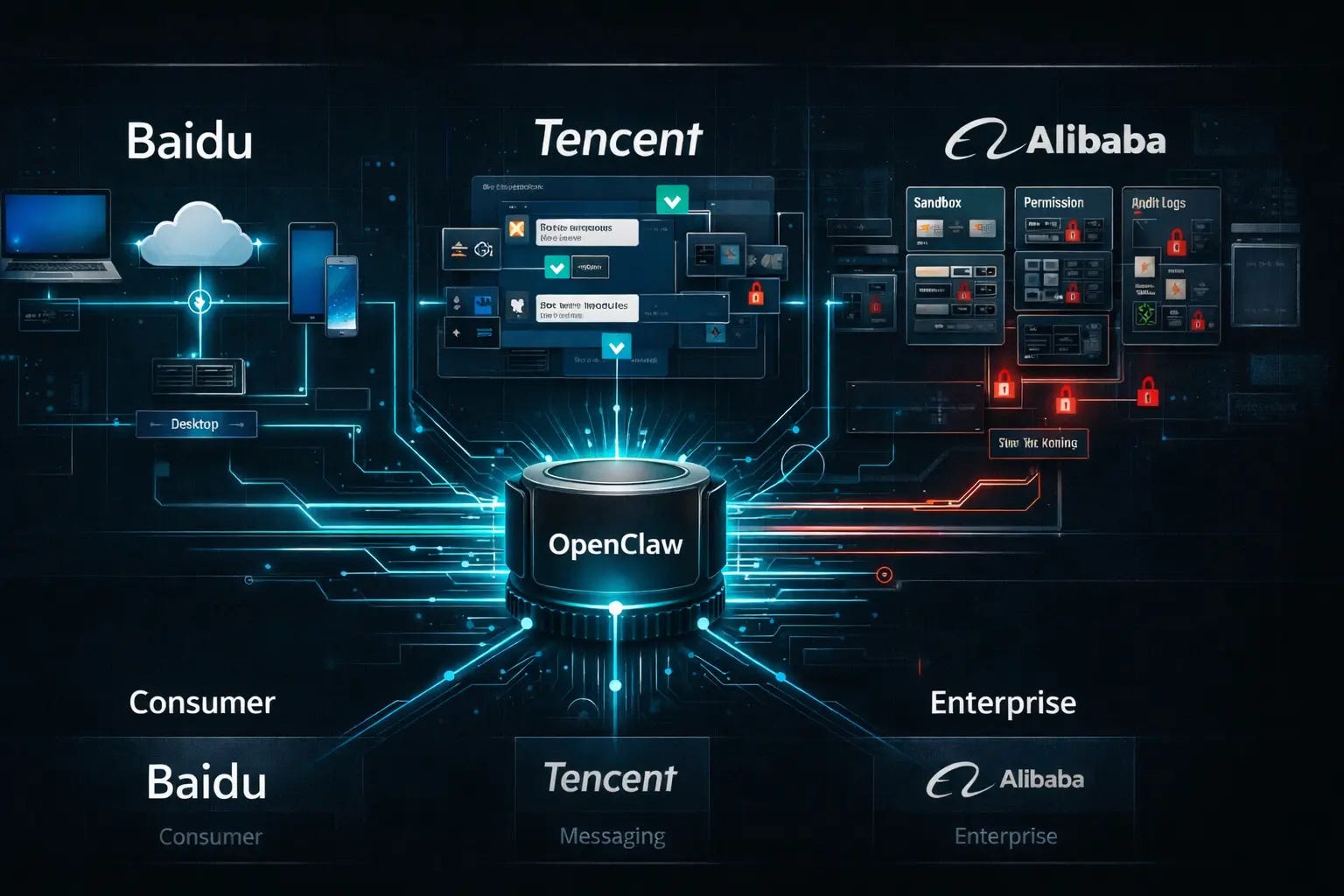
The shared initial impulse was to lower every barrier and get agents running as quickly as possible. But the divergence came fast. Baidu leaned toward consumer-facing saturation, releasing what Chinese media called the “lobster family bucket” (a play on OpenClaw’s lobster mascot): agent products spanning desktop, cloud, mobile, and smart home, all wired into Baidu’s model and search capabilities. Tencent moved to lock down messaging entry points under a risk-controlled framework, launching three agent products on a single day that covered personal WeChat, enterprise chat, and WeChat Work bots. Alibaba bypassed the consumer scramble entirely, launching Wukong, an enterprise agent platform built on DingTalk with sandboxed execution, permission controls, and full audit logging. As one analysis put it, China’s big tech went from carnival to divergence within weeks.
What ByteDance Learned the Hard Way
To understand why OpenClaw succeeded in China, it helps to look at what failed three months earlier.
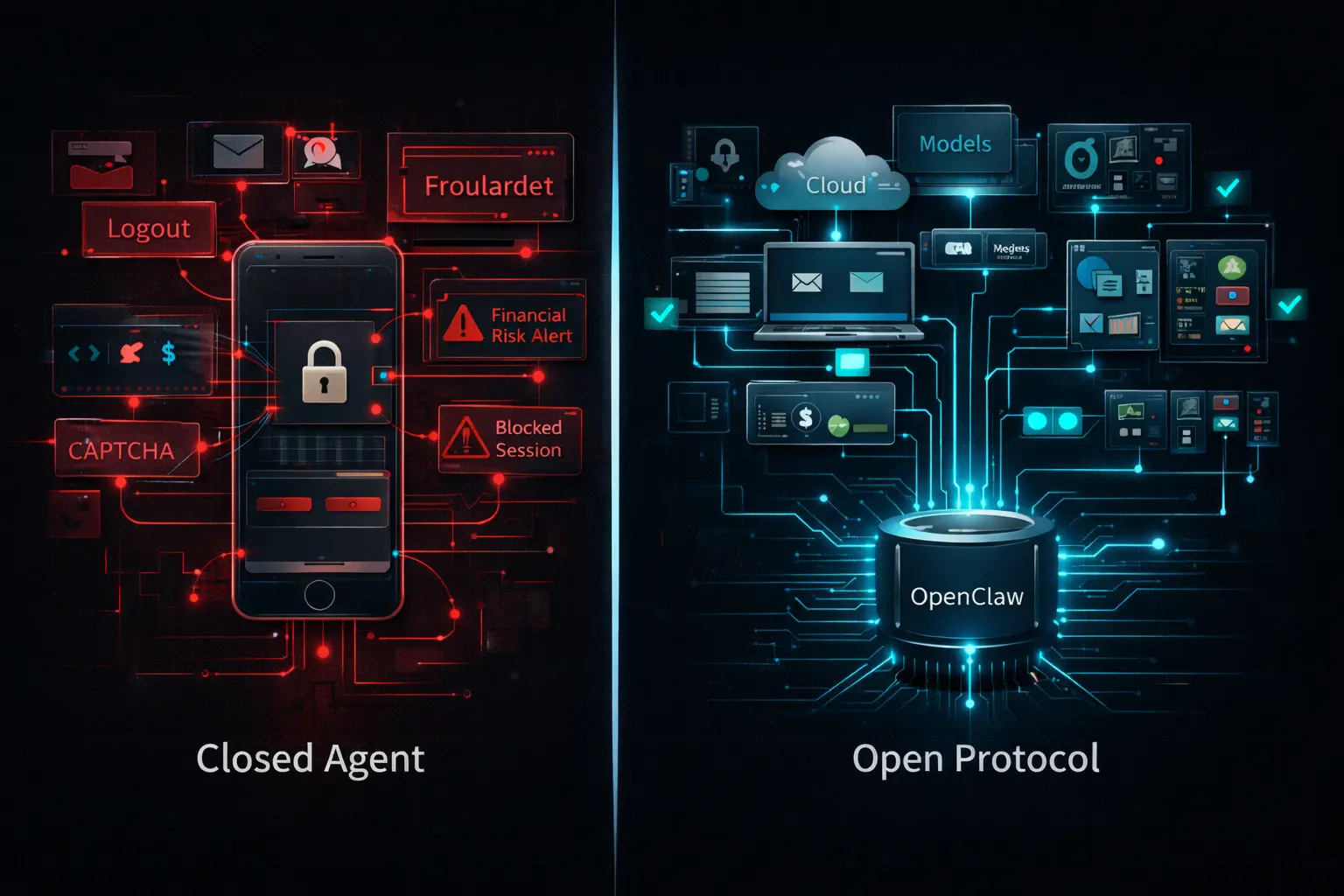
In December 2025, ByteDance launched Doubao Phone Assistant, an AI agent embedded in a smartphone that used screen-reading technology to operate apps on the user’s behalf. The pitch was functionally identical to OpenClaw: AI that completes real tasks across multiple applications. Within 48 hours, WeChat forced users to log out. Taobao triggered CAPTCHA challenges. Financial apps flagged security risks. ByteDance retreated. The problem was architectural. A closed agent controlled by one company was sitting between users and every app on their phone, collecting interaction data along the way. Super-apps treated it as a hostile act.
OpenClaw arrived with a broader feature set and met the opposite reception. Users choose their own model, their own cloud, and their own deployment environment. Data stays on the user’s machine. No single company sits in the middle. Cloud vendors gained infrastructure revenue. Model providers gained a distribution channel. Messaging platforms faced integration rather than displacement. OpenClaw succeeded in China because it generated revenue for everyone in the stack instead of threatening any single player.
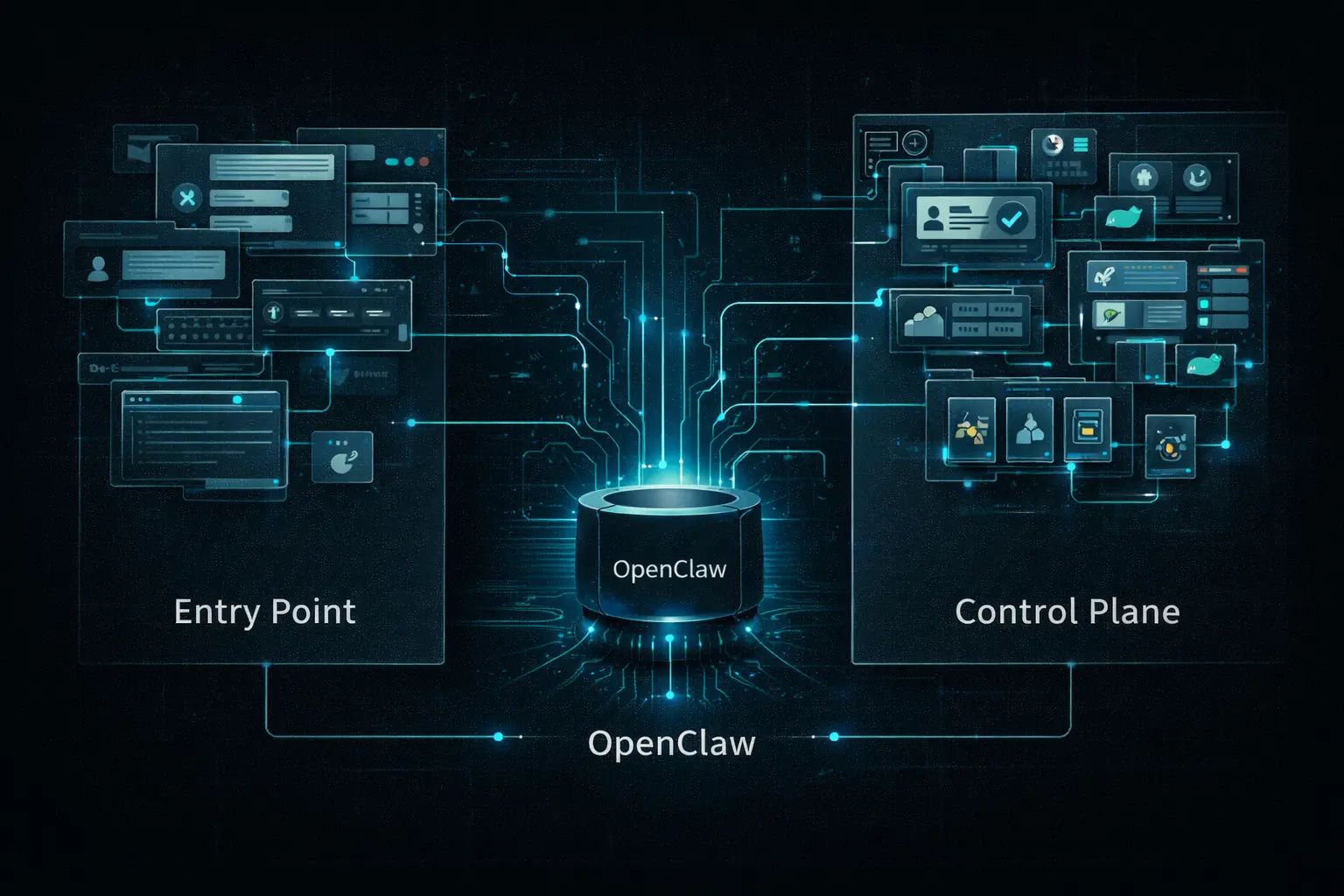
This is why the scramble to own the agent’s messaging layer intensified so quickly. Every major Chinese platform began asking the same question: how do we become the interface through which agents access our ecosystem? Taobao’s desktop app quietly added MCP protocol support so that agents could search products, compare prices, and add items to shopping carts. DingTalk opened free API access for OpenClaw integrations. Tencent is building, according to The Information, a native AI agent that would appear as a contact in users’ WeChat chat lists and orchestrate the platform’s ecosystem of millions of Mini Programs through natural language.
For consumer platforms and messaging incumbents, the default instinct was to compete for the entry point: the chat window where users issue commands to AI. For enterprise players like Alibaba, the more valuable layer sat closer to workflow control, permissions, and auditable execution. In both cases, companies whose strongest assets lay outside the model layer discovered that the agent era rewarded a different kind of asset.
America Builds the Control Plane
American tech companies approached the same moment from a different starting position. Where Chinese companies competed to become the agent’s front door, American companies generally moved to become the agent’s back office.
Microsoft published its security research in February, then followed up in March with product announcements that revealed the commercial strategy underneath. Copilot Cowork, developed in partnership with Anthropic, reframed agent capabilities as plan-and-review workflows running inside Microsoft 365’s security perimeter. Agent 365, announced for general availability on May 1, was positioned as a control plane for AI agents, priced at $15 per user per month and bundled with the enterprise suite. The message to IT departments was clear: the agent era is coming, and the safe way to enter it runs through our platform.
Google drew a harder line on access while building its own parallel ecosystem. Its Gemini Code Assist FAQ explicitly stated that third-party software such as OpenClaw accessing Gemini CLI violated its terms of service and could lead to account suspension. Google simultaneously expanded its Agent Development Kit, an open-source framework for building production-grade agent workflows, with integrations across code platforms, databases, and project management tools. The implicit proposition: build agents with our tools, under our governance.
Meta’s clearest move was the acquisition of Moltbook, a startup building a social platform for AI agents with identity verification and inter-agent communication. Reuters framed the deal as part of a broader race among tech giants for agent talent and infrastructure. The acquisition points toward an interest in agent identity and networking infrastructure, even if Meta’s broader agent strategy remains less public than those of its peers.
Two exceptions add important texture. AWS embraced OpenClaw on Amazon Lightsail with Bedrock as the default model, pre-configured IAM roles, and CloudTrail audit logging. Nvidia launched NemoClaw at GTC, wrapping OpenClaw in a security runtime called OpenShell with default-deny network policies, sandboxed execution, and operator-customizable policy files. Jensen Huang compared OpenClaw to Linux and HTML. Both companies found commercial opportunity in the open-source agent wave. Both also layered governance on top in ways that most Chinese counterparts did not.
Major US platform providers have generally favored bounded tool calling, managed runtimes, and governance layers as the foundation for agent capabilities. This shared preference at the interface level coexists with significant divergence underneath: execution environments, identity systems, and audit approaches still vary widely across providers. The common thread is not a single architecture but a general instinct to keep the platform in charge of every interaction.
The contrast with China’s dominant approach is structural. OpenClaw defines a persistent, high-privilege execution shell that runs autonomously around the clock, calling model APIs hundreds of times per day while accessing local files, browsers, and messaging platforms. American platforms generally define bounded tool calls orchestrated within controlled permissions. China’s ecosystem tilted first toward rapid absorption, even as major players quickly diverged on risk control. The US ecosystem tilted first toward managed execution and governance, though AWS and Nvidia moved fastest to commercialize the open-source agent wave directly.
The Token Divide
The deepest split shows up in how each side thinks about the economics of AI computation.
This Week, Alibaba’s CEO Eddie Wu and Nvidia’s Jensen Huang independently elevated the same word to the center of their corporate narratives within 48 hours of each other. Wu reorganized five AI units into a new business group whose stated mission is to “create, deliver, and apply tokens.” Huang argued at GTC that token throughput per watt now determines a technology company’s viability. The word converged. The commercial logic underneath it did not.
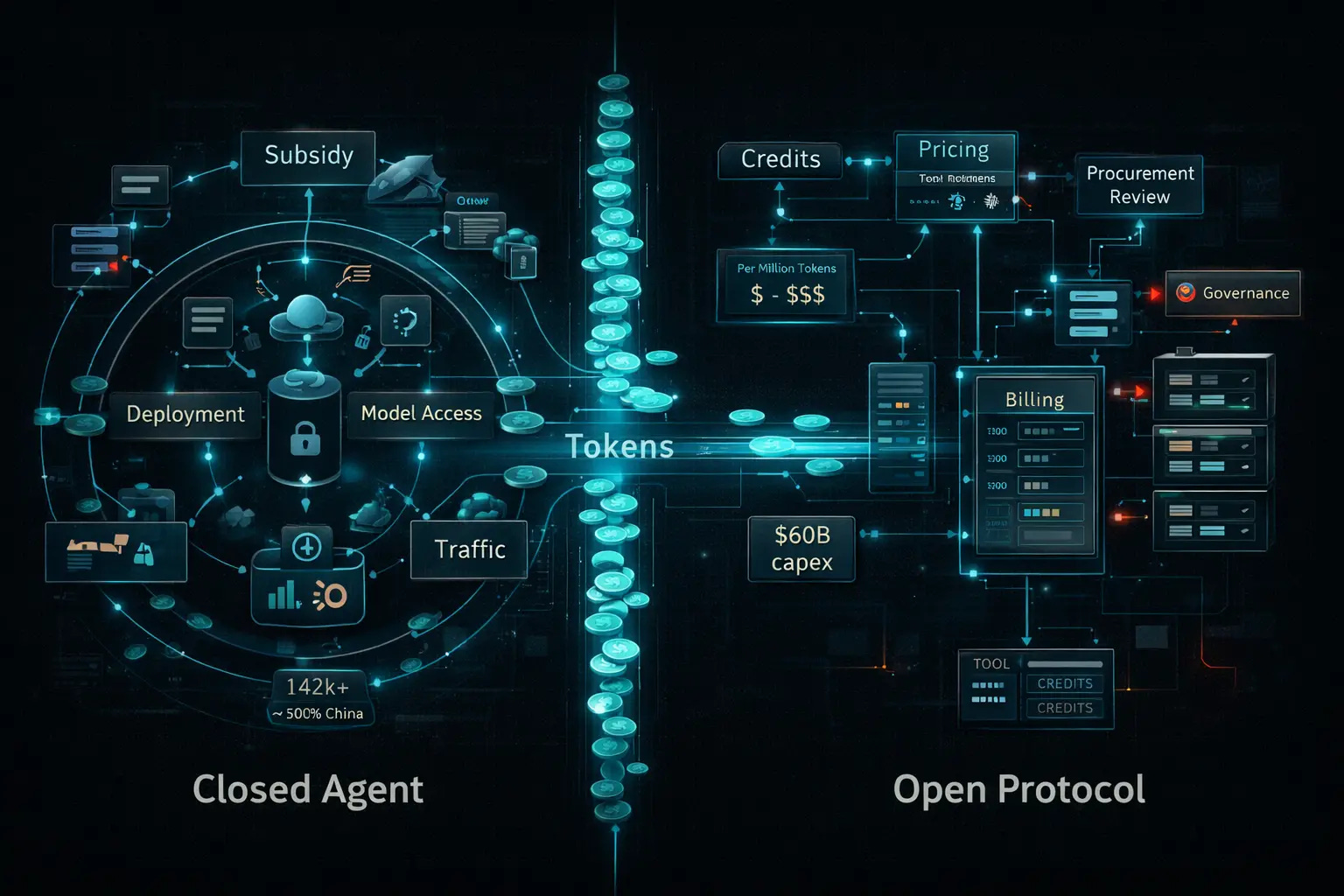
Key platforms and local governments across China’s AI ecosystem have moved to subsidize early agent deployment to stimulate inference demand. DingTalk opened unlimited free API access for OpenClaw integrations through the end of March. Baidu offered vouchers to new users who completed their first deployment. A Shenzhen district government proposed publicly funded “digital employee application vouchers.” The reasoning follows from the math of agent workloads. A single configured OpenClaw instance can consume tens to hundreds of times more tokens per day than a chatbot user. Exact figures vary by configuration and workload, but the directional gap is consistent across estimates. ByteDance, Alibaba, and Tencent together were estimated to have spent around $60 billion in combined AI-related capital expenditure over the past year. Agent workloads that generate sustained, around-the-clock API calls begin to justify that investment. Subsidize deployment now, harvest cloud revenue as usage compounds.
American companies are metering token consumption to make it enterprise-ready. OpenAI prices access per million tokens with tool-specific surcharges. Anthropic layers in caching discounts, batch processing rates, and data residency premiums. Microsoft abstracts raw token costs into enterprise credit packs. Apple takes yet another path, absorbing inference costs into device hardware through its on-device Foundation Models framework and charging developers nothing per request. The American market is building multiple billing architectures in parallel, all designed to make agent costs predictable and defensible in a procurement review.
Both approaches share an underlying vulnerability. Tokens are not like electricity. A kilowatt-hour from a coal plant works identically to one from a wind farm. Tokens from Claude, Qwen, and GPT differ enormously in reasoning quality, coding reliability, and factual accuracy. Any framework that treats tokens as interchangeable units will eventually collide with the fact that users choose models based on capability. Microsoft’s credit system quietly sidesteps this by bundling model choice into the platform. China’s subsidy-driven ecosystem, where low-cost models hold an early advantage in agent traffic, has not yet confronted that tension head-on.
Two Regulatory Clocks
China’s regulatory system responded on dual tracks. The National Internet Emergency Center and the Ministry of Industry and Information Technology issued formal warnings about OpenClaw’s default configurations, high-privilege execution, and poisoned skill plugins. State broadcaster CCTV reported that 85 percent of publicly exposed instances lacked proper authentication and that over 10 percent of skills on ClawHub, the community plugin marketplace, contained malicious code. Universities issued campus-wide bans. The China Internet Finance Association warned against deploying agents in financial environments. At the same time, district governments in Shenzhen were drafting subsidy programs for the same technology, and industry associations in Suzhou were publishing best-practice frameworks for “rational adoption.” Central authorities flagged risk while local authorities chased industrial opportunity.
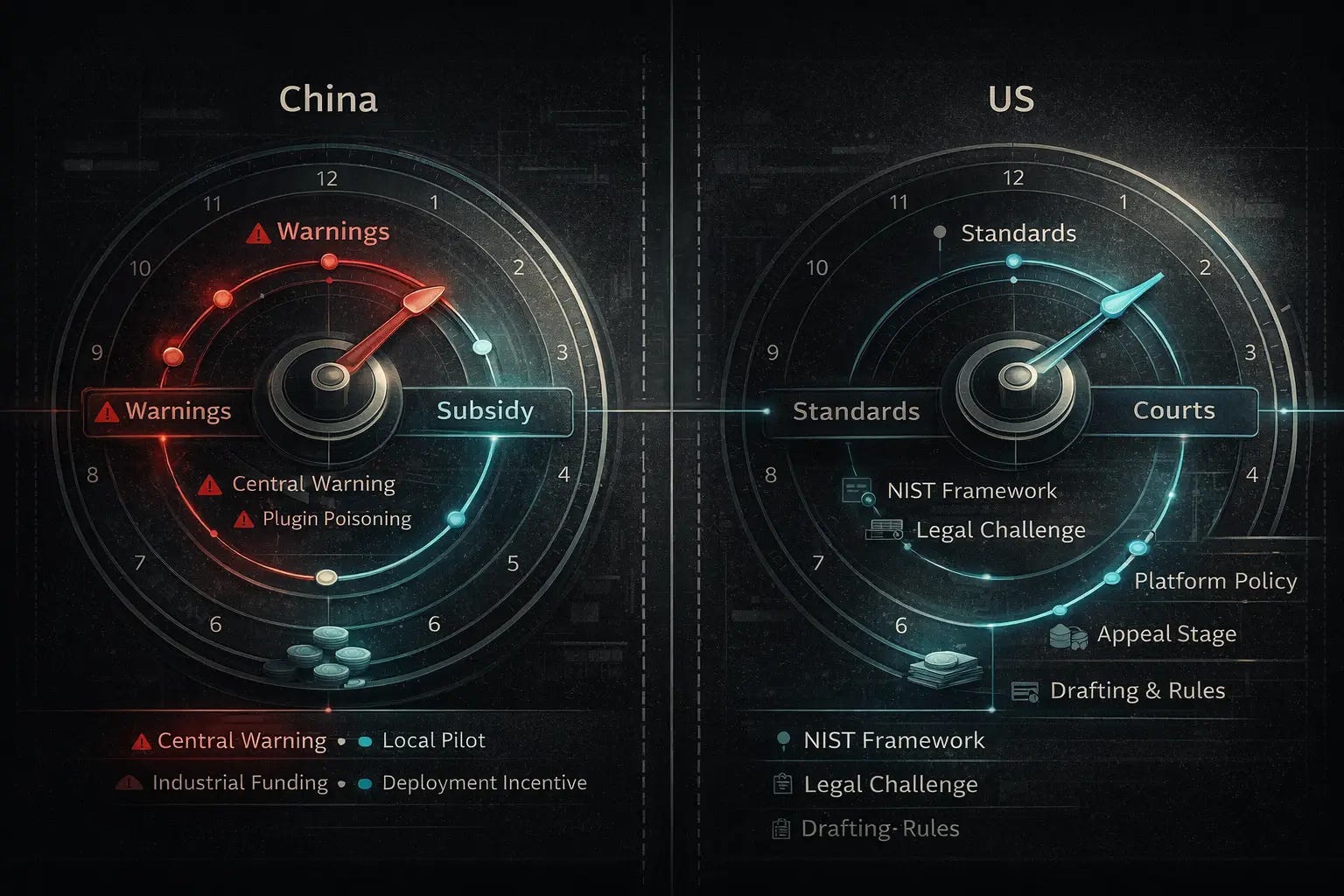
America’s boundaries are forming through different channels. NIST announced an AI Agent Standards Initiative in February, targeting interoperability and secure identity protocols for autonomous agents. In the courts, Amazon and Perplexity AI entered federal litigation over whether an AI shopping agent can access e-commerce accounts on behalf of users, a case now in the appeals process that may set precedent for what agents are permitted to do inside platform boundaries. Standards bodies and courtrooms, rather than administrative directives, are drawing the lines.
Two Paths, One Verdict Still Pending
China’s AI industry built enormous inference capacity and needs demand to fill it. The default instinct has been to lower barriers, subsidize adoption, and compete for the messaging interface where users issue commands. That instinct is genuine and the early commercial results are significant, but it is not monolithic. The rapid divergence between consumer saturation, risk-controlled entry points, and enterprise-grade platforms shows that China’s tech establishment is already debating which layer of the agent stack will capture durable value.
America’s AI industry holds established enterprise relationships and mature billing infrastructure. The default instinct has been to meter, govern, and sell agent labor as a managed service. That instinct is equally genuine, but it is not uniform. AWS and Nvidia have shown that embracing an open-source agent framework and adding governance on top is a viable path between full absorption and outright restriction.
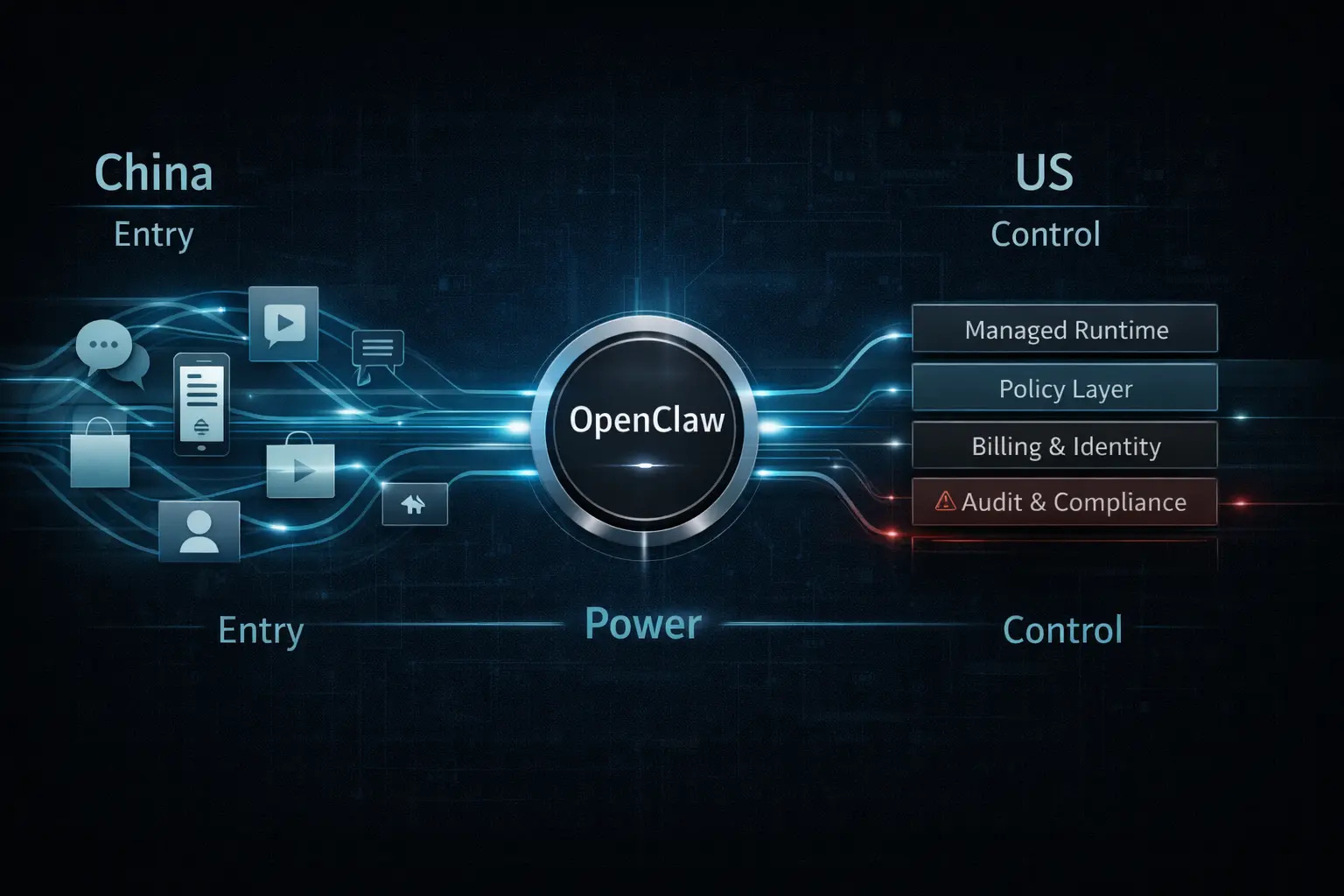
OpenClaw did not create this divide. It exposed where each ecosystem already wanted agent power to sit.
Alibaba and Tencent both report quarterly earnings this week. The agent wave crested too recently to show up in the numbers, which makes these results a useful pre-agent baseline. In the coming issues of Hello China Tech, I will track how that baseline shifts as token economics and messaging-layer competition reshape both companies’ finances. Premiume subscribers get these first.