

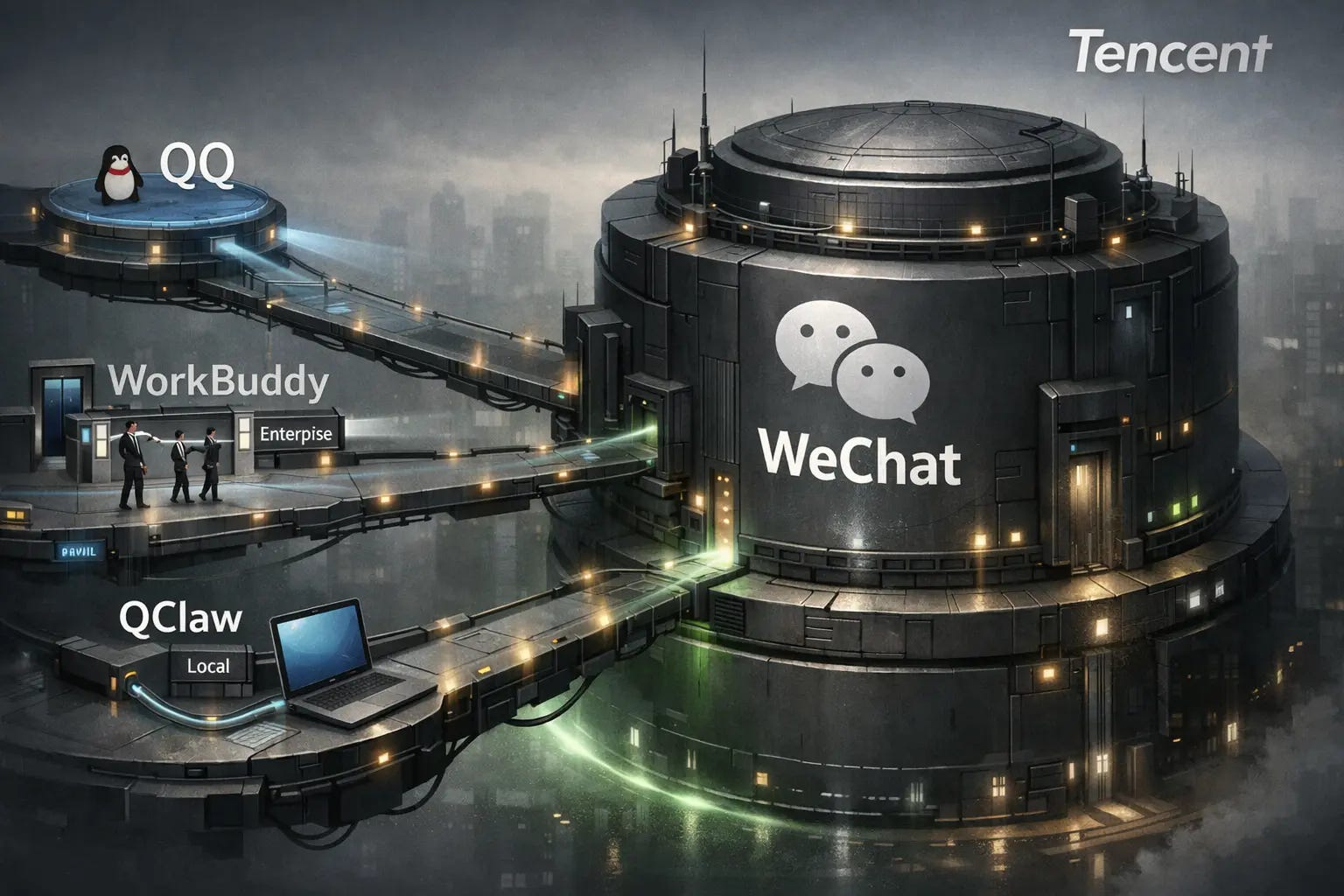
On March 9, Tencent released three AI agent products in a single day. QClaw, a desktop app that connects the open-source agent framework OpenClaw to personal WeChat and QQ accounts. WorkBuddy, an enterprise-grade agent compatible with WeChat Work, Feishu (China’s equivalent of Slack), and DingTalk. And an OpenClaw integration for WeChat Work’s smart bot platform. The following Monday, Tencent’s stock surged nearly 7 per cent, pushing its market capitalization back above HK$5 trillion. WorkBuddy crashed within hours. Tencent Cloud apologized and emergency-scaled its servers tenfold.
Citi maintained its buy rating with a HK$783 target price, calling the move a shift from “chat AI” to “execution AI.” That framing captures the market’s initial read. A more revealing question sits underneath: why Tencent, specifically, moved with unusual speed and breadth.
Every major Chinese tech company embraced OpenClaw. Alibaba Cloud, Baidu Cloud, and ByteDance’s Volcano Engine all offered deployment services. Moonshot AI and MiniMax built hosted versions around their own models. I covered the full landscape and the structural forces behind it in Monday’s analysis. Among all these players, Tencent stands apart for the breadth and speed of its response. The company was among the first in China to offer one-click cloud deployment back in January. Its engineers set up folding tables outside Shenzhen headquarters on March 6 to install OpenClaw on strangers’ devices for free. Three days later came the three-product blitz.
That urgency traces back to a problem Tencent has spent over a year trying to solve.
Outspent and Still Behind
Between Q3 2024 and Q2 2025, Tencent poured more than Rmb100 billion ($13.8 billion) into capital expenditure, the largest infrastructure build-up in its history. In December 2025, Tencent announced the appointment of Yao Shunyu, a 27-year-old former OpenAI researcher recruited months earlier, as Chief AI Scientist. It reportedly doubled market salaries to poach researchers from ByteDance. It reorganized its entire AI division into three new departments.
The results remain modest. Tencent’s flagship Hunyuan model ranked 68th on UC Berkeley’s LMArena leaderboard as of December. Its consumer AI app, Yuanbao, reached 109 million monthly active users by February 2026. That figure trails ByteDance’s Doubao at 315 million and Alibaba’s Qwen at 202 million. Yuanbao still offers users a toggle between Hunyuan and the open-source DeepSeek, a design that functions as a public concession about the limits of its own model.
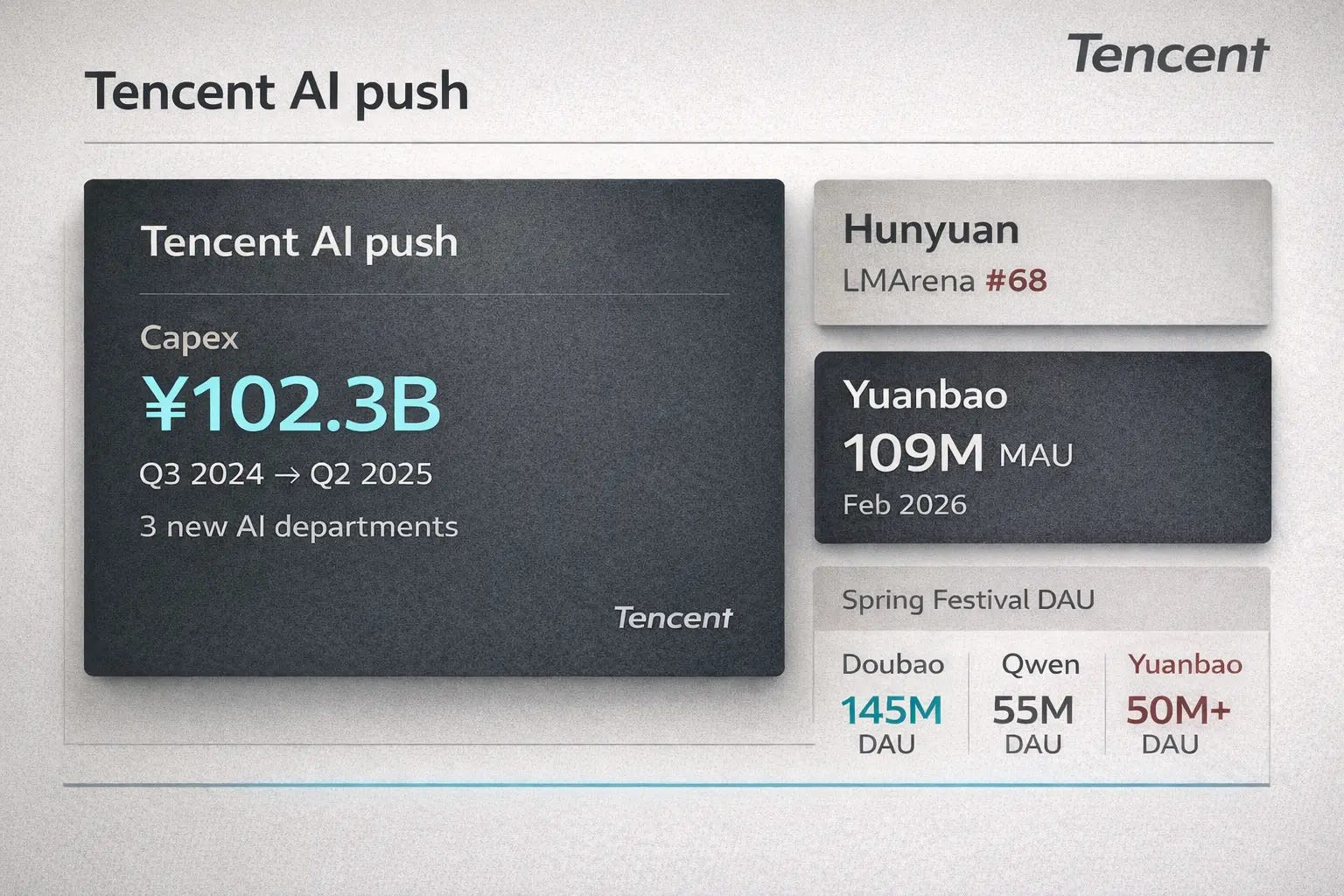
During this year’s Spring Festival in February, the scale of the gap became visceral. ByteDance’s Doubao secured an exclusive partnership with CCTV’s Spring Festival Gala and hit 145 million daily active users on New Year’s Eve. Alibaba spent over Rmb6 billion ($830 million) on Spring Festival promotions tied to Qwen, peaking at 55 million DAU. Tencent distributed Rmb1 billion in red envelopes through Yuanbao. Daily active users briefly crossed 50 million before falling back.
Tencent was spending aggressively and still losing ground. OpenClaw arrived weeks later and offered something that neither compute budgets nor talent wars had delivered: a path to competing in AI that does not depend on model superiority.
Tencent’s three-product offensive reveals a precise, layered strategy to bring AI agents into WeChat without breaking WeChat. That strategy shifts the battleground from Tencent’s weakest layer to the one it controls best.