

Three events landed within 48 hours, each from a different corner of the AI industry, each organized around the same word.
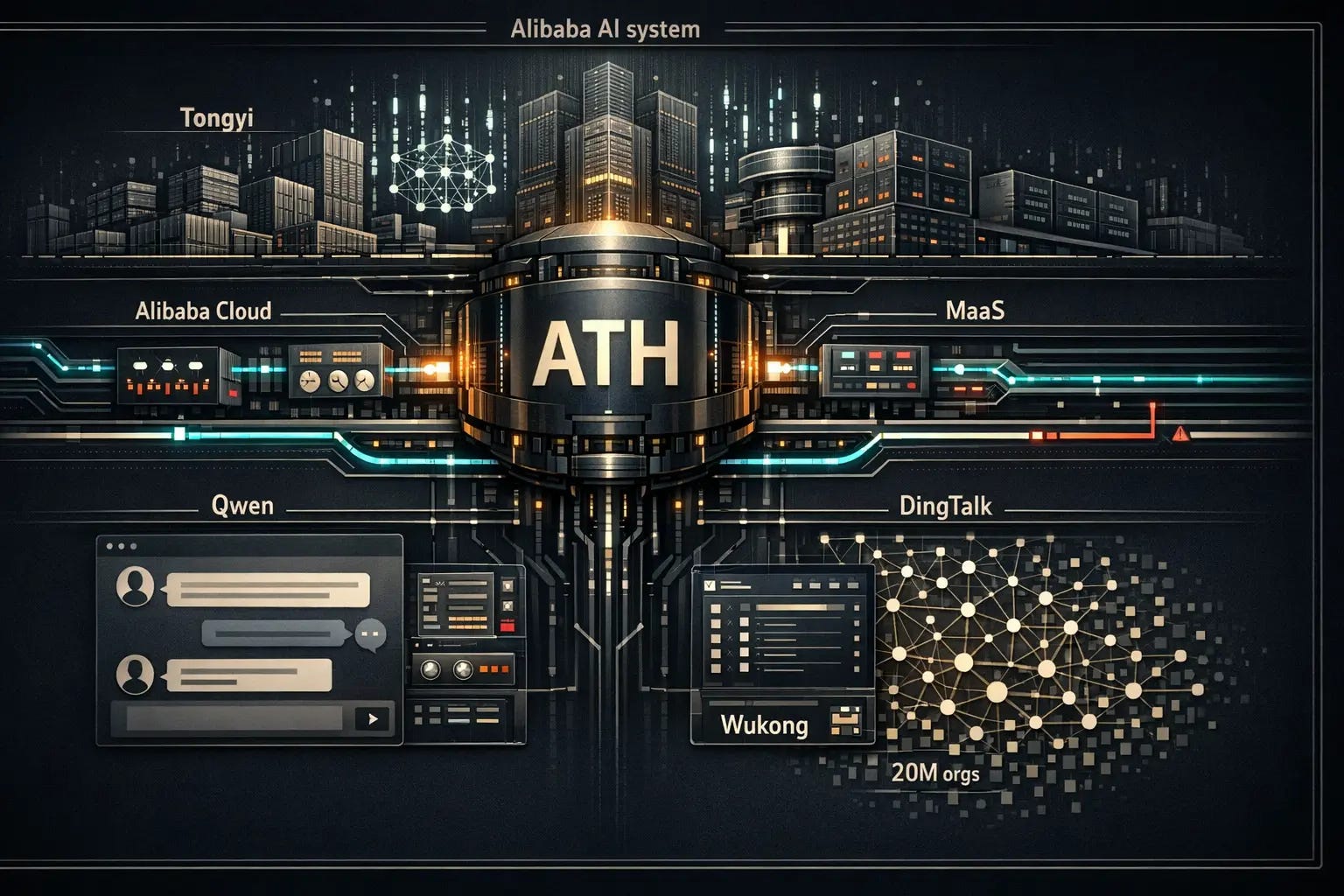
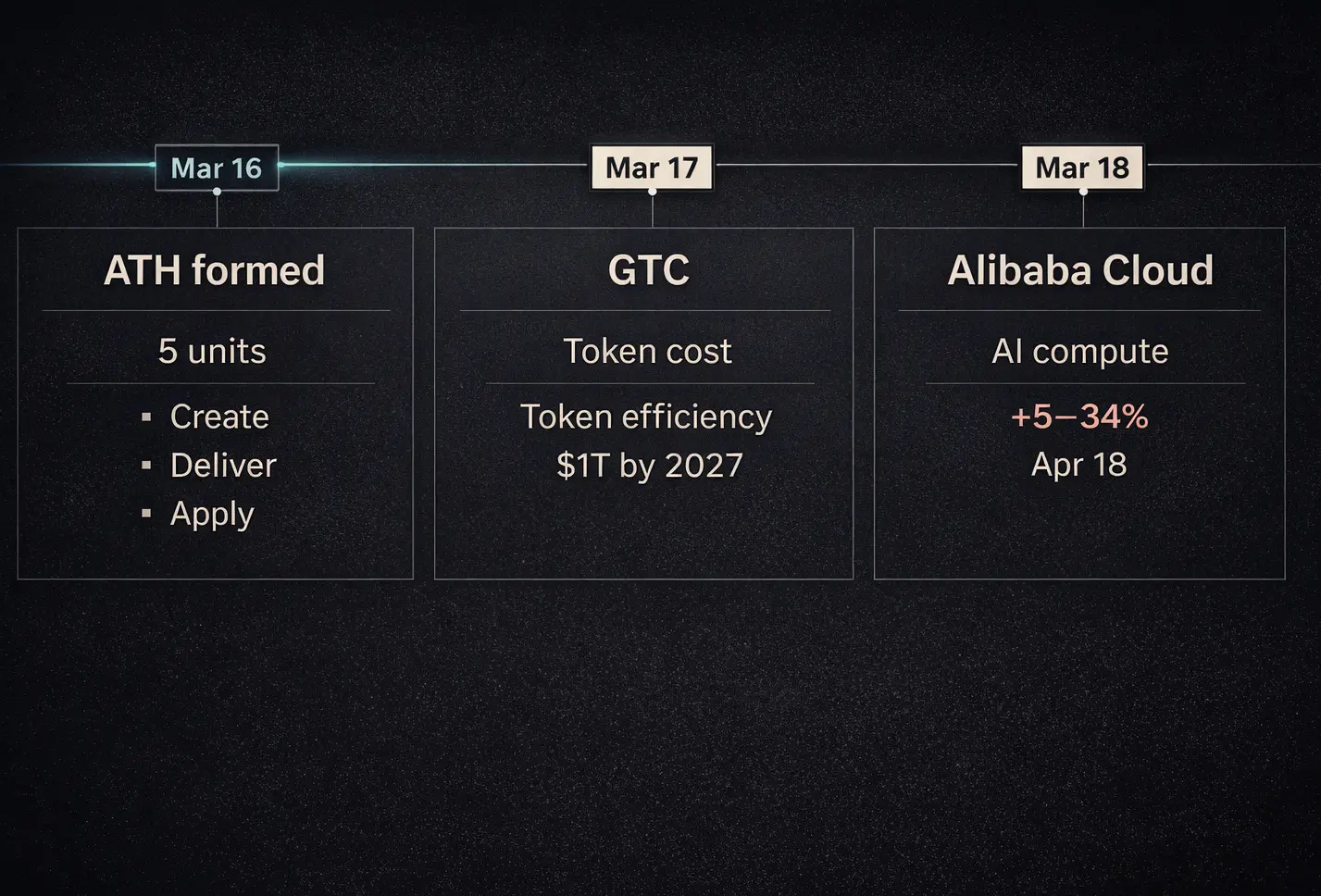
On March 16, Alibaba CEO Eddie Wu issued his third company-wide letter since taking the role. He announced the formation of Alibaba Token Hub (ATH), a new business group unifying five previously separate units: Tongyi Laboratory, the model-as-a-service platform, Qwen (consumer AI), Wukong (enterprise AI), and an AI innovation division. The declared mission: “create tokens, deliver tokens, apply tokens.” In Wu’s framing, the structure mirrors an electrical grid: Tongyi Lab as the power plant, the MaaS platform as the transmission network, consumer and enterprise products as the appliances drawing power.
Fourteen hours later, at roughly 1 AM Beijing time on March 17, Jensen Huang took the GTC stage in San Jose. China’s tech industry was asleep. Huang organized his keynote around a strikingly parallel claim: the cost and efficiency of generating tokens now determines a technology company’s revenue and survival. He predicted the global compute market would surpass $1 trillion by 2027, and unveiled Vera Rubin, NVIDIA’s latest compute platform, engineered to sharply reduce the cost of generating each token.
On March 18, Alibaba Cloud announced price increases on AI compute products effective April 18, with compute card pricing set to rise by 5 to 34 percent, citing surging demand and rising hardware costs.
Three decisions, made independently, pointing in the same direction: tokens as the foundational unit of AI’s economic layer. They were not coordinated. The cloud price adjustment followed hardware cost pressures, not a messaging strategy. But the convergence in framing is itself a signal worth examining. For readers less immersed in AI plumbing, a brief orientation: tokens are how language models measure work. Every input processed and every output generated consumes them. A casual email might cost a few hundred. A complex coding agent can burn through millions per day. Tokens are the meter by which AI companies price usage and bill customers, much the way kilowatt-hours quantify electricity consumption. The term has existed for years in technical circles. What happened this week is that two of the most powerful organizations in global technology elevated token economics into a central strategic narrative simultaneously.
The convergence deserves attention. Whether the thesis underneath carries commercial weight is the question that matters.
From Metaphor to Org Chart
ATH consolidates units that previously reported through separate chains of command, now placed directly under the CEO. In Alibaba’s hierarchy, it sits alongside Cloud Intelligence and the e-commerce group as a first-tier business cluster. The structural elevation signals that Alibaba considers token production and distribution strategically equivalent to cloud computing and online retail.
The reorganization had been forming since late 2025. As I reported in my earlier analysis of the Qwen restructuring, Alibaba had already been binding Tongyi Lab, Alibaba Cloud, and chip subsidiary Pingtougei into a vertically integrated stack that internal sources describe as “TongYunGe(通云哥).” ATH formalizes that integration into reporting lines. Models drive cloud consumption. Cloud captures margin. In-house Zhenwu chips set a floor under hardware costs. The grid analogy that Wu first introduced at the 2025 Apsara Conference has graduated from keynote metaphor to organizational architecture.
The closest recent precedent in global tech may be Google’s 2023 merger of Brain and DeepMind, two research groups that had competed for compute and pursued overlapping mandates. Chinese media have drawn the comparison extensively. It is suggestive but incomplete: Google merged two research labs. Alibaba is integrating research, infrastructure, and commercial application layers into a single operating unit. ATH’s scope is broader, and the execution challenge steeper.
According to Chinese media reports, Wu’s previous company-wide letter was sent 480 days earlier. The interval, if accurate, reflects the weight Alibaba assigns to this restructuring. One day after announcing ATH, the company launched an enterprise product called Wukong, named after the Monkey King of Chinese mythology. Built by the DingTalk team, it is an AI agent platform that coordinates multiple agents through a single interface, handling document editing, meeting transcription, approval workflows, and supplier research under enterprise-grade security controls. The product is in invitation-only beta, with planned integration into Slack, Microsoft Teams, and WeChat.
For premium subscribers who followed the OpenClaw analysis and the Qwen restructuring, ATH is where those two threads converge. OpenClaw demonstrated that agent workloads consume far more tokens than chat sessions. The Qwen reorganization shifted Alibaba’s center of gravity from open-source community building toward cloud revenue. ATH is designed to capture both dynamics: accelerating token demand on one side, cloud monetization on the other.
The architecture is internally coherent. The harder question is whether tokens behave the way the analogy assumes. Answering that requires examining what ATH’s first product actually does, stress-testing the consumption data, and locating where the metaphor begins to crack.
Continue reading with a paid subscription.
