

I have followed China’s two listed AI model companies since their December 2025 prospectuses, beginning with “Running Out of Runway” and “The First AI Company to Show Its Cards.”
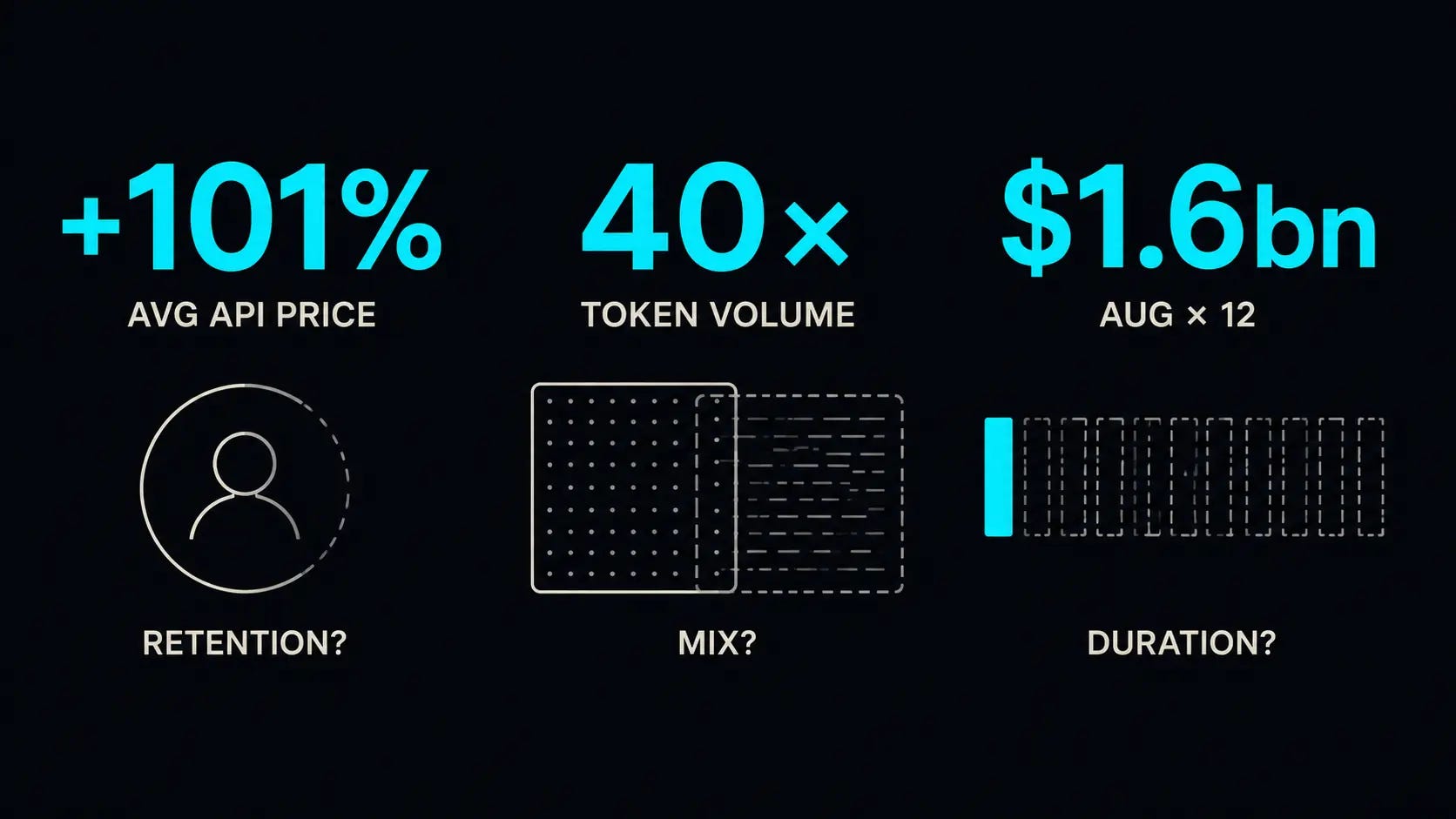
Zhipu, the Tsinghua University-backed lab that listed in Hong Kong in January, reported first-half results on August 31. Revenue rose 399.7% to Rmb 953.9m ($142m). Bloomberg reported that the figure came in about 30% below the average analyst estimate. Hours later, on the earnings call, management said its revenue run rate, August revenue multiplied by twelve, had reached $1.6bn at the end of August, against $1bn in July.
Both statements are accurate. One reports six months of recognized revenue. The other annualizes a single month.
The accounts close on June 30. The operating disclosures run to August 31. Most of them use the start of the year as their baseline, so the 101% price rise and the 40-fold token growth span both periods. What belongs only to the later window is the run rate and two model launches. Investors were asked to price June accounts against August operating metrics. The fresher numbers look faster. They are also less comparable.
In April I wrote that Zhipu had reduced its business logic to one equation: AGI commercial value equals the intelligence ceiling times token consumption scale. I also wrote that cloud gross margins could approach 30% within a year. They came in at 24.6%, up from -0.4% a year earlier.
The equation survived its first test. On the same call, management added a term the April version did not contain.
The Numbers
The revenue mix inverted inside a single reporting period. Cloud-based open-platform and API revenue reached Rmb 825.2m, up 2,735.7%, moving from 15.2% of the total a year ago to 86.5%. On-premise deployment fell 20.5% to Rmb 128.7m. The filing describes part of that decline as deliberate, reflecting a narrower approach to software licensing and a shift toward higher-value industries.
Two margin numbers moved in opposite directions. Blended gross margin fell from 50.0% to 26.4%, because the faster-growing segment is the lower-margin one. The API segment itself went from -0.4% to 24.6%. The company credits scale, higher pricing, and engineering work that lowered inference cost.
The loss line needs the two-column reading I used for MiniMax last week. Reported loss narrowed 12.1% to Rmb 2.07bn, largely because last year carried a Rmb 429.3m charge on instruments that converted at listing. Adjusted net loss, closer to operating reality, widened 12.1% to Rmb 1.96bn. Operating loss widened 13.0%.
R&D reached Rmb 2.13bn and grew 33.6%. Revenue grew nearly twelve times as fast as R&D. R&D has fallen from 7 times revenue in 2024 to 4.4 times in 2025 and 2.2 times now. Sales and marketing fell 14.8% and administrative expenses 44.2%. Growth did not require higher reported selling costs, though thin margins leave room for subsidy inside the product itself. The revenue line missed. The adjusted loss came in below a Rmb 2.75bn consensus estimate cited by Smartkarma, an analyst research platform. The stock fell 1.34% on September 1 and a further 5.26% on September 2.
The first-half numbers support part of the case I made in April. They also show its limit. Model quality may explain why customers pay more today. It does not explain how Zhipu keeps them paying when the next model catches up.
Reading a set of half-year accounts against operating metrics that close two months later is one example of how Hello China Tech reads China’s tech sector: primary sources first, three analyses a week, across AI, chips, robotics, and EVs. Subscribe free to get the next one in your inbox.
