

No pure-play AI model company has ever reported public earnings. OpenAI is private. Anthropic is private. Google and Microsoft bury their model economics inside consolidated P&L statements so vast that isolating AI-specific numbers is impossible. Every debate about whether AI companies can ever sustain themselves has been conducted, until now, without evidence.
That changed on March 2, when MiniMax released its 2025 full-year financial results. The Shanghai-based startup, which raised $614 million through a Hong Kong IPO in January, has delivered what amounts to the AI industry’s first open book. We can finally see what an AI model company actually looks like beneath the fundraising headlines.
The timing makes this personal. In December, as MiniMax was filing its prospectus, I published “China’s AI Unicorns Are Running Out of Runway,” arguing that independent AI model companies were caught in a structural bind: profitable at the unit level, insolvent at the business level, burning cash faster than the entire market could sustain. Three months and one earnings report later, that thesis needs calibration.
The trap I described is real. But MiniMax may have found the direction of an exit.
The Numbers
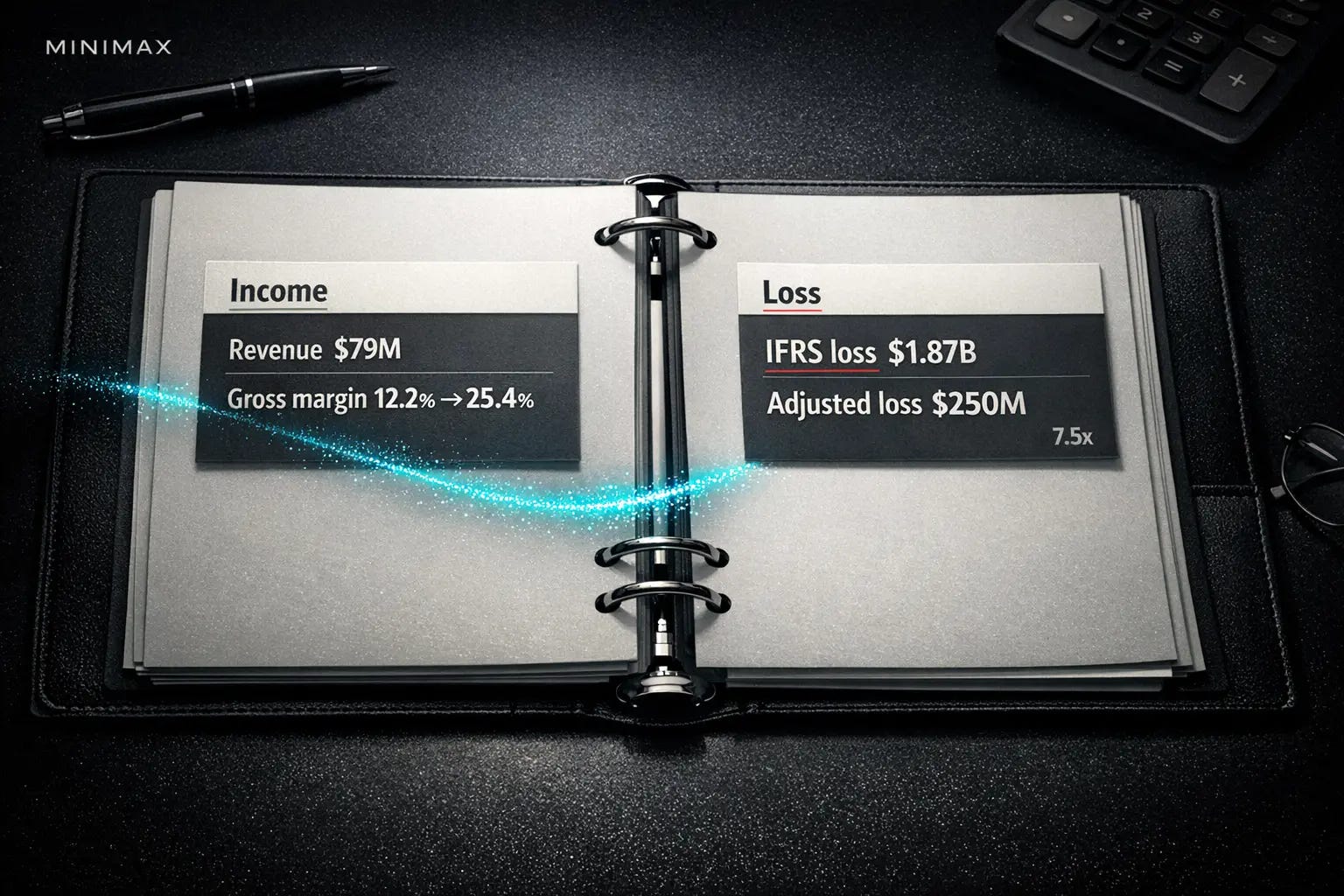
MiniMax generated $79 million in 2025 revenue, a 159% year-over-year increase. Gross profit reached $20 million, up 437%, with gross margins improving from 12.2% to 25.4%. Sales and marketing expenses fell 40%.
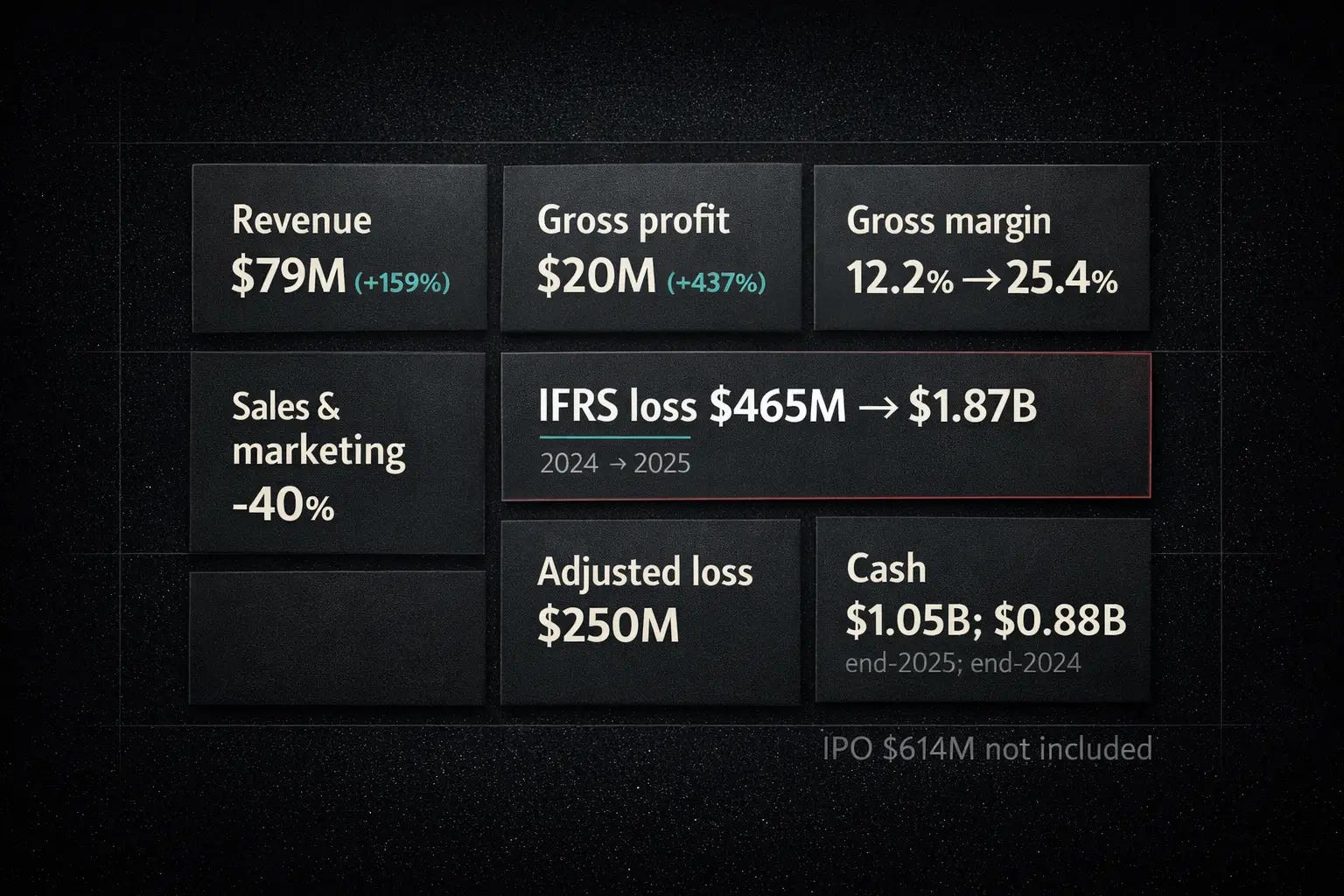
The loss picture requires careful reading. On an IFRS basis, net loss widened from $465 million in 2024 to $1.87 billion in 2025. Most of that increase reflects non-cash changes in the value of financial instruments the company holds, a common accounting effect for recently listed companies whose valuations shifted significantly during the reporting period. The adjusted net loss, which strips out these non-operational items, was $250 million for 2025. Management says the adjusted net loss margin narrowed significantly year-over-year. For investors encountering a Chinese AI company’s financials for the first time, the 7.5x gap between the IFRS and adjusted figures will be disorienting. The adjusted number better represents operational reality, but the IFRS figure is what sits on the balance sheet.
Early 2026 data is even more striking. By February, daily token consumption for MiniMax’s M2 text model series had grown sixfold compared to December. Developer registrations on the open platform quadrupled. Annualized recurring revenue crossed $150 million.
Over 70% of revenue came from international markets. Consumer-facing AI products generated 67% of total revenue, with the developer platform contributing the remaining 33%. Cash reserves stood at $1.05 billion at year-end, up from $880 million at the end of 2024. Notably, the $614 million in IPO proceeds raised in January 2026 is not yet reflected in this figure.
For perspective: OpenAI’s annualized revenue reportedly exceeded $20 billion in 2025. MiniMax sits at roughly 0.4% of that scale. The absolute gap is enormous. But the trajectory and the margin improvement tell a more interesting story than the absolute numbers alone.
What I Argued in December
For readers who missed the original analysis: MiniMax and Zhipu AI filed Hong Kong IPO prospectuses within days of each other in December 2025. Both showed strong unit economics and rapid revenue growth. Both were hemorrhaging cash at rates that dwarfed their top lines. MiniMax was burning roughly ¥2 billion per month. Together, the two companies were spending more than five times the entire Chinese LLM market on an annualized basis.
I argued this created a structural trap. Individual API calls were profitable, but competition forced continuous R&D investment that outgrew revenue. Strategy seemed irrelevant. MiniMax chose efficiency, building competitive models at roughly 1% of OpenAI’s cumulative spend. Zhipu chose scale, pouring resources into frontier development. Both ended up in the same position, filing emergency IPOs with months of runway remaining.
My conclusion was blunt. Balance sheet depth would determine survival, not model quality. Independent AI companies faced absorption by platform giants or slow extinction.
Three links formed that argument. Link one: competition dictates the level of required investment, regardless of strategy. Link two: R&D spending growth outpaces revenue growth. Link three: therefore, only deep-pocketed incumbents survive. The first earnings report lets me test each link against real operating data.
The Treadmill Keeps Running
Link one holds. The competitive pressure has not eased.
On the earnings call, CEO Yan Junjie described industry growth as a “step function” and emphasized that constant model releases are necessary to capture each wave. MiniMax shipped three text model generations in 108 days. The next generation, M3, is already under development. Every major cloud platform and coding tool is evaluating multiple model providers simultaneously. The arms race I described in December has not slowed.
The real test is link two: whether revenue growth can finally outpace R&D spending. For the first time, we have a full year of operating data to examine that question.
[🔒 Keep reading with a paid subscription]
