

This is the third installment in a series tracking how China’s first publicly listed AI model companies navigate the economics of survival. The series began with “China’s AI Unicorns Are Running Out of Runway” in December 2025 and continued with “The First AI Company to Show Its Cards” in March 2026.
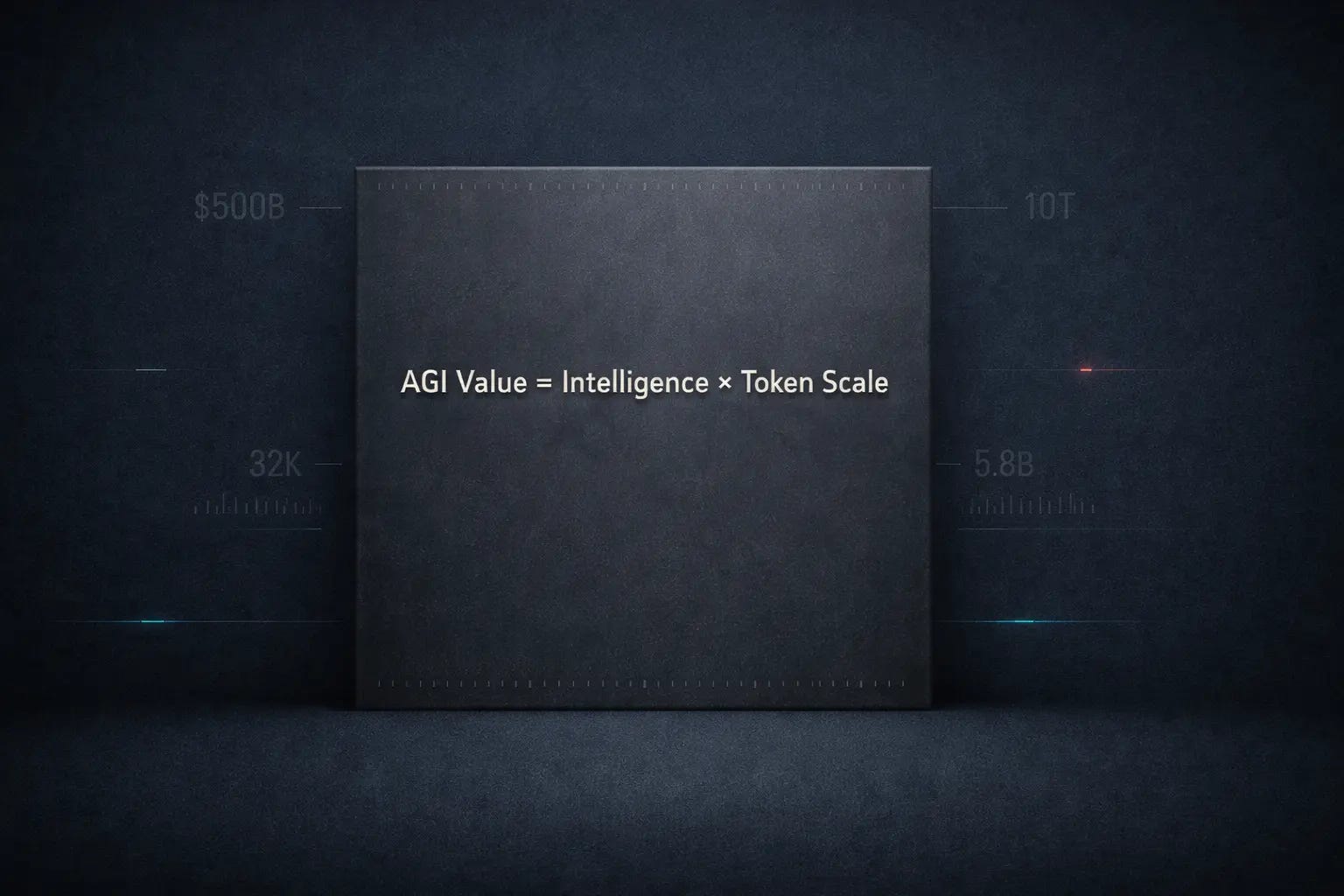
Zhipu AI opened its first earnings report with a formula.
“AGI Commercial Value = Intelligence Upper Bound x Token Consumption Scale.”
No public AI company has ever reduced its entire business logic to a single equation. OpenAI publishes blog posts about safety. Anthropic talks about responsible scaling. Google buries its AI economics inside a $350 billion conglomerate. Zhipu, the Tsinghua University-backed startup that became the world’s first pure-play AI model company to go public, chose a different path. It told investors exactly what it believes and staked its future on that belief being correct.
The formula carries a specific claim. Model quality determines pricing power. Pricing power multiplied by usage scale determines commercial value. Every dollar Zhipu spends on research, every price increase it pushes through, every customer it serves flows from this logic. The “intelligence upper bound” is the variable the company believes it can control. Token consumption is the one it believes will follow.
The first year of numbers offers an early test. Revenue reached RMB 724 million ($104.8 million) for 2025, a 132% increase. Total losses widened to RMB 4.72 billion. Gross margins compressed from 56.3% to 41%. The stock, which had surged roughly sixfold from its January IPO price to briefly push market capitalization past HK$300 billion, fell 5.5% ahead of the results. Bloomberg consensus had expected RMB 756 million in revenue.
The headline story is a company growing fast but burning faster. A full year of revenue barely covers three months of R&D spending.
But the headline obscures the structural story. During the industry-wide price war that swept China’s AI model market in late 2024 and early 2025, Zhipu had cut its flagship GLM-4-Plus by as much as 90%. By early 2026, the dynamic had inverted. The company raised API prices by 83% and its coding subscription by 30%. Demand still exceeded supply. CEO Zhang Peng said the bottleneck was compute capacity, not customers.
That reversal, from price war to pricing power in a single year, is the most significant signal in the report. And the most uncertain.
In December, I argued that Zhipu and MiniMax, the two pure-play AI companies that rushed to list in Hong Kong, were both caught in the same structural trap: profitable at the unit level, insolvent at the business level, with competition dictating the pace of spending. Three months later, MiniMax’s earnings suggested one escape route through open-source distribution and global consumer reach. The gap between R&D growth and revenue growth closed for the first time.
Viewed through the lens of the last two earnings reports, the divergence between the two companies is now sharp. Zhipu’s earnings test a fundamentally different hypothesis. Where MiniMax bet on distribution, Zhipu bet on quality. Where MiniMax went global and consumer-facing, Zhipu stayed domestic and enterprise-focused. Where MiniMax let open-source adoption drive volume, Zhipu raised prices and let scarcity do the work.
The question the formula poses is whether an AI company can achieve durable pricing power through model quality alone.
[🔒 Keep reading with a paid subscription]