


This is the fourth installment in a series tracking how China’s first publicly listed AI model companies navigate the economics of survival. The series began with “China’s AI Unicorns Are Running Out of Runway” in December 2025 and continued with “The First AI Company to Show Its Cards” in March 2026 and “Zhipu Bet Everything on One Equation” in April 2026.
MiniMax, the Shanghai-based AI company that listed in Hong Kong in January, reported first-half results on August 26. Revenue for the six months to June 30 reached $116.6m, up 283.1% from a year earlier. Six months of sales beat all of 2025 by nearly half. On the earnings call, management said its ARR measure passed $800m in August, against $150m in February, and that token consumption in July ran at 20 times January’s level.
The market was positioned the other way. Going into the report, short positions had climbed to 20% of MiniMax’s free float, the highest since listing, against 6% for Zhipu, the Tsinghua University-backed lab that listed one day earlier. MiniMax’s market value stood near $13bn in late August, about a quarter of Zhipu’s. The day after the results, the stock rose 3.8%.
In December I argued that both companies were caught in a structural trap: profitable per API call, insolvent as businesses. In March, after MiniMax’s first annual report showed revenue outrunning R&D, I set four conditions under which the escape could continue. This report grades them against a second set of numbers.
The grade is not the one I expected. One condition split, two held, and the third became harder to classify. Revenue again grew faster than R&D, and the adjusted loss more than doubled at the same time. What my March framework missed was a distinction: enterprise customers do not necessarily imply custom-delivery economics. And MiniMax used the call to state a survival equation of its own, a mirror image of the one Zhipu staked its listing on.
The Numbers
A year ago MiniMax earned 69.7% of revenue from consumer products such as Talkie, its AI companion app, and Hailuo AI, its video tool. In this report, the open platform and enterprise services earned $73.9m, up 703.1%, or 63.4% of revenue. Consumer products grew 100.9% to $42.6m and fell to 36.6% of the mix. Two reporting periods were enough to reverse the revenue mix.
The loss line needs the same two-column reading as in March. The IFRS net loss narrowed 11% to $358m, mostly because last year carried a $253.9m fair-value charge on preferred shares that converted at listing. The adjusted net loss, closer to operating reality, more than doubled to $293m. R&D spending rose 138.8% to $296.9m, 2.5 times revenue.
Gross margin rose to 17.9% from 12.1% a year earlier. Sequentially it fell: full-year 2025 came in at 25.4%, which implies the second half of 2025 ran near 34%. The balance sheet offers signs of where some of the capital is going. Property and equipment jumped from $1.6m to $74.9m, and non-current prepayments rose from $0.9m to $100.8m, a shift consistent with the self-built cluster push management describes, though the filing does not itemize the assets. Cash and cash equivalents stood at $930.9m at June 30, within a broader cash-balance measure of $1.32bn that includes financial assets and deposits. A July placement and convertible bond raised HK$16bn in gross proceeds (about $2bn), and management put current reserves above $3bn.
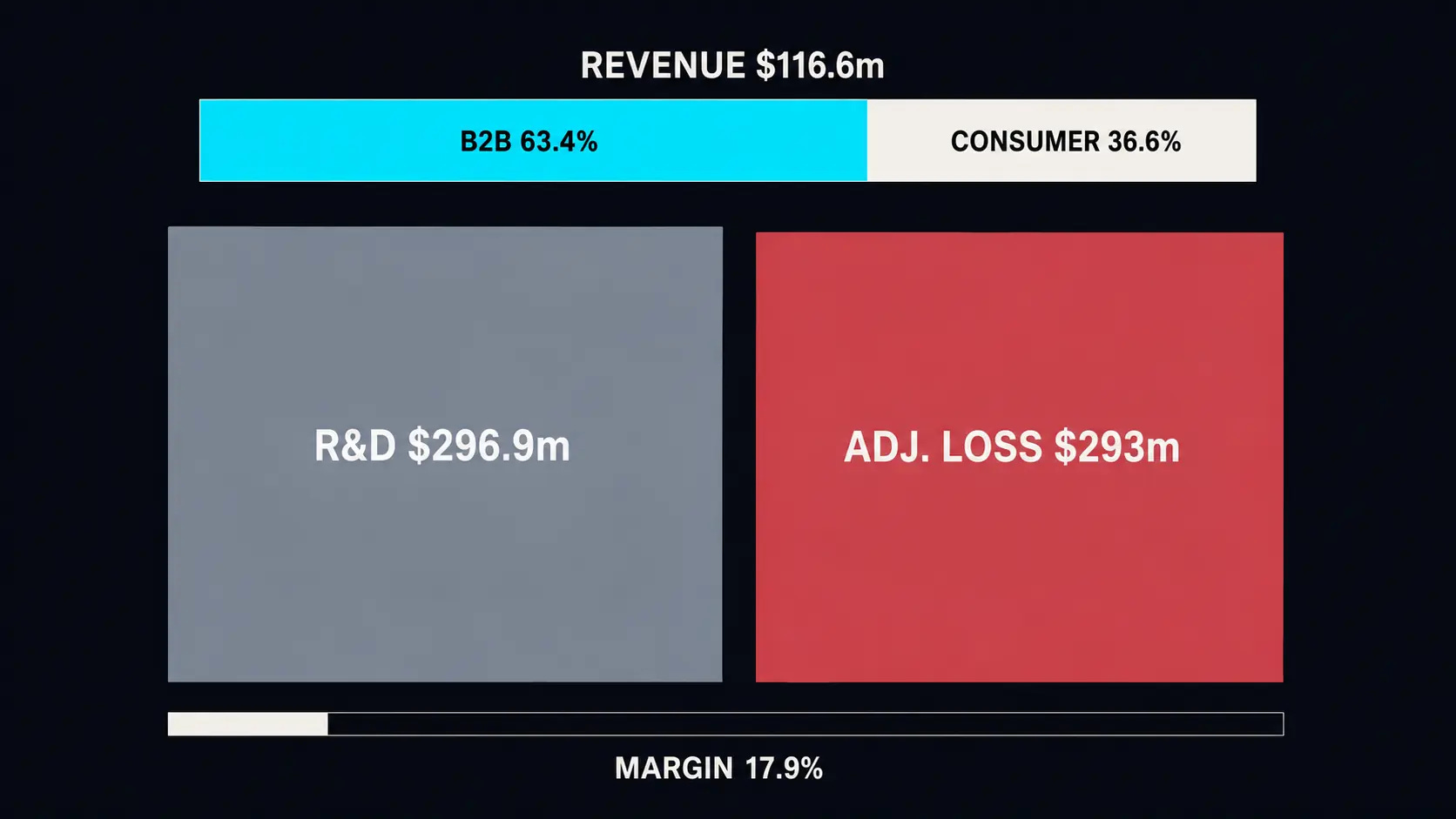
The efficiency ratios in this report improve while the absolute losses widen. The $800m ARR, the 20x token growth and the 2m enterprise customers and developers explain why the same report supports opposite positions. Deciding between those positions requires reopening the four conditions I set in March, and asking what each of the three numbers actually measures.
If grading an AI company’s earnings against survival conditions set two reports ago is new to you, this is a preview of what Hello China Tech does three times a week: reading China’s AI, chip, robotics, and EV sectors from primary sources most English coverage never touches. Subscribe free to get every new analysis as it publishes.
