

Editor’s Note: This is Hello China Tech’s final piece for 2025. We launched six months ago, and your support has made this journey possible. Thank you for reading.
We’ll resume regular updates on Monday, January 5, 2026. Happy holidays to all readers.
For those considering paid subscriptions, our 20% annual discount remains available through the new year. Don’t miss it.
Poe Zhao
The Chinese robotics industry’s 2025 priorities revealed themselves in an unlikely arena: a televised bidding war for Spring Festival Gala sponsorship.
Late December reports described AgiBot and Unitree Robotics competing for prime placement, with offers allegedly reaching 100 million RMB ($14 million). AgiBot denied the specific claims. But the narrative resonated because it captured something real—an industry learning to manufacture publicity faster than profits.
The Spring Festival Gala is no ordinary television program. It has Super Bowl-scale reach. It also carries ritual-level legitimacy in China’s media ecosystem. The 2025 broadcast reached 16.8 billion viewer impressions with 78.88% audience share. Whether or not the reported bidding war occurred exactly as described, companies are willing to spend millions advertising robots that still struggle with basic tasks.
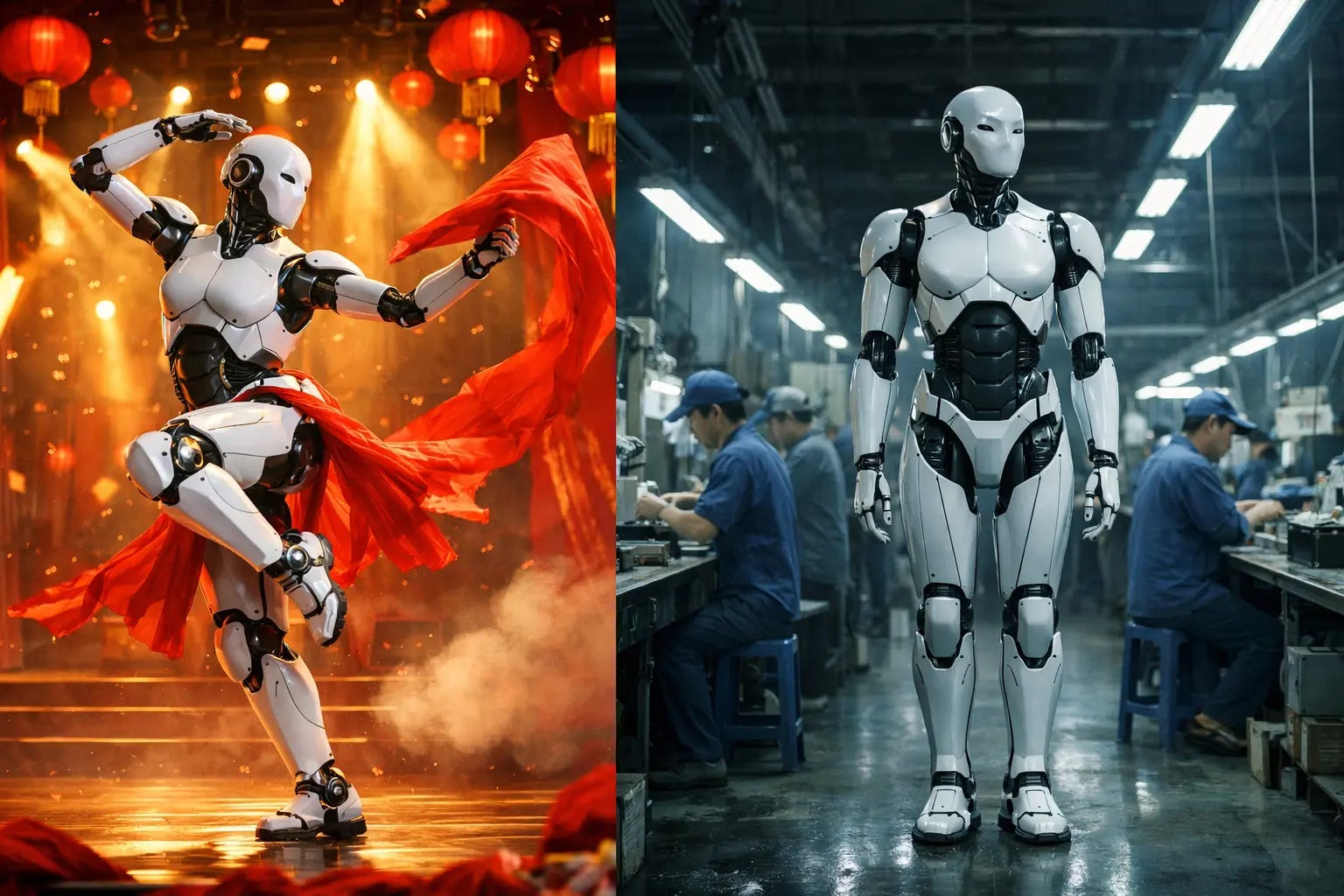
These machines can perform synchronized folk dances for television cameras. They cannot yet match the economics of assembly-line workers in Jiangsu and Zhejiang provinces, China’s manufacturing heartland where comprehensive labor costs average 150,000 RMB ($21,000) annually. For robots to make economic sense in these clusters, they must deliver returns within 24 months at total costs under 300,000 RMB ($42,000).
Yet 2025 saw extraordinary capital deployment. Total robotics industry investment reached 57 billion RMB ($7.9 billion) across 610 deals through late December, nearly tripling from 2024 levels, according to industry data. Seventy-five percent of disclosed orders come from educational institutions, not factories
This is a story about an industry racing against time and discovering that prime-time visibility cannot substitute for unit economics.
From Laboratory Spectacle to Prime-Time Advertising
The Spring Festival Gala bidding war signals a strategic inflection. Companies are transitioning from engineering demonstrations to marketing competitions, driven by financing imperatives rather than technical readiness.
This shift began with psychological pressure. Figure AI’s $2.6 billion valuation in early 2024, achieved before meaningful commercial deployment, created severe “valuation anxiety” among Chinese competitors. Venture investors and public market participants demanded tangible evidence of commercial traction beyond technical milestones. Large-scale order announcements, regardless of immediate profitability, became the currency for justifying valuations and signaling market leadership.
In February 2025, Unitree Robotics deployed 16 H1 humanoid robots during the Spring Festival Gala, executing synchronized northeastern folk dance routines in traditional cotton-padded jackets. The performance transformed industry dynamics overnight.
Rental companies reported earning over 100,000 RMB ($14,000) monthly leasing robots for corporate events and government exhibitions. More critically, the exposure provided official endorsement valuable in negotiations with local governments and state-owned enterprises.

Three months later, Beijing elevated the stakes further. The 2025 Government Work Report marked the first official mention of “embodied intelligence” and “intelligent robots” in state planning documents. This wasn’t a ceremonial speech—it was Beijing’s top-level policy signal for the year.
This designation unlocked structured capital deployment. Municipal governments in Beijing, Shanghai, Shenzhen, and Hubei established robotics-focused funds totaling 26 billion RMB ($3.6 billion). As I revealed in my Flashpoint analysis, this represents municipal balance-sheet engineering. Local authorities are converting robotics startups into listable “advanced manufacturing champions” as land-sale revenue vanishes. Three portfolio companies are already queuing for IPO within twelve months.
The financing explosion reshaped competitive dynamics. Stock market enthusiasm mirrored venture activity. One hundred ten A-share robotics concept stocks gained an average 67.63% through November 2025, with eighteen names doubling in value, Securities Times reported.
Order announcements followed the same explosive trajectory. UBTECH announced a 250 million RMB ($35 million) contract in September, establishing a global record for single humanoid robot orders. Galbot secured deals exceeding 700 million RMB ($97 million). AI² Robotics and Astribot each reported contracts surpassing 500 million RMB ($69 million). China Mobile’s 124 million RMB ($17 million) tender, won jointly by AgiBot and Unitree Robotics, marked another milestone in large-scale state procurement.
But as I documented in my September analysis of order credibility, the substance behind these announcements varies dramatically. A widely circulated case based on public records and media reporting revealed one company announcing a spectacular multi-thousand-unit order. The purchasing entity was established just days before the deal announcement, with personnel overlaps between buyer and seller raising fundamental questions about arm’s-length transaction status. This pattern appears across multiple announced deals.
“We’re not worried about lacking orders; we’re worried about being slower than competitors,” says Tan Min, Chief Brand Officer at UBTECH. This sentiment captures 2025’s transformed priorities. Speed to market visibility now outweighs deployment quality. The industry is manufacturing IPOs, not just robots.
The Economics Cliff: Why Most Robots Fail the Factory Test
Behind the marketing blitz and order rush lies a brutal economic reality that most current platforms cannot overcome.
Industrial buyers in Jiangsu and Zhejiang manufacturing clusters operate under rigid cost constraints. Comprehensive labor costs, including wages, mandatory insurance, dormitory expenses, and recruitment overhead, total 150,000 RMB ($21,000) annually per worker. Factory operators require 24-month payback periods for capital equipment.
This establishes an absolute performance threshold: total cost of ownership, including hardware purchase, preventive maintenance, electricity consumption, and software subscriptions, cannot exceed 300,000 RMB ($42,000) over two years.
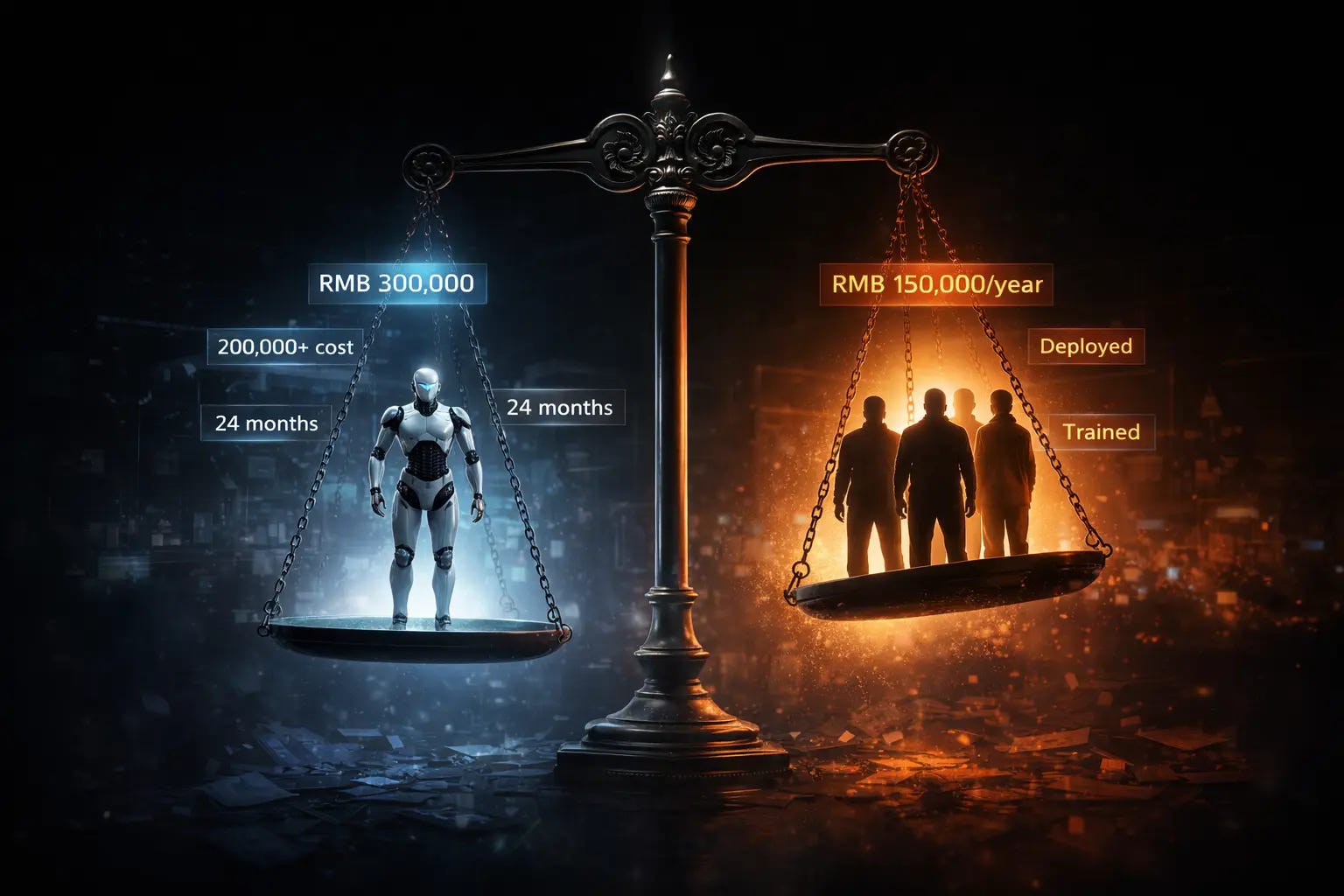
Current humanoid platforms struggle to meet this benchmark when configured for actual industrial tasks. Most high-capability robots cost 200,000 RMB ($28,000) or more at wholesale pricing. Operating expenses and downtime push total expenditure well beyond the economic ceiling.
As I explored in my December analysis of factory economics, the math creates an existential challenge. These machines compete not against Boston Dynamics prototypes but against human workers who are already deployed, already trained, and already cost-effective across thousands of factories.
This economic reality explains the industry’s bifurcated development patterns. Unitree Robotics, founded in 2016, reported revenue exceeding 1 billion RMB ($139 million) in 2024 with five consecutive years of profitability, according to founder Wang Xingxing.
The company’s success derives primarily from quadruped robots, which captured 69.75% global market share with 23,700 units sold. Humanoid platforms represent only 30% of revenue despite attracting disproportionate media attention. Wang admits openly the technical limitations: “Actions like opening doors and mopping remain very complex for robots. Expecting them to work directly in homes isn’t realistic yet.”
Contrast this with AgiBot, founded in 2023 by former Huawei “genius youth” Peng Zhihui. The company completed eleven funding rounds totaling over 5 billion RMB ($694 million), reaching a 15 billion RMB ($2.1 billion) valuation.
According to Caijing magazine reporting, AgiBot is rapidly pivoting from research emphasis toward commercialization urgency. Multiple core personnel departed as the company restructured research departments into separate business units, implementing internal competition mechanisms to accelerate product iteration. The strategy prioritizes speed over stability.
The capital flood enabling this urgency reveals deeper governmental priorities. As I documented in my Flashpoint column, the $3.6 billion in municipal robotics funds deployed between early 2024 and mid-2025 isn’t patient capital nurturing innovation. Beijing’s 1 billion RMB ($139 million) fund, managed by Hong Kong-listed Shoucheng Holdings, claimed triple book value returns within a year of establishment. Fund managers describe robotics deals as scarce assets, with hot projects receiving subscription interest double their fundraising targets.
This is municipal fiscal repositioning. Local governments face collapsing land-sale revenues and need new sources of fiscal health. Converting robotics startups into listable assets before the IPO window closes serves balance-sheet needs, not industrial development timelines. Three portfolio companies are queuing for public offerings within twelve months. Beijing wants exits, not engineering breakthroughs.
“We’re seeing batched exits from humanoid robotics companies. The commercialization path isn’t clear,” says Zhu Xiaohu, managing partner at GSR Ventures, explaining his firm’s portfolio reduction strategy. Industry observers predict eighty percent of existing companies may not survive, according to investment professionals tracking the sector. National Development and Reform Commission spokesperson Li Chao noted in November that “technological routes, business models, and application scenarios remain immature. Risk prevention is necessary.”
2026: Exits, Consolidation, or Collapse?
The aggressive capital deployment and marketing blitz mask fundamental execution challenges that will determine which companies survive the coming shakeout.
Manufacturing scale-up represents the first brutal test. Most Chinese robotics companies remain essentially prototyping operations. Moving from workshop assembly to industrial-scale production requires massive capital investment, supply chain maturation, and quality control systems these startups have never deployed.
Noetix Robotics disclosed that early production runs suffered systematic ankle joint failures because assembly workers consistently omitted a small mechanical locking component during high-volume assembly. The company redesigned the assembly sequence to install components during receiving inspection, eliminating the failure mode regardless of worker behavior.
This incident reveals the transition challenge. These machines integrate thousands of precision components under tight tolerances. Supply chains accustomed to smartphone production (high precision, low mechanical stress) or automotive manufacturing (high stress, looser precision) struggle with the hybrid requirements robotics demand.
Current production capacities expose the scale gap. Noetix operates a 200-unit monthly facility with a 300-unit plant coming online. Booster Robotics has delivered 700 total units since inception. These numbers represent rounding errors compared to the thousand-unit orders being announced.

Framework agreements structuring major deals postpone the moment of truth. Deliveries spread across multi-year timelines, creating revenue visibility for fundraising purposes while deferring actual performance validation. Morgan Stanley and Goldman Sachs research notes that many high-profile contracts represent framework agreements with uncertain execution likelihood rather than firm purchase commitments.
Customer analysis reveals additional credibility concerns. Multiple major announced orders involve transactions between companies and their equity investors. These arrangements serve strategic purposes: investors gain early technology access while startups secure committed revenue for production planning. They don’t represent organic market demand. Price discovery becomes opaque when capital flows between affiliated entities.
Educational institutions comprise the second major customer category. Seventy-five percent of humanoid robot purchases in the first half of 2025 came from universities and research organizations, according to the Humanoid Robot Scenario Application Alliance.
These deployments face benign operating conditions: supervised use, short duty cycles, controlled environments. A robot succeeding in a university laboratory proves nothing about industrial readiness. Factory floors feature dust, electromagnetic interference, continuous operation, and zero tolerance for downtime.
Yet beneath these execution challenges, Chinese manufacturers are pursuing a coherent long-term strategy. “The core objective is acquiring high-quality real-machine data,” says Yao Maoqing, General Manager of Embodied Business at AgiBot. This reveals the asymmetric bet.
Rather than perfecting intelligence in simulation before scaling hardware (the approach Tesla employs), Chinese companies invert the sequence. Deploy thousands of imperfect, inexpensive robots into real-world scenarios. Accept high failure rates. Capture edge cases at volume.
“Competition over the next three years is competition in real-scenario closed loops,” says Guo Yandong, founder and CEO of AI² Robotics. “Whichever company deploys robots in more real commercial scenarios and feeds operational data back to improve models and hardware will build competitive moats others cannot cross.”
If these companies survive the manufacturing gauntlet and execution challenges, they will control the world’s largest fleets of deployed data collectors. They’re trading hardware margins for information advantage.
Whether this strategy succeeds depends on several unproven assumptions: Do low-quality hardware platforms generate high-quality training data? Can these companies process field data at scale? Most critically, can they translate deployment learnings into meaningful performance improvements before capital exhausts?
The coming bifurcation will separate sustainable niches from venture-scale ambitions. One segment will retreat into educational products, exhibition rentals, and entertainment applications. These represent real businesses generating actual revenue that don’t support unicorn valuations.
The survivors who master industrial economics will increasingly resemble Foxconn rather than AI research labs. Their products may abandon humanoid form factors entirely if wheeled bases with articulated manipulators prove more economically viable. Aesthetics will matter less than reliability, serviceability, and total cost of ownership.
What happens in 2026 depends on three variables.
First, policy continuity. Can government funds secure IPO exits before regulatory scrutiny intensifies or market conditions deteriorate?
Second, technical breakthrough velocity. When will multimodal models and embodied intelligence cross from current L2-L3 capability levels to genuine industrial utility?
Third, scenario validation. Can factory deployments demonstrate positive ROI within twelve to eighteen months, or will cost pressures force retreat to narrower applications?

This competition reveals broader patterns in China’s technology commercialization model. Policy support and capital enthusiasm create brief windows for aggressive scaling attempts. But sustainable businesses require crossing economic thresholds that capital alone cannot overcome.
The robotics boom may ultimately succeed. China’s electric vehicle industry followed a similar trajectory of early subsidies, overcapacity, brutal consolidation, then global competitiveness. But robotics faces longer adoption curves and less forgiving unit economics than automotive manufacturing.
The Spring Festival Gala bidding closed without public announcement of winners. Whether AgiBot or Unitree or some third competitor secured the placement matters less than what the competition itself reveals about 2025’s industry dynamics.
An entire sector bet tens of millions on prime-time visibility rather than patient factory-floor deployment. The robots performed impressively on stage. The economic models remain unproven in production.
Somewhere between spectacle and spreadsheet reality, a few companies will build sustainable businesses by learning to manufacture profits alongside publicity. The rest will become footnotes in China’s latest technology euphoria cycle.
The question for 2026 isn’t whether robots can dance. It’s whether the companies building them can survive long enough to make them work.
Excellent summary. I’ve been working in China robotics for 14 years. Rarely that I find an article where I don’t find something to complain. This is really spot on.
Very in depth.