
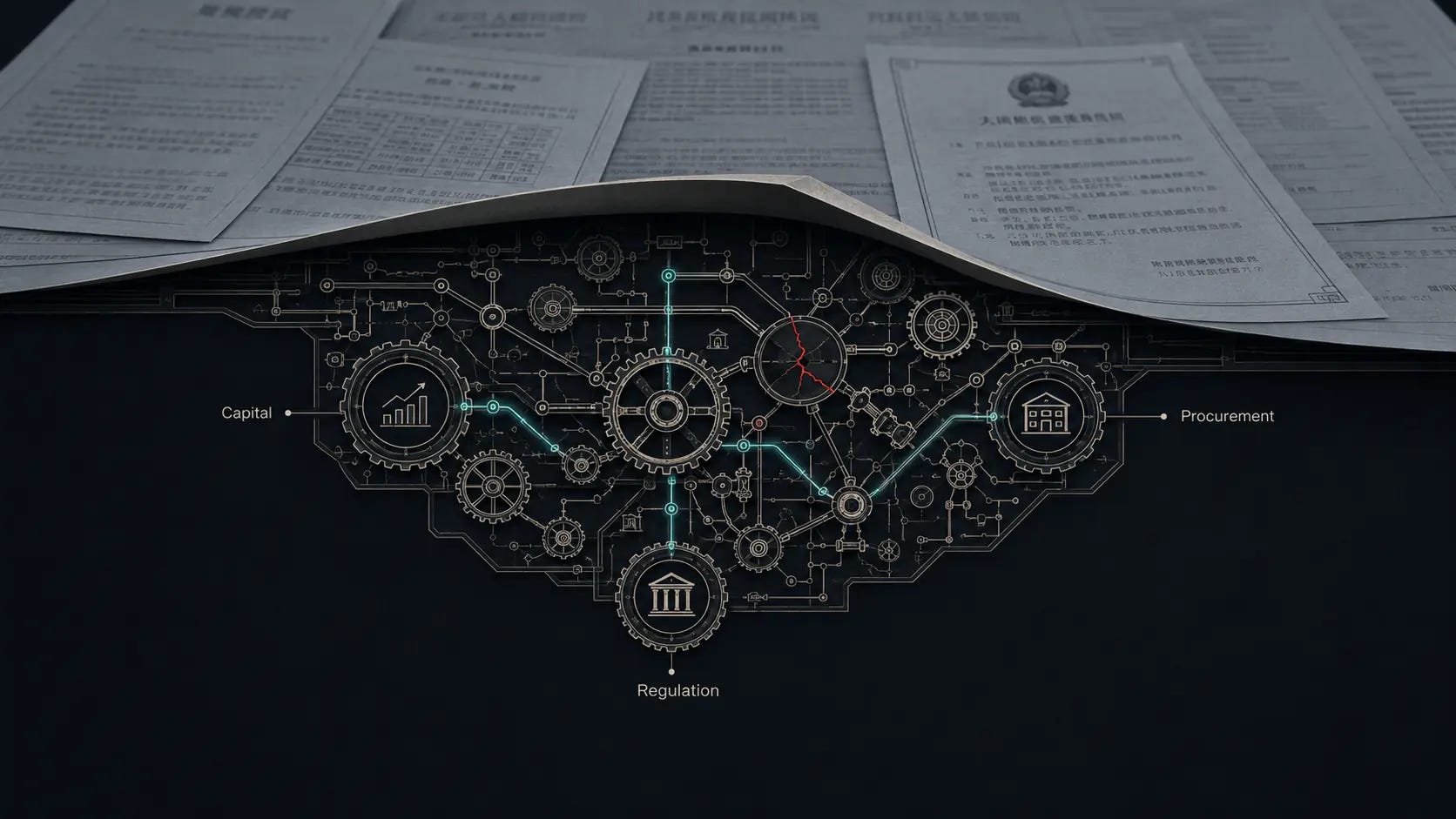
The System Underneath
Western tech media covers China through a familiar lens: geopolitical threat, copycat economy, or regulatory crackdown. Chinese state media tells a mirror-image story of inevitable triumph. Neither is useful if you need to make decisions about investments, partnerships, strategy, or policy.
Hello China Tech exists to close that gap.
I read China’s technology industry in its native language every day: IPO prospectuses, government filings, state-owned enterprise procurement announcements, earnings calls, policy documents, and industry reporting from sources like 36Kr, Sohu, and Jiemian. I translate the system underneath the words: the institutional mechanics, competitive dynamics, and strategic constraints that explain why Chinese tech companies behave the way they do.
I publish three deep dives every week, more than 200 in the newsletter’s first year. My analysis has been cited by Bloomberg, the Financial Times, Reuters, The Economist, CNN, AFP, WIRED, and the South China Morning Post.
What Makes This Different
I read what you can’t.
Most English-language China tech analysis works from translated wire reports and English-language press releases. I work from Chinese-language primary sources: regulatory filings that reveal how Beijing’s AI approval system actually functions, IPO prospectuses that expose a GPU startup’s real customer concentration, SOE deployment reports that show where AI models run in production. When I reported that DeepSeek had been deployed across 113 state-owned enterprises, the source was original Chinese-language reporting that Western media had not covered.
I build frameworks that outlast the news cycle.
Every deep analysis produces a reusable analytical tool, a way of understanding that applies beyond the single story. Four examples:
The Sanctions Paradox. US export controls were supposed to slow China’s AI. Instead, they forced architectural innovations (DeepSeek’s sparse attention, mixture-of-experts) that cut inference costs 25–30x. The framework helps you assess the effectiveness of technology containment and the real competitive position of companies operating under restriction.
The Golden Cage. Zhipu AI carries a $5.5 billion valuation, but its government backer is simultaneously lead investor, primary regulator, and largest customer. Privileged access and constrained strategic freedom come in equal measure. Use it to test any state-backed Chinese tech company’s true degree of strategic freedom and where its valuation assumptions break.
The Air Pocket. Xiaomi Auto’s 25.5% gross margin looked like it rivaled BMW. I showed it was a temporary peak: depleting order backlogs, expiring subsidies, and tightening safety regulations all converging in mid-2026. It shows where the hidden expiration dates sit inside impressive quarterly numbers.
The Token Economy. China is pricing AI like a utility: telecom operators bundle tokens into phone plans, cloud platforms sell coding quotas that vanish in minutes, and the unit of competition is shifting from model benchmarks to tokens processed per day. The framework helps you read China’s AI market through its demand layer (tokens, tenders, and pricing) rather than its press releases.
The principles underneath these frameworks are consolidated in The China Tech Field Guide, a free annual document scored against outcomes and re-issued every July.
I challenge both sides.
I am pro-clarity. That means scrutinizing Western narratives and Chinese triumphalism with equal rigor.
When Western media framed idle Chinese-made chips as procurement failures, I explained why they represent the calculated transition costs of building sovereign compute infrastructure. When Chinese robotics companies secured Spring Festival Gala placements, I documented that leading robots operate at 30–50% of human efficiency and that marketing spend inversely correlates with product maturity. Chinese AI toys shipped in the millions, and I tracked the 30–40% return rates and the “two-week wall” that no company has solved.
The world is more interesting than either side’s narrative allows. My job is to show you the structural reality underneath.
I grade my own calls in public.
Every essay in the archive carries a date, so every call can be checked. The China Tech Field Guide re-scores the newsletter’s core principles against outcomes each July. The annual calibration letter, What I Got Wrong About China Tech, goes one level down and grades individual calls: in year one, two held clean, one broke on its arithmetic, and one I missed. It is free to read, and it is the standard every future essay gets held to.
Start Here: Four Articles That Define the Perspective
If you’re new to Hello China Tech, start with The China Tech Field Guide: six principles from a year of essays, free, with a PDF edition for sharing. Then these four essays show how the thinking works in practice. All four are free to read:
In July 2026, a Chinese outlet published a 118-item transcript of a nearly four-hour investor meeting with DeepSeek founder Liang Wenfeng. DeepSeek has not confirmed it, and there was no English version. Western coverage had read DeepSeek as an efficiency story. Liang’s own account is about scarcity: talent, models, and applications all trace back to compute. I reorganized the transcript by theme, translated the key answers, and checked them against my earlier DeepSeek calls.What it shows: how I work from a Chinese-language primary source that had no English version, and where it confirms or contradicts my own record.
Chinese platforms launched 14,600 AI-generated short dramas in a single month. Production costs collapsed by 90%, human actors were displaced, faces were appropriated at industrial scale, and regulators issued rules within seven days. None of these forces are unique to China.What it shows: how I connect production economics, labor, regulation, and culture into one narrative, and why China’s market is a preview of everyone else’s.
Within the same few months of early 2026, Zhipu rebranded itself the Chinese Anthropic, MiniMax reversed three years of avoiding enterprise sales, and DeepSeek opened the door to outside money. These moves share one cause: platform giants can pursue every AI monetization route at once, while independent labs can afford exactly one.What it shows: how I build a framework that explains a whole sector’s behavior, not just one company’s news.
One year of paid essays, scored against what actually happened: Moonshot’s IPO reversal, the token economy’s audited numbers, the calls that held and the one I missed.What it shows: the accountability standard behind everything else on this list. When the analysis is wrong, you read it here first.
What I Cover
AI & Large Language Models. DeepSeek, Zhipu, MiniMax, Moonshot, StepFun, and the platform giants (ByteDance, Alibaba, Tencent, Baidu). Model competition, pricing dynamics, state-directed enterprise deployment, the economics of AI startup survival, and the demand layer (tokens, tenders, and workflow integration) that Western coverage largely ignores.
Semiconductors & the Chip War. Nvidia vs. Huawei’s parallel ecosystem. Domestic GPU challengers (Moore Threads, Enflame, Kunlunxin, Cambricon) analyzed through their prospectus filings. CXMT’s DRAM challenge and the Hefei Model of state-as-VC. Export control dynamics, analog chip retaliation, and the credential economy governing procurement.
Electric Vehicles & Autonomous Driving. The tension between domestic price-war survival and global brand-building. CATL’s value-chain dominance. Robotaxi expansion into the Middle East. Why component suppliers with technological moats historically outperform manufacturers during consolidation phases.
Robotics & Embodied AI. The 70% overlap thesis between smart cars and humanoid robots, and why the remaining 30% is where difficulty concentrates. Unitree’s Xiaomi model vs. Zhiyuan’s Huawei model. The gap between visibility and viability.
Policy & Industrial Structure. AI regulation as developmental infrastructure. Content labeling as accountability engineering. The LGFV mechanics behind state-backed tech champions. How both sides weaponize market access. The concepts, Xinchuang, siyouhua bushu, Ya Shi Pingtai Zeren, that have no English equivalent but shape every deal in this market.
Content Formats
Deep Dives. Long-form analysis with original frameworks, drawn from primary Chinese sources. Three per week. Paid subscribers read every piece in full; free subscribers receive previews, plus selected deep dives unlocked in full.
FlashPoint. Rapid-response analysis of market-moving events. Terse, financial-first, one event, one structural implication. Published the same day or the next morning, while others are still translating the headline. Paid only.
Weekly Recap. A Sunday email that ties the week’s essays into one narrative thread and flags what to watch next. Free to every subscriber.
Who I Am
I’m Poe Zhao. I’ve spent 12 years analyzing technology and innovation industries, founded Dailyio, and am based in Beijing.
What that means in practice: I read Chinese IPO prospectuses, government AI filing databases, SOE procurement announcements, provincial policy documents, WeChat industry groups, and brokerage research reports every day, in their original language. Then I write for a global audience that needs the system decoded and the concepts translated.
I built Hello China Tech on three editorial convictions:
Treat Chinese tech companies as rational actors.Their strategies have internal logic shaped by specific constraints: regulatory environments, capital structures, competitive dynamics, political economy. Understanding that logic is more useful than defaulting to “state subsidy” or “IP theft” explanations.
Explain the machinery behind the output. When a Chinese AI chip startup IPOs in 88 days, look past the speed: the STAR Market’s political mandate, the Xinchuang procurement system, and the LGFV funding cycle made it possible. When 113 SOEs deploy DeepSeek, the real story is siyouhua bushu(private on-premise deployment) as a structural barrier to foreign AI companies.
Maintain intellectual honesty about both systems. Chinese innovations under constraint are genuinely impressive, and they are responses to constraints rather than fundamental breakthroughs. The Hefei Model produced world-class display manufacturing, and its funding mechanism is collapsing as land sale revenues dry up. Holding both truths at once is the honest position.
How I Work, and How I Use AI
Chinese is my first language. English is my second. I want readers to know how each article is made.
What is mine. Every topic, argument and conclusion in Hello China Tech is mine. I choose what to write about. I read the Chinese sources myself: company filings, policy documents, earnings calls, local media and industry conversations. The frameworks and the calls are my own, and I put my name on them.
How I use AI. I think and outline in Chinese first. Some articles I draft in English by hand, from my own notes. Others start as Chinese notes and an outline. Either way, AI tools help me in three ways.
Drafting: when I start in Chinese, AI produces the first English draft from my notes and outline.
Editing: AI helps me make the English clearer and shorter, whether the draft is mine or AI’s.
Challenge: I ask AI to find weak points in my argument. I decide what to change.
Article illustrations are generated with AI image tools from my prompts. The same rules apply to my posts on X and Substack Notes, and to every email I send.
What AI does not do. AI does not choose my topics or form my views. I read and edit every line before it is published. I check every number and quote against the original Chinese source.
Why I work this way. My value to readers is access to Chinese-language sources and judgment built over 12 years of covering this industry. AI lets me deliver that in clear English, faster than I could alone. I keep the English plain on purpose.
Responsibility. If something is wrong, the mistake is mine. If you spot an error, reply to the email and I will correct it in public.
Last updated: September 2026
Who This Is For
Investment professionals. VCs, hedge fund analysts, and institutional investors who need primary-source analysis of Chinese tech companies. You get filings-based financial analysis and frameworks grounded in prospectuses and procurement records.
Corporate strategists and executives. Leaders at multinational companies who face decisions on Chinese competition, partnerships, and supply chains. You get the institutional context, how procurement systems, policy incentives, and capital structures work, that determines whether a deal or market entry will succeed.
Policy analysts and researchers. Think tank researchers and government analysts tracking technology competition. The conceptual vocabulary and the analysis you need to move beyond headline narratives.
Subscribe
Free subscribers get:
Previews of all three weekly deep dives
Selected deep dives unlocked in full
The Weekly Recap every Sunday
The China Tech Field Guide and the annual calibration letter, in full
More than 50 full articles in the open archive
Paid subscribers get:
Every deep dive in full, three per week
FlashPoint rapid-response analysis, published while the event is still moving
The complete archive: more than 200 analyses and every framework
For Institutional Readers
Hello China Tech offers Institutional Access for investment firms, strategy teams, founders, and institutional readers who need written analysis on China’s technology market.
The plan includes full paid access to Hello China Tech and a limited number of written question credits each year. All work is delivered in writing.
Institutional Access is an industry analysis product. It does not include calls, investment advice, securities recommendations, due diligence, deal sourcing, non-public information, sponsored content, or any influence over Hello China Tech’s editorial judgment.
To request access, please complete this short form: Request Institutional Access
Get in Touch
Reply to any newsletter or email me directly. I read every message.
Find me on X: @poezhao0605
