


Every Sunday I pick the China tech stories that mattered that week, say what I make of each, and link back to where I first wrote about it. Subscribe free
This week’s letter starts in Nvidia’s boardroom. The four Chinese stories after it each touch one question: who pays for AI and the hardware behind it, and who collects. China’s statistics bureau, Xiaomi, a Chinese chip designer and two robotaxi developers each answered part of it.
Jensen Huang is back as Nvidia’s CEO.
In its November 23 announcement, Nvidia says its board received input from senior levels of the US government and, based on that input, is confident his reinstatement poses no national security risk. On November 17, Colette Kress, Nvidia’s interim CEO after Huang stepped down, said Nvidia will no longer sell its H200 chips in China, TechCrunch reported. Nvidia’s statement does not say if that decision stands. I think his exit and return made Nvidia’s China sales a national security question, and I expect its high-end chips to get harder for China to buy.
Electronics supplied most of China’s industrial profit growth.
China’s statistics bureau says profits at major industrial firms rose 16.0% in January-October, according to its November 27 commentary. Electronics added 9.7 points of that growth, as its profits doubled. The bureau credits rising demand for AI computing power, which lifted memory chips and related manufacturing.
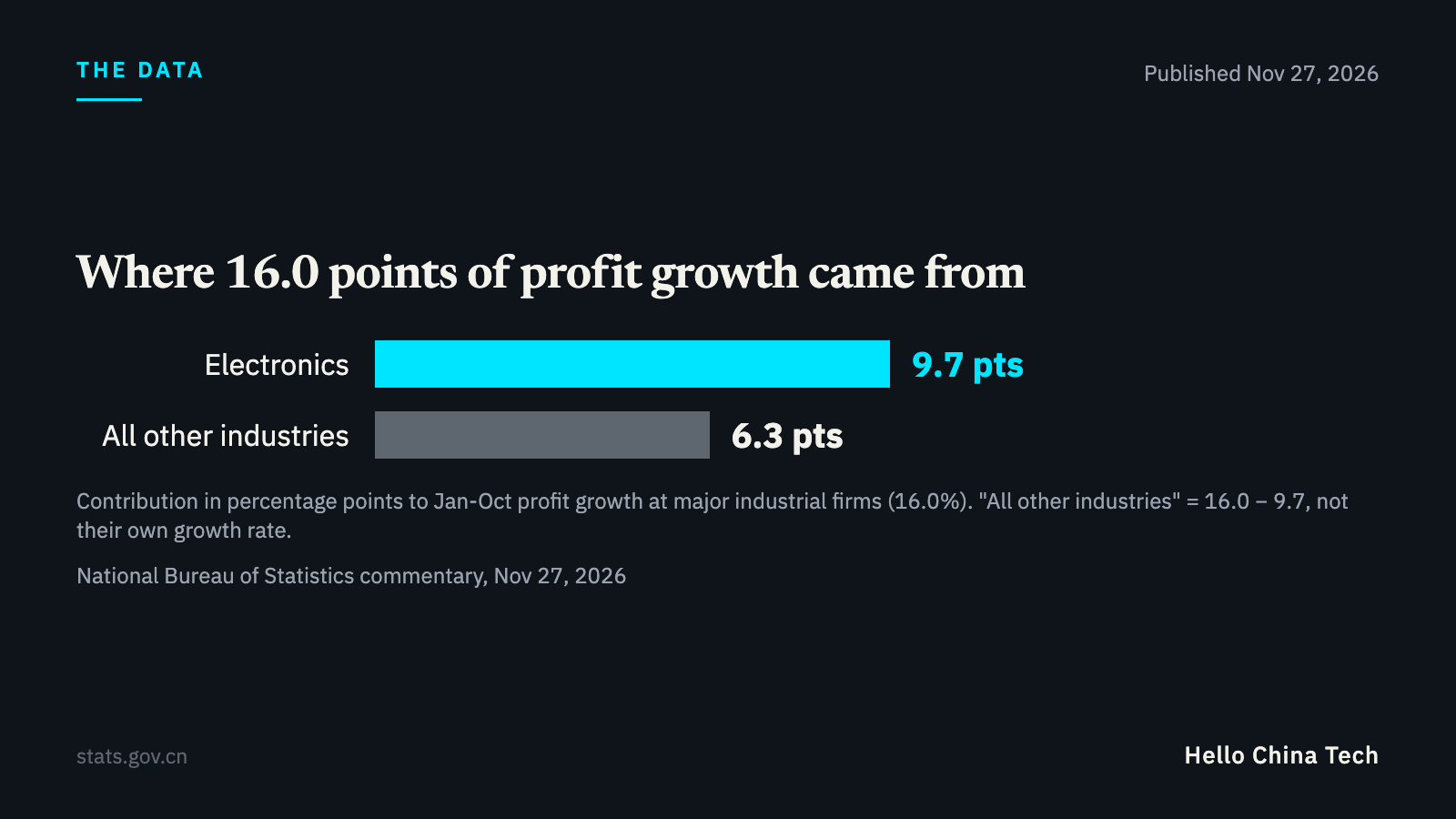
More than half of the headline growth comes from one sector’s contribution, so I would call the recovery narrow. The bureau gives growth rates, not amounts. I cannot tell from it how much of the gain is memory prices and how much is volume.
Xiaomi’s margin on cars, AI and new projects fell to 19.2%.
On November 24, Xiaomi reported a 19.2% gross margin for its NEV, AI and other new initiatives segment in the third quarter, down from 25.5% a year earlier, according to its results filing. The segment posted a Rmb 3.4bn operating loss. Xiaomi attributed the margin drop to fewer SU7 Ultra deliveries, higher component prices and rising AI costs. It did not say which components rose. CXMT, a Chinese memory chipmaker, earned an 89.53% gross margin in the same quarter, and its IPO placement report lists affiliates of Xiaomi as strategic investors with long-term supply cooperation agreements. If memory is among those components, I would read the bureau’s memory gains and Xiaomi’s margin as one price rise. Memory makers count it as profit, and buyers like Xiaomi count it as cost. This week I worked through what Xiaomi’s supply tie to CXMT is worth this quarter.
Enflame says Tencent will stay its biggest buyer.
Enflame is a Shanghai-listed AI chip designer. Its chief executive, Zhao Lidong, said on November 23 that sales to Tencent should stay a high share of revenue “for a certain period,” Chinese business outlet Yicai reported. He said Enflame is also pursuing other internet companies, model developers and telecom carriers. A Tencent unit held 17.95% of Enflame at the end of September, the largest single holding in its third-quarter report. To me, this is one place Tencent’s domestic chip supply sits. It is an outside company, and its chief executive is the one saying who gets served first. This week I asked who decides which Chinese buyers get substitute chips first under Washington’s new rule on remote access.
WeRide earns most of its robotaxi money abroad.
WeRide’s third-quarter robotaxi revenue exceeded Rmb 100m, with overseas markets generating over 90% of it, the company reported on November 20. On Pony AI’s November 18 call, finance chief Leo Wang said per-vehicle margins run higher abroad than in China. Abroad, Pony AI targets higher-fare cities where local partners buy the cars and cover depot, charging, cleaning and maintenance costs. I read the overseas push as a way for developers such as Pony AI and WeRide to improve per-car economics. They rely on platforms to reach foreign riders. Uber, a main overseas channel for both, plans about 1,000 driverless cars outside the US by the end of 2027, from every supplier. My Wednesday piece looks at what Uber’s plan means for China’s robotaxi contracts.
$150/year, or $20/month. You can also buy any single piece at the end of its free preview ($5 for a deep dive, $3 for a FlashPoint).
Poe