


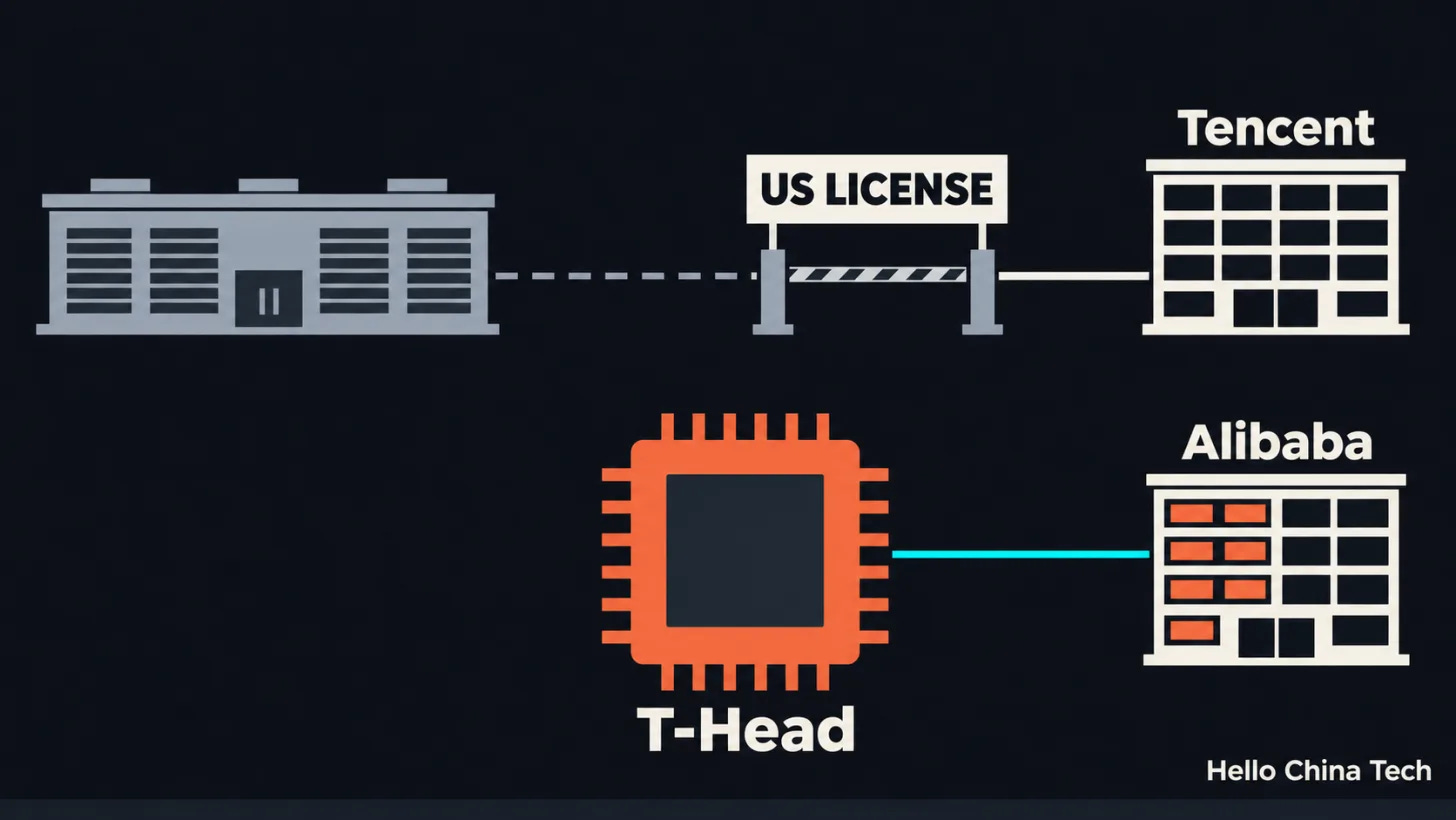
Chinese AI buyers had three side channels to Nvidia compute, as I wrote on November 16: export-compliant gaming and workstation cards, limited H200 supplies, and rented capacity in overseas data centers. I named one condition that would change my view of the US policy risk: "Continued access to export-compliant cards and overseas compute on comparable terms through the first quarter of 2027."
The same day, the US Commerce Department's Bureau of Industry and Security (BIS) announced a rule on the third channel. It was published in the Federal Register and took effect on November 19. The condition needed both halves. For large overseas clusters the terms are no longer comparable, so the condition has failed, four months early.
Tencent, the owner of the WeChat messaging app, and Alibaba, the e-commerce and cloud group, held earnings calls on November 18 and November 19. The Register built its headline on one line from Tencent president Martin Lau: "It sets everyone back in China." His next sentence was about quantity: "everyone is actually having less compute, advanced compute to work with."
The setback is not equal, and the two calls show where it differs. I read them as the first evidence that advanced compute inside China is becoming a ration. In these two disclosures, volume gives way first. The sellers expect price to follow. Whoever holds substitute supply decides who is served, and in what order.
Hello China Tech reads China's AI, chip, robotics and EV sectors from primary sources that English coverage rarely reaches. Subscribe free to get each new analysis as it publishes.
A Gate on the Third Channel
The interim final rule, Addressing Remote Access to Advanced Semiconductors, adds a new section to US export rules. It works through the hardware. A license is now needed for exports, re-exports and in-country transfers of advanced AI chips and servers when the party moving them knows they are going to certain data centers. The test is whether the data center, "wherever located," gives a "significant volume" of compute to or for certain companies. These are companies headquartered in Macau or in Country Group D:5, an export-control group that includes China. A company whose ultimate parent is headquartered there is treated the same way. The word "for" reaches the middleman. The rule applies when the supplier knows that an outside customer of the data center is training models for such a company, or providing models to it.
The threshold is more than 12m in "aggregate TPP," a measure of total processing performance. It is counted across one site or several linked sites. Applications are reviewed case by case. BIS states that compute at this level allows the "training or running" of advanced models. The control turns on volume and on who the customer is, so inference above the threshold is covered along with training. It makes one exception by use: compute supplied only for commercial recommender systems, with the customer, the volume and the checks on that use reported to BIS. A system that generates text, images or code does not qualify. Neither does one with such a model built in, even if it also makes recommendations.
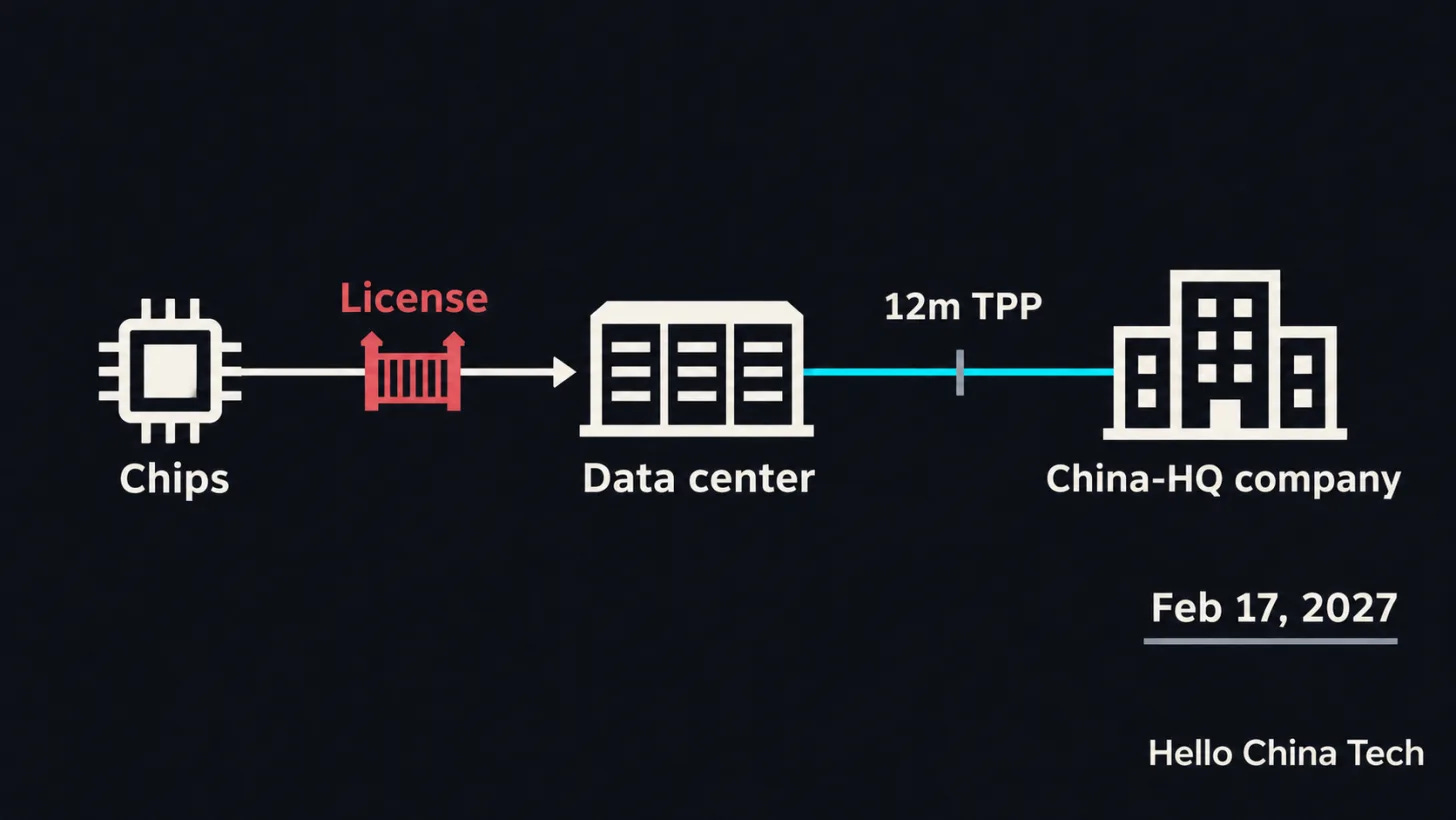
The rule also reaches chips that have already shipped. If a data center later starts supplying such companies above the threshold, the change of use counts as an in-country transfer, and its owner or operator needs a license. Data centers that were already doing so before the rule was published, and want to continue, have 90 days from the effective date to obtain a license "or face future export restrictions." That deadline falls on February 17, 2027. Data centers are also expected to check who owns or controls their customers. If a data center declines or is unable to show those checks, the exporter is presumed to know, unless it resolves the doubt before the transaction. The rule separately adds a license requirement for advanced chip exports to Indonesia, Malaysia, Singapore, Thailand and Brazil. Shipments whose final recipient or end user has a US headquarters or ultimate parent are excluded, provided the exporter meets the rule's reporting requirements.
What follows is the evidence that the rule is turning advanced compute in China into a rationed good, the strongest objections to that reading, and what it means for holders of Alibaba and Tencent. Only need this article? Buy the full article as a PDF for $5. No subscription needed.