

The newsletter covers China’s technology industry one essay at a time. A report puts a year of that coverage on one sector into a single document that stands on its own. Each report runs about 10,000 words plus data tables, ships as a PDF, and carries an edition year and a data cutoff date.
Available now
China’s Token Economy: The Count and the Invoice, 2026 Edition

China’s token count now feeds national briefings, credit programs, carrier strategy and company budgets. This report shows who uses the number, what it leaves out, and who carries the risk when it is misread.
Three questions it answers:
What do China’s national token figures actually count, and why do they not line up?
What happens when a token count becomes an input for subsidies, credit and procurement?
Why do some sellers and buyers move to credits, seats and revenue as they get closer to the bill, and what do run rates really measure?
Inside: five chapters, from the official name of the unit to what one number can and cannot show. Where my earlier calls were wrong, the chapter says so. The report closes with five directions to watch and four questions to ask of any token number. The data appendix holds seven tables, from official figures to public procurement, each figure with its source. 33 pages, data as of October 31, 2026.
It is written for investors who meet token counts and run rates in Chinese AI earnings calls and filings, policy researchers who follow China’s AI measurement, local credit programs and export rules, and industry readers who buy, sell or price AI services and need to compare units across vendors.
Buy the report ($99) · Read the free sample: the Executive Summary and Chapter 2
China’s Parallel AI Stack: Built on Chips, Waiting on Memory, 2026 Edition
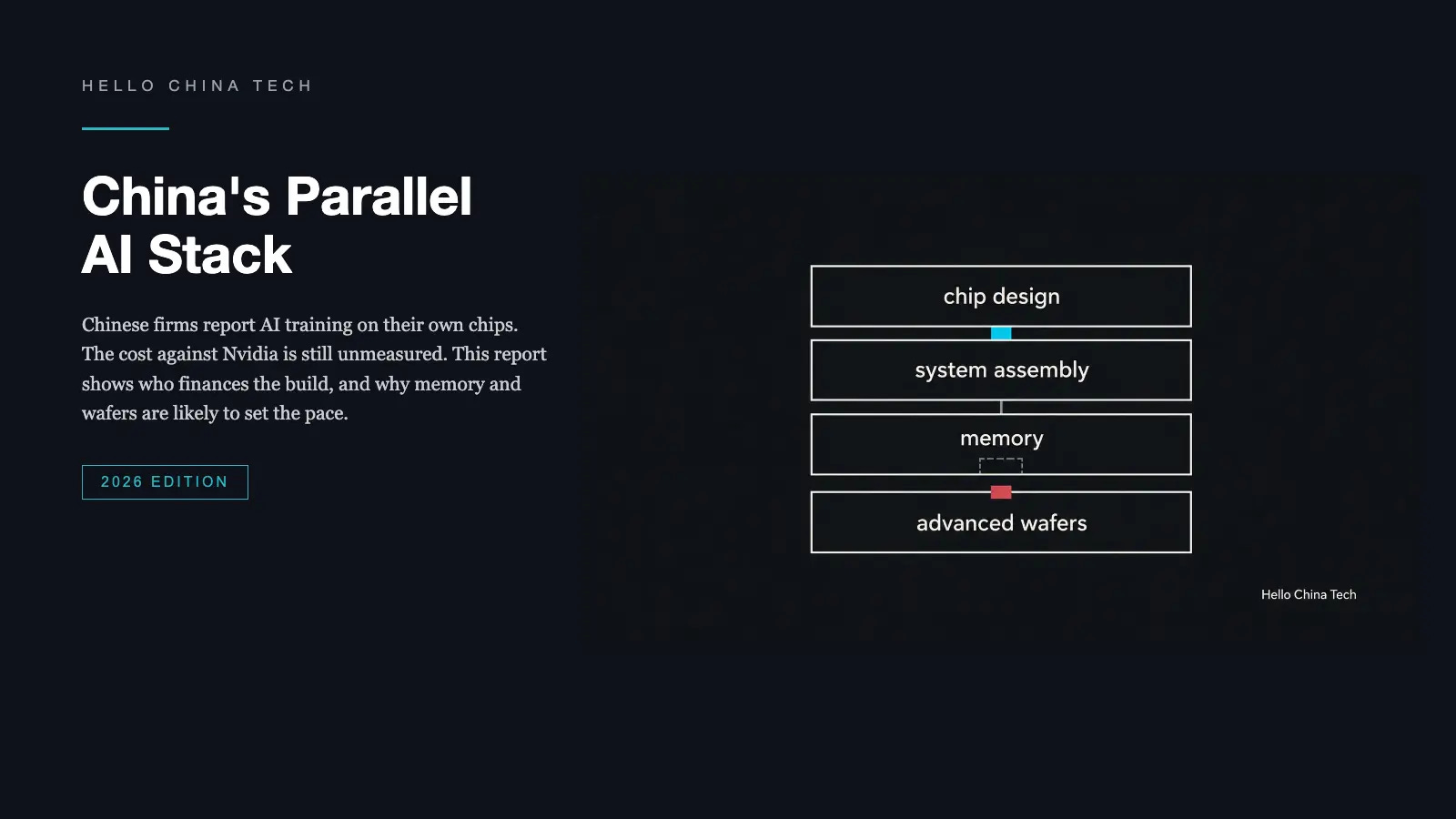
Chinese companies now report training runs on domestic AI chips at every level of difficulty. This report shows what is known about the cost, who finances the build, and why memory and advanced wafers are likely to set the pace.
Three questions it answers:
China can now train large AI models on its own chips. What does the public record show about the cost against Nvidia, and what would a fair comparison need?
Who is financing China’s domestic AI chip build: buyers, suppliers and banks, or the stock market?
Which inputs decide when the gap narrows, and which layers of the stack do not need a Chinese version at all?
Inside: five chapters, from the training runs on record to the layers where China already supplies the global build. Where my earlier calls were wrong or are still open, the chapter says so. The report closes with six directions to watch and a short guide to reading the next chip headline. The data appendix holds six tables, from chip designers’ first-half accounts to memory and foundry indicators, each figure with its source. 32 pages, data as of October 7, 2026.
It is written for investors who follow Chinese AI chip, memory and foundry stocks or Nvidia’s China exposure, policy researchers who track export controls and China’s purchasing rules for AI compute, and industry readers who need a map of China’s AI compute stack by layer rather than by company.
Buy the report ($99) · Read the free sample: the Executive Summary and Chapter 1
Who Pays While China’s Robots Learn: China’s Embodied AI Industry, 2026 Edition
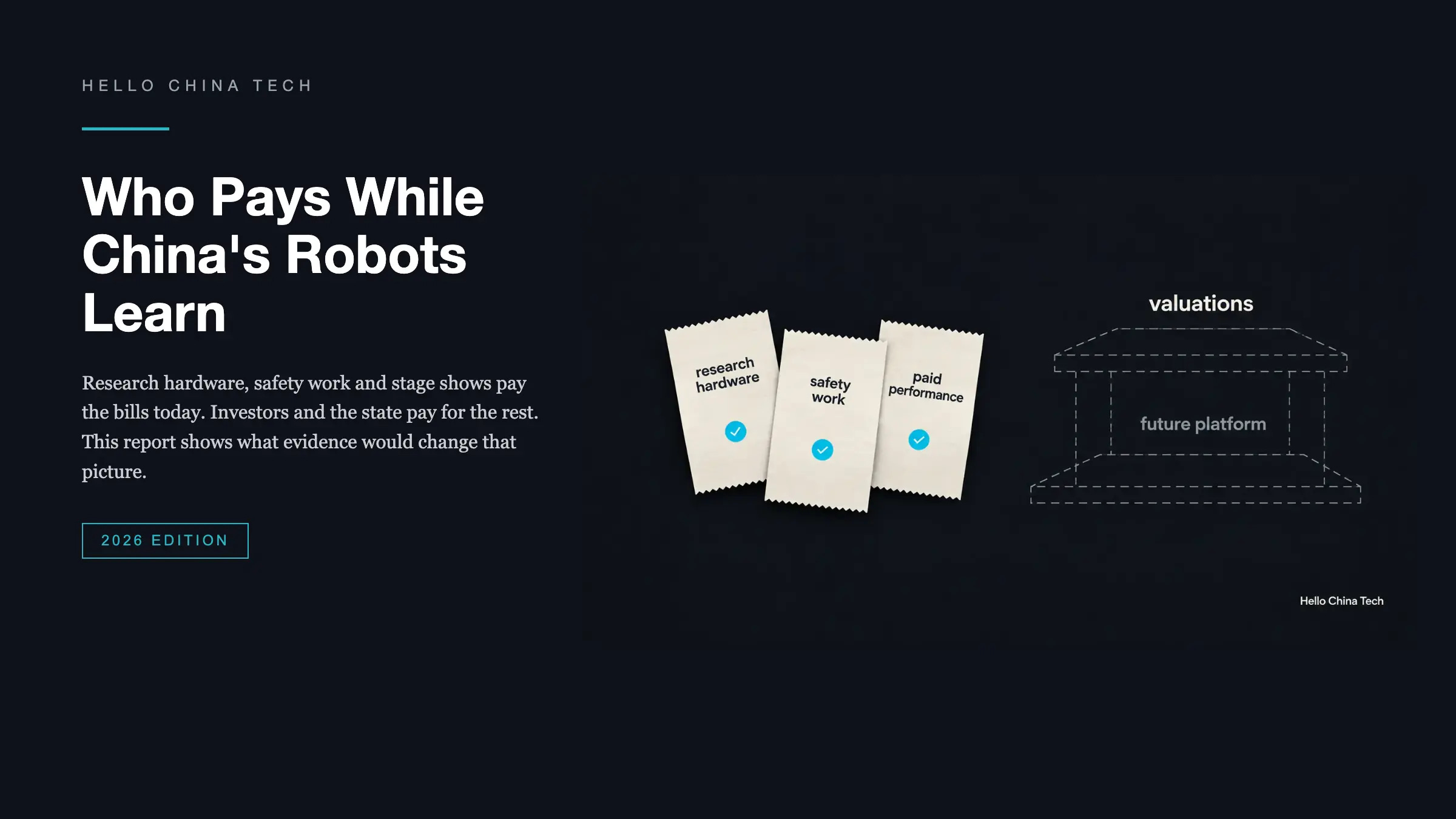
China’s robot companies earn their money from research labs, safety work and stage shows. Their valuations assume something else. This report shows who pays for the gap, and what evidence would change that picture.
Three questions it answers:
Which of China’s robot businesses make money today, and who are their buyers?
Who is paying for the general-purpose robot that valuations assume: private investors, capital markets or the state?
Which evidence would show that productive demand has arrived, and which would show progress toward general-purpose capability?
Inside: five chapters (One Label, Five Businesses; Who Pays Today; Who Pays for the Wait; How Long the Wait; How You Will Know). A Scorecard grades eleven earlier calls. A Watchlist lists twelve checkpoints, starting with Unitree’s third-quarter report on October 29, 2026. The data appendix holds shipments, funding and two prospectuses side by side. 29 pages, data as of October 6, 2026.
It is written for investors who follow Chinese robotics or Hong Kong and STAR Market listings, policy researchers who track how the Chinese state funds and measures a new industry, and industry readers who need a map of the sector by business rather than by company.
This is the Founding report for the October to December 2026 quarter.
Buy the report ($99) · Read the free sample
What every report includes
My earlier calls, checked. Where I got something wrong before, the report says so and names the assumption that failed.
What to watch. Most reports close with three to five things worth following, and why. Annual editions, and this first robotics report, close with a full Scorecard of my earlier calls and a dated Watchlist.
Data appendix. Each figure with its source and a source level. Where sources disagree, both are shown.
Each report also has a free sample, the Executive Summary and one full chapter, open to everyone.
Pricing
Anyone: $99 per report.
Paid subscribers, monthly or annual, and team subscription members: $49 per report. The code is in each report’s launch post, visible when you are signed in.
Founding members: one report each quarter at no cost, chosen by me.
Institutional clients: every report, delivered on launch day.
Each PDF carries the buyer’s email address on every page. Payment and delivery run through Payhip. The download page opens as soon as payment clears, and the link also arrives by email.
Coming next
How China Funds Its Tech Race. Where the money comes from: state funds, listings before profit, and the mechanisms that keep companies raising.
New reports are announced here when they are scheduled. Subscribers hear first by email.