

On September 10, Huawei published a transcript on Xinsheng Community, the public face of its internal forum. It records a Q&A between supervisory board chairman Guo Ping and a group of new employees. Sina Tech republished the full text on September 15. Guo says he was likely Huawei’s first graduate recruit. He later served as rotating chairman and now heads the supervisory board, which oversees executive conduct and financial reporting.
This article selects eight of the transcript’s 25 questions, reframes them for an investor audience, and translates Guo’s answers. The analysis compares those answers with Huawei’s 2025 annual report, a June speech by device chief Yu Chengdong, and an investor transcript published by Tencent Tech but not confirmed by DeepSeek, which Guo himself cited.
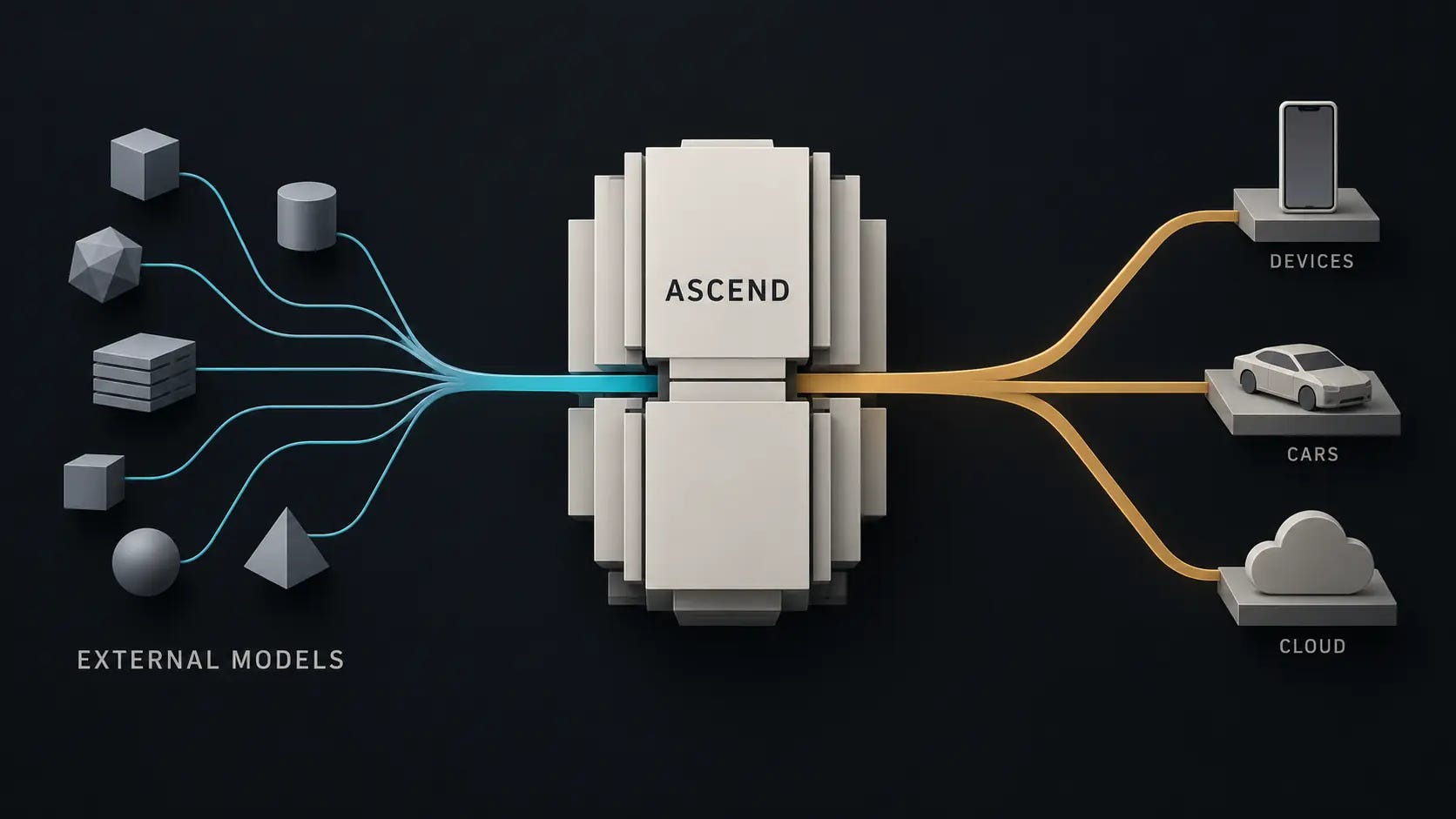
The transcript discloses both Huawei’s Nvidia ambition and the hierarchy behind it. Infrastructure should support every model, while devices, cars, and cloud claim a stronger need for models of their own. With Ascend supply constrained, that strategic distinction becomes a resource-allocation decision.
Huawei’s three-tier AI model rule and the resource tension behind it is one example of how Hello China Tech reads China’s tech sector: primary sources first, three analyses a week, across AI, chips, robotics, and EVs. Subscribe free to get the next one in your inbox.
Q1: Which Huawei businesses need their own models?
A new hire asked how the company views in-house large models at the strategic level.
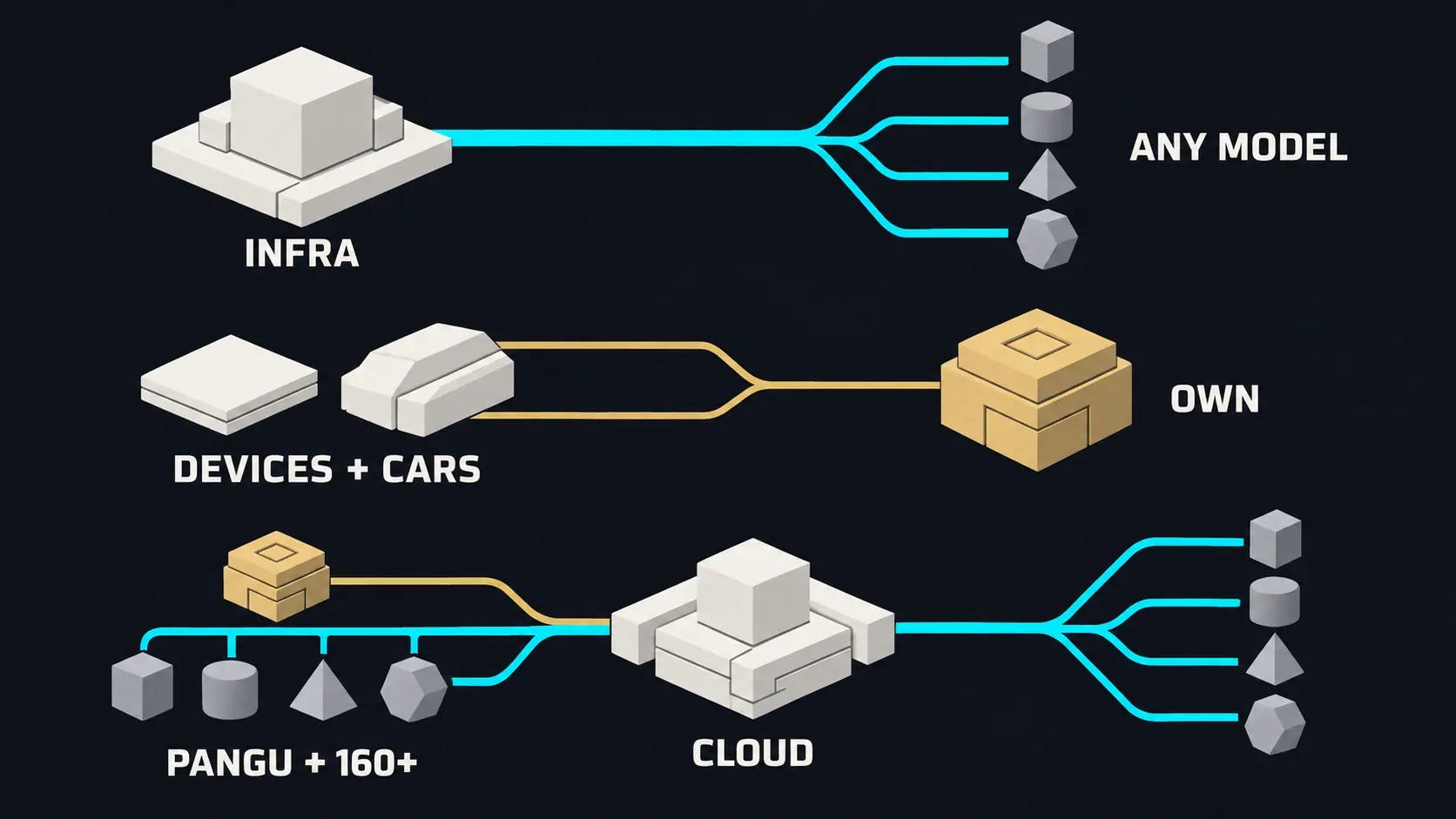
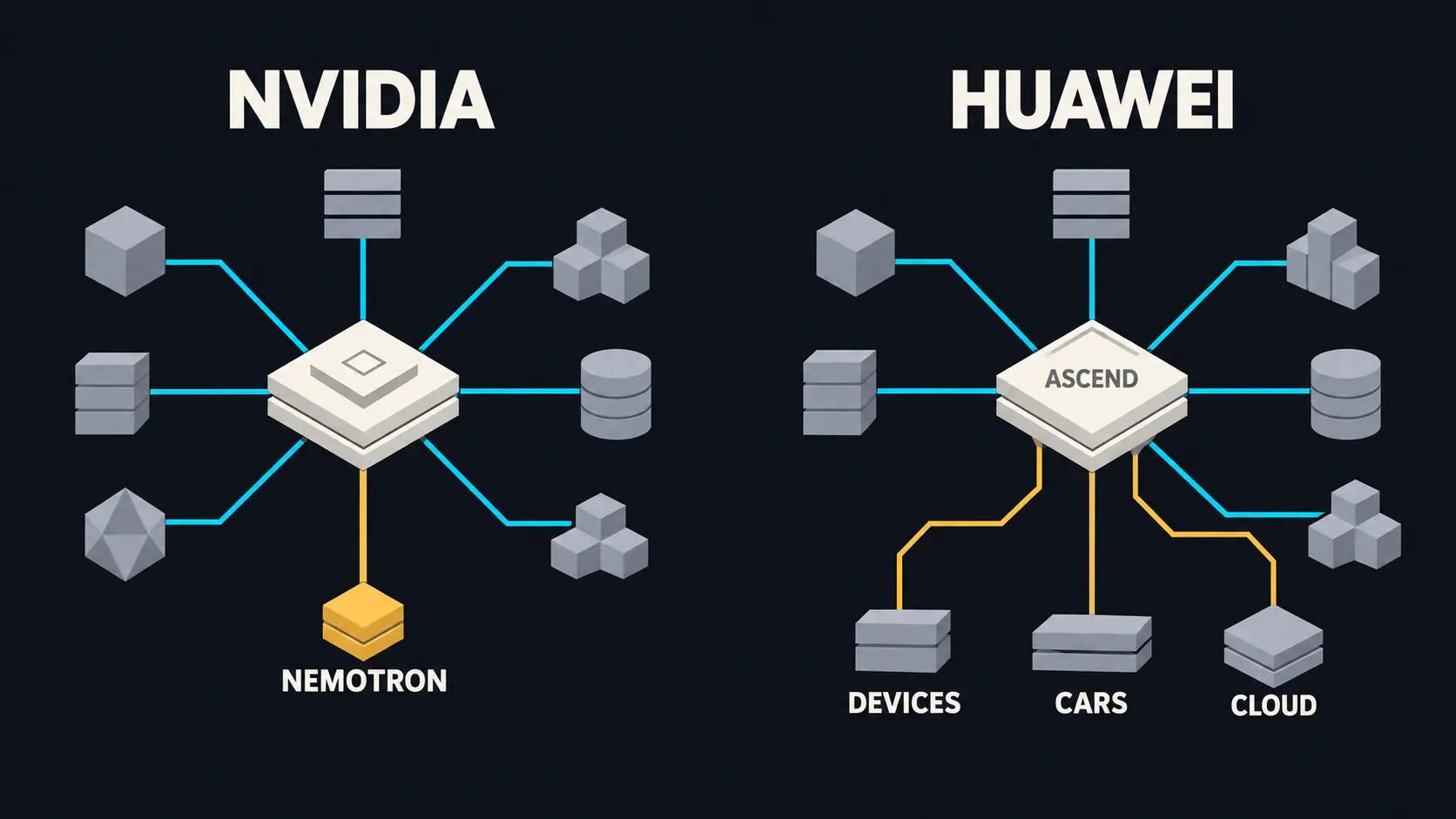
Guo: “Huawei focuses on connectivity and computing, but different business units have different needs for in-house large models. For the ICT business and computing, Huawei’s goal is to be Nvidia. Our core advantage lies not in owning a large model, but in supporting customers to build excellent ones, ensuring any large model in the world can run efficiently on Huawei’s Ascend, Kunpeng, supernodes, and clusters.
For devices and intelligent driving, it is best to have our own. Most mainstream open-source models only release the weights. Continued training and fine-tuning remain difficult, and data open-sourcing lags. In devices and intelligent driving, in-house models hold the advantage.
For Huawei Cloud, as cloud and AI converge deeply, lacking a competitive model means lacking business competitiveness. Huawei Cloud must have its own model to maintain a competitive edge.
Huawei’s model strategy is closely tied to its business goals. We keep investing, but deploy differently by scenario.”
What the filing says. The 2025 annual report lists five named segments plus a residual line. ICT infrastructure, the tier Guo wants to run like Nvidia, brought in Rmb 375bn ($54bn), up 2.6%. The consumer business generated Rmb 344.5bn in revenue. Digital Power, not directly tied to the model question, added Rmb 77.3bn. The intelligent automotive solutions segment, where an in-house model is “best,” generated Rmb 45bn, up 72.1%. Cloud, the segment that “must” build its own model, reported Rmb 32.2bn in external revenue and was the only named segment to shrink, down 3.5%. A footnote discloses that cloud’s total revenue, including services to other Huawei businesses, reached Rmb 72.1bn, implying roughly Rmb 39.9bn in internal transactions. Huawei Cloud is pursuing both sides: developing and open-sourcing its Pangu models while supporting more than 160 state-of-the-art models on its platform. Its differentiation, per the annual report, comes partly from post-training and Ascend-specific optimization.
Q2: Without CUDA, what is Huawei’s moat?
A new hire noted that Nvidia’s moat comes from advanced process, software-hardware integration, and the CUDA ecosystem. The hire asked what comparable advantages Huawei holds or plans to build.
Guo: “When I was in school, Intel had just introduced the IDM model, integrating process and manufacturing. Then TSMC invented the foundry model, separating design from fabrication. Huawei is constrained on advanced nodes, so we need to push design-manufacturing integration harder, using combined strengths to make up for process gaps. […]
Ms. He Tingbo proposed the Tau Scaling Law. Its essence is replacing geometric scaling with temporal scaling, bringing process technology and manufacturing more closely together under constraint. This path has value for the global semiconductor industry, but Huawei faces more severe constraints and the pursuit is more urgent.
On moats, I recommend reading the four-hour transcript of DeepSeek founder Liang Wenfeng. It argues that in the AI era, accelerating technology cycles may erode moats like Nvidia’s CUDA ecosystem, and that AI could achieve breakthroughs or replacements.”
What the transcript records. Guo cited the transcript we annotated in July, without naming a specific passage. The closest match is item #62, where Liang said Nvidia’s CUDA moat “is being eroded fast.” Liang’s reason: AI can write code, making ecosystem-building far easier. But item #70 adds a point Guo did not mention: “Huawei’s problem is still insufficient capacity.” On Liang’s account, manufacturing capacity has become the immediate constraint, even as the software gap remains unresolved. We examined the hardware path behind the Tau Scaling Law in our analysis of Huawei’s LogicFolding chip.
Q3: How far behind is Ascend?
The same answer continued.
Guo: “Our Ascend 950 series has narrowed the gap through architecture innovation despite process constraints, and may catch up in the future. The key is delivering customer experience and solving real problems, not stacking parameters. Huawei uses system-architecture thinking to recombine competitive elements, building overall advantage through clusters and supernodes.”
What the ecosystem numbers show. The 2025 annual report counts 43 mainstream foundation models pre-trained on Ascend, over 400 open-source models adapted to the platform, more than 350 partners that have launched Ascend-based AI appliances, and 4 million developers. Huawei’s 384-NPU SuperPoD has been deployed at scale. At Huawei Connect 2026 this week in Shanghai, the main-stage program is scheduled to include iFlytek, an AI company best known for speech recognition, presenting “Spark plus Ascend.” A third-party model is scheduled for Huawei’s main stage. That is what “be Nvidia” looks like on a conference agenda.
Q4: Why did Huawei’s own models fall behind?
A new hire asked what kind of company Huawei is and how Guo’s view has changed over time.
Guo: “Before the comprehensive sanctions in 2019, Huawei went from victory to victory. We started with a few people selling others’ products, caught nearly every opportunity in our sector from the 1980s onward, and turned each into results.
A sanctioned company typically has two outcomes: ‘in jungle’ or ‘in prison.’ Huawei is carving a third path: surviving. […]
Seeing an opportunity does not guarantee success. In large models, Huawei started early but did not take a leading position. There is no need for discouragement. Top tech companies at home and abroad invested enormously without achieving breakthroughs. Instead, Anthropic, Moonshot AI’s Kimi, and DeepSeek produced the breakthroughs. Large companies have advantages and disadvantages. Corporate form must keep evolving.”
What Yu said in June. At Huawei’s developer conference on June 12, Yu Chengdong, now head of the Product Investment Review Board, offered context for the lag. He said Huawei allocates a large share of Ascend output to domestic customers. The chips Huawei keeps for itself are, in his words, “very limited.” He said Huawei could not train models with tens of trillions of parameters under its current compute constraints. The larger model he announced, openPangu 2.0 Pro, has 505 billion total parameters and 18 billion active. He also promised a 30-billion-parameter on-device Pangu model running on Kirin “this autumn.”
A note before the next question.
Guo wants Ascend to run every customer’s model. Forty-three foundation models pre-train on the platform. More than 160 state-of-the-art models are available through Huawei Cloud. That is the “be Nvidia” tier.
He also wants devices, cars, and the cloud to build their own models. Yu said Huawei keeps few chips for itself. Liang, whose transcript Guo cited, said the constraint is capacity.
Guo presented this as a model strategy. Yu’s comments suggest it also functions as a resource hierarchy. Huawei must decide where in-house models create enough value to justify scarce internal compute, and where the company is better served by selling Ascend infrastructure to outside model builders. Nvidia also develops foundation models, but it does not operate Huawei’s combination of consumer devices, automotive systems, public cloud, and AI accelerators. Huawei has more internal business units competing for access to the same constrained compute platform.
Q5: Huawei sold 20% of Yinwang. Is it still Huawei’s?
A new hire asked whether Huawei will reduce its management of Yinwang, the intelligent auto subsidiary, after selling 20% of equity.
Guo: “Yinwang is controlled by Huawei, with capital ties to many partners. The intelligent auto components it provides are an extension of Huawei’s ICT business.
Huawei has intelligent agents with data-flywheel technology. The most prominent are the phone business and intelligent driving. AI agents need data-flywheel support. In carrier networks, the operator owns the network and Huawei helps with autonomous operation. In intelligent vehicles, Huawei provides driving services directly through Yinwang. For a considerable period, Huawei expects to continue leading Yinwang’s development.”
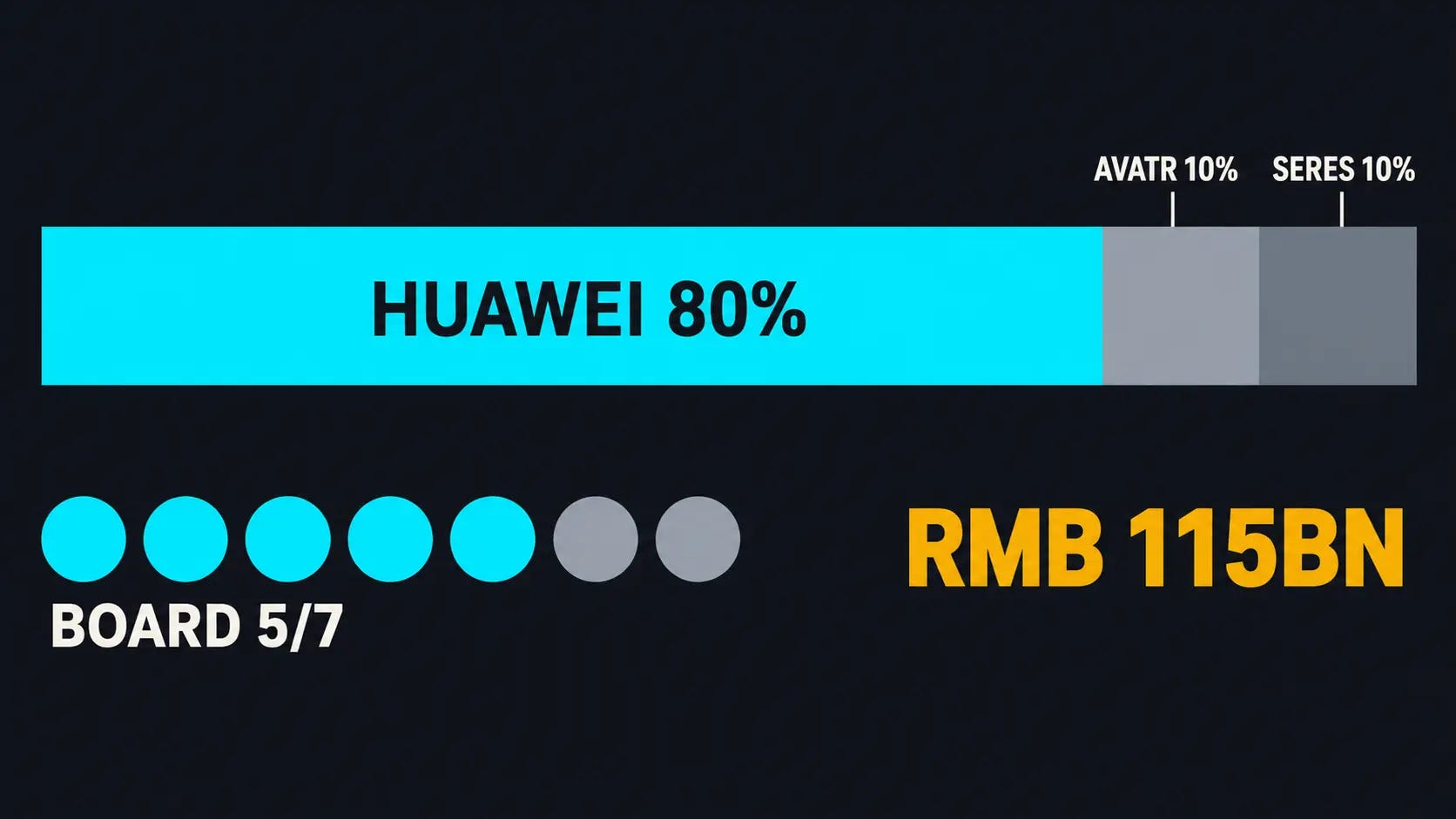
What the ownership structure shows. In March 2025, Yinwang’s ownership changed: Huawei 80%, Avatr (a Chang’an Auto subsidiary) 10%, Seres (a Huawei partner automaker) 10%. Each minority stake cost Rmb 11.5bn (about $1.6bn at the time), implying a Rmb 115bn valuation. The board has seven seats. Huawei holds five, including the chair. The annual report states Huawei “did not lose control.” The auto segment generated Rmb 45bn in revenue in 2025, up 72.1%. We covered Huawei’s expanding role in China’s auto supply chain in December.
Q6: Will the car unit go abroad?
A new hire asked about overseas expansion plans for the auto business.
Guo: “Huawei’s intelligent auto components business has been global from the start. However, finished vehicles carry strong regional and geopolitical traits, especially intelligent vehicles involving data, safety, and privacy.
Huawei’s intelligent components are a global business, but Huawei chose ‘not to build cars.’ Whether an automaker sells only in China or goes global is each automaker’s strategic choice.”
The split. Guo’s distinction matters alongside Q5. The automaker carries the vehicle into the market and assumes the front-line burden of homologation, sales, and local compliance. Huawei remains exposed through the technology, data systems, and geopolitical scrutiny attached to its name.
Q7: Revenue is near its 2020 peak. Does strategy change?
A new hire noted that revenue has returned to historical highs and asked whether strategy would adjust.
Guo: “In March 2021, the annual report disclosed 2020 revenue of more than Rmb 890bn, the historical peak. In the years since, facing extreme external pressure and sanctions, we survived and preserved business continuity and competitiveness.
Going forward, the core strategy is ‘focus’: going deep in connectivity and computing. There are no plans to expand into new businesses. We hope to deliver digital infrastructure solutions for global customers, provide diversified solutions for AI development, and contribute to the rise of China’s electronics industry.”
What the number is. Guo put the 2020 peak at “more than Rmb 890bn.” The 2025 report records Rmb 880.9bn ($126bn), up 2.2%. R&D spending was Rmb 192.3bn, or 21.8% of revenue. “Focus, no new businesses” pairs with Q1. Huawei is not expanding its business lines. It is deepening each one’s position in the AI stack. The R&D ratio shows the scale of that investment, though the annual report does not disclose how the spending divides across chips, models, devices, and other businesses.
Q8: Where does China stand on compute, data, and talent?
A new hire asked how AI talent integrates with traditional ICT businesses.
Guo: “For the ICT industry, AI applications lean toward inference. […] Among AI’s three elements, China lags in compute. But in data, China has industrial applications across nearly every category, with advantages in data applications, inference, and real-world scenarios. In talent, the two sides are roughly equal.”
Two accounts of the same gap. In the DeepSeek transcript, Liang reduced all differences to one variable: compute. Guo agrees on compute but adds two qualifiers: China has advantages in data applications and is roughly level in talent. Both descriptions point to the same constraint. Ascend compute is the scarce input. Where it goes shapes which of Guo’s three tiers gets served.
Five phrases from the transcript
Tau (τ) Scaling Law (韬定律). Proposed by He Tingbo, who runs Huawei’s semiconductor business. Replaces geometric scaling with temporal scaling: tighter design-manufacturing integration to improve performance without a new process node. We examined the first chip built on it in September.
Data flywheel (数据飞轮). Guo uses this term to identify which businesses generate their own data loops: phones and intelligent driving are the clearest examples. The pattern suggests a rule of thumb: businesses with proprietary data loops have a stronger case for in-house models, while businesses built around customer-owned data tilt toward infrastructure. Huawei Cloud straddles both sides.
More, faster, better, cheaper (多快好省). How Huawei describes its entry into the carrier-equipment market as a latecomer. The phrase originated in Mao-era political language and remains common in Chinese management rhetoric.
In jungle / in prison. Guo’s own English, spoken in the original. His two standard outcomes for a sanctioned company. Huawei, he said, is building a third path.
“Choose the work you love; learn to love the work you are asked to do” (爱一行干一行 / 干一行爱一行). Guo’s career formula. The first half applies to junior employees who pick their own lane. The second is the requirement for senior managers: accept the assignment and grow into it.
This analysis is free. The paid coverage behind it did the groundwork: China’s Supernode Moment mapped the competitive shift from chips to integrated systems that Guo’s “clusters and supernodes” language confirms, and The Silicon Bill Behind Huawei’s Folded Kirin examined the manufacturing method Guo calls the Tau Scaling Law.