

This is a preview of what Hello China Tech does three times a week: reading China’s AI, chip, and robotics sectors through primary sources and verifiable claims. Subscribe free to get every new analysis as it publishes.
In late July 2026, Tencent Tech, Tencent’s technology news outlet, published a lightly edited transcript of a nearly 4-hour investor meeting with DeepSeek founder Liang Wenfeng. The 118-item transcript covers AGI strategy, chip supply, pricing, team retention, and the company’s first external fundraise, a round exceeding Rmb 50bn ($7.4bn) that we analyzed last month. DeepSeek has not confirmed the record. This article selects from the transcript, reorganizes it by theme, and compares it with Hello China Tech’s existing DeepSeek coverage.
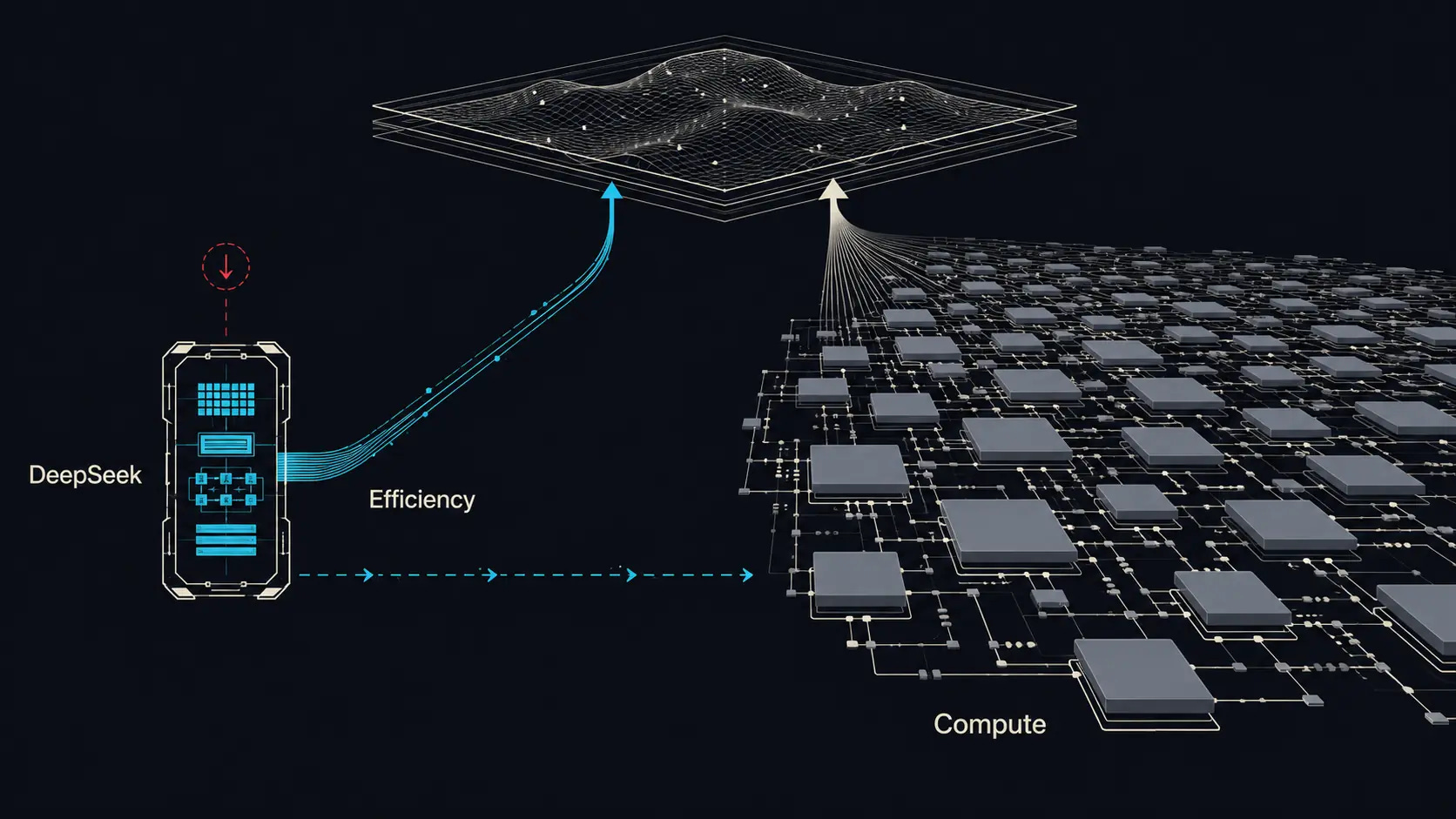
Since January 2025, the prevailing Western reading of DeepSeek has centered on efficiency. A comparatively small Chinese lab appeared to show that frontier-level performance could be approached without the compute budgets of the largest US labs. Bloomberg framed the company as championing China’s “bid to flood the world with cheap AI.” Liang offered a different account of the gap with the US:
“All the differences we see, including talent, model capability, and applications, can be attributed to differences in compute resources.” (#56)
In his account, the advantages held by DeepSeek’s American competitors reduce to one variable. They can deploy more compute.
The Confession
The efficiency record is real. Liang’s investor-facing account, however, frames efficiency as an adaptation to scarcity.
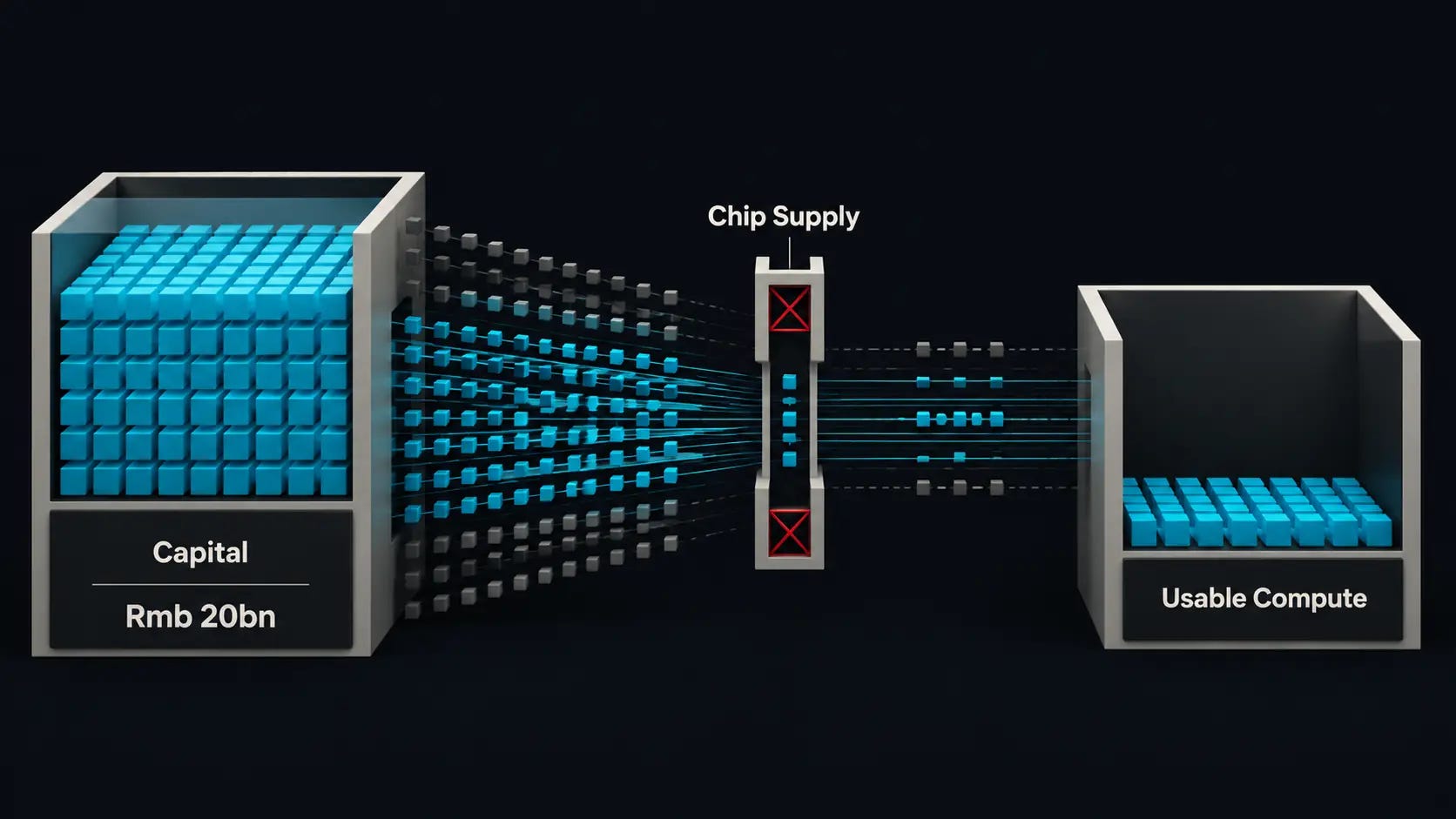
“The biggest gap between us and the US is in resources. On one hand, we can’t buy enough chips domestically. On the other, our capital investment is far less than America’s. The salary share is small. The bulk is compute.” (#55)
“Spending Rmb 20bn this year would mean our procurement team did an exceptional job. It is extremely difficult to spend that much. You can’t buy that many chips, and the prices are high.” (#54)
He argued that the talent gap follows from the same constraint.
“Talent is not the bottleneck. Resources are the biggest bottleneck. Resources first affect talent development: less compute means fewer experimental opportunities, so our talent base overall is weaker than America’s. The talent gap is fundamentally a compute gap.” (#43)
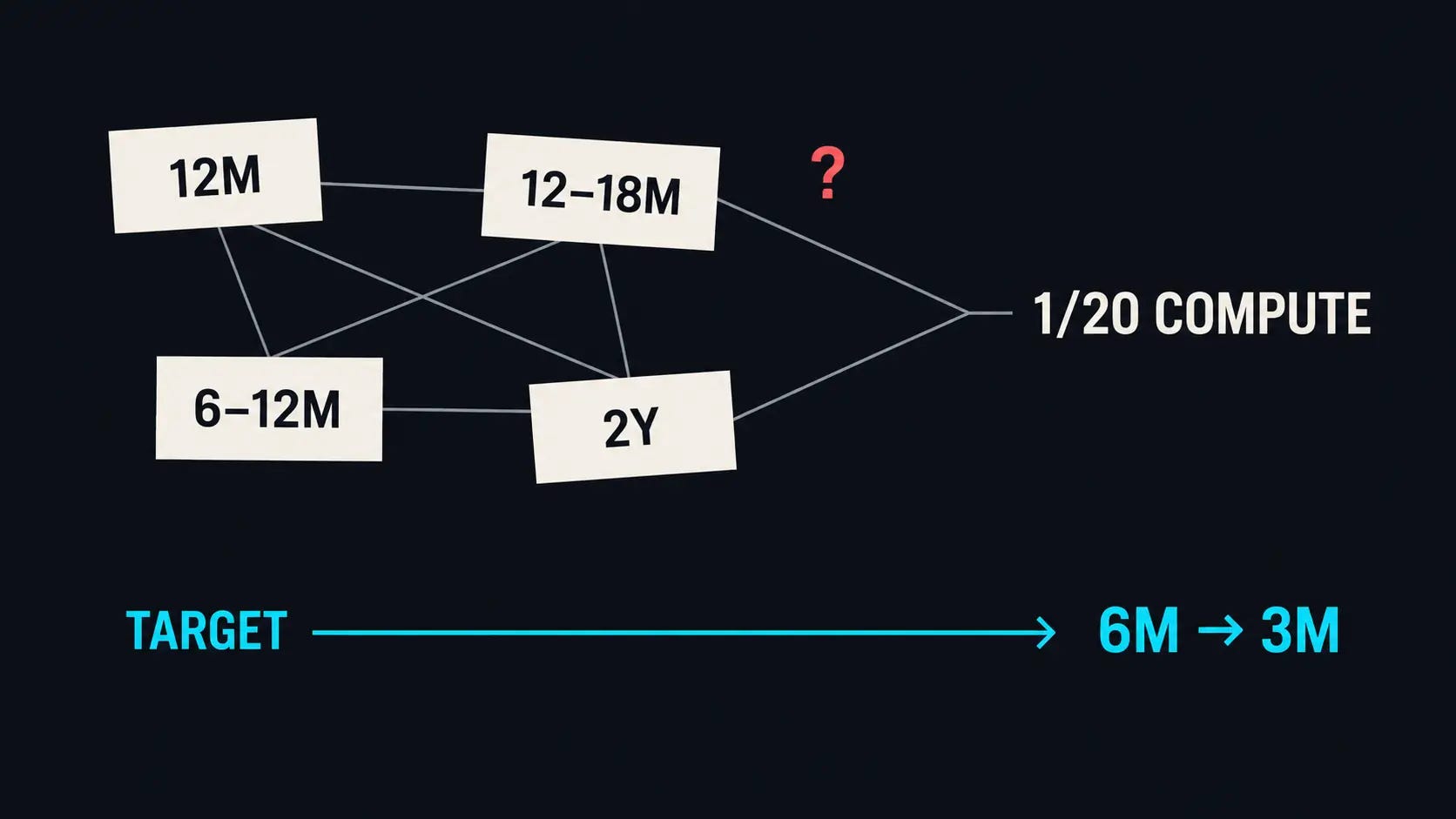
On the US-China timeline gap, the transcript is notably imprecise. In a single exchange (#57), Liang described DeepSeek as 12 months behind, 12 to 18 months behind, 6 to 12 months behind, and then summarized: “to put it simply, two years behind, using one-twentieth of the compute.” The range is wide enough that it should be read as conversational approximation rather than a calibrated estimate. The transcribed text appears muddled at this point. What remains consistent is the aspiration:
“We want to rewrite that narrative. A fraction of the compute, but closing the gap to 6 months, 3 months.” (#58)
On scaling, he was direct.
“We believe in scaling. Bigger is always better. What stops us from scaling is compute, not desire. We train a model at this size not because it is enough, but because that is all our resources allow.” (#59, #60)
“When Silicon Valley says scaling has hit a ceiling, that is for Silicon Valley. We in China are nowhere near that point.” (#61)
Liang extended the resource argument to data. High-quality annotation, he said, offers China no meaningful cost advantage.
“There is no cost advantage for data annotation in China. Especially for high-end data, there is no cost advantage.” (#107)
This challenges a common assumption among Western investors that Chinese AI companies benefit from systematically lower labor costs. For high-end annotation, by Liang’s account, costs converge globally. DeepSeek cannot match American annotation spending simply by hiring at lower cost, so it relies more heavily on its own researchers for high-quality data work.
“You could say that half our core researchers, our most important people, are labeling data right now.” (#109)
Liang prefaced this with “you could say,” signaling characterization. The actual proportion may differ. But a substantial share of DeepSeek’s senior research staff appears to be doing data work that better-capitalized US labs can fund at a different scale.
This is a clean narrative, perhaps too clean. The transcript is not fully consistent on its own terms. In the discussion of team retention, Liang said money and resources were “not problems” (#38, #41). Elsewhere, he described resources as the biggest bottleneck (#43) and the largest source of the gap with US labs (#55). DeepSeek may have enough capital to survive without having enough usable compute to close that gap. Organizational capacity, regulatory latitude, and academic pipelines also shape model capability independently of compute budgets, yet Liang’s formulation collapses them into a single variable. It also suits a post-fundraise investor audience because it gives the problem a price tag.
The Wager
Liang attached a deadline to one of his claims. Within one year, he said, real-world deployment would overturn the perception that China’s domestic chip ecosystem is unusable or immature.
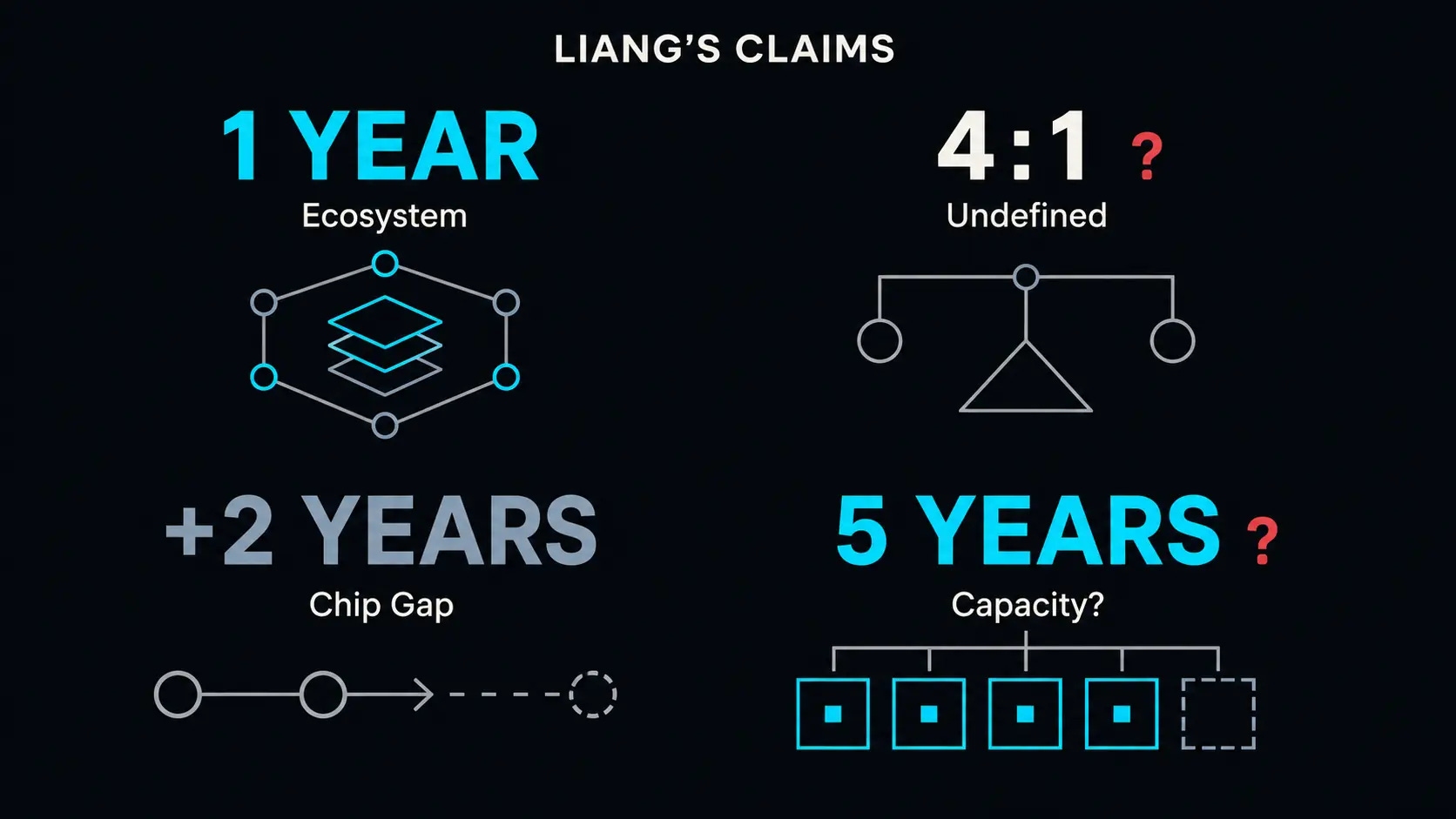
“There is a historic window for domestic AI chip substitution. We believe that within the next year, something will be verified: the domestic chip ecosystem has no problems at all.” (#64)
He described a technical migration already underway.
“V3 used Nvidia chips but did not use Nvidia’s ecosystem. We wrote a high-level compiler called TileLang and built everything else on TileLang’s ecosystem. We already barely depend on Nvidia’s ecosystem.” (#66)
Liang was unusually direct about Huawei’s 950 super-node.
“I am fairly optimistic about domestic compute. On this point, Nvidia is digging its own grave. Huawei’s 950 super-node can fully replace Nvidia’s GB200 and GB300 in performance and price.” (#67)
“Four Huawei chips match one Nvidia chip.” (#68)
These figures require calibration. Liang did not specify which Huawei or Nvidia chips the 4:1 ratio refers to, what workload was being compared, or whether it measures raw performance, training throughput, or a system-level substitution ratio. In “China’s AI Chips Enter the Training Stack,” we noted that while Chinese vendors’ chips outperform Nvidia’s export-restricted H20 on several metrics, public disclosures do not yet establish efficiency parity with Nvidia’s B-series for frontier training. Numerical claims like these can carry market weight even when their benchmarks are left undefined.
Liang then put numbers on the remaining gap.
“On chips, I believe the ecosystem gap will disappear. But on the chips themselves, the gap is fourfold plus two years.” (#69)
In a separate answer (#65), he called manufacturing capacity the only remaining problem. That is hard to reconcile with an undefined 4:1 comparison and a two-year lag, both of which suggest constraints beyond manufacturing capacity alone.
“I don’t believe that five years from now we will still be stuck on capacity. Right now, this year, next year, the year after, probably still stuck. But five years out, I am fairly optimistic.” (#71)
In earlier coverage, we linked DeepSeek’s V4 pricing to Huawei’s Ascend 950 delivery schedule and explored whether a state-backed round would signal deeper integration. Items #66 through #70 provide direct evidence of DeepSeek’s technical collaboration with Huawei, but they confirm neither the pricing schedule nor the state investor’s motivation.
The Strategy
DeepSeek’s most distinctive strategic choices—restraint, open-weight releases, and aggressive pricing—each intersect with the compute question.
“Restraint is a strategy. Sometimes you give up some things to gain more of others.” (#11)
“Those who take more get beaten by those who take less. You don’t even need to actually be taking more. If your ambition is to take more, you will be beaten by someone whose ambition is to take less.” (#79)
By “taking less,” Liang meant accepting narrower margins and a smaller share of the commercial value created by AI.
On pricing, Liang described a formula: buy equipment and recover the cost in 10 months.
“Our API pricing delivers a reasonable profit. We buy a batch of equipment, and it pays for itself in about ten months.” (#91)
Liang acknowledged that profit-maximizing logic would set prices higher: “I could raise the price by half, or double it, and token consumption would barely change” (#92). Here the compute constraint reappears. Higher computational efficiency allows DeepSeek to train or serve larger models on a fixed hardware budget.
“If my computational efficiency is higher, I can support a larger model with the same amount of compute.” (#99)
On open source, Liang dismissed the case for keeping models proprietary, using ByteDance, the parent company of TikTok, as his example.
“Our strongest model will probably be open-sourced too. I can’t see what good closed-source does. ByteDance’s model is closed-source. What is the benefit? I see none.” (#100)
“Even if the model is open-source, even if you tell everyone everything, the barrier to entry is still extremely high. For others to actually use it is very difficult. And to use it at low cost is even harder.” (#101)
Liang did not trace all three choices to scarcity. He described restraint as a way to maximize the probability of reaching AGI (#12). He argued that open-weight releases would not undermine DeepSeek’s business model because deployment and low-cost operation remain difficult (#101, #102). Compute directly shapes the company’s architecture and pricing economics; restraint and openness have broader strategic rationales.
Liang also stopped short of applying the compute thesis universally. On enterprise revenue, he said the long-term ceiling would be demand, not compute (#94). Compute may limit how fast DeepSeek advances the frontier, while enterprise demand limits how much of that capability can be converted into revenue.
The discussion of team stability reveals a second priority.
“Our single biggest core interest is preserving team stability. You could even say it is our only core interest. As long as I can keep the team stable, we will succeed at AGI. It is that simple.” (#37)
“This risk has been substantially relieved by our recent fundraise. Everyone received fairly large option grants.” (#39)
Liang treats usable compute as the largest external constraint and team cohesion as the company’s most important internal priority. Capital can finance procurement, but as Liang noted (#54), it cannot guarantee chip supply. Option grants can improve retention, but they do not by themselves create team cohesion. The transcript confirms that the fundraise was intended to reduce retention risk; its effect on usable compute remains less certain.
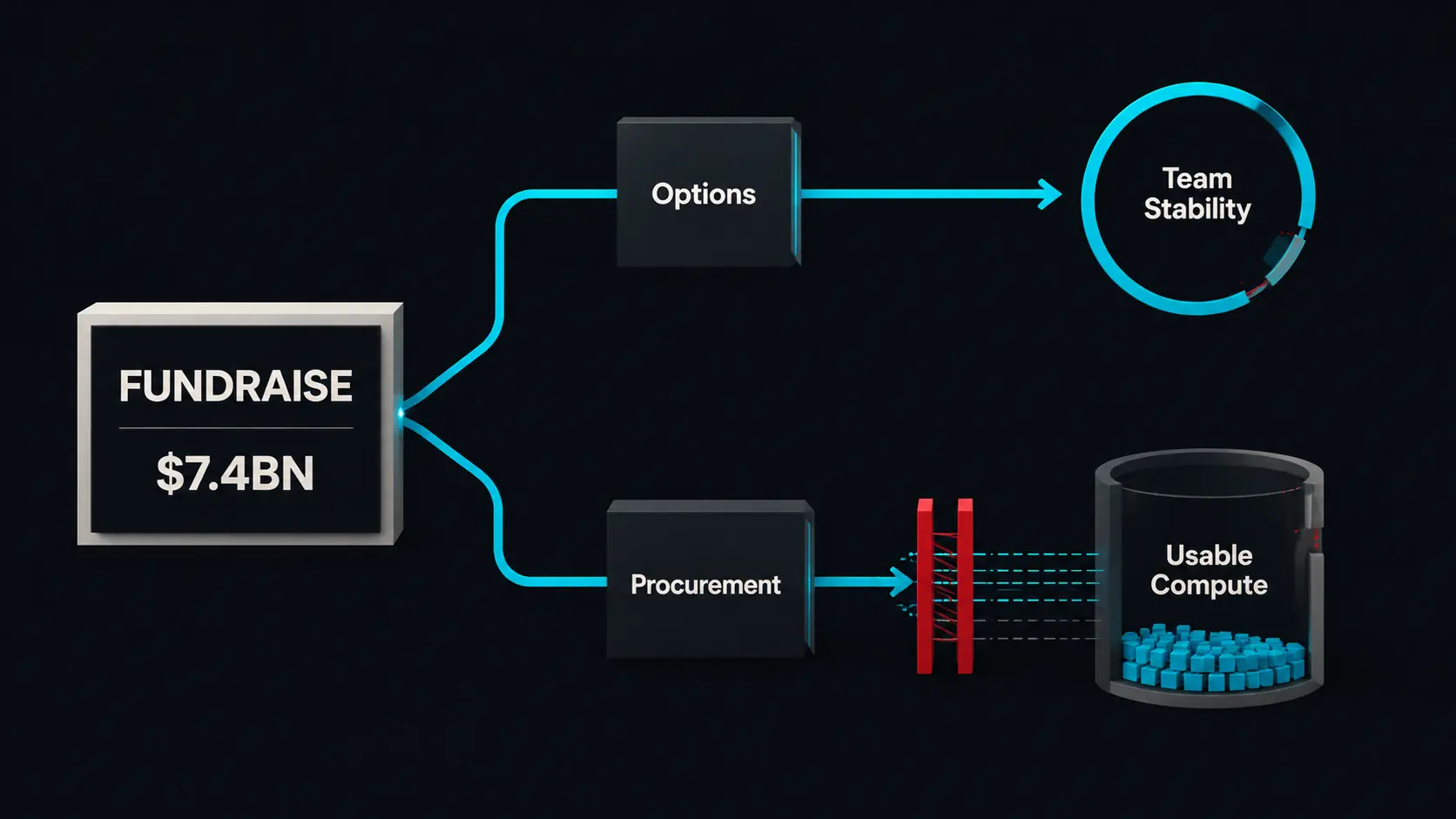
In “DeepSeek’s $7.4 Billion Price Tag,” we argued that the round’s LP structure, 5-year lock-up, and Liang’s personal $3bn anchor were designed to give researchers a valuation anchor that made competing offers easier to decline. Items #37 through #39 support one part of that analysis: Liang explicitly linked the fundraise and larger option grants to reduced retention risk. Whether the valuation anchor holds remains the open question we flagged then.
The Scorecard
A nearly 4-hour investor session mixes operating detail with founder narrative and fundraising persuasion. The claims worth tracking are the ones with deadlines or numbers.
Liang’s domestic chip ecosystem wager has the clearest deadline: “within one year,” real-world deployment will demonstrate that the ecosystem works (#64). The transcript was published in July 2026; the meeting’s exact date was not disclosed.
He said V4 and its subsequent versions would support native multimodality (#86). V4 had already been released by the time the transcript was published. Its documentation can show whether the current model meets that description, while support in later versions remains a product commitment.
He also sketched a conditional commercial scenario: if DeepSeek generates several hundred million dollars in enterprise revenue in 2026 and demand continues to grow, the company could approach net profitability in 2027 (#95).
Other claims are directional rather than testable. “Fourfold plus two years” (#69) and a “3-month model gap” (#58) lack defined baselines, so they cannot function as clean metrics. They describe Liang’s expectations, not scorecard entries.
Liang’s comments on Huawei integration (#66–#70) also support Hello China Tech’s earlier thesis that DeepSeek is becoming more deeply tied to domestic hardware. They do not establish that this integration motivated the state investor’s participation.
The clearest test of Liang’s compute thesis now has a deadline. Within one year, real-world deployment should show whether China’s domestic chip ecosystem can supply the usable compute DeepSeek needs to scale.