


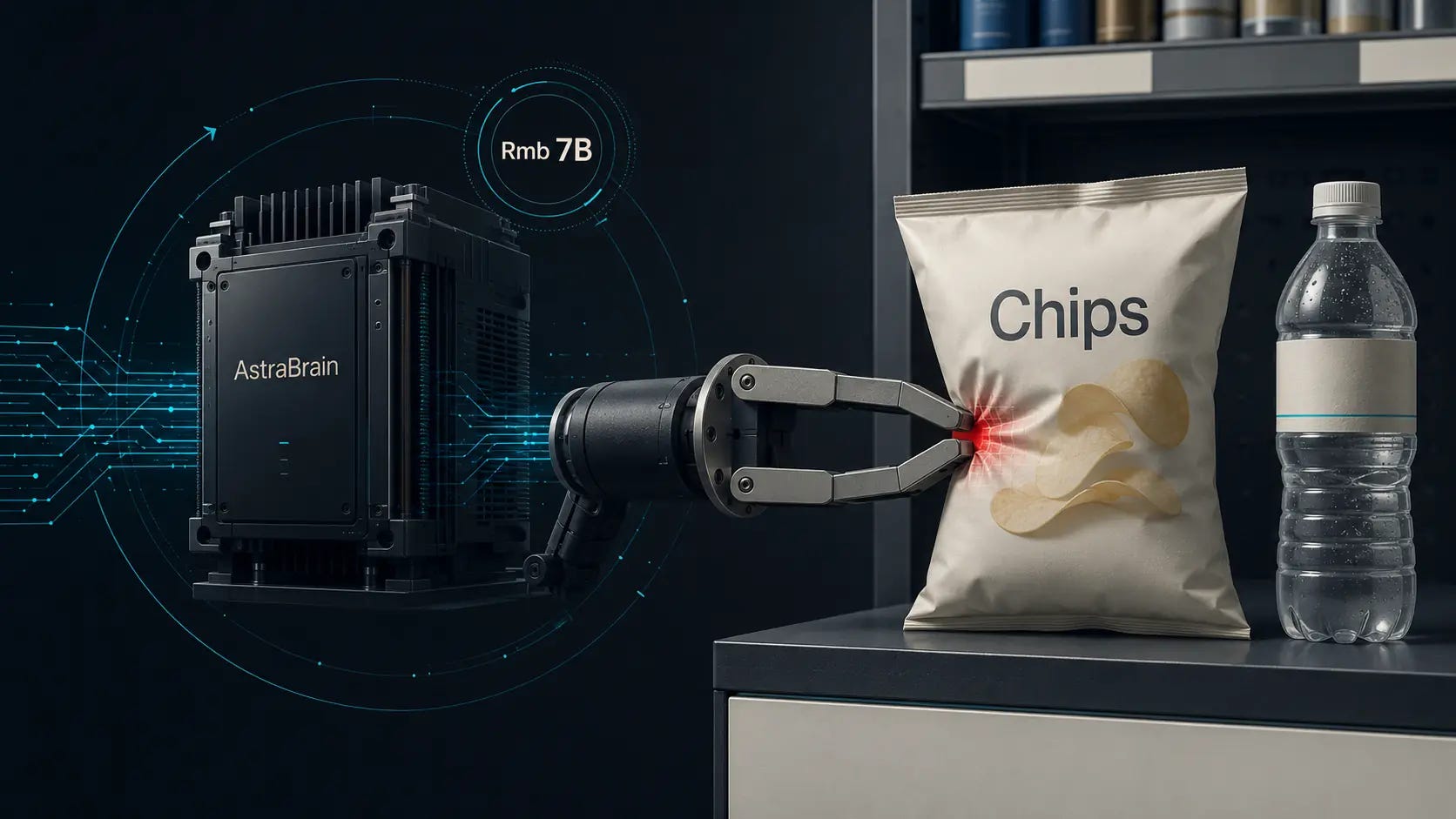
In a FamilyMart in Beijing’s Zhongguancun area, a humanoid robot named Galbot stands behind the counter. It can retrieve a bottle of jasmine pu’er tea from a refrigerated case. Sometimes the bottle topples when Galbot sets it down. A bag of Lay’s potato chips sits on a nearby shelf. Galbot does not attempt it. By the company’s own account, grippers fail on chip bags roughly 4 times in 10, a rate too high for customer-facing service.
This FamilyMart is not standard. At 63 square meters, it is 40% smaller than a typical outlet, redesigned to fit the robot’s operational needs. It carries about 1,000 SKUs, roughly 60% of the normal range. Galbot handles fewer than 10 of them. Four full-time employees staff the store, the same headcount as a comparable FamilyMart without a robot. Galbot cannot complete a full transaction on its own; after retrieving an item, human staff handle payment. Galaxy General (银河通用), Galbot’s developer, invested in this location on the ground floor of its own headquarters and stationed engineers inside to collect training data.
Galaxy General is the best-funded startup in China’s embodied AI sector, the field focused on robots that perceive and act in physical environments. Founded in May 2023, it has raised nearly Rmb 7 billion (roughly $1 billion) in three years. Its March 2026 round of Rmb 2.5 billion set the sector’s single-round record for a third time and drew the third phase of China’s Big Fund, a state-backed vehicle better known for semiconductor investment, alongside SMIC-affiliated Zhongxin Juyuan. The Big Fund had never previously invested in embodied AI. Galaxy General’s valuation now exceeds Rmb 20 billion (roughly $3 billion). Galaxy General ships fewer than 150 robots a year. A single Galbot is priced at around Rmb 700,000.
The company’s thesis is that the robot’s “brain,” the AI model governing perception, planning, and execution, matters more than the body. Galaxy General built AstraBrain, an end-to-end model that integrates task planning, motor control, and neural coordination into a single architecture, rather than developing these modules separately as most competitors do. Many of those competitors rely on foundation models from Alibaba, ByteDance, or Huawei. Galaxy General argues that integrated, proprietary intelligence is the value layer. Morgan Stanley’s framing of the sector reinforces the capital logic behind bets like Galaxy General’s: a May 2026 report projected a $7.5 trillion global humanoid robot market by 2050, described China’s trajectory as a potential replay of its EV success, and noted that China accounted for about 46% of global humanoid robot venture funding in the first months of 2026.
Galaxy General sits at the center of that capital wave, part of the consensus machine that has driven successive funding surges across China’s AI and chip sectors. The convenience store is where the premise meets the physical world.
Galaxy General’s engineers are discovering that chip bags, ambient noise, and compute budgets create constraints no model can shortcut. What follows examines what the convenience store deployment reveals about the brain-first bet, why Galaxy General spends millions on its competitor’s hardware, and what a quieter signal from Xiaomi’s factory floor suggests about which path reaches commercial viability first.