

Editor’s Note: This article extends two earlier Hello China Tech analyses. In “The Geopolitical Arbitrage Playbook,” I examined why China’s AI chip companies had to go public. In “DeepSeek’s $7.4 Billion Price Tag,” I dissected the governance design of DeepSeek’s first external round. This piece asks the next question: what happens after the capital arrives?
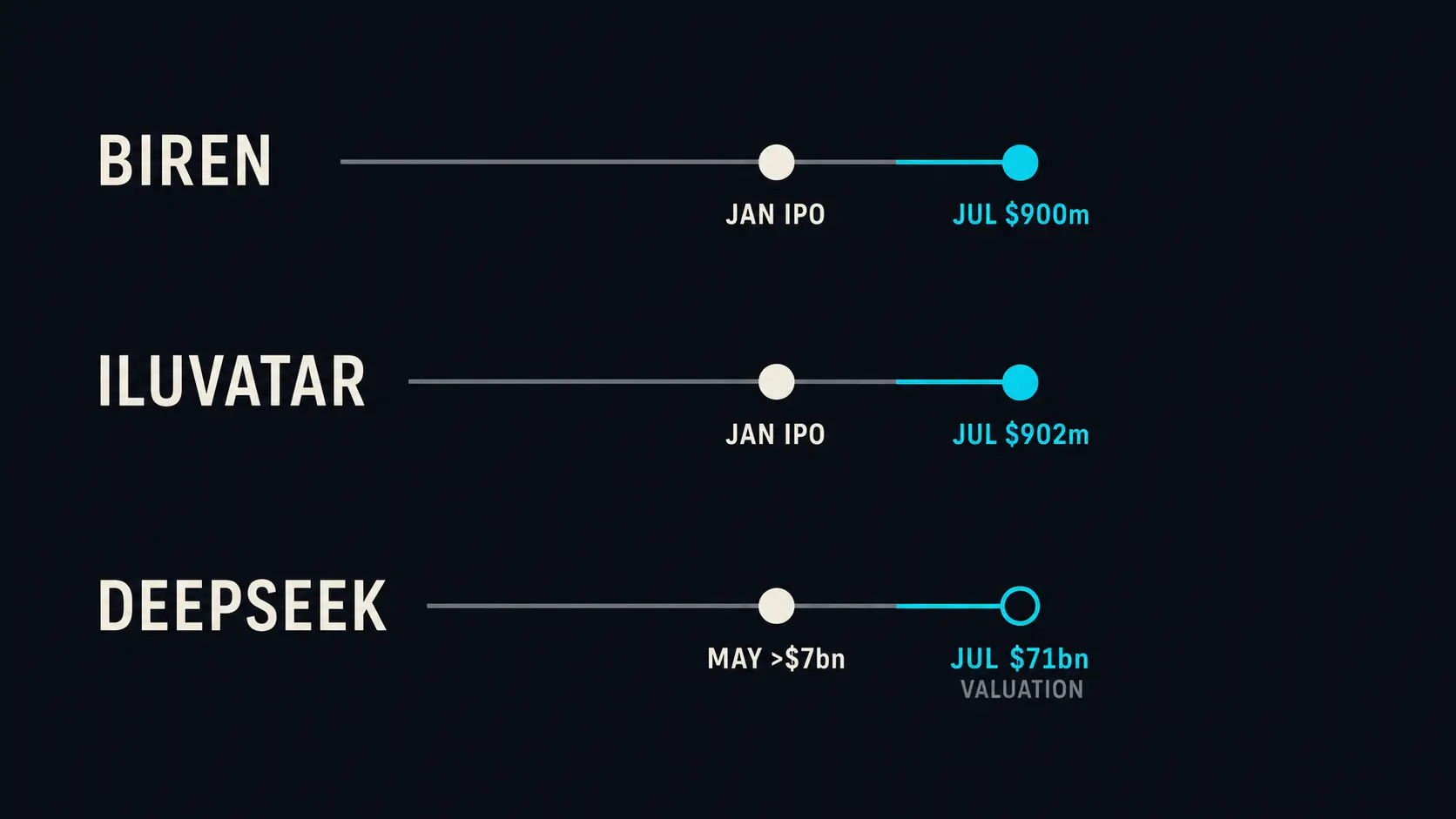
In early July 2026, two of China’s newly listed AI chip companies returned to the market for more cash. Biren Technology, a Shanghai-based GPU designer that went public in Hong Kong in January, raised $900m through a share placement. Over 70% of IPO proceeds earmarked for working capital and general corporate purposes had already been used. Within days, Iluvatar CoreX raised $902m in its own placement, roughly double what its IPO collected 6 months earlier.
The same week brought more. Zhipu, a Beijing-based AI model company, priced a $4bn share sale. Days later, DeepSeek began talks for a new funding round at a $71bn pre-money valuation, barely a month after closing a first round of more than $7bn, about $3bn of which came from founder Liang Wenfeng. CXMT, China’s national DRAM champion, priced an IPO on Shanghai’s tech-focused STAR Board that could raise as much as $9.8bn including an overallotment option, roughly double an earlier estimate. And in humanoid robotics, quarterly investment hit $6.95bn in Q2, more than doubling the previous quarter and rising over 6 times year-on-year.
The sums are large, and the cadence is accelerating.
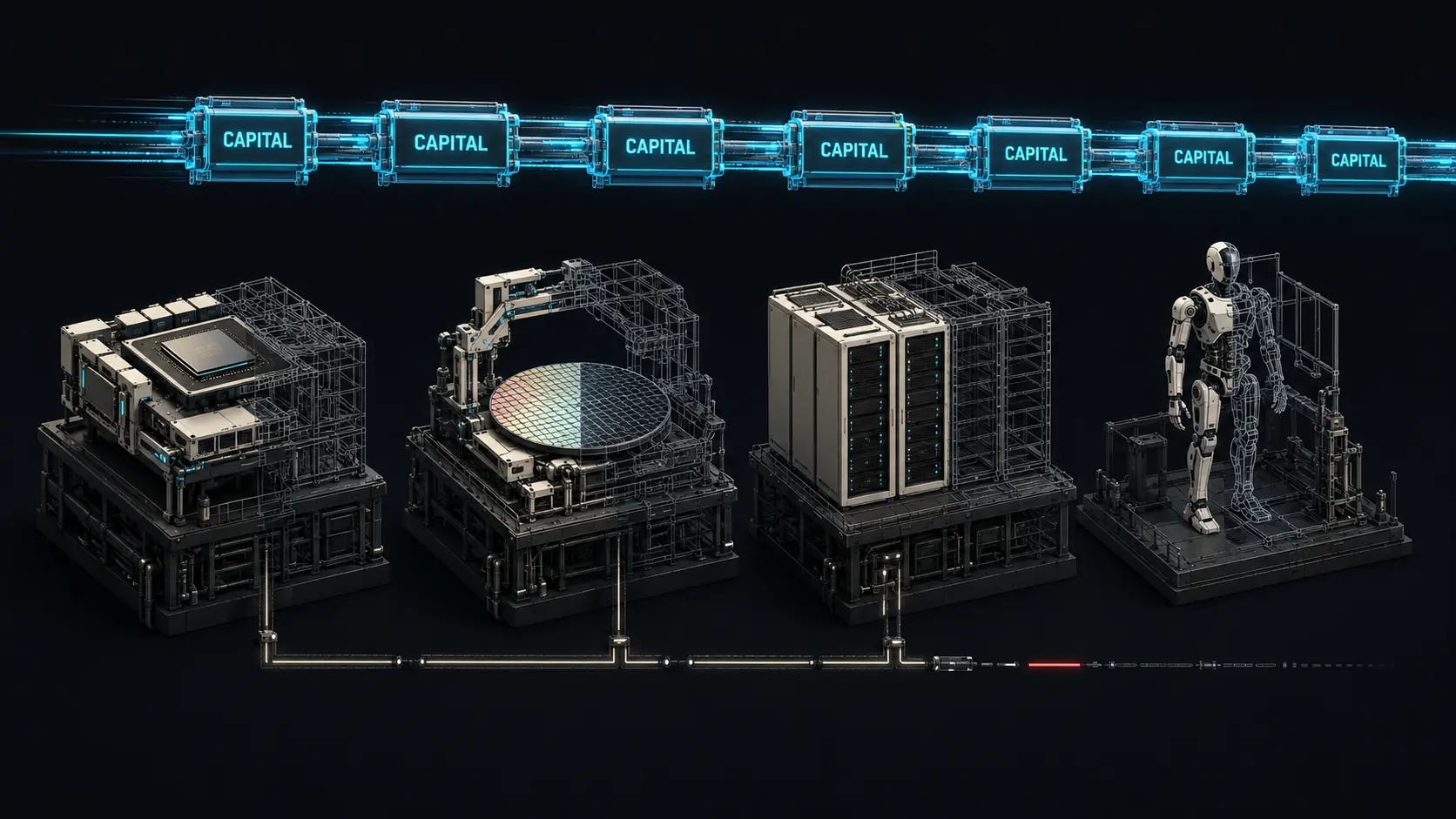
This consistency across sectors and company stages points toward something structural. China’s AI industry appears to have entered a perpetual capital cycle in which the IPO opens a channel for continuous fundraising rather than closing the capital chapter. Across these transactions, external capital is arriving before current operations can finance the next stage of expansion. The disclosed uses include fabrication capacity, chip procurement, data centers, component inventories, R&D and technical hiring.
When R&D Outspends Revenue
Among the most revealing documents in this cycle are the Hong Kong listing prospectuses filed by Biren and Iluvatar under Chapter 18C, a rule that allows pre-profit technology companies to list. Without it, neither company would have qualified for a public offering, and the post-IPO placements that followed would not have been possible.
Both filings expose a structural gap between what these companies earn and what they spend. In 2024, Biren’s R&D spending ran at roughly 2.5 times its revenue. Its net loss was approximately 4.6 times revenue. Virtually all its sales came from a handful of customers. Iluvatar’s deficit followed the same shape at a lower intensity: R&D exceeded revenue by a factor of 1.4, and net losses by 1.7 times. In both cases, research spending alone outpaced total sales. When R&D alone exceeds revenue, continued access to external capital becomes essential to sustaining the current expansion.
This distinction matters for reading the back-to-back placements. Biren is directing 60% of its $900m placement toward GPU mass production, while Iluvatar is using part of its proceeds for critical-component procurement. Both are using public equity to finance commercialization that current revenue cannot yet support. The prospectuses describe the conditions under which the companies might eventually become self-sustaining. That point remains distant.
The filings explain why the capital keeps coming. The harder question is whether the assets it funds can eventually generate enough cash flow to replace it.
This piece builds on two earlier Hello China Tech analyses of China’s AI chip IPO wave and DeepSeek’s fundraising architecture. If those are useful lenses, subscribe free and get every new analysis as it publishes.