

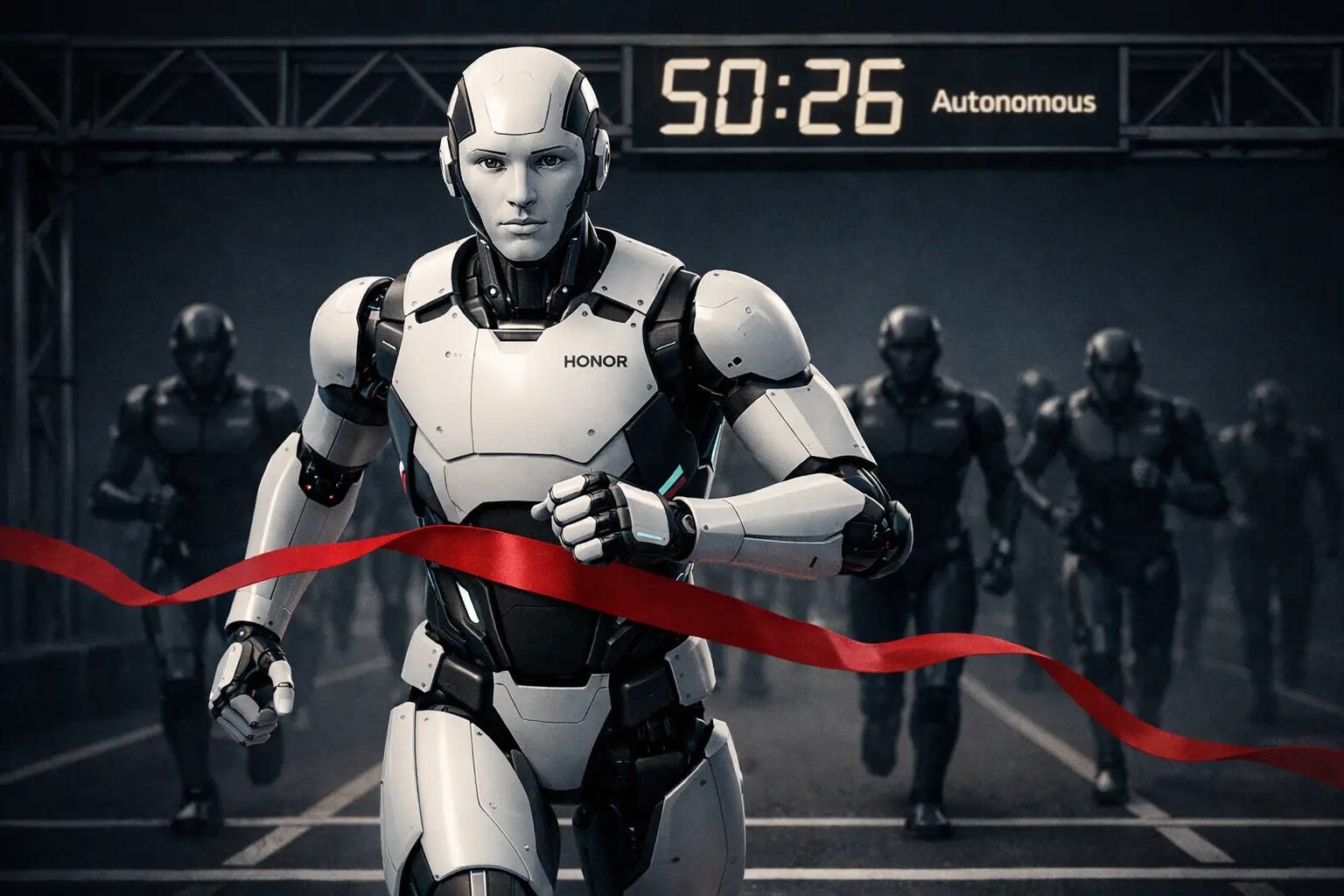
On April 19, a humanoid robot built by Honor, the smartphone brand spun out of Huawei, crossed the finish line of the Beijing E-Town Half Marathon in 50 minutes and 26 seconds. The time beat the human world record. It finished ahead of every pure-play robotics entrant on the course.
Honor swept the top three positions, all running autonomously. According to race-day reporting, Honor-series robots filled all six top overall positions after the weighted calculation penalized remote-controlled entries. The team had existed for roughly one year. Its machines navigated 22 turns and multiple terrain changes across 21 kilometers without human intervention.
The companies that dominated last year’s inaugural race, including the Beijing Humanoid Robot Innovation Center’s Tiangong Ultra and Songyan Dynamics, were displaced from the podium. Unitree, the sector’s top revenue generator by disclosed financials, has a $610 million IPO filing pending on the Shanghai STAR board. But its humanoid revenue still comes overwhelmingly from research buyers rather than industrial labor substitution. Even Unitree could not break through Honor’s formation despite demonstrating sprint speeds that would have shattered the human 1500-meter record.
A year ago, the same race looked like a blooper reel. Most robots could not finish. The champion needed 2 hours and 40 minutes for a distance that elite human runners cover in under an hour. This year, 47 of 102 teams completed the course, compared to six last year. The performance gap between 2025 and 2026 compressed years of visible progress into one season of iteration.
The speed improvement will generate headlines. The identity of the winner tells a more consequential story.
Why a Phone Company
Honor’s engineering lead told reporters after the race that the winning robot achieved full-stack in-house development, from hardware to algorithms, within a single year. The machine relied on dual lidar sensors and satellite positioning for autonomous navigation. When it collided with another robot mid-race, an internal dynamic balancing algorithm pulled it back to stable posture without human intervention.
The thermal management system shows where the structural advantage sits. Running generates heat that degrades motor performance and eventually triggers system failure. Honor addressed this by adapting liquid cooling technology from its smartphone product line. The cooling supplier, Huake Lengxin, confirmed that it designed a miniature pump one-quarter the size of competing products, capable of dissipating over 2,000 watts. The system went through five design iterations and accounts for less than 2% of the robot’s total bill of materials.
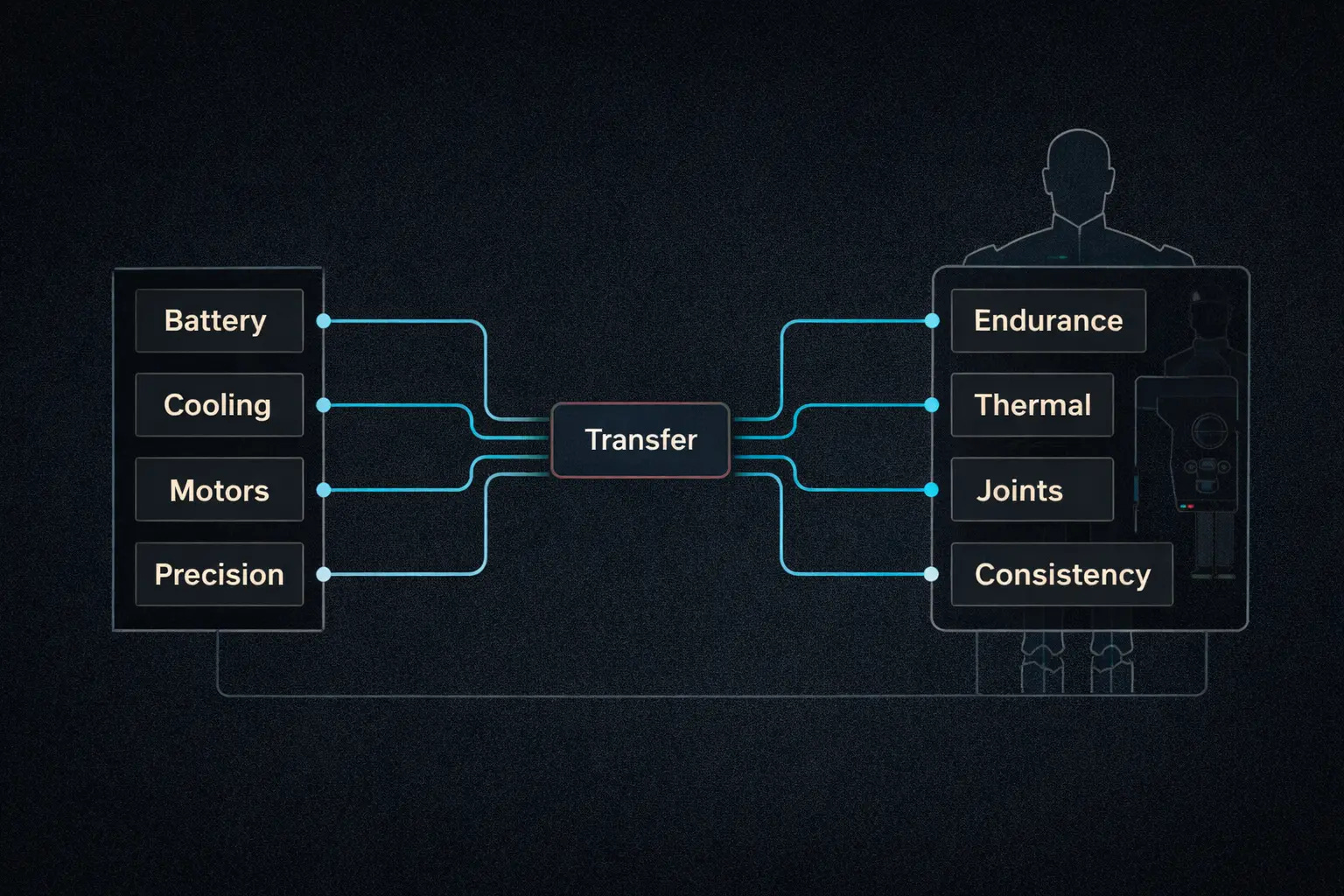
Battery energy density. Motor reliability. Thermal management at miniature scale. Precision component manufacturing with consistent quality across thousands of units. China’s consumer electronics supply chain has refined these capabilities over two decades of shipping billions of devices. An executive at Shoucheng Holdings, the Hong Kong-listed firm managing Beijing’s RMB 10 billion robotics fund, attributed the result to this lineage: companies with access to mature supply chains could guarantee the kind of battery performance and component-level consistency that smaller startups, with limited procurement leverage, struggle to match.
The pattern extends beyond smartphones. CITIC Securities has estimated more than 60% hardware overlap between smart vehicle and humanoid robot supply chains. XPeng, the electric vehicle maker, claims 70% software reuse between its car AI and its robot AI. The marathon results offer the clearest public demonstration yet that the hardware bridge connecting consumer electronics to robotics carries real competitive weight.
But there is a catch embedded in that confirmation.
This analysis continues below for Hello China Tech Premium subscribers.
