
Weekend Brief: China’s GPU Startups Trade Survival for Growth
Three months of Premium analysis reveal the structural deal reshaping China's semiconductor strategy.

Over the past few months, I’ve published three Premium analyses tracking China’s GPU sector through a critical inflection point. The Metax Paradoxin August revealed the industry’s actual competitive position through forced regulatory disclosure. Moore Threads IPO in September examined how state backing accelerates market entry while locking in strategic dependencies. This week’s IPO Rush analysis exposed why venture capital withdrawal is pushing the entire sector toward public markets simultaneously.

These aren’t three separate company stories. They document the evolution of what I call “The Captive Market Bargain” – a structural deal where Chinese GPU companies accept permanent technical lag and commercial constraints in exchange for guaranteed access to protected market segments. This bargain shapes every strategic decision these companies make, determines their viable business models, and ultimately limits their growth trajectories regardless of engineering talent or capital deployment.
The urgency behind this week’s IPO rush makes the bargain’s terms starkly visible: when private capital stops believing in catch-up narratives, the only remaining patient capital comes from public markets willing to fund national strategic priorities over commercial returns.
The Bargain Takes Shape: From Disclosure to Dependence
The contours of this captive market bargain emerged clearly across three distinct phases of industry development.
The Metax Paradox: China’s AI Chips Under Forced Transparency (Premium) documented the bargain’s actual terms through unprecedented regulatory disclosure. Shanghai Stock Exchange inquiries forced Metax to reveal specifics that marketing materials obscure: persistent 2–3 generation performance gaps, 35% pricing erosion over 18 months, customer concentration in government and enterprise segments that prioritize supply chain security over raw capability. The piece introduced the “Quadrant B Trap” – Chinese GPU makers excel at serving customers who value availability over performance, but struggle to penetrate high-value commercial segments dominated by internet giants. This isn’t temporary positioning. It’s the structural foundation of the entire business model.
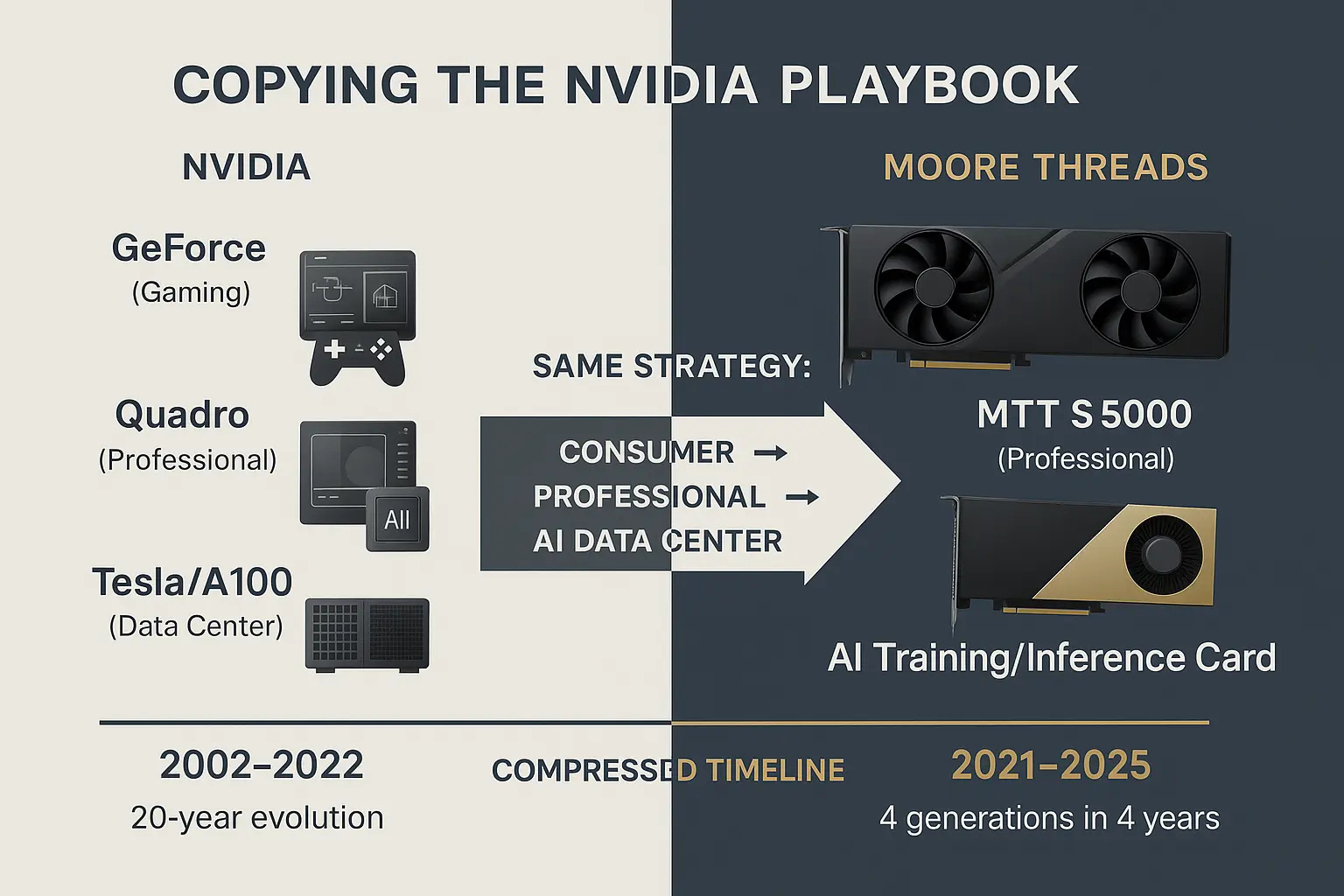
Moore Threads IPO: China’s $1.1B Bet Against NVIDIA (Premium) showed how companies deliberately deepen this dependence rather than resist it. Moore Threads’ 88-day regulatory approval and participation in state-led initiatives like the Open Interconnect Standard for AI (OISA) demonstrates active construction of mutual dependence. The company isn’t just accepting protection – it’s architecting its entire technology stack and go-to-market strategy around permanent integration with national strategic priorities. The analysis revealed critical trade-offs: pursuing an “all-function” platform strategy spreads resources thin across gaming, professional graphics, and AI compute, while the 2 billion RMB order pipeline consists largely of “in-negotiation” contracts rather than firm commitments. The bargain provides market access but constrains commercial flexibility.

China’s GPU Startups Rush to IPO as Venture Funding Dries Up (Premium) exposed the bargain’s sustainability test. Moore Threads spent Rmb3.8bn on R&D while generating Rmb1.3bn in revenue. Metax burned Rmb2.5bn developing chips that produced Rmb1.1bn in sales. Neither covers operating costs from customer payments. The synchronized rush to public markets reveals a harsh reality: venture capitalists who initially funded these companies no longer believe catch-up timelines justify continued private investment. The captive market provides revenue, but not at economics that satisfy return-focused capital. Public markets become the only remaining source willing to fund development through multiple product cycles without demanding commercial viability.
Why This Bargain Matters
This captive market structure creates distinct implications for different market participants:
For investors, the bargain fundamentally changes valuation frameworks. Traditional semiconductor metrics – gross margins, R&D efficiency, market share gains – become misleading when the addressable market is artificially bounded. What matters instead: the captive market’s absolute size, pricing power sustainability within protected segments, and government willingness to fund profitability gaps through patient public market capital. Companies that successfully convert “in-negotiation” pipelines to recurring revenue from state-owned enterprises and telecom operators establish defensible positions. Those that fail face quarterly scrutiny of unsustainable burn rates.
For global competitors, the bargain reveals where competition actually occurs. NVIDIA doesn’t lose to Chinese GPU makers on technical merit – it loses access to specific customer segments through regulatory mandate. The competitive battleground isn’t raw performance but rather which workloads can tolerate performance trade-offs for supply chain independence. Inference tasks, which value GPU quantity over individual chip capability, represent the most vulnerable segment. Training workloads requiring cutting-edge performance remain protected by technical moats, at least until Chinese manufacturers close the 2–3 generation gap or until US export controls tighten further and shrink available alternatives.
For Chinese tech giants, the bargain forces explicit infrastructure choices. ByteDance, Tencent, Alibaba, and Baidu must decide how much technical capability they’ll sacrifice for strategic security. The emerging pattern: dual-track strategies maintaining both foreign suppliers for performance-critical applications and domestic suppliers for strategic insurance. This bifurcation creates sustainable revenue for Chinese GPU makers but caps their total addressable market. They become insurance policies rather than preferred vendors – stable but limited.
The Bargain’s Unresolved Boundaries
Several critical questions remain unresolved, and their answers will determine whether this bargain produces sustainable businesses or merely delays inevitable consolidation:
Can the captive market expand beyond its current boundaries? Current revenue concentrates in government computing platforms, telecom operators, and state-owned enterprises. Sustainable growth requires either expanding the definition of “strategic” workloads that mandate domestic chips, or achieving sufficient price-performance ratios to win commercial customers despite technical gaps. The former depends on policy expansion; the latter requires closing the 2–3 generation gap while maintaining cost advantages.
What happens when quarterly disclosure meets multi-year product cycles? Public market patience typically exhausts faster than semiconductor development timelines. These companies require 3–5 years to achieve meaningful technical progress, but public markets demand quarterly evidence of commercialization momentum. The tension between engineering reality and market expectations could force premature pivots, underinvestment in foundational R&D, or aggressive revenue recognition that undermines long-term positioning.

Does dependence create survivability or stagnation? The bargain provides insulation from pure market competition, enabling companies to develop capabilities without facing immediate commercial failure. But protection can also reduce pressure to innovate, encourage complacency in customer service, and allow technical gaps to persist longer than necessary. The question isn’t whether dependence helps short-term survival – it clearly does – but whether it produces the discipline required for eventual commercial competitiveness beyond protected segments.
Why Premium Subscribers Understood This Framework Months Ago
The captive market bargain wasn’t visible in IPO headlines or funding announcements. It emerged through systematic analysis of regulatory filings, customer segmentation data, and strategic positioning choices across multiple companies and quarters.
Premium subscribers accessed this framework as it developed. In August, Metax’s regulatory response revealed the “Quadrant B Trap” through specific metrics: 25,000 GPUs generating only $105M revenue, customer concentration in government platforms versus internet giants, 35% pricing erosion despite volume growth. In September, Moore Threads’ IPO approval received celebratory coverage, but Premium analysis identified strategic constraints: resource dispersion across the “all-function” platform, pipeline composition showing “in-negotiation” versus firm orders, the automotive hedge signaling data center commercialization challenges.
This week’s IPO rush connected the pattern. Premium subscribers understood venture capital’s withdrawal reflects recognition that captive market economics don’t support traditional exit timelines.
Premium delivers three distinct advantages:
⏱️ Timing – The captive market bargain framework emerged in August. Premium subscribers had three months to recalibrate their understanding of Chinese GPU dynamics before it became conventional wisdom.
🔬 Mechanism – Beyond knowing companies are rushing to IPO, Premium explained why captive market economics make public markets the only viable funding source, and what specific metrics determine sustainability.
📊 Data – Each piece drew from regulatory filings and prospectus details: Metax’s customer composition showing government platform concentration, Moore Threads’ gross margin flip from -70% to +70% revealing pricing power within protected segments, pipeline composition distinguishing firm orders from negotiations.
Free content provides valuable frameworks. Understanding the captive market bargain while it was forming required the detailed regulatory analysis and strategic positioning assessment that Premium provides.
The captive market bargain will continue evolving as these companies transition to public market scrutiny. Premium subscribers will track each phase as it develops, not after patterns become conventional wisdom.