

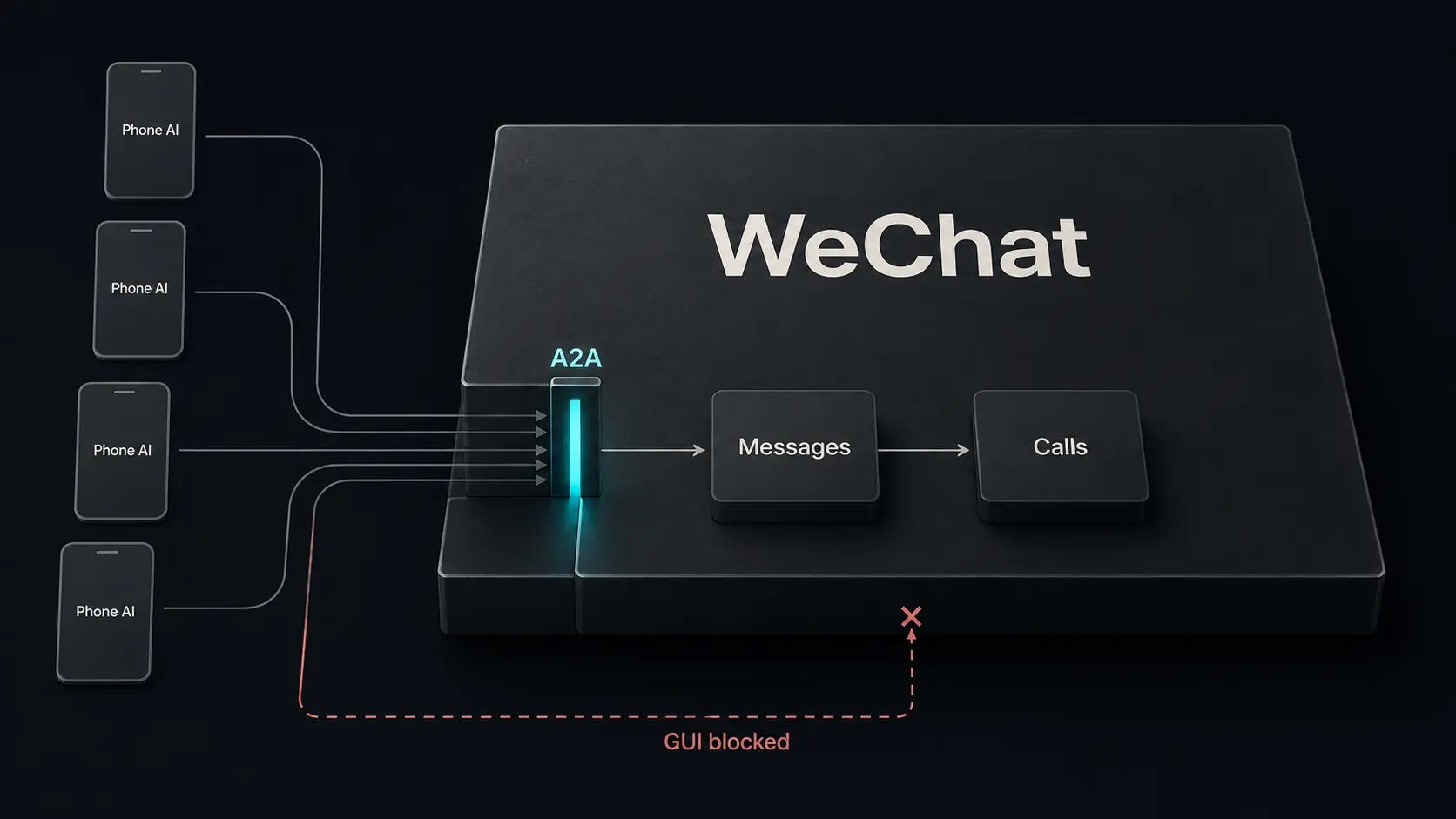
In December 2025, WeChat, China’s ubiquitous super app with 1.4 billion monthly users, forced users of ByteDance’s Doubao Phone Assistant to log out within days of the product’s launch. The app flagged accounts for abnormal activity and shut down access. ByteDance retreated, disabling WeChat functionality and limiting its AI agent to a narrow set of scenarios.
On June 4, Tencent confirmed what looked like the opposite. WeChat is cooperating with Huawei, Honor, Xiaomi, OPPO, and Vivo to provide what Chinese reports describe as A2A, or Agent-to-Agent, capabilities to their phone AI assistants. This is not the open Agent2Agent protocol promoted by Google and the Linux Foundation, but a Tencent-controlled access arrangement between WeChat and phone assistants. Users can ask their phone’s AI to send a WeChat message or make a WeChat voice or video call. Honor, the Shenzhen-based smartphone brand, has completed integration across its Magic 8, 500, and X70 series, with 50% of online active devices connected.
The reversal appears dramatic. A platform that treated external AI agents as security threats now welcomes them. But WeChat has built a new entry point and chosen who gets access. For unauthorized agents, the barriers remain intact.
The Door Tencent Designed
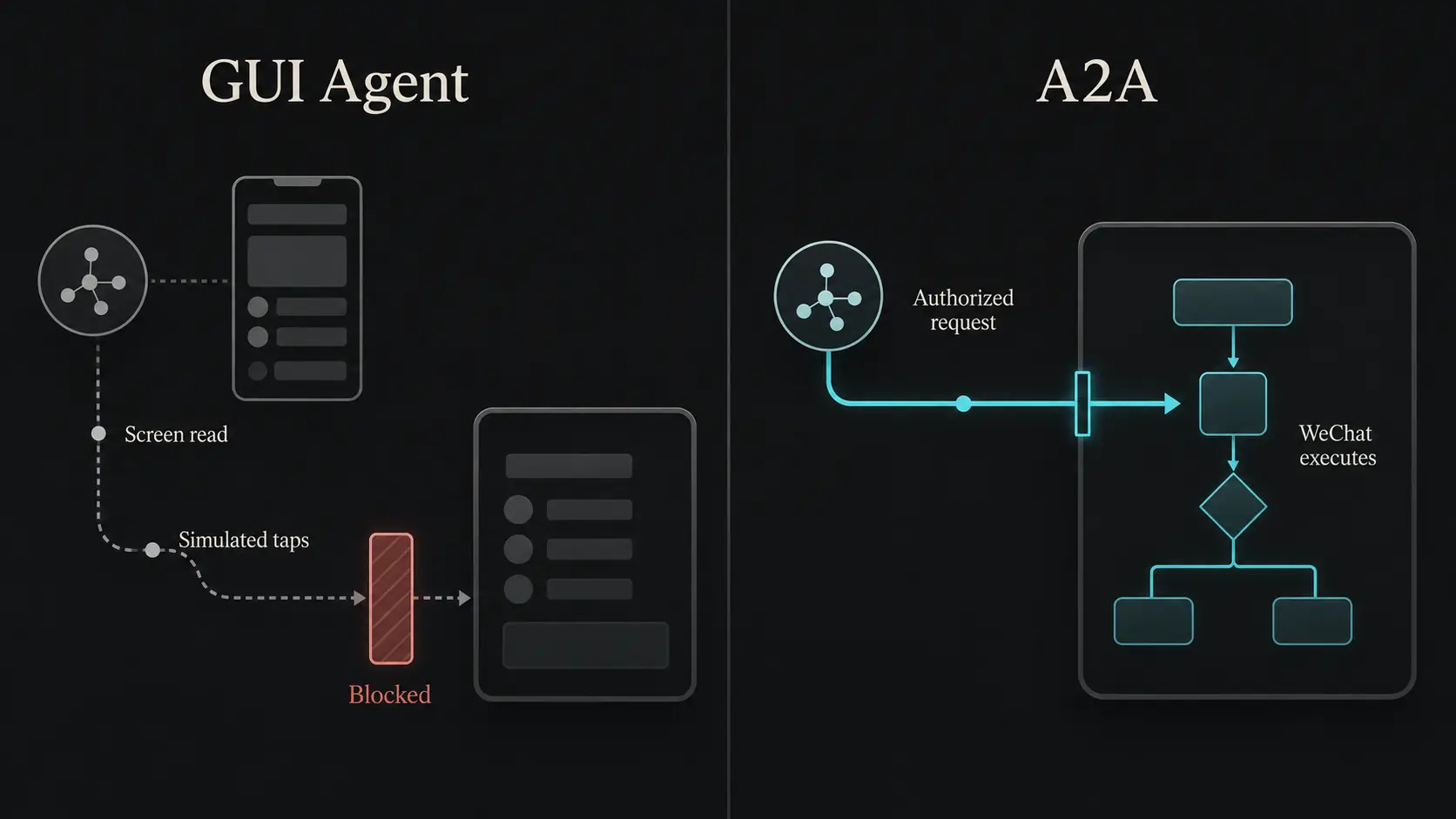
The mechanism keeps execution and data inside WeChat. A phone AI assistant, such as Honor’s YOYO, Xiaomi’s XiaoAi, or Huawei’s Xiaoyi, converts a user’s spoken command into a structured request and passes it to WeChat through an encrypted channel. WeChat executes the instruction within its own system and sends back the result. The phone assistant initiates the request, but WeChat keeps the execution layer inside its own environment.
This contrasts with the GUI agent approach ByteDance attempted. Doubao operated at the system level, reading screens and simulating finger taps to navigate apps without their permission. Tencent president Martin Lau framed the distinction in the company’s Q1 2026 earnings call. An application that operates inside other apps without authorization, he said, is “essentially plundering” them. Applications pretending to be operating systems and “invading” other apps would not be tolerated.
The framing matters beyond rhetoric. A2A embeds this principle into architecture. Dual authorization, meaning user consent plus application permission, routes supported WeChat interactions through Tencent’s controlled channel. The company defines which functions are available. Currently that scope is narrow: sending messages and making voice or video calls. Tencent retains the ability to define the scope of access and, in practice, to expand or withdraw permissions.
The AI Gap Behind the Reversal
WeChat’s mini-program ecosystem handles food delivery, government services, healthcare, and payments. Yet Tencent’s standalone AI application, Yuanbao, remains far smaller than its leading rivals. Third-party data cited in Chinese media put Yuanbao at about 57.35 million monthly active users in March 2026, compared with 345 million for Doubao and 166 million for Qwen.
The spending gap also matters, though the categories need to be read carefully. Tencent’s 2025 capital expenditure was about RMB 79 billion, much of it tied to AI infrastructure. That was still below the scale implied by ByteDance’s reported RMB 150 billion-plus 2025 capex plan and Alibaba’s RMB 380 billion three-year commitment to cloud and AI infrastructure.
These numbers reveal a strategic imbalance. Tencent is under pressure on two fronts: its standalone AI app lags Doubao and Qwen in usage, while rivals have moved faster in model-led agent products. WeChat remains its strongest card.
The Financial Times reported on June 2 that Tencent was testing a WeChat-native AI agent and aimed to begin the required compliance process as soon as that month. The company would then test the agent with a small group of outside users before a phased rollout. A public launch date had not been set.
Users would swipe right on the main WeChat screen to access an AI chat box capable of issuing commands across the app’s millions of mini-programs. Tencent’s stock rose 10.5% that day, its largest single-day gain since January 2021. The surge suggested investors saw the WeChat AI agent as evidence that the platform’s ecosystem advantages could carry into the AI era.
A2A fits into this broader strategy because Tencent faces a timing problem. WeChat’s own agent has not yet launched, while phone assistants are already becoming the first AI contact point on mobile devices. Without an authorized channel, system-level assistants would either fail to handle WeChat requests or keep testing ways to route around WeChat. A2A gives Tencent a third option: let the phone assistant capture the user’s intent, but force execution back into WeChat.
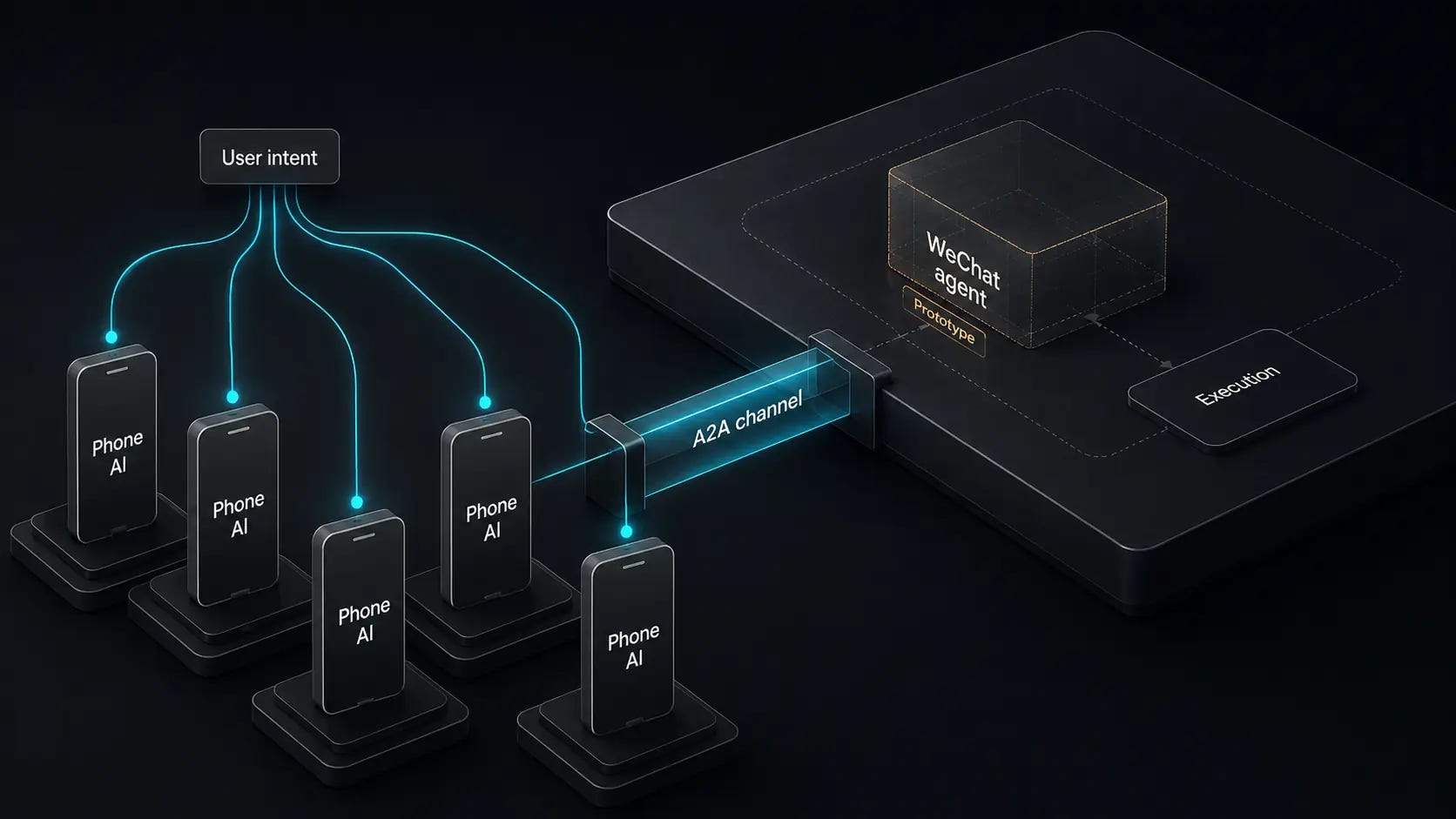
In my recent analysis of Tencent’s agent push, I argued that the company was trying to occupy every surface where users might interact with AI, even while its model and cloud infrastructure remained under pressure. WeChat A2A is the next step in that strategy. It does not merely add another agent surface. It defines how outside agent surfaces are allowed to connect back to Tencent’s most important ecosystem.
One person inside Tencent described the logic: any phone agent that cannot interact with WeChat cannot be considered a real system-level agent. Tencent would inevitably open this door. The only question was timing.
The surface story is industry cooperation. The deeper story is protocol power. WeChat is defining the terms under which outside AI can touch China’s most important app.
