

Editor’s note: Last year, I mapped the great reshuffling of EV startups. Last month, I traced where BYD’s profit rebound is coming from. Those pieces followed companies. This one follows the factories they leave behind. It settles a question from The China Tech Field Guide: in the ripen-then-glut cycle, what does the exit phase look like on the ground?
On September 9, nine Chinese ministries published the 15th Five-Year Plan for the intelligent connected new energy vehicle industry. For the first time, “capacity early-warning and regulation” was listed as a standalone priority in a national auto plan. Power batteries were included alongside vehicles. The exit mechanism was described as “market-based and rule-of-law-based.”
The plan pledges to push capacity exit through market-based channels. Three numbers suggest the market has already started.
In the first eight months of 2026, China’s automakers produced 20.3 million vehicles, down 3.8 per cent from a year earlier. Over the same period, they exported 7.15 million, up 66.7 per cent. Exports as a share of production rose from just over one-fifth for all of 2025 to 35.3 per cent in the first eight months of this year. Auto manufacturing utilization averaged 70.6 per cent in the first half of 2026, one percentage point below the same period a year earlier.
Output is falling. Exports are rising. The official utilization rate fell modestly. The likely explanation is that domestic-bound production fell sharply while exports cushioned the decline.
China’s car factories are being sorted unevenly. Some change hands, some lose their products, and some leave manufacturing altogether. The sorting runs on two broad tracks: factory-level restructuring and exports that absorb slack. Within the first track, three different outcomes emerge.
Hello China Tech publishes three analyses a week on China’s AI, chips, robotics, and EVs, built from primary sources rather than second-hand coverage. If reading factory-level utilization rates that no industry headline shows is the kind of analysis you want more of, subscribe free and get each one as it publishes.
The Wrong Denominator
The 70.6 per cent headline is useful but misleading. The NBS figure measures output value against estimated production capacity for the auto manufacturing industry, not vehicles against the nameplate capacity of individual plants. Gasgoo, a Chinese auto industry data provider, estimated passenger car capacity at roughly 55 million units in 2023. Actual production was 26 million. That suggests utilization closer to 47 per cent by design capacity.
Neither number captures where the slack actually sits. Annual reports from listed automakers show gaps that no industry average can describe.
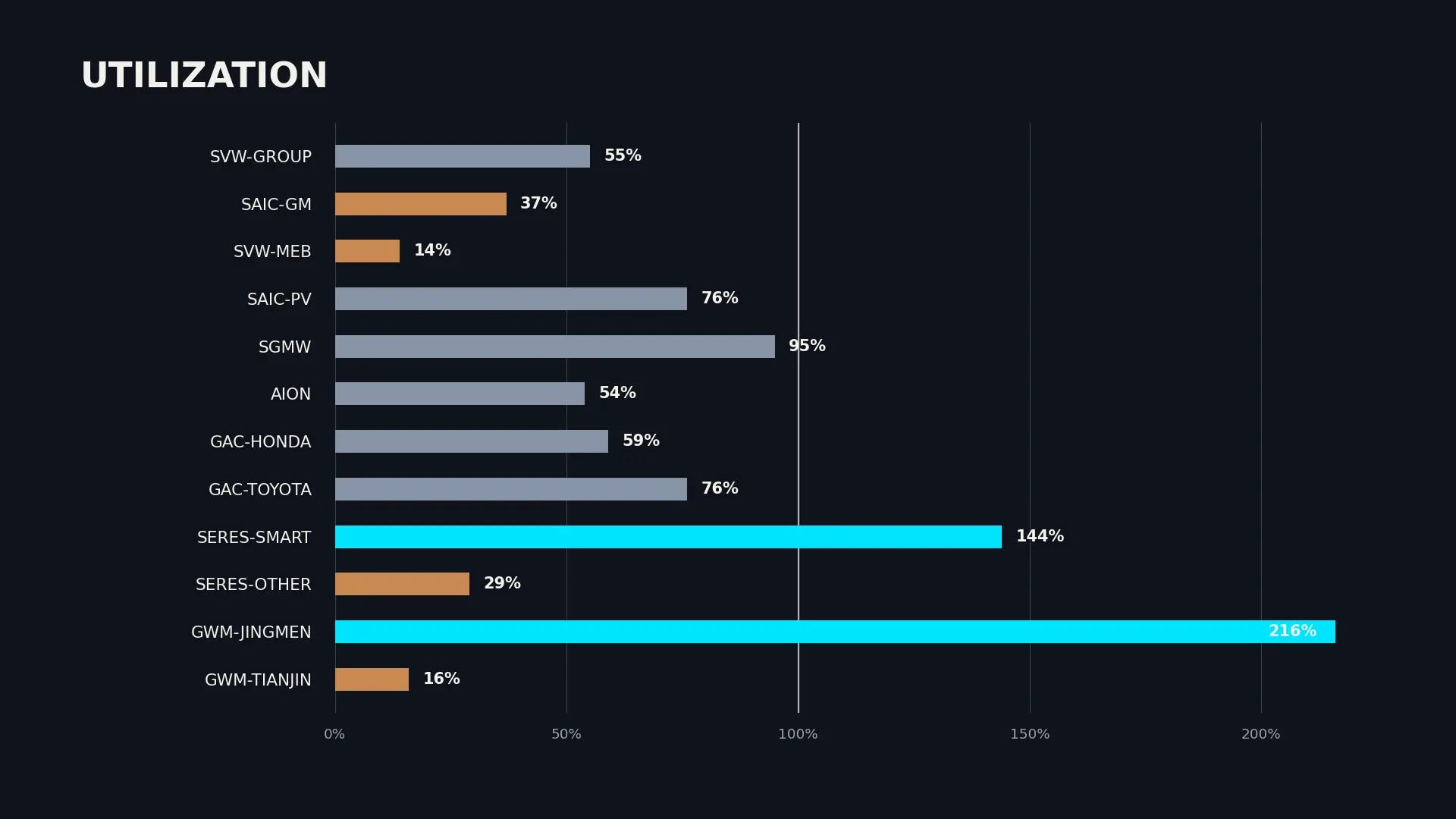
Within the same holding group, one factory runs at 216 per cent of nameplate capacity. Another runs at 16 per cent. The spread inside a single company is more than ten to one.
The SAIC MEB plant is a new, EV-only factory. It runs at 14 per cent. Idleness does not follow ownership type or fuel type. A Reuters investigation in December 2025 framed the divide as petrol versus electric, legacy versus new. That is partially right. The fuller pattern is simpler: the plants standing idle are the ones without a product that sells.
For paid subscribers: a plant-by-plant ledger of what happened at nine joint-venture sites since 2021, what used factories cost compared with new ones, and why the export valve has a date on it.