

Dozens of Products, One Thin Foundation
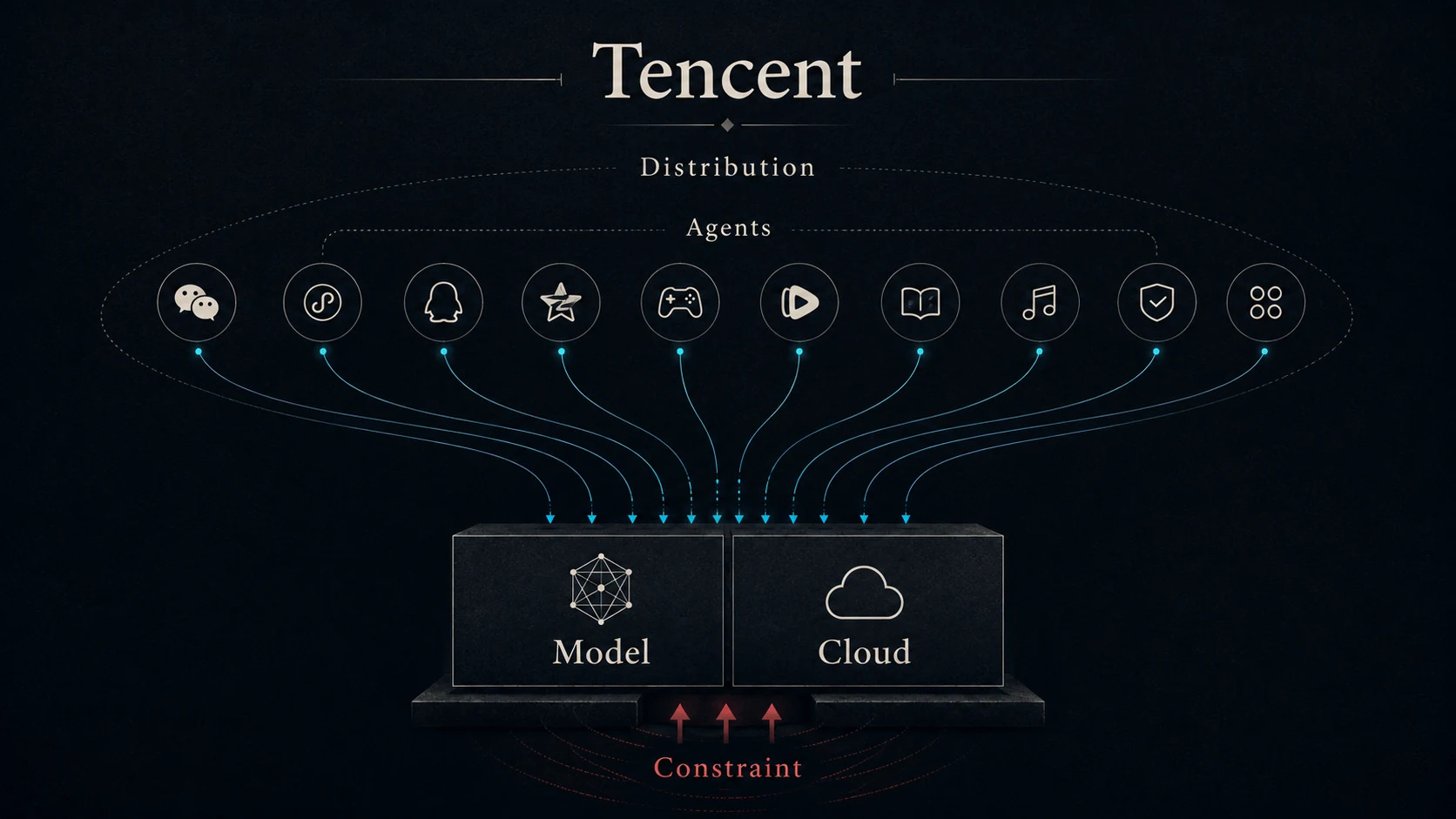
Between March and May 2026, Tencent launched an unusually broad wave of AI agent products across office productivity, coding, desktop control, data analytics, design, and operating-system-level assistance. WorkBuddy for office productivity. CodeBuddy for software development. QClaw for personal desktops. DataBuddy for data analytics. Ardot for UI/UX design. Marvis, an operating-system-level assistant released in late May, uses a six-agent system led by a main agent that delegates tasks to File, Computer, App, Browser, and Search agents. DataBuddy targets data pipelines. Ardot targets UI/UX design and code handoff. These are not general-purpose chatbots. Tencent is pushing agents into work categories where task completion, not conversation quality, determines value. Alongside these new products, Tencent upgraded Yuanbao, QQ Browser, Sogou Input, and Tencent Meeting with agent capabilities and began preparing to convert WeChat Mini Programs into AI-callable skills, meaning services that agents can invoke directly rather than pages users open manually.
Chairman Pony Ma personally promoted the product lineup on WeChat Moments, listing over a dozen agent variants and noting that more were coming. Tang Daosheng, Tencent’s Senior Executive Vice President and CEO of the Cloud and Smart Industries Group (CSIG), declared that AI’s application paradigm was shifting from chatbots to agents.
The product wave landed against a less flattering set of recent numbers. Yuanbao, Tencent’s consumer AI app, reported 57.35 million monthly active users. ByteDance’s Doubao reported 345 million. Alibaba’s Qwen app reported 166 million. In China’s public cloud IaaS market, Tencent Cloud ranked 5th at 8% share. In Model-as-a-Service (MaaS), the segment where token-based AI services are growing fastest, ByteDance’s Volcano Engine, Alibaba Cloud, and Baidu AI Cloud held nearly 90% combined. Tencent Cloud did not appear among the named players. New AI products implied roughly Rmb 8.8 billion ($1.2 billion) in quarterly non-IFRS operating-profit drag.
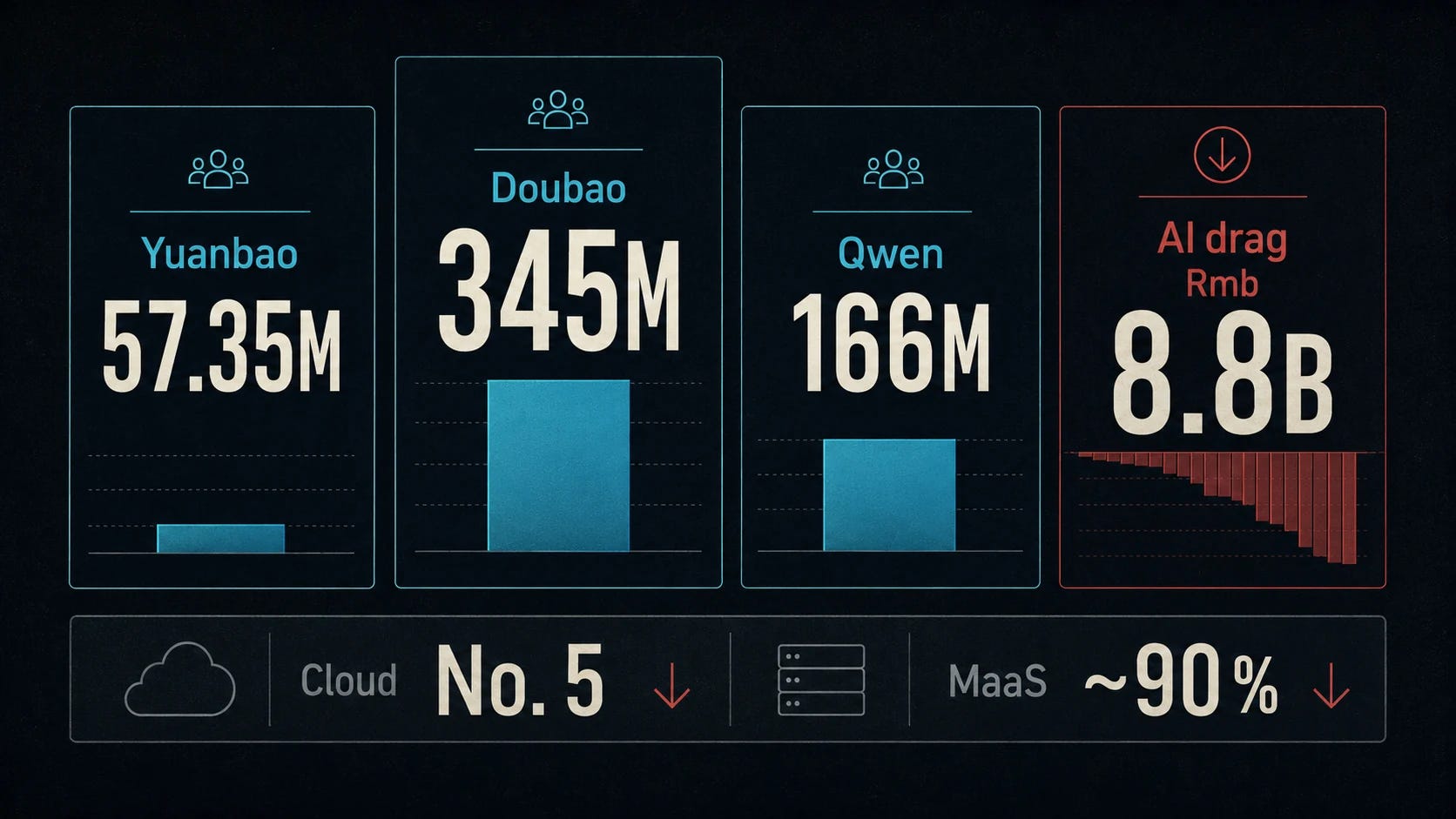
That contrast matters beyond Tencent: in the agent era, can the company that occupies the most user touchpoints first build a durable advantage, even when the model underneath is still catching up and the cloud infrastructure is still undersized?
In my March analysis, I described Tencent’s strategic logic as “interface layer beats model layer.” In my May analysis, I described the company as a cash machine funding a loss-making AI venture. Both frameworks hold. What has changed is the volume of execution data available to stress-test them.
WeChat won the messaging market through ubiquity: be everywhere, optimize later. Applied to agents, the strategy translates into a deliberate bet: plant a flag on every surface where users might interact with AI, then improve the products from inside the ecosystem. The bet assumes that agents will reward early occupancy the way messaging once did. Three months of execution data offer a first evaluation. The early evidence is mixed.
Tencent’s agent proliferation, model rebuild, and early user feedback reveal a set of tensions that may determine whether the company’s distribution advantage translates to AI-era market share. Below, I trace the evidence across each layer of the strategy.
