

On May 13, Alibaba and Tencent reported quarterly earnings within hours of each other. Both missed revenue estimates. Both saw their US-traded shares rise.
Alibaba posted its first operating loss in five years. Free cash flow swung from a Rmb 3.7 billion inflow a year earlier to a Rmb 17.3 billion outflow. Its US-listed shares gained 8.2%. Tencent reported its slowest revenue growth in six quarters, at 9% year over year. Its US stock climbed nearly 5%.
The market’s willingness to reward deteriorating headline numbers points to a shared question that now dominates both investment cases: when does AI spending convert into AI revenue? Both companies have been spending aggressively. Neither has fully answered the question. But on the same day, they offered strikingly different frameworks for how the conversion will happen.
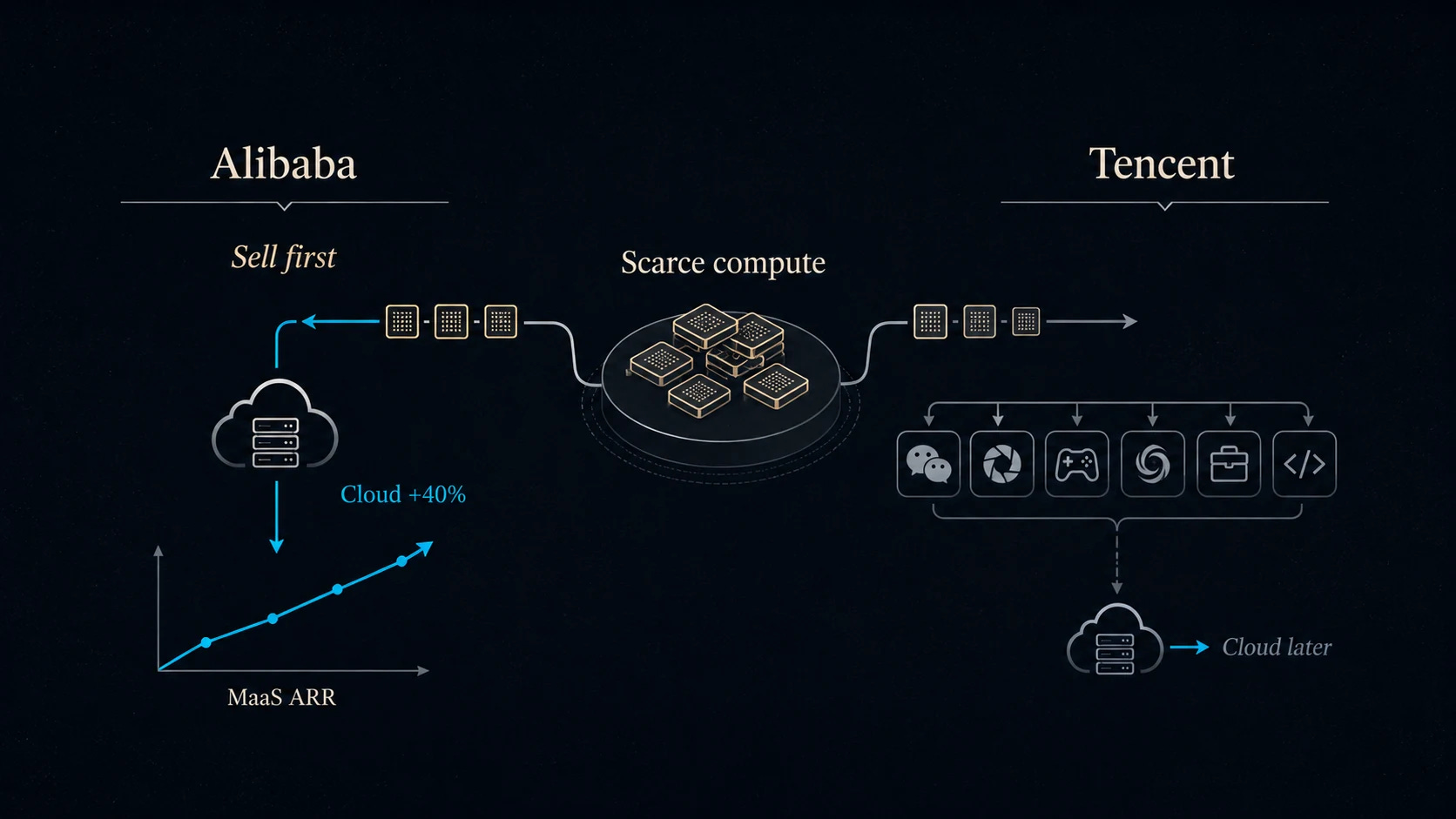
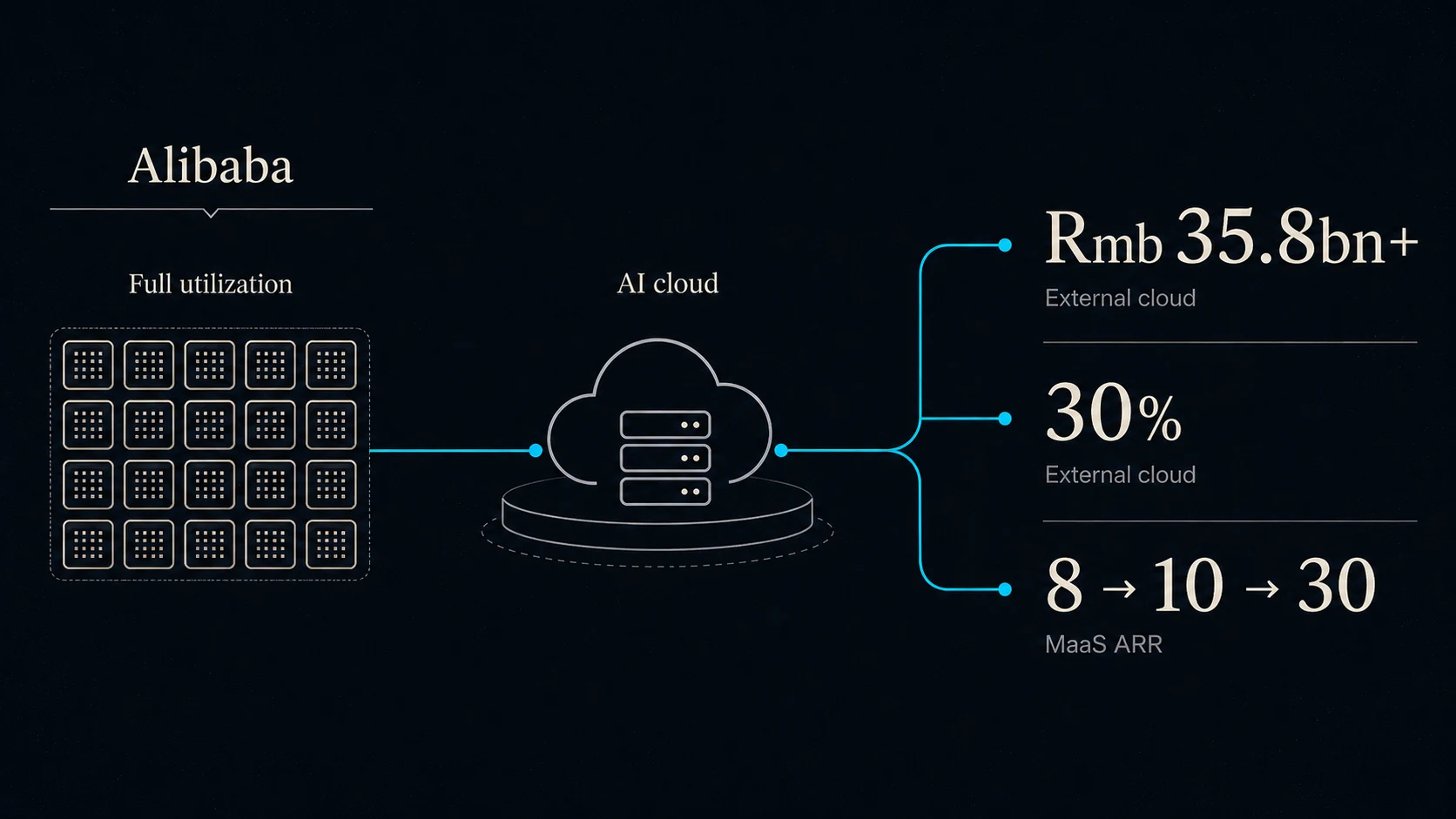
Alibaba chose to sell first. CEO Eddie Wu disclosed two AI metrics for the first time. AI-related cloud product revenue now annualizes above Rmb 35.8 billion, accounting for 30% of the Cloud Intelligence Group’s external revenue. Separately, the narrower model-and-application-services (MaaS) ARR had already exceeded Rmb 8 billion, is expected to surpass Rmb 10 billion in the June quarter, and is on track to exceed Rmb 30 billion by year-end. Cloud external revenue grew 40%. Wu told analysts that not a single AI card on Alibaba’s servers sits idle. The company is monetizing its compute as fast as it can deploy it.
Tencent chose to build first. Chief Strategy Officer James Mitchell told analysts that the company had “consciously” delayed monetizing AI through Tencent Cloud because it prioritized a “multiplicity of internal services” over external sales. GPU capacity went to Hunyuan model training, advertising optimization, agent development for WeChat, and productivity tools like WorkBuddy and CodeBuddy. Tencent Cloud’s AI agent solutions are already generating initial token monetization, but external cloud has not been the primary allocation priority. The difference is sequencing: which company exposes scarce compute to external revenue first.
Chip supply does not explain everything, but it determines the sequence each company can afford. Both face the same binding constraint: the number of AI chips they can source shapes what they can do, and in what order. Alibaba has proprietary chips from T-Head and an external cloud business already at scale; it chose to maximize external revenue per chip. Tencent does not operate a comparable in-house AI chip business but has more internal surfaces where AI can improve ads, games, and productivity tools; it chose to maximize internal product value per chip before supply loosens in the second half of 2026.
This quarter gave investors more AI economics than either company had previously disclosed. Below, I trace how each path works, where the financial evidence supports management’s framing, and which signals will show whether May 13 marked a real inflection or simply a better story.
