

Editor’s Note: This FlashPoint examines how a 75,000-chip allowance per approved Chinese buyer has produced zero deliveries. The H200 story reveals a harder truth about China’s AI compute market: US approval now passes through Chinese demand control. Chip export controls were not a major topic in the latest Beijing talks. The next signal is no longer whether Nvidia can obtain licenses. It is whether Beijing lets those licenses become shipments.
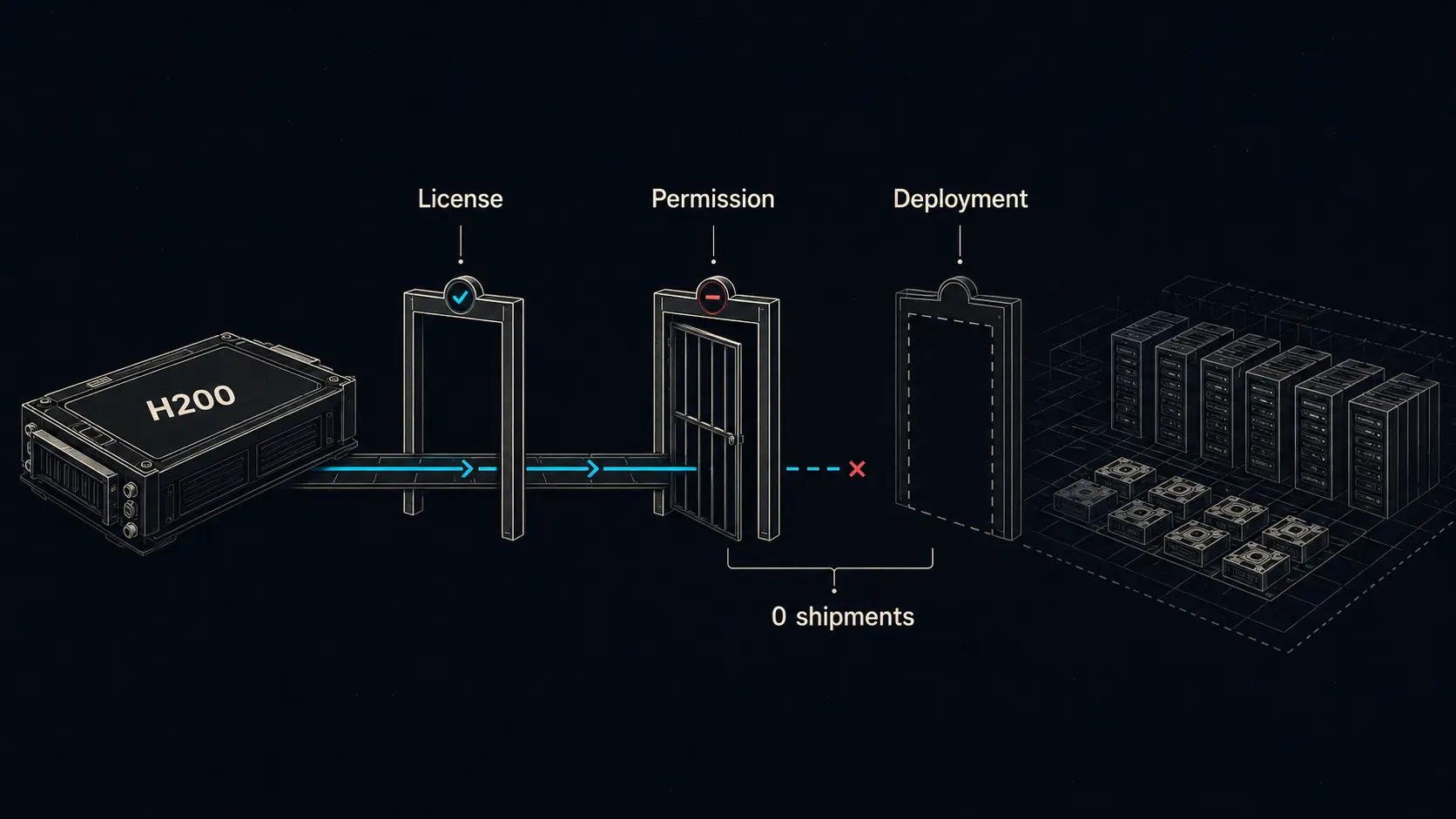
The most important number in the H200 story is zero.
The license is large enough to matter. Reuters says selected Chinese buyers, including Alibaba, Tencent, ByteDance and JD.com, can each purchase up to 75,000 H200 chips. Lenovo and Foxconn also received distributor approvals. The commercial result, so far, is still zero shipments.
That is the new power balance. Washington can open a gate. Nvidia can prepare the product. Top Chinese buyers can qualify. Beijing can still decide whether access becomes deployment.
The Beijing trip did not change that. US Trade Representative Jamieson Greer said chip export controls were not a major topic in the latest talks with Chinese officials. Trump said China had not approved H200 delivery because it wanted to develop its own chips. The signal is not a breakthrough. It is a stalemate with clearer rules.
The headline version looks bullish for Nvidia. The investor version is more awkward. China has moved from pure denial toward managed access for one high-end but non-frontier Nvidia chip. The power now sits not only in Washington’s export license, but also in Beijing’s ability to decide when Chinese demand becomes real.
H200 remains a serious product. Nvidia says it carries 141GB of HBM3E memory and 4.8TB/s of memory bandwidth. It is designed for large language model inference and training workloads that still stretch domestic Chinese accelerators. For Alibaba Cloud, Tencent Cloud or ByteDance, H200 remains useful for frontier model work, benchmark-sensitive projects and high-end research.
That is why the zero deliveries matter. Beijing is not hesitating because H200 lacks value. It is hesitating because the chip is valuable enough to recreate dependency.
Nvidia’s China problem is large enough to distort the whole story. The company once held about 95 per cent of China’s advanced AI chip market, and China previously contributed 13 per cent of its revenue. Jensen Huang has put the country’s AI opportunity at $50bn this year. That is why zero shipments carry more information than the approval list.
H200 now passes through 3 filters: US licensing, Chinese permission and corporate deployment. The first decides whether Nvidia may sell. The second decides whether Chinese buyers should buy. The third decides whether the chip enters frontier experiments or long-lived infrastructure. Only the first filter has moved in Nvidia’s favor.
This is demand governance, not merely supply security. Beijing is shaping which foreign chips Chinese companies are allowed to want at scale. Beijing’s recent supply-chain and counter-extraterritorial rules do not name Nvidia or H200. They still give Beijing a broader vocabulary for reviewing critical technology dependence.
Some Chinese AI firms still have workload-level reasons to want H200: frontier training, benchmark races and elite lab work. They also need predictable supply for multi-year inference clusters, regulated data centers and cloud infrastructure. A chip whose shipment depends on Washington, Beijing and Nvidia’s inventory is powerful. It is also a fragile foundation.
