


Editor’s note: In December 2025, I described how Huawei turned from auto supplier into platform. In July, I examined how CATL collects from both ends of its supply chain and named the test that would show its pricing power slipping. This piece settles part of that test and qualifies part of the December argument.
On September 7, Li Auto, a Beijing-based maker of premium family SUVs, posted a cut-off time on its WeChat account. Buyers of its flagship MEGA minivan who locked in an order from 3pm that day would get battery cells designed by Li Auto. Earlier buyers would get cells from CATL, the Chinese group that supplies about 40% of the world’s EV batteries.
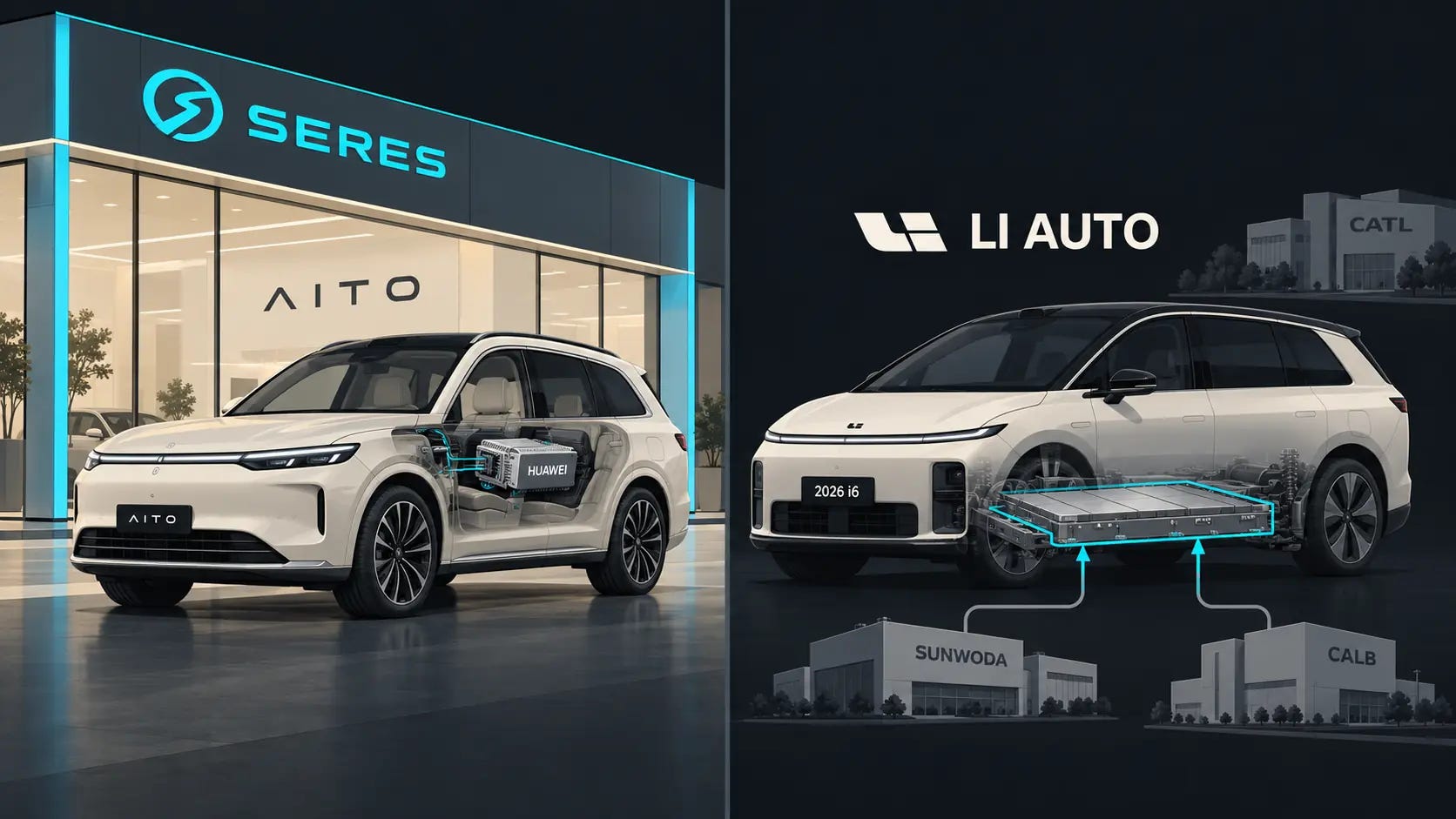
Eight days later, Huawei and Seres, a Chongqing carmaker, changed how they run Aito, the best-selling brand in Huawei’s car alliance. Seres now leads product definition, design, marketing, retail and service. Huawei’s role is to “participate and enable.” On September 30, the two signed a new five-year agreement on those terms.
Huawei and CATL are among China’s most powerful auto suppliers. Each spent years making sure car buyers knew its name. Huawei sold Aito cars in its own stores. CATL ran airport ads telling shoppers to pick an EV by its battery. In the same month, each gave up ground at one of its largest customers, though not the same ground.
Huawei remains Aito’s supplier for its Qiankun driver-assistance system and Harmony cockpit software. It handed Seres the lead on retail and product decisions. CATL lost more at Li Auto. On several new models, Li Auto now specifies the cells and orders them from Sunwoda and CALB, two Chinese battery makers.
I read this as Seres and Li Auto taking control of what the buyer sees and what goes into the car. That control may also let them challenge the premium a supplier earns from its name. They still buy the parts that are hard to make, though not always from the same supplier. Call that premium Name Rent: the extra a supplier can charge because buyers know its brand, stores or logo. Neither supplier discloses how large it is. When carmaker margins fall, it becomes an early target for the largest customers.
If separating the premium a supplier earns from its name from the price of the part itself is new to you, this is a preview of what Hello China Tech does three times a week: reading China’s AI, chip, robotics, and EV sectors from primary sources most English coverage never touches. Subscribe free to get every new analysis as it publishes.
Western coverage has mostly asked whether CATL will lose market share. I do not accept that framing, because share alone misses what is at stake. CATL still held 41.45% of China’s power battery installations in August, down from 42.33% in July. In China’s passenger-car battery installations, its first-half share rose 5.6 percentage points from a year earlier to 46.7%, according to its half-year report. At Li Auto, CATL is losing volume. Across the market, the open question is pricing power, and the first-half accounts do not yet isolate it.
The two suppliers put their names in front of buyers in different ways. What follows looks at how each arrangement works, why the pressure falls on them now, and why buyers may decide the outcome.
