

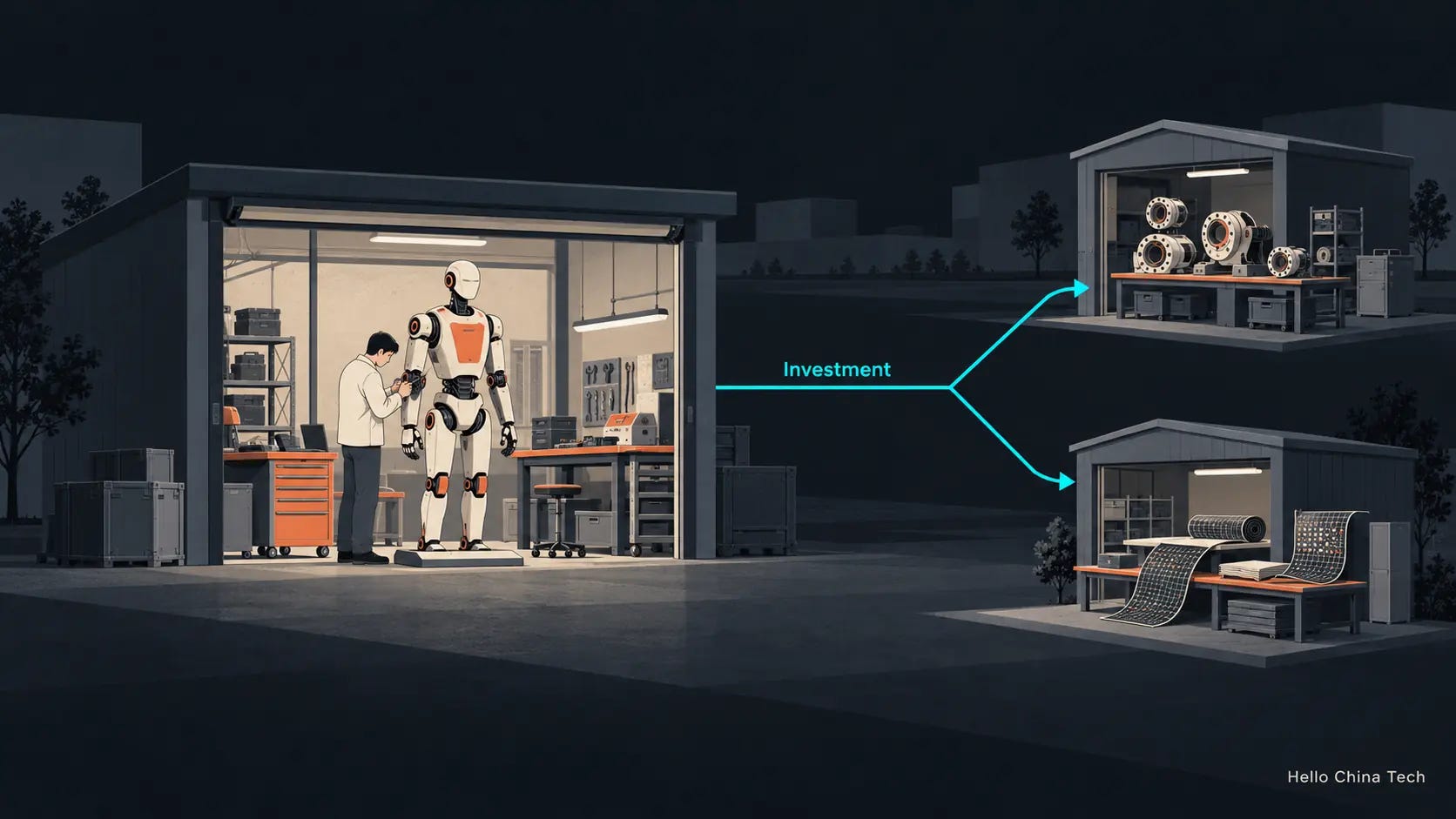
On October 10, two small Chinese robot component companies announced funding rounds. Juxie Intelligence, a Wuxi maker of robot joint components, closed an A+ round of more than Rmb 100m. Moxian Technology, a Dongguan maker of flexible tactile sensors, closed an industrial round of tens of millions of yuan. X Square Robot, a Shenzhen humanoid robot startup, appeared on both investor lists.
X Square is two and a half years old. It has raised more than Rmb 5bn, is valued at about Rmb 20bn and has no mass-production revenue yet, according to Barron’s China. Reuters in September listed it among the humanoid makers preparing to go public. A company preparing for its own IPO has become an investor in its joint and tactile sensor suppliers.
I read China’s robot primary market in the second half of 2026 as a market that has begun to finance itself. That is a payer my report on the sector did not have on its list two weeks ago. Companies preparing to list are among the sector’s most active investors, putting money into suppliers, data vendors, model startups and each other. The financial funds already in the sector, Hillhouse and Sequoia among them, are still in the same rounds. DeepSeek, the AI lab, holds a small IPO allocation in a robot maker and has reportedly backed two robot model startups. The investing began before IPO scrutiny increased this autumn. I expect slower listings to raise the pressure on these companies to show what their investments bring to the business, and where an investment creates a related-party relationship, transactions with the investee will need closer review.
Hello China Tech publishes new analyses every week on China's AI, chips, robotics, and EVs, built from primary sources rather than second-hand coverage. If reading a robot startup's fund commitment as three separate numbers, what it promised, what it paid and what seat it got, is the kind of reading you want more of, subscribe free and get each one as it publishes.
The Gate Behind the Queue
Unitree Robotics, the Hangzhou company that is the public face of China’s humanoid boom, listed on Shanghai’s STAR Market, the technology board, on August 19. Its IPO price was Rmb 150.80 a share. By September 21 the stock had fallen about 55% from its peak. That day Reuters reported that regulators had used window guidance, informal instructions to investment banks and investment firms, to hold back some humanoid listings. One source called humanoid IPOs frozen for now. Another said there was no formal ban. The regulator did not comment, and no published directive was cited.
What has been published is the Hong Kong rulebook that most of the queue would have to pass. About 40 to 50 robot and embodied AI companies are among the more than 500 applicants waiting outside the Hong Kong exchange, by Barron’s China’s count. The route for a loss-making robot company is Chapter 18C, the exchange’s channel for specialist technology companies. A commercial company under 18C needs at least HK$250m of revenue in its latest audited year and a market value of HK$4bn at listing. Commercial here means revenue, not profit. A pre-commercial company needs HK$8bn. Those two floors are a temporary reduction from HK$6bn and HK$10bn. The reduction runs from September 1, 2024 to August 31, 2027 and covers applications submitted by that date. A commercial applicant must also show research and development spending of at least 15% of total operating expenditure, in two of the three years before listing and across the three combined.
The thresholds in the current rulebook are the ones set in September 2024. What changed is the secondary market’s reaction to the first big humanoid listing, and the regulator’s reading of that reaction. In China the published rule is one gate and the regulator’s reading of the secondary market is another, and the second has narrowed this autumn. Some private robot projects have already taken valuation cuts of 30% to 50%, according to Leo Wang of Qianchuang Capital, a venture investor. First-half 2026 fundraising in embodied AI topped Rmb 90bn (about $13bn), five times a year earlier, with more than twenty companies valued above Rmb 10bn, by Pedaily’s count. I read most of that money as priced against an IPO that has since moved further off.
In Who Pays While China’s Robots Learn, the report I published this month, I counted three payers for the wait before a general-purpose robot can pay for itself: private capital, public markets and the state. The deals of October 10 point to a fourth, which the report did not count because the documents did not yet exist. Robot companies are paying for each other’s wait. What follows is the record of that fourth payer, and it goes on the report’s Watchlist.
The paid section maps twelve disclosed deals by layer and compares three fund arrangements, separating commitments, payments and decision rights. It then reviews what is disclosed about DeepSeek’s robot investments.