
$7 Billion and Three China AI Bets
Moonshot, StepFun, and DeepSeek raised in the same week. They’re selling three very different things.

This week, three major China AI financing stories surfaced within days of each other.
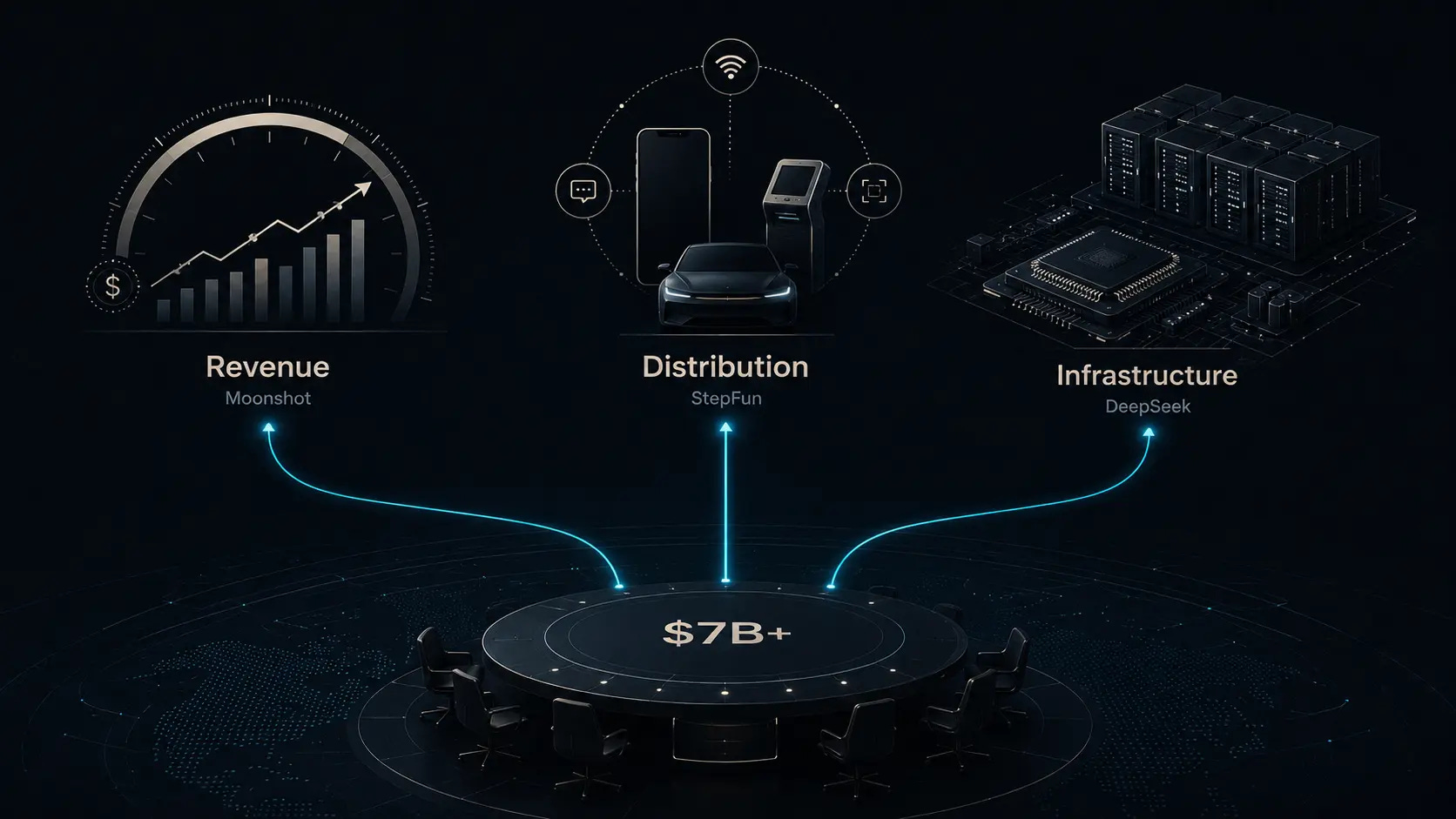
Moonshot AI closed approximately $2 billion at a valuation above $20 billion. StepFun is reportedly nearing a roughly $2.5 billion round while restructuring its corporate setup for a possible Hong Kong IPO. DeepSeek is in talks that could value it at roughly $45 billion to $50 billion, with China’s state-backed semiconductor investment infrastructure as a potential lead investor.
The reported and potential capital involved exceeds $7 billion. More important, the money is being spread across three different theories of AI value creation: revenue, distribution, and infrastructure.
The timing matters because investors now have public-market benchmarks. By early May, Hong Kong-listed Zhipu and MiniMax were trading at market capitalizations of roughly $52 billion and $32 billion. Private-round valuations are no longer floating without liquid comparables.
What the Money Is Actually Buying
DeepSeek’s round is the most consequential, but also the least settled.
According to Reuters, China’s Rmb 60 billion national AI fund, backed by capital linked to the China Integrated Circuit Industry Investment Fund, is in talks to become one of the lead investors. The Financial Times framed it more directly: the Big Fund itself is in discussions to lead the round at a valuation of roughly $45 billion. The Information reported a larger fundraising target of up to Rmb 50 billion, roughly $7.35 billion, with founder Liang Wenfeng planning to contribute the single largest check himself.
The exact financing size remains uncertain. The investor category matters more.
In its publicly visible mandate, the Big Fund has been a semiconductor supply-chain investor, not an AI model investor. Its portfolio covers chip fabrication, memory, and the surrounding semiconductor ecosystem. If the fund or its affiliated capital leads this round, the implication is that Beijing may be starting to treat frontier AI capacity the way it treats semiconductor supply: as critical infrastructure requiring domestic assurance.
Meanwhile, Chinese corporate filings cited in local reports suggest Liang recently raised his direct personal stake from 1% to 34%, with direct and indirect control estimated at roughly 84%. The exact control figure varies across reports, but the direction is clear: founder control appears to be consolidating at the same time DeepSeek is being priced as a possible national strategic asset.
Moonshot AI tells a cleaner commercial story.
HF Capital confirmed approximately $2 billion raised at a valuation above $20 billion, led by Meituan’s venture arm. The headline metric is ARR. Moonshot’s April ARR surpassed $200 million, up from more than $100 million in March.
Investors are paying for evidence that a Chinese AI lab can turn model usage into recurring revenue.
StepFun carries a different signal.
Its roughly $2.5 billion reported round is tied to a possible Hong Kong IPO path. The reported investor lineup includes Huaqin Technology, Longcheer Technology, OmniVision, ZTE, and HKIC, Hong Kong’s government-backed investment vehicle.
These are not generic financial investors. They point to device supply chains, industrial policy, and terminal distribution: the ability to embed models into phones, cars, and other hardware access points.
This would follow StepFun’s January Series B+ round of more than Rmb 5 billion, suggesting a company trying to move quickly from private capital support to public-market readiness.
The Patterns Were Already Visible
These repricing events did not come out of nowhere. Each follows a pattern I have been tracking in Premium research.
StepFun is the distribution case.
In February, I published a Premium analysis of StepFun’s earlier $720 million Series B+ round, “StepFun’s $720M Round and Yin Qi’s Distribution Bet.”
That piece examined why StepFun chose Yin Qi, the founder of Megvii, one of China’s original “Four AI Dragons” in the 2010s computer vision boom, as chairman despite three failed IPO attempts. The core argument centered on what his decade at Megvii taught him about where AI moats actually form.
StepFun is trying to invert the old AI logic: distribution first, model capability second. This week’s reported investor lineup of device ODMs and sensor makers does not prove the thesis. It shows that the device supply chain is now underwriting the question.
Moonshot is the revenue case.
In March, I examined the company’s revenue claims in “Kimi’s 20-Day Revenue Record: What Moonshot AI’s Numbers Actually Show.”
The analysis unpacked why “20 days versus a full year” was a carefully constructed claim. The denominator covered barely four months of monetization from a company that had just dismantled its previous growth model. The piece went deeper into the API economics, consumer subscription math, and developer adoption dynamics behind the headline.
At a valuation above $20 billion, that scrutiny framework matters more, not less.
DeepSeek is the infrastructure case.
In late April, I published “DeepSeek’s Compute-Shaping Bet,” arguing that V4’s real significance lies in its hardware specification sections, where DeepSeek effectively tells chip vendors what kinds of workloads and constraints they need to optimize for.
DeepSeek’s API pricing page effectively tied V4-Pro’s future price reduction to the scaled shipment of Huawei’s Ascend 950 super-nodes in the second half of 2026. When a model lab starts writing workload requirements for chip vendors, it begins to look less like an application company and more like a piece of infrastructure.
That analysis led directly to my most recent Premium piece, “DeepSeek, the Big Fund, and China’s AI Stack,” published as the Big Fund talks surfaced.
It traces a specific feedback loop: model workloads defining what domestic hardware should look like, and domestic hardware making those workloads economically viable. The piece examines what a state-backed anchor investor could mean for DeepSeek’s independence, Liang’s control structure, and the reflexive cycle that US export controls may be accelerating.
Where Each Bet Gets Tested
These three theories will also interact.
If DeepSeek’s open-source models continue to commoditize base capabilities, Moonshot’s revenue thesis faces margin pressure while StepFun’s distribution thesis may strengthen. The outcome of each bet partly depends on the other two.
The fact that all three rounds are happening at the same time reveals something about the market itself. Capital is placing parallel bets on divergent theses, pricing optionality across the entire AI value chain. That pattern resembles early-stage platform competition more than late-stage consolidation.
For investors and strategists, the question increasingly shifts from which company has the best model to which theory of value creation proves durable.
Revenue, distribution, or infrastructure.
The Weekend Brief shows the pattern. Premium research gives readers the operating framework: how to judge which AI value thesis is working before the market turns it into consensus.
Subscribe to Hello China Tech Premium · $20/month or $150/year