

ByteDance, the company that built a $550 billion empire on algorithmic video feeds, launched a commerce app in February containing zero videos. That product decision tells you more about where China’s local services war is heading than any earnings report.
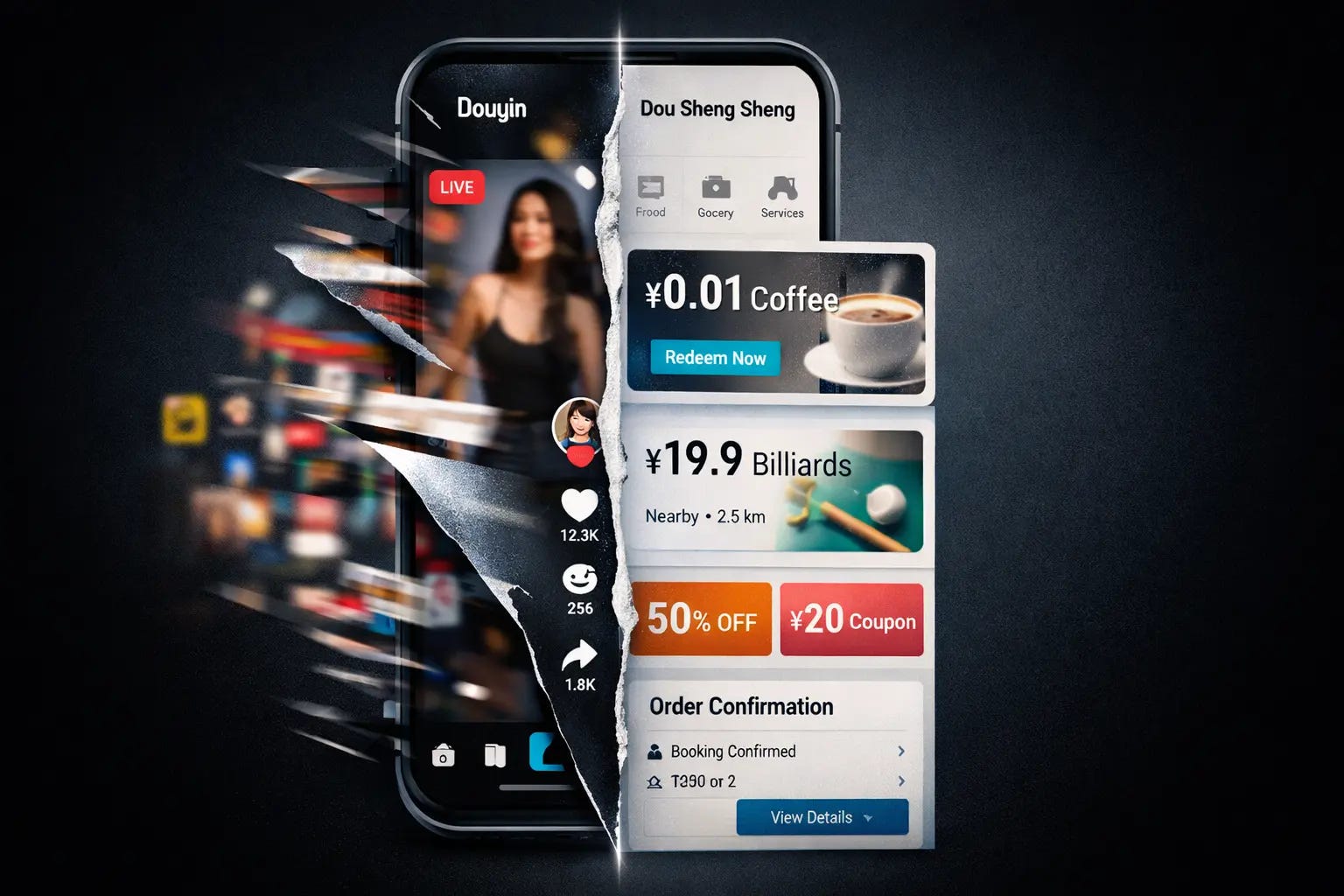
Dou Sheng Sheng (roughly “Douyin Saver”) appeared in Chinese app stores on February 11, 2026, days before the China New Year holiday. No short videos. No livestreams. No influencer content. The interface resembles a stripped-down Groupon: location-based deals, digital coupons, one-tap purchase. Luckin Coffee for Rmb 0.01 on a first order. Two hours of billiards for Rmb 19.9. The app climbed to fourth place on Apple’s China free chart within two weeks, sitting above Meituan.
ByteDance designed its most ambitious local commerce product by removing the feature that defines ByteDance.
This analysis follows two earlier pieces on Meituan’s deteriorating competitive position. The first examined how Alibaba’s rebranding of Eleme into Taobao Shangou signaled a multi-year siege of Meituan’s delivery business. The second analyzed Meituan’s $717 million acquisition of Dingdong as a defensive move to deny competitors instant retail infrastructure. Those pieces documented pressure on two fronts: delivery operations and warehouse logistics.
Dou Sheng Sheng opens a third front. ByteDance now targets the local-services profit pool that has historically helped Meituan absorb pressure elsewhere in the business.
The Content Ceiling
Douyin entered local services in 2020 with an approach that suited its DNA. Short videos and livestreams drove impulse purchases. A food blogger films a sizzling hot pot. Viewers tap the coupon link below. Revenue flows. The model produced impressive aggregate numbers. Chinese media reports put Douyin local services GMV above Rmb 850 billion ($117 billion) in 2025. Douyin’s official year-end recap reported 59 per cent growth, 3.99 million new merchants, and 15.2 million active storefronts.
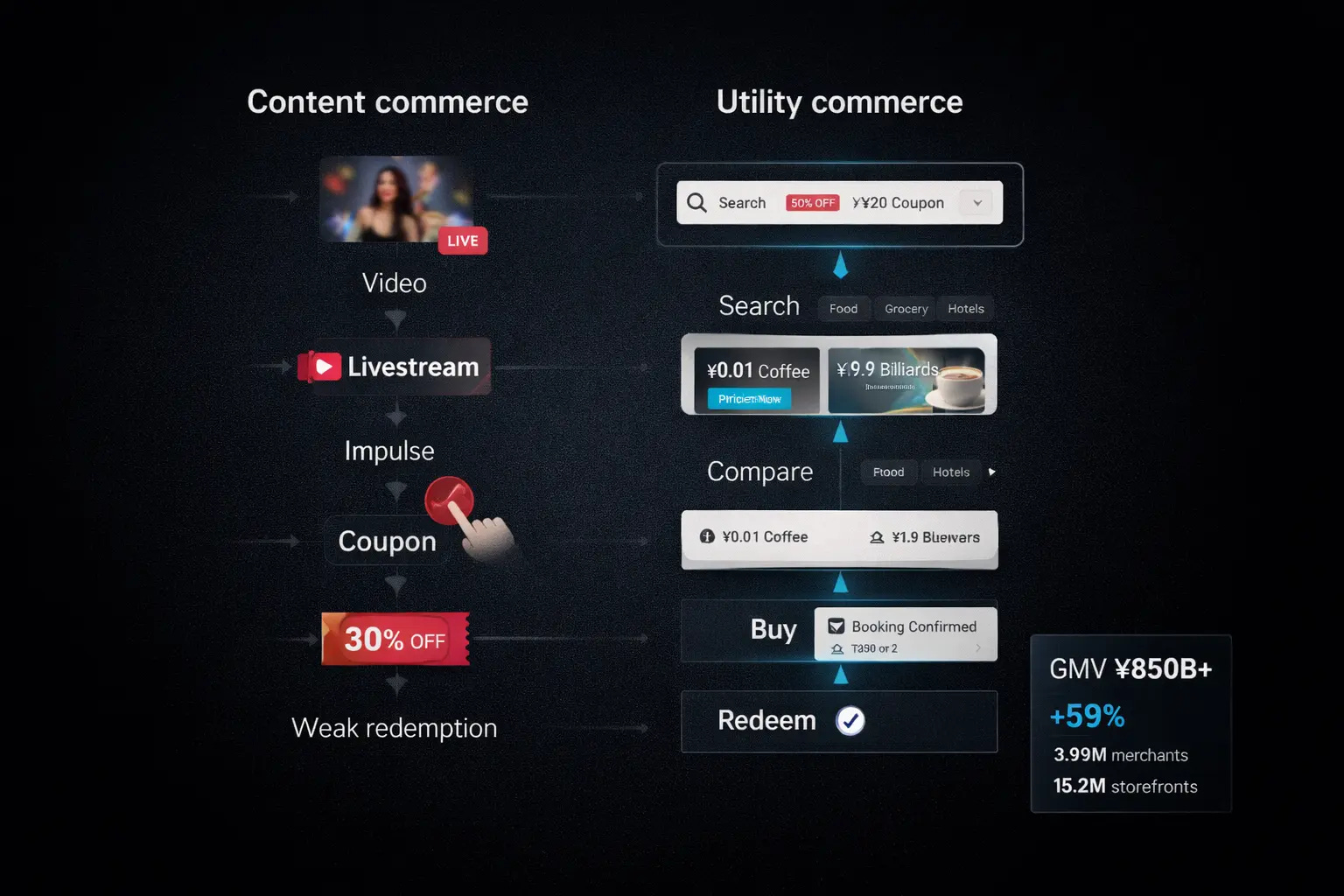
These figures mask a structural problem. Content-driven commerce depends on creators producing engaging material for every restaurant, salon, and karaoke venue across a 500-city network. Chain brands with marketing departments can manage this. Luckin can coordinate thousands of videos across its locations. For a typical independent noodle shop, the cost is prohibitive.
Chinese tech media analysis suggests Douyin’s centralized distribution tends to favor larger chain merchants, while Meituan remains structurally more dependent on smaller and mid-sized businesses. These merchants struggle to participate in Douyin’s content-driven model. Some independent operators have told Chinese media they joined Douyin but never attempted a livestream and rarely posted videos.
Redemption rates expose the deeper weakness. When users encounter deals while scrolling entertainment feeds, purchase intent remains low. Many buy coupons on impulse and never visit the store. According to 2025 industry figures cited by Chinese tech media, Douyin’s hotel and travel coupon redemption rate sits below 50 per cent. Ctrip reaches roughly 90 per cent for comparable products. The gap reflects a fundamental difference in user mindset between passive entertainment and active shopping.
Douyin’s leadership recognized these limits. During 2025, while Alibaba and Meituan waged an expensive delivery war, Douyin shifted to a defensive posture on food delivery, halting large-scale subsidies and offering full commission rebates to a select group of merchants through invitation only. Resources flowed instead toward in-store services. The logic was straightforward. Delivery requires a rider network Douyin does not own. In-store services require only online marketing and offline coupon redemption.
Dou Sheng Sheng carries this logic to its endpoint. By removing video entirely, ByteDance created a pure utility product where merchants list standardized deals without producing any content. The app functions as a search-and-compare tool organized by location, price, and category. ByteDance effectively built a deal-discovery tool that resembles Meituan’s original group-buying product.
ByteDance built this app by stripping away its own greatest advantage. The reason reveals which part of Meituan’s business is genuinely vulnerable.